
First Principles for the Adults in the Building
I wrote some months ago that leadership is more than technique, that the leader’s real work is not the mastery of instruments but the patient handing on of truth, beauty, and humane order into the lives of others. This, of course, sits aside other principles I left largely untouched, and which now deserve their own treatment.
So, let me offer these three principles. None will be new to you. That is rather the point. First principles are not novelties. They are those old, obvious truths that institutions drift away from precisely because everyone assumed they were already tacitly understood. Institutions require tending and cultivation to perpetuate their principles and mission.
The first principle is the one on which the others depend: the school does not exist for the sake of the adults. Say such a thing in a room of educators and you’ll always get the kind of ritual assents that issue from those who don’t really believe something but have been habituated to pay lip service. And, for too many, to say that the school exists for the sake of its students, that it was established to serve children, and that it is bound first to protect the promises it has made to them, is a truth with uncomfortable implications.
The fact that this principle is often easily perverted does not weaken its veracity. Nonetheless, before moving on, let’s quickly address the distortions. This principle does not imply the adults do not matter. They matter enormously. A school leader is under a real moral obligation to care for his colleagues, and it is right and just for him to do everything in his power to create the conditions in which they can succeed, thrive, find contentment in their work, and feel safe in their posts. Anyone who reads the first principle to imply otherwise is being dishonest. Anyone with any sense understands that a leader who treats his people as instruments has failed before he has begun.
But here is the distinction that matters. The care a leader owes his colleagues is real, and it is also ordered. It points somewhere. It points back to the principle. The success of the teacher has as its aim the success of the child. How could it be otherwise? The flourishing of the faculty is in service to the flourishing of the student. When that ordering is clear, care for the adults and care for the children are not in tension at all; they are one continuous act. When that ordering is lost, everything begins to distort.
We have all seen the distortion. It shows up when a school quietly reorganizes itself around the comfort of its employees. It shows up when staff satisfaction becomes the high-water mark of institutional health, as if the school were a workplace first and a school second. It shows up when hard conversations about a struggling teacher are avoided because the adults have come to believe the institution exists to protect them. It shows up when a schedule, a policy, or a hire is decided by asking what the adults would prefer rather than what the students require.
It’s almost never the case that the people in these scenarios are villains. They have simply lost the thread. And the leader’s job is to hold the thread.
Teaching, we know, is best described as an act of love. And school leaders should describe it as such. Love, as the old definition has it, is willing the good of the other. Teaching is fundamentally that: the daily, deliberate willing of the student’s good, and often at real cost to oneself. Much of that love is sacrificial. The teacher who forgets this, or who comes to resent it, cannot become a great teacher, no matter how gifted. And the leader who fails to set this truth before his colleagues, and to remind them of it constantly, has forsaken the school’s very reason for existing.
Leaders should say this to faculty plainly and warmly and repeatedly: I will care for you with everything I have, and I will do it so that you can care for them. That single sentence, said and backed by action, will do more for your culture than a year of programming.
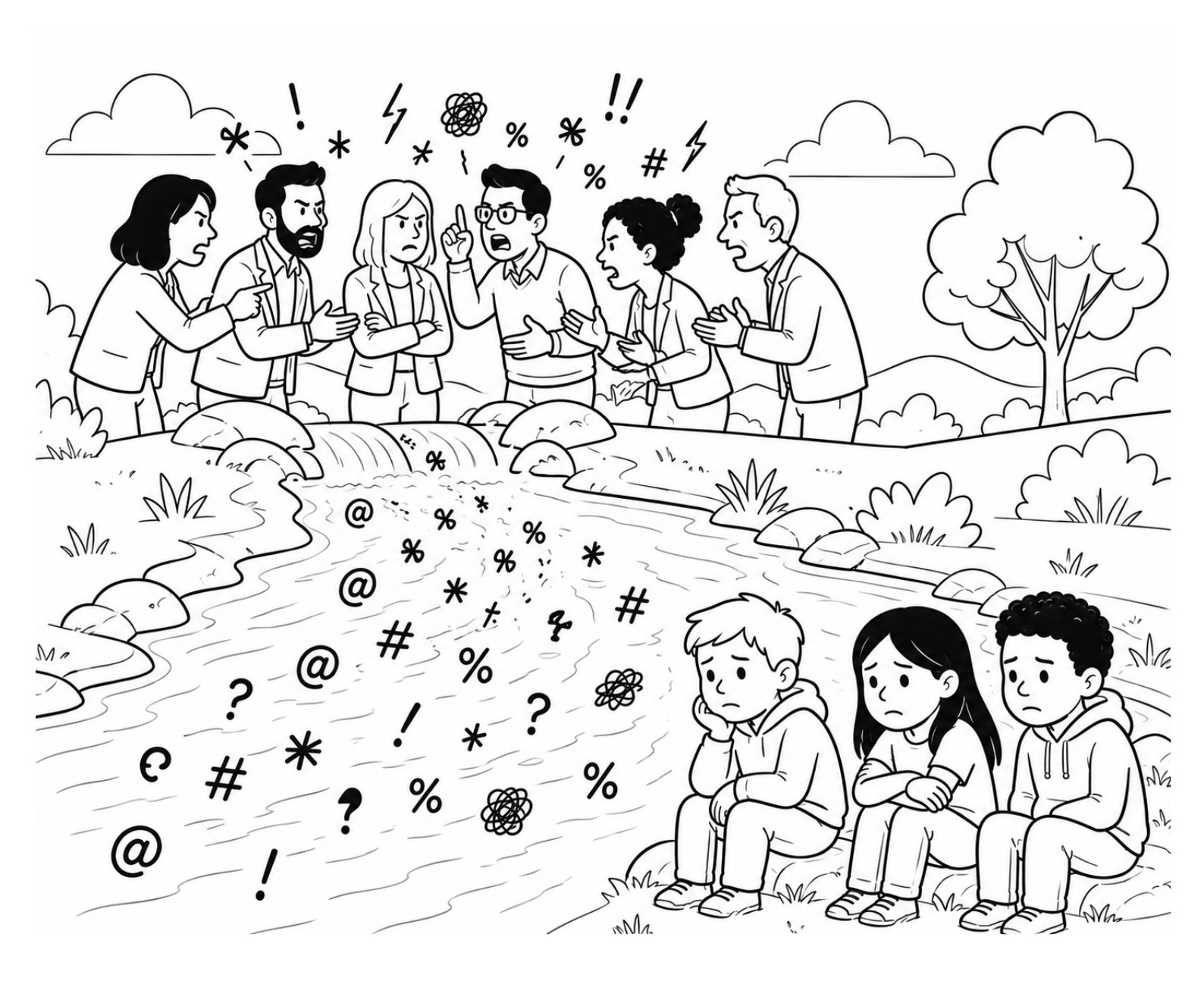
Here is the second principle: the culture of a school is always downstream of its adult culture. And the adult culture is always downstream of its leadership culture.

Think of it as a headwater and stream. Whatever enters the water at the source flows down. If there is health at the top, health flows down. If there is dysfunction at the top, or anywhere along the stream, it flows down too. And in a school, this is the fact that ought to keep us honest: downstream, there is always a child. There is no stretch of the stream that empties out somewhere harmless. Every current in the adult culture eventually reaches a kid.
The adults in a school are kidding themselves if they believe the students are somehow insulated from their infighting, their gossip, self-preoccupation, their disorder, their politics, their vices. Children are the most attentive anthropologists on the planet. They cannot always name what they perceive, but they perceive nearly everything. They know which teachers respect one another and which merely tolerate one another. They know when the front office is at war with the faculty lounge. They feel the difference between a hallway where the adults trust each other and one where they do not, the way you feel a change in the weather before you can explain it. The culture of the adults creates the culture of the school. There is no second, separate culture manufactured for the students’ benefit. There is only the one, and everyone drinks from it.
And that culture is not made in the mission statement. It is made in the collective decisions of the adults, in a thousand things large and small, every day, every week, every quarter, every year. It is made in what gets said in the parking lot after the meeting. It is made in whether a colleague’s absence is covered with generosity or with grievance. It is made in whether the new teacher is welcomed into the guild or left to fend for herself. All of it, together, creates the air the school breathes.
So, it is incumbent upon the adults of a school to take their own character seriously, not only as a private matter of personal development, but as a public matter of institutional stewardship. The adults must love one another enough to want their colleagues to become the best people they can be, and to help them get there.
And school leaders must model this before anyone else can be expected to attempt it. This personal responsibility of leadership is the hard part, and it’s no use pretending it’s otherwise. It is far easier to reach for a management trick, some new meeting structure or feedback protocol that promises cultural change without personal change. It is equally easy to reach for the philosophical trick, the eloquent talk about virtue and community delivered by a leader whose daily conduct among his colleagues tells a different story. I know both temptations well. I have felt the pull of each. I have fallen into both more than I’d like to admit. But a leader who chooses protocol or verbal eloquence over the real work of living well among his people has abdicated the very core of leadership, which is virtue. You are the headwaters. What you are flows downstream. There is no technique that changes this and no rhetoric that hides it for long.
The third principle takes us back to what we’ve already said within the first two, but it bears repeating: love is willing the good of the other. Love is not warm fuzzies. Love is not sentimentality. It’s not the condition of being nice and agreeable, which is perhaps the most common counterfeit of love in schools full of pleasant people.
Saint Paul gave us the real specification, and it reads like a job description for a faculty: Love is patient, love is kind. It does not envy, it does not boast, it is not proud. It does not dishonor others, it is not self-seeking, it is not easily angered, it keeps no record of wrongs. Love does not delight in evil but rejoices with the truth. It always protects, always trusts, always hopes, always perseveres.
Read that list slowly and you will notice something. Almost nothing on it is a sentiment alone. Nearly all of it is work. Patience is work. Keeping no record of wrongs is work. Rejoicing with the truth, especially when the truth is inconvenient, is very hard work indeed. Love, rightly understood, is among the most demanding disciplines a group of adults can undertake together.
And here is the consequence for schools: if the children are going to inhabit a loving school environment, it will only come about because the adults lived it out first among each other. There is no other route. Which means school leaders bear the responsibility to set the conditions under which rich and robust acts of love become the norm among the adults, not the exception.
I’m part of a firm, Arcadia Education, that presses leaders to take up Lencioni’s Five Dysfunctions of a Team. We don’t do this because we think it’s a clever management technique that will drive better results. We do it because underneath the business vocabulary, Lencioni is describing a set of communal virtues, real and difficult ones, without which it is very nearly impossible to build a healthy team of any kind. Vulnerability-based trust is an act of humility. Healthy conflict is an act of honesty governed by charity. Commitment, accountability, attention to shared results: each is love wearing work clothes. The framework endures because the virtues are real.
Think about the people who love you most. Your best friend. The family member closest to you. What marks them out is not that they are the most agreeable people in your life. It is that they are willing to tell you the truth. If someone loves me, they will tell me when I am wrong, when I am failing, when I am off course. They will do it with patience and kindness, no doubt. But they will do it. Their concern for my present and future well-being outweighs their concern for the comfort of the moment. That is what love looks like among adults, and leaders must make it a staple of their school cultures or it does not become one.
This work is hard to do. It is so much easier to write about. And it never gets perfectly done. It always needs tending. No one is ever finished, and everyone, leader included, needs grace along the way. The picture is not a serene faculty gliding through the year in effortless harmony. The picture is always messier and better than that: imperfect adults, working at truly loving one another, failing at it regularly, forgiving one another, and discovering that in the work they are becoming better people and better for one another.
And here is the beautiful secret hiding inside all that mess. These are the schools that end up with the finest character formation programs for their kids. Not because they bought a curriculum. Because the only character formation program that has ever actually worked, for children and adults alike, is to be around imperfect but good people, striving to do their best as human beings and teachers, over a long period of time. That is the whole program. Everything else is supplementary material.
So, what should all this mean for the way you approach the coming year? Let me suggest something simple, and simple is the point.
Lay the principles down early, in your own voice, at the opening meeting. Tell your people plainly whom the school exists for, and tell them just as plainly how much you intend to care for them in service of that end. Tell them that the culture their students will live in is the one the adults build together, and that you know it starts with you. Do not delegate this speech and do not outsource it to a document.
Then spend the year keeping the thread in your hand. When a decision comes to your desk dressed up as a question of adult preference, ask aloud what the students require, and let your people hear you ask it. When the stream picks up something it shouldn’t, gossip, faction, quiet contempt, go to the headwaters first and check your own contribution before addressing anyone else’s. When a hard conversation is owed to a colleague, have it, with patience and kindness, and let it be known that in your school, telling one another the truth is what love does. And when you fail at any of this, as you will and as I do, name it, receive the grace, and continue. Your recovery will teach as much or more than your consistency ever could.
None of this is glamorous. Most of it will never appear in a strategic plan. But it is real work. It is hopeful work, because it asks nothing exotic of you. It asks only that you and your colleagues become, slowly and together, the kind of people worth being around for a long period of time. Your students will be around you for exactly that.
Downstream, there is always a child. This year, let that be the sentence that orders everything else.

Erik Twist is the Principal Partner and President of Arcadia Education. From 2008 to 2022, Erik helped build Great Hearts Academies into the largest network of classical schools in the country. He served as president of Great Hearts Arizona from 2017 to 2022. Erik was a member of the Arizona State Board for Charter Schools from 2016 to 2021, as well as a member of the Arizona Charter Schools Association. Erik holds degrees from Trinity University, where he studied political science, and Oxford University, where he studied theology and philosophy. Erik has been married for 20 years to Allison and they have six children.
Comments
Nothing yet. Say the first thing.
Sign in to join the conversation.