
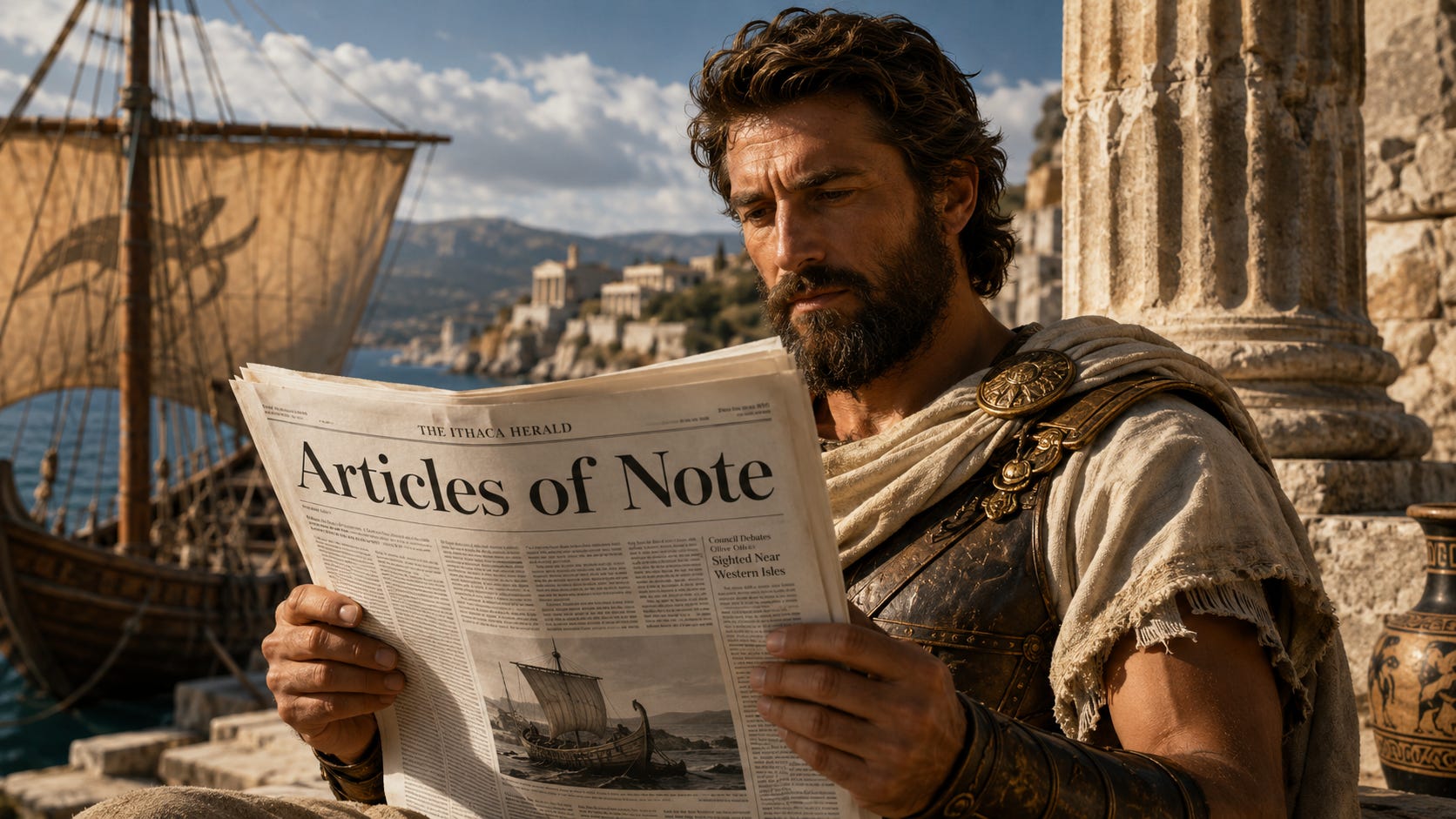
Why Nolan’s “Odyssey” Is Inspiring Adults To Learn Again – Emily de Rotstein, Forbes
Box office returns for The Odyssey have surpassed $700 million worldwide, with projected final returns well over $1 billion. But interest has moved beyond passive viewing. Sales of all print editions are skyrocketing, and the interest has extended to Spotify streams of audiobook versions.
The movie is getting people talking. The Odyssey has become the unexpected topic of summer barbecues and family gatherings, the catalyst for “read-alongs” and book clubs. The enduring human themes of courage, sacrifice, and loyalty have resulted in a spontaneous revival in lifelong learning and shared dialogue.
‘I Saw Myself Translated’: Language, Education, and the Love of Latin – Daniel Fitzpatrick, Word on Fire
If the final purpose of education is to lead the human person out of the bondage of ignorance and sin into the illumination of intellect and freedom of will found in communion with the triune God, then the educational journey must be one conducted along the pathways of the Logos. Following the Word, we encounter and come to know most deeply both the things made through the Word and the words whereby we cultivate and express our knowledge. And, in the process, we hope that we ourselves will be written into the story of salvation.
The reading crisis is changing the conversation – Robert Pondiscio, Thomas B. Fordham Institute
During my years at TIME magazine, the newsroom had a rule of thumb: If something happens once, it’s news. Twice is a coincidence. Three times? That’s a trend.
We’re not quite at three, but within the span of 10 days, The Atlantic and The New York Times opinion sections published surprising essays in support of Texas’s much-debated statewide curriculum and mandated reading list. Neither piece embraced Texas politics or dismissed concerns about religion in public schools. But both did something remarkable that would have been hard to picture even a few months ago: They evaluated Texas’s efforts not on predictable culture-war grounds, but on their educational merits.
Tocqueville Among the Homeschoolers – Robert Pondiscio, The Next 30 Years
I was flattered to be invited earlier this summer to deliver a commencement address for a small group of homeschool graduates and their families not far from where I live in upstate New York. Preparing the speech forced me to wrestle with a tension that has long shaped my own thinking about education.
I’ve spent much of my career arguing for educational choice. At the same time, I consider myself an unabashed institutionalist. Healthy institutions—from schools and churches to libraries and Little League—form the indispensable infrastructure of society.
The Supply Side of School Choice – Michael McShane, Informed Choice
If you build it, they will come makes a great tagline for a mythical baseball movie but a poor strategy for educational improvement. Markets are not magic and are shaped by external factors that encourage or discourage participation.
School choice programs are no exception. How they are structured, how much money they offer, what regulations they place on families and providers, and more will determine if schools choose to participate and the level to which they will choose to participate.
Why Education Savings Accounts Are the Right Path to School Choice – Grover Norquist and Wendy Damron, National Review
ESAs pair well with income-tax elimination, while tax credit scholarships don’t.
In addition to being at the forefront of a national movement to drive down, flatten, and even phase out state income taxes, South Carolina is also a national leader in what has been dubbed the “golden age of school choice.” In 2023, two years after beginning to cut the state income tax, South Carolina lawmakers enacted the South Carolina Education Scholarship Trust Fund (ESTF) Program, which is now providing thousands of children across the Palmetto State with resources to attend the school of their choice. South Carolina’s ESTF program is providing eligible children with annual education savings accounts (ESA) now valued at over $7,600, which is indexed to grow with inflation and can be used to pay for tuition, school supplies, testing fees, transportation, and other education-related expenses.
Glenn Youngkin Goes to Bat for School Choice – The Editorial Board, The Wall Street Journal
Thank goodness Glenn Youngkin is picking a fight on school choice. The former Virginia Governor is behind Empowering America’s Parents, a group planning to advertise directly to voters in the 19 states that haven’t joined the new federal program for tax-credit scholarships. “If they blow this opportunity,” Mr. Youngkin said on social media, “they’ll be leaving kids behind in their state while children in other states get the benefit.”
‘Kindergarten Readiness’ Is A Myth—Here’s What Experts Wish It Meant – Beth Ann Mayer, Yahoo Life
Nearly half of 3- and 4-year-olds were enrolled in school between 2021 and 2022. Some of these children will enter kindergarten this fall, and—for them and their parents—it can feel like a destination rather than a beginning. "Kindergarten readiness" is often discussed in preschool pamphlets, on social media, and elsewhere. It may feel like a far cry from parents' childhoods, when kindergarten was about playing and learning the ABCs, not walking in and knowing how to write them.
How AI and Screens Are Changing Reading (with Naomi Baron) – Nat Malkus, AEI
AI is transforming not only the way students work but also the way they read.
AI summarizes readings for students, changing the way they engage with texts, form judgments, and—perhaps—develop cognitively.
On this episode of The Report Card, Nat Malkus speaks with Naomi Baron about these changes and more.
Does Early Access to Social Media Harm Later Learning? New Evidence from Italy – Marco Gui and Giovanni Abbiati, After Babel
The Science of Reading and Teaching English Learners to Read Are Not Incompatible – Conor P. Williams, The 74
While our primary focus in the past has been on social media and mental health, in the last two years, major declines in test scores in countries around the world have drawn increasing attention to the effects of the phone-based childhood on educational outcomes and cognitive development more broadly.
New and important research has uncovered clear, consistent, and concerning associations between short form video consumption and reduced cognitive performance—not unlike similar associations found in the early days of the social media and mental health debate.
On AI Policy, Students Have Plenty to Say – David Weldon, EdSurge
Adults from seemingly every corner of society are weighing in on artificial intelligence policies in the classroom. But what do students have to say about it?
A recent event offered some clues, as student leaders from around the nation proposed a set of national guidelines for the use of AI in schools at the America’s Youth AI Festival in Boston. The three-day event brought together student leaders, educators, and school system leaders from across the country to discuss acceptable AI use in schools.
Ed “Techlash” Is in Full Swing – Frederick Hess, Education Next
Robin Lake, the director of the Center on Reinventing Public Education, recently wrote an article asking people to consider what makes us distinctively human. Our friend Michael Goldstein is starting a research center focused on how to get kids off their phones. And 22 states have passed phone bans.
In short, we are starting to ask: What do we want for our young people? Will technology help or hinder their development? And if technology proves harmful, how do we respond?
Public Schools Shouldn’t Be Fiefdoms of Government Speech – Philip Hamburger, National Review
Parent Justin Jacobsen has had it with Lincoln, Nebraska’s public schools. He’s therefore paid tens of thousands of dollars to educate his youngest children outside the government monopoly. Now, he’s taking legal action against state officials, asking the court to declare unconstitutional the state’s pressure to send his kids to public schools.
Give Your Kid Real Work – Liz Wolfe, The Freepress
A few days ago, I set my 3.5-year-old son up with some cucumbers, an Opinel knife, some fish sauce, some vinegar, and a bowl. We had friends over, and I was searing Korean short ribs. Figure it out, buddy.
The cucumbers were not evenly sliced, and he was overzealous with the fish sauce, but it worked well enough as a side dish, saving me five minutes of time. It wasn’t busy work; I really needed my time freed up, and I judged him capable-ish of handling the responsibility. My hope was not that the task would be done perfectly but that the salad would not be dressed with blood. Success.
The Art of the Deal for Teachers – Rick Hess, Rick Hess On Education
I’ve long argued that, at current levels of school spending, the typical teacher could and should be earning six figures right now—and that the salary for teachers in the Big Apple ought to be $200,000 a year. Moreover, I’m a longtime champion of the entrepreneurial impulse in education, having made the case in books like Educational Entrepreneurship and The Cage-Busting Teacher. I love the idea of accomplished, entrepreneurial educators making a buck.
University of Michigan won’t use letter grades for some freshmen next fall - Leila Fadel, Majd Al-Waheidi, NPR
The University of Michigan is trying a new approach to curb the mental health crisis among college-age students: covering freshmen’s letter grades during their first semester.
Starting in fall 2027, students entering the university’s College of Literature, Science, and the Arts will receive pass or no-credit marks on their transcripts for the first semester, instead of traditional letter grades. Their actual grades will still be kept internally.
The university says the pilot program is intended to ease academic pressure, helping freshmen adjust to college and helping them “start strong and curb the mental health crisis unfolding among college-aged individuals.”
Comments
Nothing yet. Say the first thing.
Sign in to join the conversation.