
One of my greatest worries as a parent of three little kids is how I will be able to protect them from the vicious and ensnaring harms of online pornography.
My husband is a pastor and part of his work involves counseling young men struggling with pornography. I have heard from him that these young men often grew up in homes with loving, involved parents, but they stumbled upon pornography accidentally as young boys and then developed secret addictions that burdened them through the rest of childhood, the teen years, college, and followed them into their adult lives. These men were exposed during childhood. Accidentally. And their parents didn’t know.
And it’s not just boys.
One counselor I spoke with who counsels female teens has found the same. She told me about the extensive amount of pornography exposure and use she encounters in her patients. When I asked how they first came across it, without skipping a beat she said, “the minute they got a smartphone.” The average age of first smartphone has steadily decreased down to around age 10 or 11. Unsurprisingly, the age of first pornography exposure has declined along with it, to now be around 12 years old.
The thought that my child could struggle with an addiction as an adult because of something he or she comes across as a young child, fills me with dread, because in my work I have read the stories of the devastation that pornography brings to human brains and souls.
I spend much of my time immersed in research on how harmful pornography is and how common pornography exposure is among children and teens. Most depressing of all in my work, I come face to face repeatedly with how inadequate parental controls and filters are in this smartphone era. Parents have told me innumerable times of all the loopholes, bugs, workarounds, and incompatibilities between software, so that even with parental controls and filters children are being exposed to terrible obscenity online. More than half of teens (58%) say they have encountered pornography accidentally, mainly through online means. And sadly accidental exposure can quickly spiral into kids actively seeking porn out, leading to serious addictions because of the addictive effects pornography has on the brain.
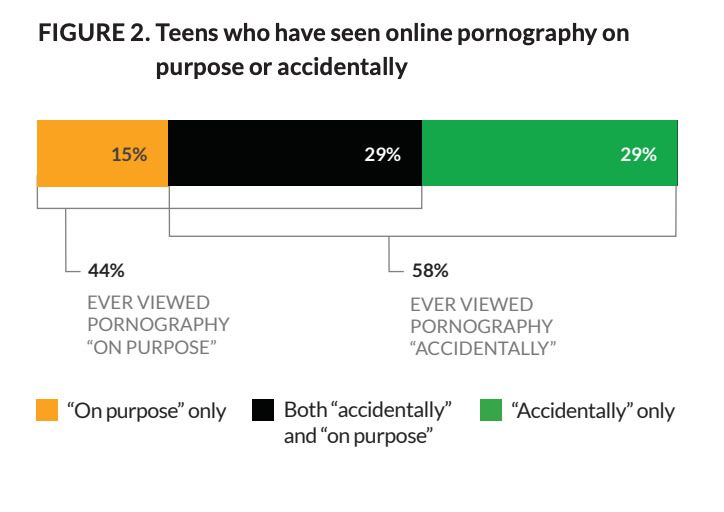
Source: Common Sense Media
You would think then that I of all parents should be well-prepared for how to effectively protect my kids. But that’s just the problem: my research has shown me that I as an individual parent cannot sufficiently shield my children completely from exposure to pornography in this smartphone era. That’s why it keeps me up at night. I can’t control whether or not my child will see pornography some day. It’s terrifying. So much of parenting on a daily basis reveals to me how I am not in control of my children and their hearts and lives. For this control freak, that can be hard to swallow.
So I pray and trust God, as I also try to do my best to protect them and prepare them for the many harms and dangers they will face in this life. And in this digital era, that list must include pornography. So what can we do as parents?
The greatest step I would recommend, as I explain in my new book, The Tech Exit, is not giving children smartphones or social media at all. The smartphone is just too dangerous and difficult to effectively lock down. With hundreds of apps and in-app browsers there are too many portals to the online world, where porn is too easily accessible. Did you know a child can get to PornHub inside Snapchat in just 5 clicks without ever leaving the app and external controls can’t filter inside the app and its in-app browser?
Say no to social media and opt for alternative phones (like Pinwheel, Bark, Gabb, Wise, or Light) to smartphones instead.
Other steps we are taking is that our kids don’t yet have access to the internet in our home. (They are all five and under). But I am dreading the day when they get older and it becomes necessary for them to use a computer for school-related projects. I realize right now I have the luxury of small children who don’t have to use the internet and whom I am with for all their waking hours.
I feel a daunting sense of dread as we approach the elementary and then tween and teen years where I know they will have to increasingly use the internet for school and where they will be going off to school with other kids who may have more internet access than I do.
For now, our plan for when that time comes is to purchase a home computer, install protective software on it, and have it in a public space so that others can always walk by and see what they are doing.
We also don’t own a smart TV or have any tablets in the house. We have a TV but it’s not connected to the internet. Instead we use an HDMI cable to connect one of our laptops when we allow our children to watch a show or movie. My husband and I each do have a laptop but they are password protected and kept away from our children.
I also made the change about a year ago to get a Wisephone instead of a smartphone, which has no internet access or social media (I highly recommend it. It has all the tools I need: Uber, Maps, Venmo, a camera but without any internet, email or social media. If you want to try one out you can use my code: CLARE to get $20 off). My husband does use a smartphone but it’s also password protected. The bottom line for us is there are no internet-connected devices in the home that children can access independently.

The Wisephone by Techless
Despite all these protective measures we are taking, I know from my work that I can’t rely on them alone as the protection. The reality for our kids is they are growing up in an internet-saturated, smartphone and app-dominated culture. Smartphones and screens are everywhere. And I can’t control them all. And I won’t always be with my kids.
So we spend more time focusing on preparing our kids for how to face pornography if and when they come across it, because they won’t always be under our roof or in our care. It has become a part of our daily life and conversation.
Experts advise that training should be early and often. My friend Chris McKenna at Protect Young Eyes talks about “10 before 10” - ten talks about pornography before age 10. This is not one long sit-down conversation about the birds and the bees; these are frequent, short conversations with our kids to tell them if they come across a picture or video of naked people or anything that makes them uncomfortable to come talk to us about it, so we can help them. I want my children to come to me as a safe person to tell, not to run to their friends or Google for the answers. We also view our training as preparing them for how to handle digital temptations when they’re on their own in adulthood.
We have found the book Good Pictures, Bad Pictures, Jr. a helpful resource for introducing our children to the concept of pornography in an age-appropriate way for toddlers using the language of “bad pictures” and the book walks through what they should do if they see a bad picture, which is to turn, run, and tell a parent (the version for elementary aged kids is Good Pictures, Bad Pictures). Another mom I know said she just regularly asks her teens, “so have you seen any pornography lately?”
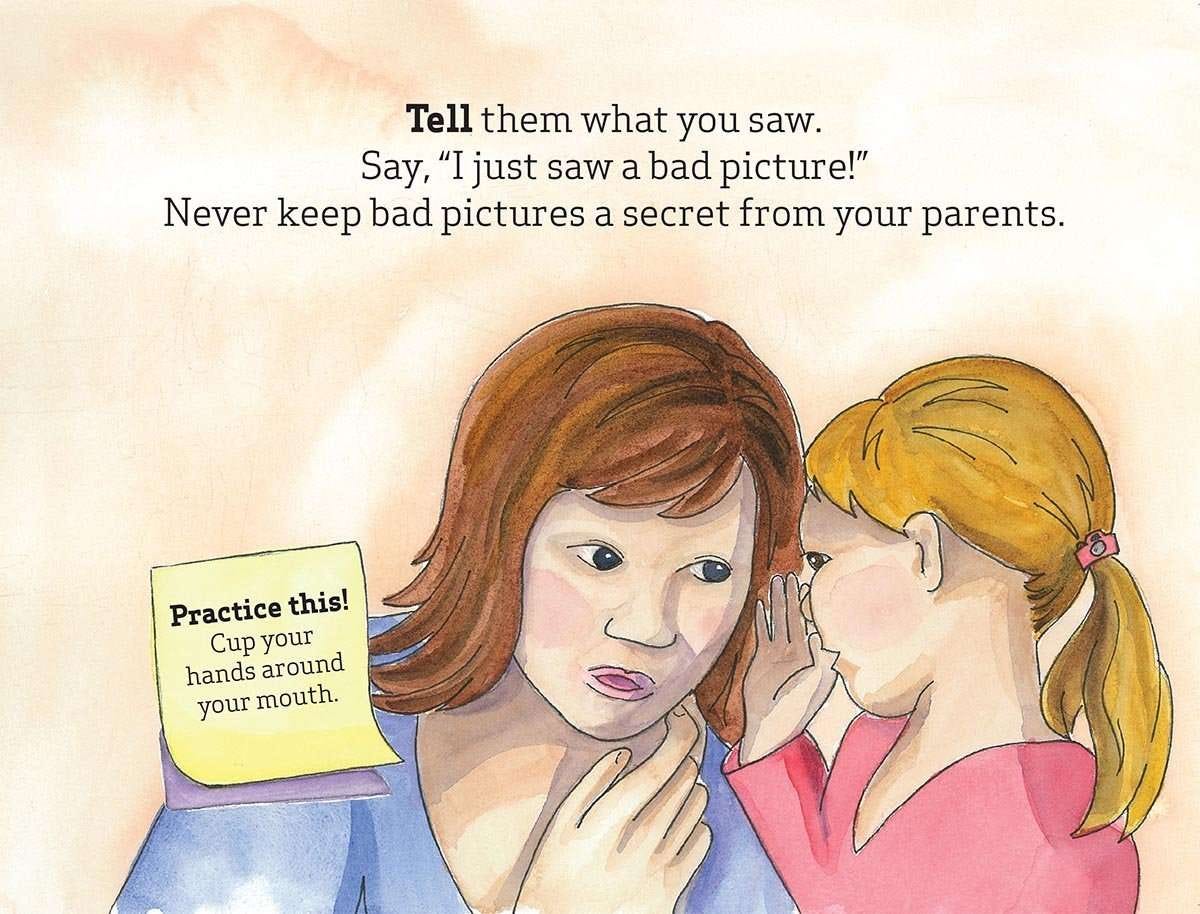
Source: Good Pictures, Bad Pictures, Jr.
Preparing our kids for how to handle pornography is one of the technological realities we now all are forced to reckon with as parents. Parenting has changed in this digital age. If we don’t take on the technology, it will take us.
But I also am not accepting that this culture is the way it always will be. This is why I do the work that I am doing in the policy space to advocate for better laws. I don’t want to live in a world where any child with a smartphone can pull up PornHub and show it to my kids. This should be intolerable to us all.
Yes, parents will always be on the frontlines in the battle to protect our children’s hearts and minds. But the soldiers on the frontlines also need back up. Laws can be a powerful aid to critically back parents up.
One of the most important policy efforts I have been involved in over the last several years is helping states pass age-verification laws for pornography websites. This was the precise kind of law at issue in the recent Supreme Court case Free Speech Coalition v. Paxton, where the porn industry sued the state of Texas over its age-verification law (H.B. 1181) for porn websites.
These laws have faced uphill battles due to past Supreme Court precedents that had struck down other age-verification laws in 1997 (Reno v. ACLU) and 2004 (Ashcroft v. ACLU), which is why the Supreme Court’s recent decision in the Paxton case that just came down two weeks ago is a tremendous VICTORY for parents and children as the Court held 6-3 that Texas’s law to age restrict pornography websites is constitutional. And in doing so also applied intermediate scrutiny, which opens up much more FREEDOM for states to pass laws to protect kids from online pornography.
Maybe you don’t know what intermediate scrutiny means? Or how age-verification laws work? No worries!
The legal arguments and jargon can feel daunting to understand so let me briefly explain what this ruling means to me as a mom and why it should matter to you too.
Until this ruling there has been a great disparity between children’s access to obscenity in the real world versus the virtual world. In the real world a child can’t buy porn from a convenience store, but until now in the virtual world, a child could easily click through to PornHub’s content with no need to show ID, and a parent would never know.
The porn industry wants all the burden to be on the end users of the internet, rather than having the responsibility to cut access off at the source. But we don’t apply this absurd logic to the real world: It’s not on parents to run around and keep every store in town from selling cigarettes, alcohol, or pornography magazines to their kids; it’s on the sellers to restrict their access. Like the real world, in the virtual world it should be on the pornography websites themselves to restrict access for minors. And the Court’s opinion now makes it so.
In fact, the opinion notes that “the need for age verification online is even greater [than the real world]. Unlike a store clerk, a website operator cannot look at its visitors and estimate their ages. Without a requirement to submit proof of age, even clearly underage minors would be able to access sexual content undetected.” The ease of being anonymous online means that verification is even more needed in the virtual world to protect our kids. This ruling critically brings the governance of the virtual world more into alignment with the governance of the real world.
The most critical outcome of the case was not only that the law was upheld as constitutional but that the Court applied intermediate scrutiny and explicitly said that the “least restrictive means” test (of strict scrutiny) does NOT apply to age-verification laws for pornography websites.
In the opinion written by Justice Thomas, the Court states that “Because H. B. 1181 simply requires proof of age to access content that is obscene to minors, it does not directly regulate adults’ protected speech” and that “adults have no First Amendment right to avoid age verification.” The Court found that any burden on protected activity is only incidental, so intermediate scrutiny applies.
Why is intermediate scrutiny so significant?
The Court’s application of intermediate scrutiny means that states and Congress now have much more flexibility and freedom in how they pass laws to protect kids from online obscenity, to be able to address the problem from multiple angles since they no longer have the limitation of proving a law is “the least restrictive means,” which effectively limited the government to only one legal solution to this problem. This is why from my policy work perspective I am so ecstatic about this ruling and the opportunities it creates for more laws in this area.
And what does this ruling mean to me as the average mom?
What this law and this ruling to uphold it means for me as a parent is that now with age-verification if one of my children were to accidentally click on a link to a pornography website online they wouldn’t be able to get through to its obscene material, like videos of rape, incest, bondage, or child sexual abuse, which is the kinds of material these websites profit off of.
What this law also means is that another child at school or on the school bus couldn’t pull up a pornography website and show it to my kid.
It also means for the child with busy working parents or a single mom who aren’t able to oversee their children’s technology use or after school hours as much is they are also protected from accessing and being sucked into the obscene content on these websites.
These laws provide a critical collective solution to help push pornography out of childhood and restrict it effectively to adults, that backs parents up in their own efforts and helps protect all children. This ruling is a critical step forward in the important work to turn the culture around and has given me more hope for the future than I have ever had in my policy work. And so we do all we can to protect and prepare our own children, and we also press onwards in encouraging our legislators to continue to pass laws to protect our kids online with the wind in our sails.
If you want to hear me explain more about the Paxton case and decision, you can listen to this recent podcast interview on the Love Means More podcast by the United States Conference of Catholic Bishops (USCCB). Here’s a short clip from it:
I had a great conversation with Rusty Reno, Editor at First Things, back in June for an event they hosted about my book, The Tech Exit. We discussed how we can reclaim childhood from smartphones that you can now listen to on their podcast here.
I also appeared on the Daily Signal’s Problematic Women podcast this past week discussing The Tech Exit and other current events. Watch here.
No posts
Comments
Nothing yet. Say the first thing.
Sign in to join the conversation.