
Welcome to the August edition of CLAMOR! By popular demand, this month’s edition offers practical advice for noise fights. Plus, sound therapy for Parkinson’s Disease, new studies on noise pollution as an environmental justice issue, a Clamor event in NYC, and why Bluetooth speakers on hiking trails are a crime against nature.
This post is going to dig into the noisy nitty gritty. It’s a bit of a departure from Clamor’s normal fare. Typically, I explore ways to make noise discussions broader, more proactive and forward thinking, and more inclusive of the sounds we want to hear and not just those we want to shut up. As noted in my June newsletter, however, I know many readers are also hungry for more immediate help waging noise fights in the here and now.
To help fill that gap, I spoke with two veterans of the noise trenches—healthcare and environmental scientist Jamie Banks, founder and president of the nonprofit Quiet Communities, and Rick Reibstein, an environmental lawyer and former manager of the Massachusetts Toxics Use Reduction program who chairs the nonprofit’s legal advisory council. Quiet Communities has multiple anti-noise campaigns, pursuing everything from quiet restaurants to quiet skies, and they field hundreds of inquiries a year from people under sonic assault seeking anti-noise strategies, solidarity, or at least a sympathetic ear. What follows is a condensed version of that conversation, edited for clarity.
Q: Let’s start with an overview of the complex matrix of authorities and noise regulations that may or may not be enforced. Can you give me the big picture of what people need to navigate when they take on a noise fight?
REIBSTEIN: Well, if we had not dismantled the EPA’s Office of Noise Abatement and Control [in 1981], then their “Every Community Helping Others” program would have informed local communities on how to respond. The ECHO program was efficient governance. Instead of the feds trying to control everything and do everything, the goal was to help states and cities learn from each other and form networks and regional technical centers staffed with experts to figure out how to mitigate the noises from different sources.
Instead, there’s now a patchwork of laws at the state and local level, many of which are not enforced, or they have impractical enforcement methods. So, they get ignored. But if someone is making noise that is harming someone else, then they have a responsibility to try to mitigate that harm. With that concept in mind, you have a common-law property right through the law of nuisance, you have the state and local rules for allowable noise, and you have the state’s general duties to protect the public health. You have various things that you can pursue at law, but they're all difficult.
BANKS: And apart from the ECHO program of technical assistance that Rick was referring to, the Office of Noise Abatement and Control provided for research, education, noise regulations for certain class of products, interstate commerce, and transportation.
So, all of that is gone. And in the meantime, there would have been so much more to learn. For example, the decibel isn't enough. The decibel is one characteristic of the sound, but there's pattern, duration of exposure, tonal components, roughness, sharpness, and frequency spectra. That's particularly problematic because so many of the complaints come when industrial noise, aviation, gas leaf blowers, whatever, have those strong low frequency components. It comes right through your walls and windows. You cannot get away from it. But because the A-weighted decibel is really the sole metric that's relied on and underweights low-frequency sound, we have ordinances in the country that aren't protecting people.
Q: That's what I hear a lot from people. They contact their local or county government, and somebody comes out with a sound meter and says well, this isn't breaking any decibel threshold, so there’s nothing we can do.
REIBSTEIN: It happens way too frequently.
Q: Rick, you recently gave a talk through Quiet Communities outlining steps people can take to fight noise—like asking local authorities to investigate the noise and collecting evidence of harm—that had the potential to resolve the issue or, if not, to build a stronger case for eventual litigation. Can you walk me through those?
REIBSTEIN: There’s also a third purpose, which is to make you look good and reasonable and make people want to help you. So, you talk about your right not to be harmed and you ask that they do an investigation into why this noise is happening.
Right there, you're educating the local official who thinks, oh, I don't have to worry about shutting down the local steel mill, the gun club, or the local sawmill. I just need to get an expert in there who can look at possible noise mitigation. Many states also have a pollution prevention program, but even though noise is a pollution, a lot of those programs don't know what to do about noise. My program in Massachusetts would have gone in without hesitation but there will be many that will say, oh we don't know how. By the way, these pollution prevention visits are usually confidential, so the company doesn't need to worry about people coming in and fining them or telling the world what they see.
Now suppose that's what you've done. But the officials do nothing, and the company completely ignores you. Now you're going to court. By this time, you've set yourself up as reasonable and you're presenting a picture to the judge and the jury of people who are acting in bad faith, because they don't even try. Now in court what's before the judge is a balancing test. In a nuisance case, you're supposed to weigh the gravity of the harm against the utility of the action. Both of those have a reasonableness test.
Q: Can we dig into the evidence gathering piece? There are a lot of apps with noise meters now. But do you need to have scientific instrumentation that’s precisely deployed? Can evidence be logging noise events in a journal? What do you suggest?
REIBSTEIN: You shouldn’t just grab a snapshot of the problem with a few sound meter readings. You want a more continuous sound measurement over time. And if you can, you want to have enough people in the neighborhood participate in the measurements and pool their data. Some of the apps will do that, but that’s beyond my expertise. The point is, that if you can show a cluster of harm, then the Department of Public Health has to respond. But it also is evidence in your case, before you sue or pursue any litigation or anything, it's like, hey, you're ignoring me, but this is real. Look, there are 48 people who are registering this noise. We don't want to fight with you. We want you to do this investigation.
BANKS: I think one of the things that was pointed out with noise meters, and I'm not sure how it applies to the apps, is that, to take this evidence to court, you have to show that the meter has been calibrated properly.
Q: I know people in neighborhood groups have partnered with public-health researchers to get calibrated, scientifically-validated evidence of their noise exposure. But, not everybody can arrange that. These noise apps are accessible, networkable, and usually free, but are they a waste of time if people want to use their data as evidence in court?
BANKS: It's a little complicated apart from the app itself. It could be the app from NIOSH, the occupational safety and the health division of the National Institutes of Health, which is considered a quality app for noise measurements. But within that app, are people using the right metric for the specific kind of sound? What is the distance away from the property? Did you do indoor measurements and outdoor measurements? Was your measurement at the property line? How does that mesh with whatever ordinance is on the books? There’s a lot to it. So even though I want to say, “crowdsource this data,” and it’s fine to send people out with these sound meter apps, it's not as simple as that.
REIBSTEIN: You also have to show harm. You have to show that these noise levels are corresponding with people being disturbed by them. So, you have to couple the sound measurements with surveys or reports or letters from a doctor to show that all these people in the neighborhood lost sleep that week, because of all the noise.
Q: How does Quiet Communities pick its noise battles?
REIBSTEIN: It grew organically. We’re almost all volunteers. So, it's what everyone was willing to do, and what interests them. Jamie shapes and influences and brings things together and helps it coalesce. Jamie then says, oh, you guys should work together, or these issues go together. Otherwise, we'd all be wasting our time accomplishing very little.
BANKS: You know, we're still quite young, even though we're going on year 13. In terms of knowing how to approach this, we cannot possibly step into the shoes of the federal government. But in fact, that vacuum has really created a problem, because a lot of those complaints are coming to us. And as Rick noted, we only have so many people, and many are volunteers, there's no real funding. The challenge is to create a sustainable business model to support our existence going forward. We’re working on that, and one of the aims is to be able to scale what we do. So instead of helping 20 communities a year, we have resources and expertise that can be dispersed among many communities - almost recreating the ECHO program.
Q: One of the campaigns that seems to be notching a lot of wins recently is the one against noisy and heavily polluting landscaping with gas-powered blowers and other equipment. What’s contributed to that success?
BANKS: The landcare program is the oldest, and it is really how Quiet Communities started. In 2010, I was working at home. And I had lived in my town outside Boston for about 25 years at that point. I lived in a little village setting right in the middle of town and always enjoyed it. But over time, more and more of the properties around me started hiring landscape maintenance companies. And so I was hearing this noise of the leaf blowers and lawnmowers for hours every day, every working day of the week, sometimes as early as 6:30 in the morning. It just was crazy.
The workers were not wearing hearing protection. I have videos of them blowing up incredible amounts of dust apart from the combustion vapors and then taking the blowers and blowing the dust off of each other. I was just aghast and because I am a health scientist, I started looking into the health effects and talking to all these communities around the country dealing with this pollution.
So, there's a long story to this. I did a lot of work here in Lincoln. We formed a citizens' committee. We became a subcommittee of the conservation commission eventually, and it took us seven years in this environmentally conscious town to get a summer restriction on gas-powered leaf blowers. It was brutal.
REIBSTEIN: But this is the approach that Quiet Communities takes, which is you don’t just say we hate gas leaf blowers so let’s ban them, like some places have tried, only to find that the police don’t know how to enforce it and don’t want to do it, and so it doesn’t work. Instead, you go out and you teach people about the alternatives, and you try and bring together stakeholders. We’ve taught people about better lawn care and gone to our representatives asking for money from the legislature to help contractors to switch to electric equipment. We’ve gone to DPWs and asked them to take some electric equipment so they can demonstrate its effectiveness for the town. And we’ve hosted conferences and invited all the contractors to come and see how this equipment works.
Q: Can you talk more about engaging stakeholders and broadening the campaign against gas leaf blowers? It starts as a noise complaint, but it has become an issue that’s also about worker health and environmental harm.
BANKS: Yes, I could hear that sound, but I could also open my front door and smell the gas fumes. And I just thought, this cannot be good. It's not good for me. It's certainly not good for the workers that are exposed to this for hours a day with a gas tank on their back. Then I ran into somebody at EPA named Bob McConnell and talked to him, and he said, we should look at the National Emissions Inventory database and look at the pollution coming out of those machines. So, we put together a paper about the nationwide levels of emissions, including volatile organic compounds, nitrogen oxides, fine particulate matter, and carbon monoxide.
We partnered very early on with an organization called the American Green Zone Alliance that was trying to promote a programmatic approach to an enduring change to more sustainable landcare practices. We've now been working with them for 12 years. We helped transition entire municipalities to electric, all of their municipal operations. We recently helped transition the entire Los Angeles Unified School District - more than 800 campuses.
And one of the things we do is something we do as part of that program is an Environmental Landscape Footprint, quantifying the noise emissions, the toxic air pollutants, the fuel that's spilled upon refueling, the non-recyclable waste that's associated with maintaining gas equipment with lubricants, detergents, oils, and the fuel consumption. And then we also do an economic analysis to show that investing in equipment that is quite a bit more expensive upfront can be highly cost-effective because of the avoided fuel cost and reduced costs of maintenance - those can start to kick in very quickly at commercial scale. So, there's a real solution here.
Q: One of the biggest challenges I hear from people fighting noise is feeling hopeless and powerless and alone. Given the number of folks you've been engaging with, do you have some words of assurance on that front?
REIBSTEIN: We get these complaints. And I find out that these people are suffering unbelievably. I try to help them, and I often feel completely unable to help them, but they still write me after to say, “Thank you so much. I'm so happy that you are there to talk to. Someone believes me.” So, even when I haven't been able to really help them, I'm at least doing that, which is of some help. I think it's important for us to be there for people. I feel bad about all those that we're not helping.
Anyway, I teach environmental law and policy at Boston University, and Jamie doesn't know this yet, but this semester, I want the students to take some of these noise complaints and follow up on them, to call people and ask what’s going on so that at least people feel reached out to. It’ll be voluntary. Students won't have to do this, but some of them really like opportunities to deal with real-world problems.
BANKS: Well, I think that's great and yes, we can work on that. The other thing we try and do is highlight lead-by-example success stories, where people can take hope in looking at those other communities that have been successful in dealing with noise issues, even if sometimes those wins are small.
Acoustic Odds and Ends

I have heard a bit about acoustic therapies for Parkinson’s Disease (Here is an overview and here is a study of one specific therapy called “Binaural Beat Stimulation”). There are several approaches being studied and multiple theories about how acoustic stimulation could help people struggling with motor control. Maybe the soundwaves kickstart alternative motor networks in the brain, or provide important rhythmic cues to stabilize and coordinate movement, or trigger the production of dopamine, the key neurotransmitter deficiency in Parkinson’s Disease. But, nothing prepared me for this video posted by a Canadian man named David who blogs about life with Parkinson’s. David discovered that low frequency soundwaves (128 hertz) calmed his dyskinesia , which is involuntary, repetitive, twitching and jerky muscle movement that can be a symptom of Parkinson’s or a side effect of some medications (hat tip to acoustic consultant Gary Madras, whose LinkedIn post introduced me to this video):
New studies are adding evidence for a “noise gap” in America — in which the worst noise pollution from transportation and industrial sources is in lower-income communities of color — including a nationwide study published in Nature and another focused on Portland, Oregon from the Journal of Exposure Science and Environmental Epidemiology. There’s mounting interest in the cumulative impacts of multiple pollution exposures, especially in the most vulnerable communities. Nevertheless, noise pollution struggles for recognition in these studies and policy discussions, despite being the second largest cause of environmental health problems behind air pollution, according to the World Health Organization.
Book News! If you’re in New York City, I hope you’ll join me for a talk about Clamor with Tanya Bonner, leader of the Washington Heights/Inwood Noise Task Force. We’ll be at Sisters Uptown Bookstore in Washington Heights on Tuesday August 19, starting at 6:30 PM and wrapping up at 8 PM. Stop by and say hi.
Finally, I’m an avid hiker (pics below), and nothing makes me feel like more of a grumpy old man than encountering groups of teenagers or twenty-somethings bopping along the trail with their personal playlists blaring from a Bluetooth speaker.
I get the appeal. I listen to music on my runs, but through earbuds. I also appreciate that these are (almost always) young people choosing to get together in nature rather than peer endlessly into their phones. This is definitely a good thing. Who cares if they need some tunes to power them to the overlook? Well, I do.
Am I being too much of a curmudgeon? Maybe. But, one of the biggest reasons I love to hike is the multisensory immersion in nature that it offers and the all-too-rare feeling of being away. I can’t help feeling that these Spotify-tethered hikers are diluting that experience for themselves and marring it for others—me in particular. For more on this issue, last month, the president of the American Trail Running Association, Adam Chase, argued both sides for the running vertical of Outside online.
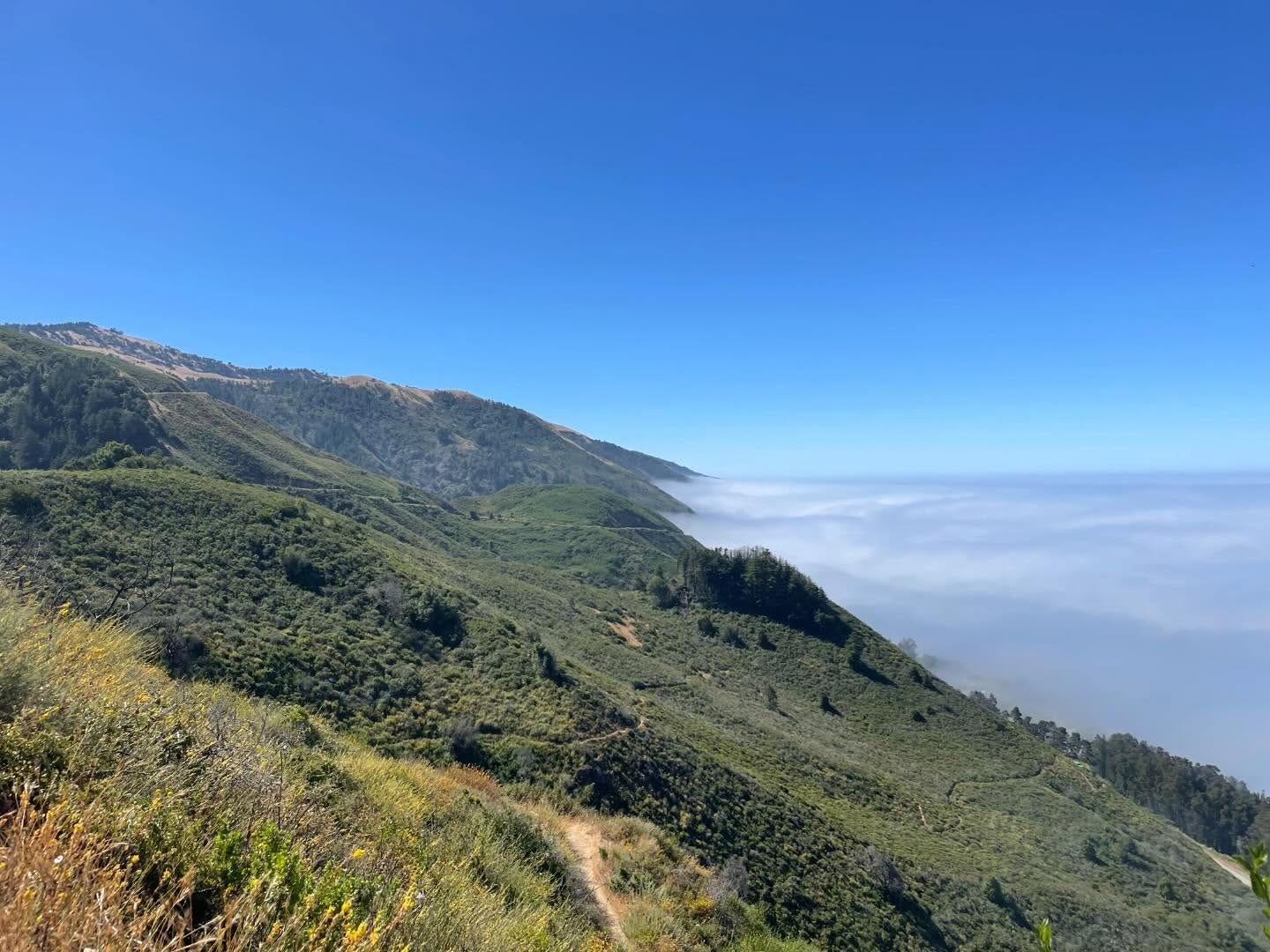
Descending the Vicente Flat trail in Big Sur, California last summer.

Thanks so much for reading CLAMOR! Please spread the word and subscribe for free to receive new posts and support my work.
No posts
Comments
Nothing yet. Say the first thing.
Sign in to join the conversation.