
As the campaign season kicks into high gear, incumbent Commissioner Mike French has made the $35 million federal Recompete Pilot Program the glittering, diamond-encrusted centerpiece of his reelection platform.
The headline promise is 900 living-wage jobs over five years.
It sounds amazing. It sounds effortless. It sounds exactly like a slick late-night infomercial selling a magical solution for money problems.
Before anyone buys the cure, I question the ingredients.

Don’t get me wrong — I genuinely want Recompete to do good for this area. I live here, I want local families to thrive, and I would love nothing more than a bustling local economy because I love commerce.
But given this region’s history with temporary government funding, skepticism isn’t cynical. It’s survival.
First, a hard clarification: Recompete isn’t simply a Clallam County program. The federally designated region spans Clallam County, Jefferson County, and five Tribal Nations — Hoh, Makah, Jamestown S’Klallam, Lower Elwha Klallam, and Quileute. Clallam County is merely the lead applicant for the approximately $35 million pool.
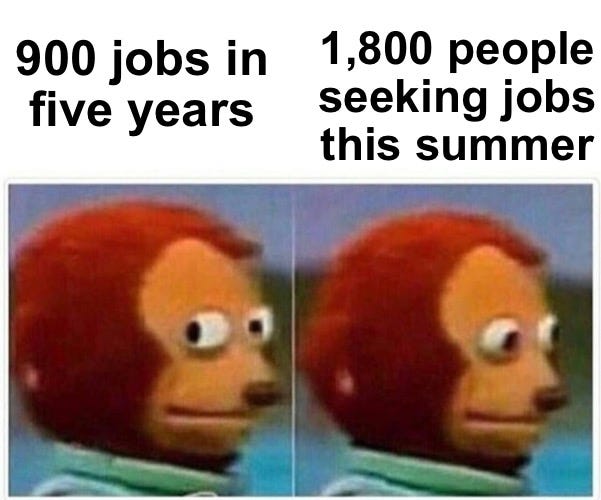
In June 2026, roughly 1,315 people were seeking work in Clallam County, and another 546 were searching in Jefferson County. Meanwhile, the Recompete effort talks about 900 jobs over five years.
Obviously, unemployment isn’t a fixed number. People enter and leave the workforce constantly. But I question what exactly is being labeled a “job.”
Recompete’s first-year reporting counted 208 participants, 21 people placed into jobs after training, and 38 new jobs created through Recompete investments. Those are useful accomplishments, but let’s be blunt: they are not the same thing as creating 900 new, permanent, private-sector jobs.
If a headline number is going to be used as campaign proof of economic transformation, taxpayers deserve to know exactly what it measures.
Government money can be a useful catalyst, but it isn’t a permanent economic engine. Recompete is a five-year investment. That means eventually, the federal money stops.
That’s where I get skeptical.
If businesses aren’t strong enough to continue the momentum after the grant ends, the county is left begging for another grant to replace the first one. That isn’t sustainable economic development; it’s an endless funding cycle.
The goal should be using government money to create conditions where private businesses take over, not creating an artificial economy that requires taxpayer cash just to keep operating.
There is a massive difference between government spending that leaves behind something productive and spending that disappears the second the funding ends.
Public investment in docks, industrial infrastructure, and permanent physical assets gives private businesses a foundation to build on.
Spending primarily on administration, studies, and coordination committees is impossible to defend once the grant disappears.
The question I ask is simple: What remains when the grant is gone?
Recompete’s vocational training makes sense on paper. Teaching somebody a valuable trade is a good investment.
But knowing how to weld isn’t the same thing as knowing how to run a welding business. I speak as someone who knew how to be a court reporter but not how to run a court reporting business.
If this area is serious about economic independence, financial and business literacy must be part of workforce development.
A worker needs to understand their paycheck and finances; someone starting a business needs to understand the harsh basics of running one. Again, I speak from experience.
Otherwise, the program is just teaching people how to earn money without teaching them how to keep it.

Recompete’s wraparound services are intended to remove barriers such as childcare. There is nothing wrong with helping someone overcome a hurdle that keeps them from working. Washington’s Working Connections Child Care program exists for precisely that kind of support.
But I want to pose an uncomfortable question: Does getting someone into a job actually move them toward financial independence?
A paycheck does not automatically create financial literacy. Someone can increase their income and still make poor financial decisions, accumulate debt, and remain entirely dependent on public assistance.
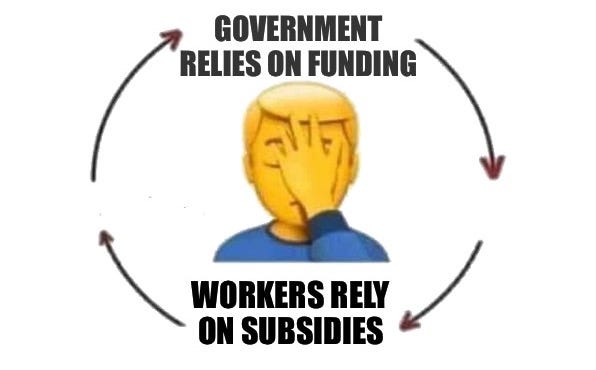
I am not suggesting people shouldn’t receive help when they genuinely need it. I am saying that a workforce program should care about what happens after someone gets the job.
If millions are being spent to create economic opportunity, the goal must be workers who eventually become financially stable enough to carry their own expenses, not simply workers who remain permanently dependent on a larger system of subsidies.
The Tribal Nations are an important part of the Recompete region, but Tribal governments operate under completely different legal and economic structures than ordinary private businesses. They play by entirely different rules involving land, regulation, and taxation.
That doesn’t diminish Tribal economic success. It simply means it isn’t an apples-to-apples comparison with a private business operating under ordinary, heavy state and local rules.
If the goal is measuring the success of the general private economy, let’s measure private businesses, private investment, and permanent jobs that actually feed back into the local municipal tax rolls.
To be fair, Commissioner French isn’t literally sitting behind a giant desk with a $35 million checkbook.
Recompete is divided among seven entities, each with its own federal contract and budget, while the Economic Development Administration reviews expenditures before reimbursing the participating organizations.
So the better question isn’t who should hold the checkbook?
It’s who should be sitting on the County Commission asking the uncomfortable questions about whether $35 million is actually producing the hard results taxpayers were promised.

This is exactly why I want Jake Seegers as Clallam County’s next commissioner.
Seegers comes from a rigorous business background and has made fiscal responsibility and practical, effective government central to his campaign. That is the exact perspective I want watching a massive economic-development investment.
Securing a grant is one political accomplishment; making sure the money produces measurable, lasting economic results is another.
If the county is going to spend $35 million trying to reshape the regional economy, I want someone at the table who thinks like a financial steward, not a program promoter.
That’s why Seegers gets my vote.
Five years from now, I don’t want the success story to be how many workshops were held, how many steering committees met, or how many grant dollars were spent. I want to know whether the region has more permanent private-sector jobs, stronger businesses, and workers who are actually more financially secure than they were before the program began.
Most importantly, I want to know what happened when the federal money stopped.
If the answer is another grant to keep the economic engine running, then the economy wasn’t built.
A grant program was built.
And I know those are two very different things.
Recompete could absolutely be a good thing for the North Olympic Peninsula. Government can help remove barriers and create opportunities, but eventually, the private economy has to take the wheel.
Because the real question isn’t how much money came into the region.
It’s what remains after it leaves.
Clallam County Data Snapshot: Washington Employment Security Department (ESD) Clallam County Profile
Statewide Monthly Bulletins: Washington ESD Monthly Employment Report and June 2026 Labor Release
Interactive Long-Term Charts: Federal Reserve Bank of St. Louis (FRED) Clallam County Timeline
Federal Program Criteria: U.S. Economic Development Administration (EDA) Recompete Portal
Regional Coalition Layout: North Olympic Peninsula Recompete Coalition (NOPRC) Partner Manifest and Clallam County Recompete Washington Portal
Exemption from State Labor Mandates: Washington Paid Leave Tribal Employers Guide
Federal Civil Rights and Labor Status: U.S. EEOC Tribal Sovereign Immunity Guidelines
Property Tax Trust Land Exemptions: U.S. Bureau of Indian Affairs (BIA) Trust Land Property Guidelines
State Tax Compacts and B&O Exemptions: Washington Department of Revenue (DOR) Tribal Tax Guide
Climate Commitment Act (CCA) Tribal Funding Allocation: Washington Department of Ecology CCA Funding Overview
The General Fund Bailout: Sequim Gazette Archive on EDC Restructuring
Leadership and Strategy Departures: Peninsula Daily News Historic EDC Reports
Crisis Management Funding: Peninsula Daily News Report on EDC Consulting Funding
Leadership Transitions: My Clallam County EDC Leadership Tracking and Clallam EDC Position Disclosures
Mike French Campaign Statements: Mike French Election Materials Document
Jake Seegers Campaign Platform: Jake Seegers Campaign Site and Ballotpedia Candidacy Profile
Disclaimer: In the spirit of total, unvarnished transparency, Google AI was used to pull the heavy data and draft the structure for this article. However, no algorithms were left unsupervised to make assumptions about local economics. Every single line, data point, and sarcastic remark was 100% overseen, edited, and approved by me, Clallamity Jen. Consider this article 100% AI-assisted, 100% human-directed, and 100% powered by my own human stubbornness.

Clallam County Election Result Updates
Mark your calendars for Thursday, August 27th, a candidate conversation with Jake Seegers & Mike French at the Sequim Grange; hosted by the Calico Cat Club. All information available online here and in the Google Event Invite.

Help get the petition to 600 signatures! You can sign the petition without displaying your name; the signature still counts, but if you want your name not to be seen by others, uncheck the box about displaying your name before clicking the submit button. Thanks to Terri D. for starting the petition!

4PA: A Clean & Safe Community for All
Monday Meetings Google Event Invite

New issues published at 6am every Monday and Thursday.
Senator Mike Chapman: (360) 786-7646, email form
Representative Adam Bernbaum: (360) 786-7916, email form
Representative Steve Tharinger: (360) 786-7904, email form
Mark Ozias: Mark.Ozias@clallamcountywa.gov
Randy Johnson: Randy.Johnson@clallamcountywa.gov
Mike French: Mike.French@clallamcountywa.gov
Loni Gores, Clerk: Loni.Gores@clallamcountywa.gov
Find all other Clallam County officials, offices, and employees in the staff directory.

No posts
Comments
Nothing yet. Say the first thing.
Sign in to join the conversation.