
January, huh.
Fellow Northern Hemisphere dwellers probably need me to say no more than that.
We’re halfway through the one where we hold on tight.
It’s dark and it’s cold and we can no longer bury that fact under flashing fairy lights and mountains of mince pies. The jingly bells and fun, fun, fun have vanished leaving a void—not one of silence, but one filled with the relentless noise of competing turn-of-the-year dos and don’ts.
“Make resolutions, start fresh, live your best life” versus “do NOT make resolutions, take it slow, hibernate.”
Both have their merits, don’t get me wrong, but I think all of us could perhaps do with something less instructive and a little more—joyful.
Joy. That’s the bit we miss most after the decorations are packed away. Not necessarily the excess, maybe we are naturally ready for a break from that. But definitely the permission slip to let this dim, dank month still glow with fun and the freedom to be ourselves.
When planning my post-festive writing return and looking for the most enjoyable entry point (for you and me), it was fairly obvious that it was the perfect time for another Dance, Magic Dance deep-dive. The series I didn’t even realise was going to be a series—yet here I am writing a fourth instalment. The uplifting edition.
In the first essay—Dance, Magic Dance—I worked my way through the different and brilliant ways on-screen dance routines can be used as storytelling in film and TV, sharing some absolute favourites. In the second—Dance, Magic Dance: summer special—I looked at various iterations of hot, sweaty, holiday on film and the dances that embodied them (and we all fell in love with Ralph Fiennes just that little bit more). Most recently I merged my love of deep-diving the dance with my love of Jane Austen, turning my magnifying glass on the choices made and stories told in the ballroom scenes of the major adaptations.
Today, I’m hoping to help you shake off the very Januaryness of January with a raft of utterly uplifting dance scenes. Not just film and TV this time round—but hey my deep-dive, my rules (and the exceptions are totally worth it, I promise). Dances that will leave you beaming (I defy you not to) and hopefully inspired to let loose and joyfully move your body towards the lighter days ahead.
Let’s dance.
The Life of Chuck
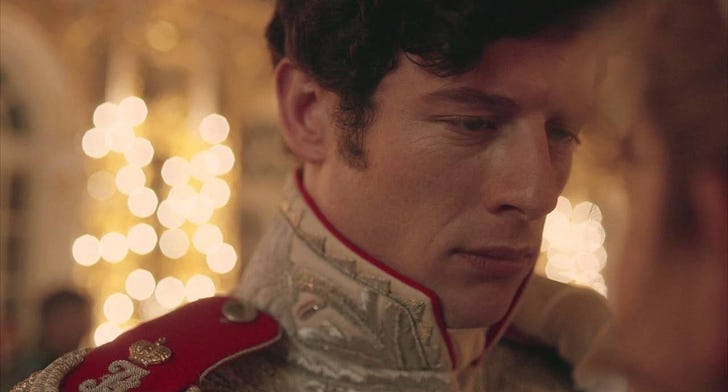
What first nudged me back towards the dancing theme was spotting that The Life of Chuck was streaming on Netflix earlier this month. I absolutely loved this deep and life-affirming film when I saw it at the cinema last summer, and stashed away the incredible Tom Hiddleston dance scene for a future essay—in the depths of dreary winter, now is the perfect time to share it.
What makes The Life of Chuck so quietly radical is not simply that it contains an amazing dance, but that the dance is a narrative hinge. Unlike other examples we’ll consider later, this is not a release valve at the end of a film, nor a flourish of character colour. The Life of Chuck, without giving too much away—and it really is a film where you benefit from knowing little beforehand—tells the story of Chuck’s life, in three acts, backwards.
The dance arrives in Act Two—it’s joy as intervention. A reminder that meaning is not only found in endings, but in the moments where we choose to move differently. It’s joyful in and of itself. A self-contained story of an unlikely man setting himself free—one that keeps unfolding, becoming bigger and more encompassing. But the cleverness of the structure means that while we can absolutely enjoy the dance at face value, watching Act One and gaining an understanding of the whole enhances the meaning of that moment exponentially.
In an interview with The New York Times, Hiddleston reflects on all that key scene embodies and how much it mattered to him to give it everything:
The dance in “Chuck” is long and complex — it lasts around six minutes — but Hiddleston performs it as though he’s making it up on the spot. As he read the script, he envisioned it as an explosion of emotion. “I just wanted it to fly,” he said. “I wanted it to be the most vital and dynamic expression of joy and movement and freedom that it could be.”
And that’s exactly what he achieved.
Thank you, Chuck.
Extra shot of joy: I was delighted to discover that one of my favourite FilmStackers, Sophie of That Final Scene, is a fellow Chuck fan, and wrote one of her trademark deeply brilliant essays about it (NB: contains spoilers, best to save for after viewing):
And always a joy to see him interviewed, here’s Tom Hiddleston and the rest of the cast talking about the film with Variety Studio (he focuses on the dance scene and the intensive prep required at about 10m30s):
Another Round
In the same week that I hit publish on Dance, Magic Dance: summer special, I came across one of the most spectacular on-screen dances I’d ever seen—the incomparable Mads Mikkelsen in Thomas Vinterberg’s Oscar-winning Another Round (MUBI).
Set in Copenhagen, this genius film follows the story of four teachers teetering on the verge of serious midlife ennui, who decide to follow an obscure theory that creativity and life in general function better when constantly topped up to a certain blood alcohol level. This experiment is genuinely fascinating to watch unfold, as it impacts their lives for better and worse. One of the things that elevates the film is its ambiguity—never spoon-feeding the characters or the audience a lesson or a neat answer.
And that runs right through to the film’s conclusion—the experiment is over, and there have been far-reaching consequences. We don’t quite know exactly what lies ahead for the men. What the future looks like for Mads Mikkelsen’s character, Martin, is particularly unclear. The film doesn’t rush to resolve this uncertainty. It lingers with it, letting the question of what comes next sit unanswered. But while we never find out to what end, something has shifted for Martin—through the whole film he has been asked by the others to share his infamous dance skills, and in the final scene he does. And I mean seriously he does.
So while it’s left up to us to decide whether Martin’s future will be a happy one (look at the comments of the video below and you’ll see opinions are fairly evenly divided), for me the very fact that he’s dancing this dance is uplifting. In this moment, he is free in a way he hasn’t been for a long time.
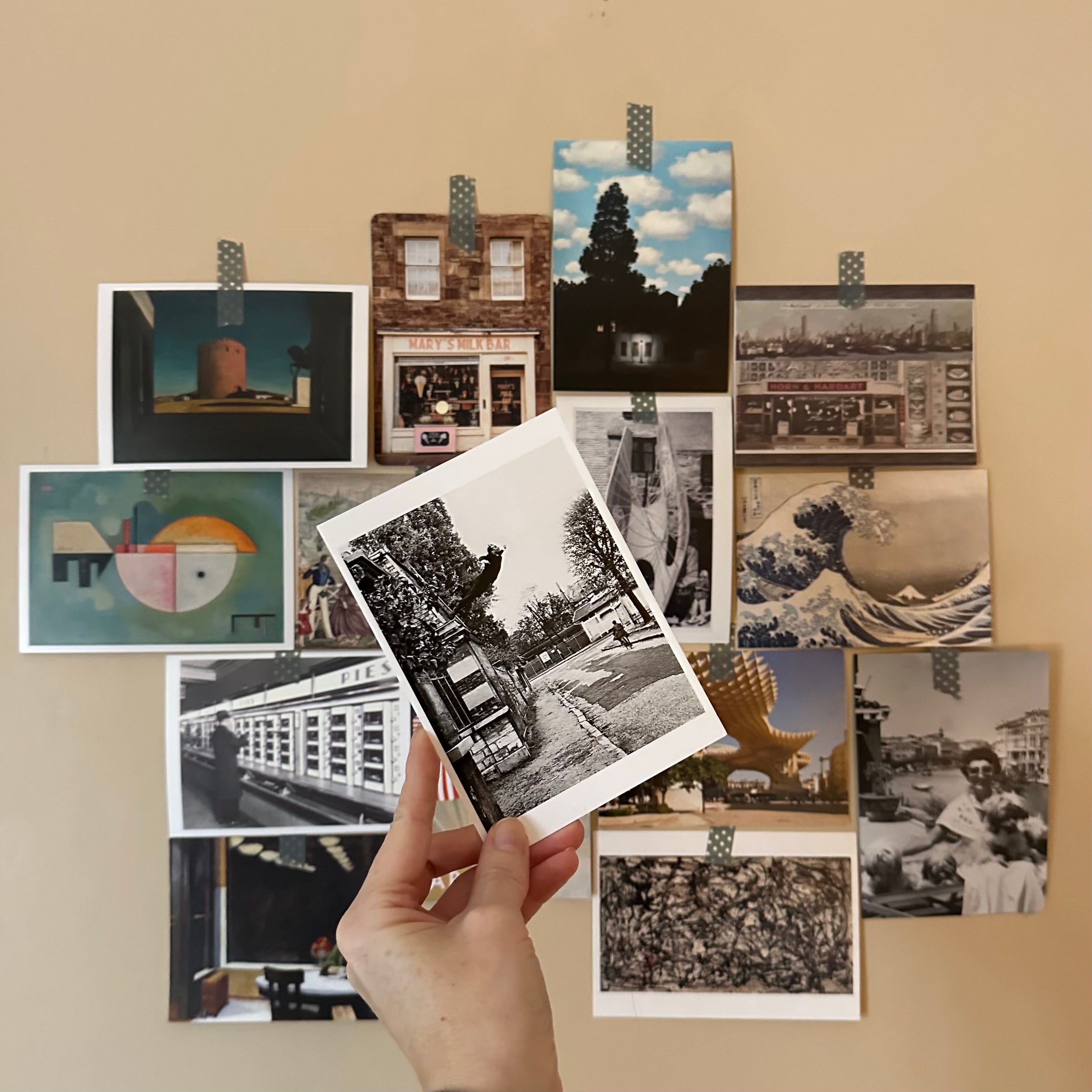
It only occurred to me when putting this piece together that the final image of the film is in all likelihood a nod to Yves Klein’s Leap into the Void—an image that feels uncannily aligned with the film’s refusal to tell us whether this ends in flight or in fall. And one which interconnection would have it, I recently obtained a postcard of:
Extra shot of joy: It’s not only Mads Mikkelsen’s character, Martin, who’s famed for his moves. Vinterberg is making fine use of Mikkelsen’s actual dance background. The man sure can can-can:
Ballad of a Small Player
Taking us from the whispered beauty (and duplicity) of Conclave’s painting-perfect Vatican to the sweaty, neon chaos of Macau’s casinos in his latest film, Ballad of a Small Player (Netflix), Edward Berger’s vision shift is undoubtedly whiplash-inducing, but nonetheless brilliant.
Colin Farrell (in another epically embodied performance) plays Brendan Reilly, a gambling addict hiding behind the grandiose alias Lord Doyle, running from debts and racking up new ones at a rate beyond reckoning. He is a lost soul hidden in a world of lost souls, simultaneously sickened by the merry-go-round of unchecked excess and unable to stop gorging before it’s all taken from him.
Within this constant vortex of desperation and destruction there is a moment where everything shifts—where Reilly is suddenly seen, his vulnerability witnessed and shared. This fleeting connection offers him a pause and a way out—albeit in an on-brand, bizarrely extreme way.
Tilda Swinton arrives to thwart his plans as Cynthia Blithe, an eccentric bounty hunter searching out the elusive Reilly for the debts he’s run away from. As he makes his bold move of escape, he offers the same to her—an opportunity to step away from the grubby hustling and into a life of choice.
And intermingled with the final credits we witness them dance together—a moment alluded to earlier in the film but unseen by us. This is essentially Colin Farrell and Tilda Swinton playing together—and having a whale of a time—while their characters share a moment of release and exhilaration fuelled by the hope of a new beginning.
In an interview for Netflix’s Tudum newsletter, Berger explained:
“I don’t think Tilda intended to play her character as tempted and vulnerable until she met Colin,” he says. “She really became tempted to give in to his promise of ‘Why don’t you live a different life?’ And that dance is an expression of that different life.”
It is a thing of beauty. Befittingly bonkers, but utterly joyful.
[The first video is an excellent fan edit of the dance cut with moments of the film, the second is as it actually appears at the end of the film, intercut with the closing credits.]
If you’re enjoying this newsletter you can support my writing in a number of ways—like, comment, share, consider upgrading your subscription or ‘buy me a coffee’. Thank you!
Daniel Craig’s Belvedere Vodka advert
OK so this is the point where I widen the remit of the on-screen dance routine beyond film and TV. In my defence, this genius advert from 2022 sees one of the world's most instantly recognisable film stars paired with one of the most joyful directors in the business—I give you Daniel Craig breaking out some bold moves for Belvedere Vodka under the watchful eye of Taika Waititi.
What I love so much about this advert is yes it can be viewed as another example of dance embodying freedom—the opening shots getting in and out of the car instantly tell the story of Craig shaking off the spectre (couldn’t resist) of James Bond—but more than that, it signifies a physical reclamation. One that couldn’t be more perfectly demonstrated than via the medium of an endearingly awkward, totally expressive and far from hyper-masculine dance through the lobby of a fancy hotel.
Where Bond’s body is always braced for impact, here Craig moves for pleasure. The result is actually quite moving—a reminder of how much identity lives in the way we move and how liberating it can be to step outside a role that has shaped the way a body is allowed to exist. And what adds to the emotional response looking back at this a few years later is seeing how authentic this physical liberation has been for Craig—we see that in his creation of Benoit Blanc as an enticingly alternative representation of masculinity, in the fashion he now embraces on the red carpet, and in his utterly compelling turn as William Lee (William Burroughs’ fictional alter ego) in Luca Guadagnino’s Queer.
Like so many of the dances here, it offers a glimpse of an alternative life—not grand or heroic, but freer, playful, and absolutely led by joy.
Extra shot of joy: Without a doubt, Daniel Craig’s dance here feels knowingly in conversation with the unforgettable Christopher Walken video for Fatboy Slim’s Weapon of Choice—another reminder that few things are more disarming than a man shedding his prescribed seriousness through dance.
Pachinko
The week after sharing the first Dance, Magic Dance deep-dive last year, I came across one of the most uplifting title sequences I’d ever seen on the Apple TV series, Pachinko. Having been utterly swept up in this Korean multi-generational saga in book form a few years earlier, I was delighted that it had translated to screen beautifully. The characters are so layered and (mostly) lovable—we root hard for them.
As with the book, the narrative weaves between timelines. Back and forth, offering up more information, more history—both family and social—on each pass. At the heart of it all is Sunja. We follow her as child, mother, grandmother. An extraordinary woman, whose choices and relentless bravery impact all those who come after her.
Pachinko covers a lot of ground temporally and emotionally. The hard life surviving in Japanese-occupied Korea is echoed not eased in the difficulties trying to build a better life as a Korean in Japan. Questions of identity and belonging run through the series, shaping the lives of almost every character.
But the opening credits of Pachinko, almost mischievously, subvert the expectations of a conventional historical epic. Against the expected gravity of inherited trauma and generational survival, we are given dance—casual, buoyant, defiantly present tense.
What’s so striking is how unselfconscious the dancing is. There is no sense of performance for an audience within the world of the show. Set against the series’ themes of displacement, endurance and erasure, the dance becomes a kind of embodied rebuttal. Before we are asked to witness suffering, we are reminded—quite deliberately—of joyful aliveness.
OK Go’s Here It Goes Again music video
Finally, I’m sharing one of the most uplifting music videos I know. Let me take you back eighteen years (oh my!) to Christmas 2007 and the gift of a little silver piece of the future that blew my mind—the iPod nano (3rd generation).
I’m a last gasp Gen-Xer, and this piece of tech made me feel like Judy Jetson. Upgraded from the cunningly marketed, overpriced datastick that was my iPod shuffle, this incredible gadget had an actual tiny screen—so I could watch music while I listened to it (taking me right back to the mind-blowing introduction of TVs on the DJ booth at the 1980s primary school disco).
And what was the first video I downloaded on the mini machine of delight? OK Go’s Here It Goes Again. Where creating a video is concerned these guys are never half-hearted, and with their 2005 hit they went for a one-take dance routine performed on eight running machines.
It is resplendent.
I still search it up on YouTube whenever a moment of delight is in order, and relive the total awe of watching grown men create something simultaneously daft and magical that I could conjure up at will in the palm of my hand.
Extra shot of joy: In 2017 four high school students from Texas recreated this routine and next-levelled the one-take madness by performing it live on stage at their school talent show. I mean, this wholesome audacity is exactly what YouTube was made for.
We are all the audience cheering and willing them on, every sassy move of the way.
So there we have it. We’ve witnessed a lot of brilliant dances, travelled extensively to do so and hopefully felt our joy quotient rise considerably.
All six excellent examples show us that a sense of liberation and lightness can be found on the other side of a good tune and a willingness to let loose and be playful.
So whack on your favourite album and dance round your kitchen like you’re Daniel Craig in a vest, or Tilda Swinton being effortlessly cool (even if she’s trying not to be).
All the bonus points if you can rustle up three friends and eight treadmills.
May your January have felt slightly less Januaryish for the time you spent reading this.
Have a wonderful rest of weekend and thanks, as ever, for reading.
If you’ve enjoyed reading this newsletter you can support my writing in a number of ways—like, comment, share, consider upgrading your subscription or ‘buy me a coffee’. Thank you!
You may also enjoy these related essays:
Deep-dives
·
February 21, 2025
A quick heads up—I think this is going to be quite a large post because of the number of videos attached, so it may cut off on email and be best viewed online.
Comments
Nothing yet. Say the first thing.
Sign in to join the conversation.