

My grandparents left Germany in 1933. They didn’t foresee the Holocaust; almost no one did. They left because my grandfather had seen enough to conclude that Jews had no future in Germany.
Others stayed. Many believed the fever would break, that the Nazis would prove incapable of governing, that respectable institutions would restrain them, that a country as civilized as Germany wouldn’t further descend into barbarism. Many had elderly parents, businesses, professions, property, friendships, a mother tongue, and lives that couldn’t simply be packed into a suitcase. Most had nowhere else to go. Leaving meant abandoning everything on the strength of a judgment about a future no one could know.
When do you leave? If you leave too soon, you might discover that you panicked, uprooted your family, left your friends, sacrificed your home, and wound up in exile for nothing.
If you leave too late, however, it will be too late.
No one wants to believe that he must flee his country. The mind bargains with the evidence because the alternative is not just upheaval—selling property, removing children from schools, leaving parents and friends, navigating foreign bureaucracies—but exile: becoming a stranger somewhere else, and perhaps an unwelcome stranger, at that. People have a tendency to tell themselves that the situation will stabilize, that institutions will hold, that the next election will change things for the better, that they are personally unlikely to be targeted, that it’s sensible to wait for more information.
But certainty is often a lagging indicator.
I’ve had to make a version of this decision myself. I left Turkey after Erdoğan gave a speech making it clear that he was aware of me, personally. I wasn’t just an abstract “journalist,” or “foreigner,” or “enemy of the people,” but a specific journalist and foreigner and enemy of the people who had caught his attention. That was the moment when I decided to go.
Someone else in Turkey—someone with a different passport, different job, different family, or a different tolerance for risk—might rationally have set the threshold elsewhere. Istanbul’s streets are full of people who are enjoying the view of the Bosphorus, relieved they didn’t uproot themselves at the first hint of trouble. Or the hundredth hint. But Turkish prisons are full of people who delayed the decision, figuring it wasn’t yet time to go.
This Sunday’s symposium is about how to identify the threshold.
Our guest of honor is a regular and beloved member of our symposium, Lieutenant Colonel Robert McTague (ret.), who is also the author of this article, one of our most widely-read of all time:
Robert spent more than 24 years on active duty in the United States Army. For much of that time, he converted estimates into decisions, decisions into orders, and orders into actions. In recent months, he’s been developing a system to answer the question: When it is time to leave?
He began working on this while asking himself under what conditions he should leave the United States. But the question applies to anyone living in a place where the political, economic, or security environment is deteriorating.
The goal of this symposium is not to decide collectively whether Robert should leave the United States. Nor is it to debate whether America has become Nazi Germany. Our goal is to help Robert refine his methodology.
His framework isn’t a finished instrument. On the contrary, as you’ll see in the reading, he’s shown us its failures, preserved the history of its revision, and explicitly invited adversarial review. So we’ll be helping him to answer a precise question: What evidence would establish that his decision system is actually useful?
To think about this, begin with this questionnaire, which I owe to K H Hardy.
Robert’s method is a significant advance on that questionnaire. His framework is auditable. Its indicators are observable; its thresholds are stated in advance; its assumptions can be challenged; it contains rules for admitting error and standing down.
But an auditable model isn’t necessarily a valid one.
Here’s what we don’t yet know: Has he chosen the right indicators? Do his thresholds have any empirical basis? Do those indicators reliably precede the danger he fears? Would acting on them produce better outcomes than using a simpler rule?
This symposium is not meant to be a presentation followed by polite questions. It’s an adversarial design workshop, which is what Robert’s method demands. He’s inviting you to break his model, and he expects you to take that invitation seriously. His paper begins with Jim Mattis’s term for studying a problem exhaustively and mistaking the study for a solution: “admiring the problem.” So our aim on Sunday is not just to admire Robert’s solution.
There’s an enormous literature telling us that our democratic institutions are decaying; public debt is becoming harder to finance; political violence is rising; and climate, energy, financial, technological, and geopolitical risks are interacting in dangerous ways. This literature explains, sometimes very well, why these dangers are connected. But it doesn’t tell you what to do about it. Mostly, you finish reading these essays and carry on just as before.
Most writing about systemic crises ends right where the difficult part begins. Robert calls this the “operationalization gap,” but I suggest we not use that term for the same reason I suggest we not discuss whether the sixth sheik’s sixth sheep’s sick. I’ll be calling it “the decision gap.” (If Robert can repeatedly say “operationalization gap” without tying his tongue into a bow, more power to him, but I’m not even going to try.) The decision gap is the distance between understanding that something dangerous may be happening and deciding what, if anything, you should do about it.
Human beings are adept at discounting evidence whose implications they can’t bear. Any useful method will have to do something our frightened minds resist doing: identify observable warnings, connect them to predetermined decisions, establish the last moment at which action remains feasible, and specify the evidence that would allow us to conclude that the danger had receded. The purpose of such a system isn’t to eliminate your judgment, but to prevent your judgment from being endlessly renegotiated under pressure until the decision has, in effect, been made for you.
Robert’s estimate, right now, assigns a 60 percent probability to the US muddling through—expensively and unpleasantly, but successfully. He assigns only a five percent probability to the most dangerous scenario he envisions: a simultaneous financial shock and a crisis of political legitimacy, each amplifying the another.
But if the consequences are sufficiently grave, a low-probability event should still inspire sensible people to prepare for it, especially when the preparations are relatively inexpensive and the opportunity to act could disappear before certainty arrives. If you wait until everyone agrees that it’s time to leave, flights, banks, consulates, housing markets, and borders will already be absorbing everyone else who has come to the same conclusion. Thus the clearest signal might arrive only after the latest time at which the information is of value.
Robert borrows two concepts from US Army doctrine.
The first is the Commander’s Critical Information Requirement: a question whose answer is necessary for a particular person to make a particular decision. A useful indicator isn’t just interesting, suggestive, or alarming. It must be observable; it must correspond to an action; it must have a threshold; and it must reach someone authorized to act upon it.
The second is the magnificently military LTIOV: the Latest Time Information Is of Value. Relevent information has an expiry date. When the last moment at which you can act upon it passes, it becomes trivia.
Applied to civilian life, this produces a more demanding method of thinking about a crisis. What precisely are you watching? What would count as confirmation? What decision would that indicator trigger? What preparations must already be in place? What evidence would persuade you that the danger had passed? And who will tell you when fear, exhaustion, attachment, or confirmation bias has made you incapable of reading your own dashboard honestly?
Robert has already subjected his model to adversarial review—by David Gordon, who recently spoke to us about the accumulating strains on the global economy, and several AIs. They broke his model repeatedly. His original probabilities were capable of arming their own alarm. A calendar date was accidentally counted as evidence. A fashionable market benchmark concealed stress in the physical economy. His model had elaborate rules for escalating an alert, but inadequate rules for standing down. Most seriously, it monitored the condition of the world while neglecting the condition of the person expected to act.
The final problem was the deepest one. The model could identify every danger correctly, issue its warning on time, and still fail—because the objective was wrong. The model assumed that physical safety was the operator’s highest value. But human beings have families, obligations, friendships, vocations, places they love, and projects that give their lives meaning. The right question, therefore, isn’t what you should do to remain safe. It’s what you’re willing to lose in order to be safe.
This symposium is really about a topic much broader than the question of whether to leave America. It’s about making good decisions in an atmosphere of radical uncertainty. How should you distinguish rational preparation from hysteria and panic? How can you avoid waiting to be sure when “sure” is apt to be synonymous with “too late?” How do you build a decision system for actual human beings, as opposed to “a rational agent with no attachments?” These questions will be relevant to you at some point in your life, even if you’re not worried about the stability of the United States.
Some questions to consider as you read Robert’s description of his model:
What would have to happen before you seriously considered leaving your country? Could you state the threshold in advance, or would every apparent threshold become negotiable once it was crossed?
What observable facts would tell you that the danger had materially increased? Which of them are genuinely independent signals, and which just repeat your own judgment back to you?
What’s the latest moment at which you could act without joining a frightened crowd attempting to use the same limited channels?
Is it possible to identify a leading indicator that’s publicly observable but not yet widely salient? Or does any usable warning system inevitably produce the crowd movement it’s supposed to precede?
How should you weigh the costs of leaving too early against the potentially irreversible costs of leaving too late?
What preparations are rational? When does prudent preparation become a source of anxiety, obsession, or self-fulfilling prophesy?
Can a person be trusted to design the triggers for his own decision? Who should have the authority to say that you’re too frightened, exhausted, confused, or otherwise incapable of interpreting your evidence honestly?
What would falsify your assessment? What evidence would cause you to stand down? Would you be psychologically capable of doing so after publicly announcing the danger?
Does the “polycrisis” framework clarify the world by revealing causal interactions, or does it create an unfalsifiable system in which everything confirms everything else?
What are you unwilling to abandon? If your decision system treats the people, work, and commitments that give your life meaning merely as variables obstructing physical safety, has it solved the wrong problem?
Robert McTague, The Operationalization Gap
or, if you’re short on time,
David Gordon, Operationalization Gap Synopsis
This is Robert’s list, but I’d like to add this—I think it will help our discussion a lot: Laura Cowley et al., “Methodological Standards for the Development and Evaluation of Clinical Prediction Rules: A Review of the Literature.” Please read:
the abstract;
“Terminology used in this review”;
“Stages in the development of clinical prediction rules”;
the sections on derivation, external validation, and impact analysis;
the conclusion.
You don’t need to master the medical or statistical detail. Concentrate on the sequence through which a proposed rule must pass:
Identify a genuine need for a rule.
Define its intended population, setting, decision, and outcome.
Derive predictors from systematically collected cases.
Determine weights and thresholds from evidence rather than intuition.
Test discrimination and calibration.
Validate the rule on genuinely new cases.
Compare it with existing practice or simpler alternatives.
Conduct an impact analysis: does using it improve decisions or outcomes?
Assess costs, acceptability, and implementation.
The article also makes a distinction that goes directly to Robert’s problem:
A prediction rule estimates the probability of an outcome.
A decision rule recommends an action once a threshold is crossed.
I’m suggesting this because Robert’s framework resembles a clinical prediction or decision rule. The medical analogy works because clinical decision rules are meant to solve a problem with almost exactly the same structure: an uncertain but potentially grave outcome; several possible warning signs; unequal costs of false positives and false negatives; a threshold at which action is recommended; individual differences in exposure; and a need to act before certainty becomes available.
As you read, ask where Robert’s framework sits in the sequence. From what body of cases were its indicators derived? What outcome is it intended to predict? Why should the thresholds chosen distinguish people who ought to leave from people who ought to remain? Against what independent cases could the rule be validated? And what simpler method must it outperform before its complexity can be said to add value?
A decision rule passes through three different stages:
Derivation: constructing the rule from observed cases.
Validation: testing it on new cases not used to construct it.
Impact analysis: establishing that people who use the rule actually make better decisions or achieve better outcomes.
Robert has done something preliminary to derivation: He’s selected predictors and thresholds largely through reasoned judgment. He hasn’t yet validated the rule, and he hasn’t shown its impact. The reading should make it immediately apparent that procedural explicitness isn’t empirical support.1
Helpful for understanding Robert’s terminology:
Understanding Latest Time Information is Of Value (LTIOV), ATP 2-01 (pages 29-31 on your reader)
Understanding of Commander’s Critical Information Requirements, ADP 5-0. (page 20 in your PDF reader)
Useful conceptual background:
The Cascade Institute, summary, What is a Global Polycrisis?
If time permits: Adam Tooze, Welcome to the world of the polycrisis
The articles below explain the intellectual genealogy of Robert’s ideas. Most of them are short articles or summaries of longer texts; they won’t take you but a minute, so try to have a look at as many as time permits. Robert has kindly uploaded all of the texts that aren’t available online to his Google Drive:
Global Risks Report 2026 | World Economic Forum, key findings
Dalio’s Power Index, pp 1-9 and 54-56
Jesse Damiani, Explaining Polycrisis and Metacrisis
Lawrence et al, Global polycrisis: the causal mechanisms of crisis entanglement
Graeme Wood, Can History Predict the Future?
Neil Howe, The Fourth Turning is Here. Howe’s updated book on the polycrisis.
One Crisis, Not Many. A note on Strauss and Howe.
Edgar Morin and Anne Bridget Kern, Homeland Earth. The Godfather text that started it all.
Ginie Servant-Miklos, Pedagogies of Collapse, Chapters 3 & 5
ChatGPT Sol and Claude Opus 5, synopsis of Ginie Servant-Miklos, Pedagogies of Collapse.
Michael J. Albert, Navigating the Polycrisis. Albert connects ecological destabilization, capitalism, energy, geopolitics, food systems, inequality, and state power.
Please come prepared to complete this table:
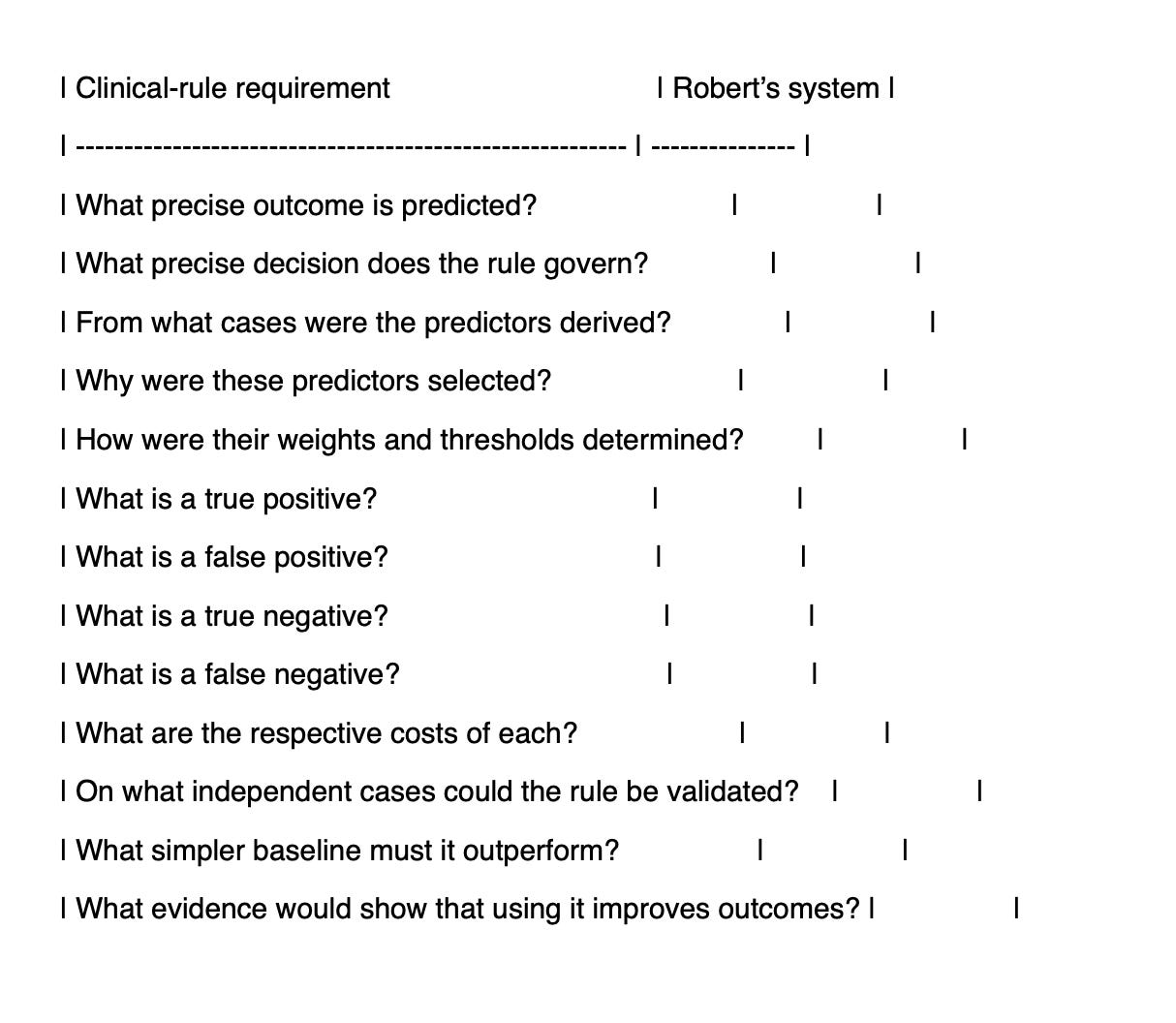
What exact decision is Robert’s framework intended to inform? Is it one binary decision—stay or leave—or a sequence of decisions, like renewing documents, moving assets, arranging housing, temporarily relocating, and finally departing?
What outcome is the system trying to prevent? Financial loss, political persecution, civil disorder, inability to leave, institutional collapse, or some combination? Can these outcomes be defined precisely enough to test?
What would count as a successful recommendation? Must the feared event actually occur, or could departure still have been rational given the information available at the time?
Is “leave the United States” too broad an action to attach to a single dashboard? Should different threats trigger different protective measures?
For each of Robert’s five indicators, can we state the complete causal chain connecting the observation to the decision to leave?
How does a thirty-year Treasury yield above 5.5 percent increase Robert’s personal need to emigrate? Which intermediate events have to occur, and how confident are we in each link?
Do retail diesel prices, high-yield spreads, stablecoin instability, and anomalous movements in the dollar measure distinct dangers, or are several expressions of the same underlying financial stress?
Robert’s convergence thesis requires both financial dislocation and a political-legitimacy crisis. Why does his dashboard contain several financial indicators but few comparable political indicators?
What observable developments would distinguish an acrimonious but constitutional political dispute from a genuine legitimacy crisis?
Against which historical cases should the framework be tested? What would it have recommended in Germany after 1933, Czechoslovakia after 1948, Iran after 1979, Venezuela under Chávez and Maduro, Hong Kong after the national-security law, Russia before and after 2022, or Turkey under Erdoğan?
In those cases, which indicators gave people useful warning before exit became significantly harder? Were they financial, political, legal, social, personal—or some combination?
Would Robert’s indicators have fired during serious but survivable American crises such as 2008, 2020, or periods of high inflation and political violence? If so, what action would they have recommended?
How many false alarms would the system generate? How costly would they be? Conversely, which dangerous political transformations might occur without producing any of Robert’s financial triggers?
Were the numerical thresholds selected because evidence shows they mark a change in regime, or because they seem intuitively alarming? What evidence would justify moving them?
Does Robert’s model improve upon informed personal judgment? What information would it reveal that a politically attentive person wouldn’t already know?
Could a much simpler set of red lines perform as well or better—for example, being personally targeted by the government, the politicization of coercive institutions, restrictions on capital or movement, the loss of a viable destination?
Does an elaborate dashboard protect its owner from denial, or is it a highly intelligent form of denial—a means of continuing to monitor rather than deciding?
What is the simplest model capable of outperforming ordinary judgment? If added complexity doesn’t improve decisions, what purpose does it serve?
Which indicators measure danger to the United States, and which measure danger to Robert? Where do those categories overlap, and where do they diverge?
What would cause the exits available specifically to Robert to close? Are those constraints being monitored directly?
Which facts about his own capacity belong in the system: health, exhaustion, finances, family obligations, destination viability, willingness to leave, or the condition of people whose choices affect his own?
Who besides Robert should assess whether he’s interpreting the dashboard honestly? What authority should that person have, and what evidence should govern the assessment?
What historical cases, counter-cases, and outcomes should be included in a retrospective test?
How should false positives and false negatives be weighted? Is leaving unnecessarily just expensive and disruptive, or might it also destroy relationships, careers, and sources of meaning that can’t be recovered?
Which parts of the framework can be tested retrospectively? Which require prospective testing?
What should Robert commit to recording between now and January 2027 so that the group can later evaluate the model without hindsight bias?
What result would persuade us that the framework adds no useful information and should be abandoned?
By the end of Sunday’s discussion, can we produce:
a precise statement of the decision;
a hierarchy of staged actions;
a causal map connecting indicators to actions;
a revised set of political, financial, personal, and exit-capacity indicators;
a list of historical cases against which to test them;
a baseline rule for comparison;
and a prospective record by which the model can later be judged?
As usual, the Zoom link is below the paywall. Come join us: This will be fun.
Comments
Nothing yet. Say the first thing.
Sign in to join the conversation.