
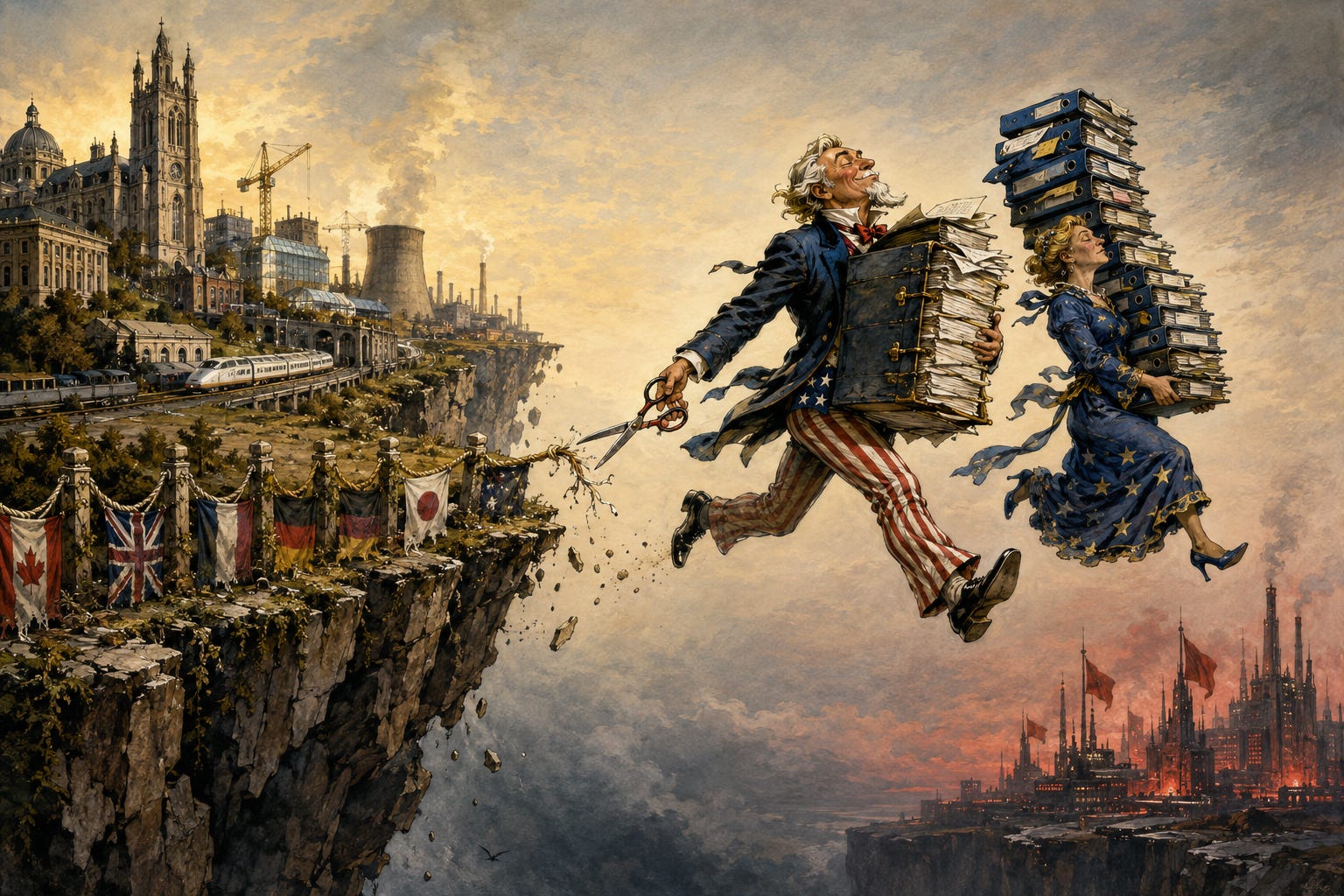
The West has spent the past decade rediscovering geopolitics. Defense budgets are rising. Governments speak of economic security, strategic autonomy, resilient supply chains, industrial policy, stockpiles, export controls, and the restoration of manufacturing. The optimistic confidence of the post–Cold War era has given way to an increasingly urgent conviction that economic policy must serve strategic ends. This has produced a strange admixture of prudent preparation, fashionable dirigisme, and—under Trump—outright vandalism.
Our economic statecraft, argues Dalibor Roháč, is not strengthening us. To the contrary, on both sides of the Atlantic, the West is preparing for great-power competition by steadily weakening the qualities that once made it formidable: its open markets, technological dynamism, attractiveness to talent, scientific excellence, and its ability to build almost anything at tolerable cost. It is responding to the threat by becoming more like the closed, dirigiste systems it is trying to defeat—protectionist, suspicious of foreigners, preoccupied with national self-sufficiency, and increasingly willing to subordinate markets and institutions to executive power.
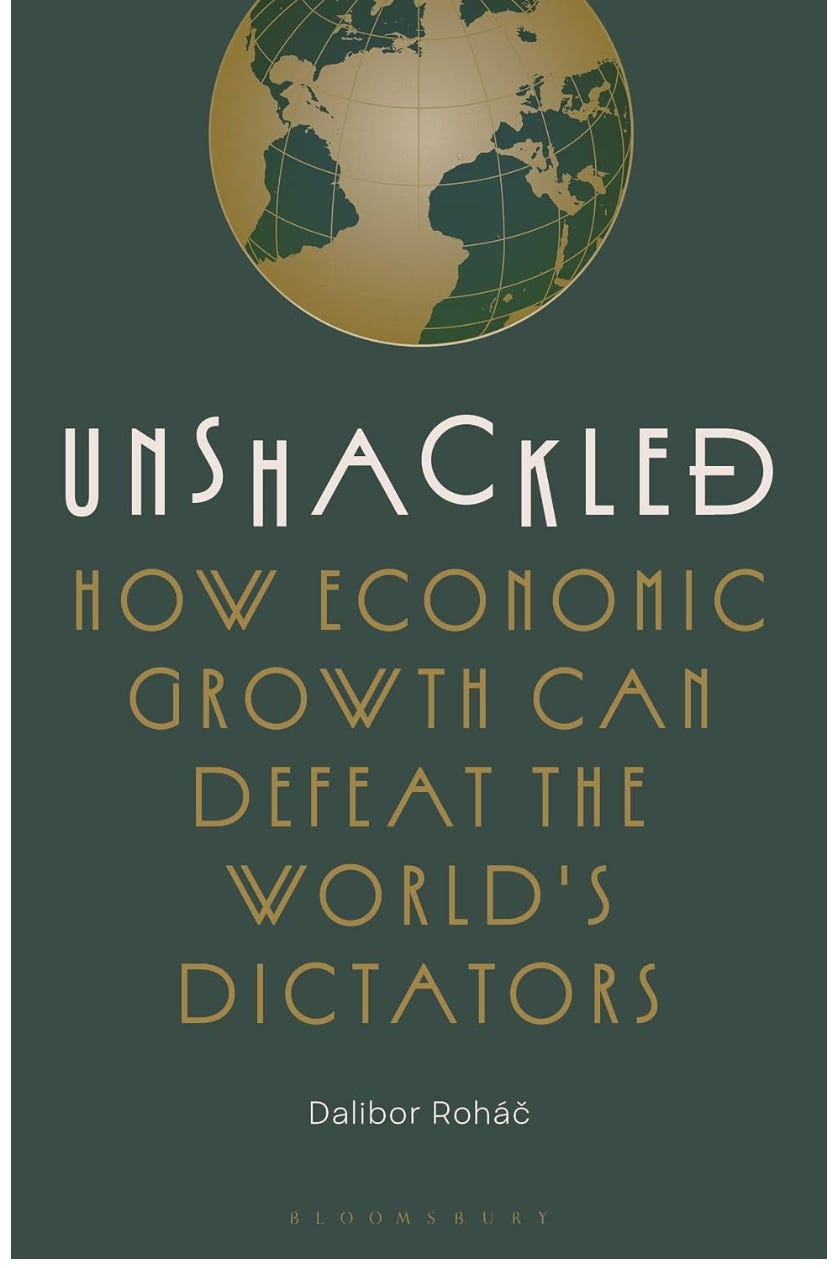
In his new book, Unshackled: How Economic Growth Can Defeat the World’s Dictators, Dalibor argues that this isn’t strategic realism. It’s strategic self-sabotage.
For many years, Dalibor was a senior fellow at the American Enterprise Institute, where he specialized in European political and economic trends, particularly in Central and Eastern Europe, the EU, US-EU relations, and the post-communist transitions of countries in the former Soviet bloc. He’s about to move to Prague to become GLOBSEC’s Director of Research. (Read more on LinkedIn.)
From the new book’s promo blurb:
In an era of increasingly adversarial geopolitical tensions, how can the United States restore its economic standing on the world stage?
The United States and its liberal democratic allies have experienced a steady decline in global economic influence since the end of the Cold War. With the rise of China and other developing economies and against the backdrop of Russia’s war of aggression in Ukraine, the United States has found itself less able to leverage trade relationships and forge broad coalitions to combat autocratic adversaries. Fiscal pressures have constrained military deterrence initiatives and development assistance budgets, diminishing US hard and soft power alike.
This book outlines a strategy to reverse these trends, arguing for a renewed commitment to ambitious economic dynamism and deeper economic integration with like-minded countries. By tackling a range of international trade policies and domestic barriers to healthy economic growth, the United States can restore the competitive advantage it needs to counter the world’s emerging authoritarian powers.
His argument begins with a neglected Cold War strategist, Stefan Possony. Possony understood that military power rests upon a deeper foundation: productive capacity, technological innovation, fiscal endurance, institutional adaptability, and access to the accumulated labor of other societies through trade. Liberal economies could prevail in a prolonged contest, he believed, because they were better at producing knowledge, wealth, and useful alliances. The collapse of the Soviet Union appeared to vindicate his argument.
But China isn’t the Soviet Union. It’s deeply integrated into the world economy; in several strategically important industries, it’s at the technological frontier; and it has become extraordinarily good at building the physical infrastructure that Western democracies no longer seem able to build at all. The US, meanwhile, has developed what Dalibor describes as a pervasive incapacity to act.
Washington is trying to compete with China by taxing the inputs American industry needs. Its legislative and regulatory bodies are paralyzed. Europe dreams of strategic autonomy while regulating, taxing, and vetoing its way toward technological dependence. The United States is attacking its own scientific institutions, immigration, and trade. Slower growth and fiscal irresponsibility have eroded the West’s ability to convert its advantages into military power and geopolitical influence. On both sides of the Atlantic, economic openness is growingly viewed as a vulnerability—even though openness was the source of the West’s power. Washington, meanwhile, is dismantling the alliance system that magnified Western advantages.
The result is a peculiar Western grand strategy. We spend enormous sums preparing for conflicts that our industrial systems are unable to sustain. The US demands that its allies join its wars while capriciously imposing tariffs and threatening to invade them. We warn that China has obtained a commanding position in critical technologies while making energy, construction, research, and manufacturing slower and more expensive at home. We’re destroying the institutions—universities, scientific agencies, immigration channels, trade relationships, constitutional restraints—that have historically distinguished us from our adversaries.
Dalibor calls for rededicating our politics to construction, energy, infrastructure, innovation, immigration, fiscal reform, and much deeper economic integration among democracies.
But he also raises the obvious question: Is the West still capable, politically, of embracing the policies upon which its survival depends?
Please read Unshackled. It’s available on Kindle. If the cost of the book is prohibitive, Dalibor has kindly given me permission to share it with you on our Google Drive. Send me a message if you need the link.
He also says,
If you think five days is too tight, the core is:
Introduction
Chapter 1 (“Back to the Cold War?”),
Chapter 2 (“A Nation of American’ts?”),
Chapter 7 (“Trade Is Not a Dirty Word”), and
Chapter 8 (“A Superpower—If You Can Keep It”)
But I don’t think you’ll find it’s too tight. (In fact, I bet you’ll read it with great interest in a single evening, as I just did.)
“The first three frame the book,” writes Dalibor, “the rest are questions that genuinely vex me. I hope your brain trust will help me solve them!”
The book argues the decisive front in the contest with China and Russia is economic and technological, not military. If that’s right, why does virtually all Western strategic debate—money, attention, careers—still flow to the military front?
The Soviet Union lost the Cold War in large part because the West outgrew and out-innovated it. But China is not the USSR: it is integrated into the world economy and, in some sectors (EVs, batteries, solar), at the innovation frontier. Which Cold War lessons still apply, and which are dangerous nostalgia?
Stefan Possony argued in 1939 that “stockpiles are stocks of labor” and that only the liberal economy can meet the demands of a long war. Where is the line between prudent economic statecraft and the protectionism that kills the goose that lays the golden eggs?
The book documents a West that can no longer build: a US$4.5 billion subway extension of three stops, a Californian high-speed rail with US$13 billion spent and no track laid, a nuclear regulator that licensed-and-operated one new reactor design in fifty years. Is this fixable within normal democratic politics, or does Mancur Olson win—do ossified societies only reform after catastrophe?
Both American parties abandoned the free-trade, free-market consensus at roughly the same time, for different reasons. What would it actually take—politically, not intellectually—to rebuild a pro-growth, pro-trade coalition in a democracy where the median voter has stopped believing in it?
The book argues the answer to weaponized interdependence is more interdependence—with more, and more varied, trusted partners. But every Western government is currently doing the opposite. Is there a plausible sequence of events, short of a war over Taiwan, that reverses this?
If the United States has become, at least for now, a revisionist power on trade—and an unreliable ally on security—should Europe and the Indo-Pacific democracies build the “free trade area of the willing” around America? Would that save the Western order or finish it off?
Democratic backsliding inside the United States is, I argue, a bigger threat to the Western alliance than anything Moscow or Beijing can do. Do folks agree? And what, concretely, can allies do about it?
Migration is simultaneously the West’s superpower and its most politically destabilizing issue. Can any democracy get the balance right—orderly, merit-tilted, popular—and who is closest?
The book closes on the “adaptive capacity of free societies” as the case for optimism. What is the best evidence for and against: are the correction mechanisms—courts, elections, markets, free debate—still functioning in the United States?
The questions Dalibor raises connect beautifully to everything else we’ve recently been discussing—suppressed price signals, the physical economy beneath the financial abstractions, American revisionism, the polycrisis and the omnishambles, and whether our societies are still functional enough to notice and reverse catastrophic error.
As usual, the link is below the jump.
See you on Sunday at 4:30 pm Paris time!
Comments
Nothing yet. Say the first thing.
Sign in to join the conversation.