
“Do you know what your biggest limitation is going to be, launching this business?
You’re not famous.”
That was the advice an esteemed expert in community building gave my co-founder and me when we set out on this together.
It has riled us both ever since.
Because, according to this expert, the single greatest threat to our whole enterprise, apparently, was that we weren’t known. In one sentence, our biggest problem had been diagnosed as a shortage of attention.
Our company, briefly: we help business owners succeed without that success costing them everything else they hold dear — their family, their health, their hobbies, their own sense of who they are. We didn’t arrive at this from a whiteboard. Between us we’ve watched more founders than we’d care to admit lose themselves in the name of ambition, dismantling the very lives they were supposedly building. And the cruel irony is that almost none of them set out for “success” in the abstract. They wanted a better life for their family. They wanted to retire early with the boat in the Caribbean. They wanted to earn enough to finally do the thing they were genuinely passionate about. Success was only ever the vehicle. Somewhere along the way it quietly became the destination, and everything else got spent getting there.
This isn’t a sales pitch. I’m telling you because it’s the reason we’re the right people to do this work. Between us we’ve grown seven companies into unicorns, and worked the whole gamut — pre-seed start-up to billion-dollar multinational. We know, better than most, what it takes to build something successful. And we know precisely how it goes wrong: how the pursuit starts charging the rest of your life for the privilege, without ever sending an invoice.
Those are our credentials. That is what makes us credible to lead this business, and it is why people work with us.
Notice what is not on that list: Fame.
And yet the advice wasn’t stupid. It was a faithful reading of the world we now live in, one that has quietly agreed that to be credible, you first have to be visible.
Did you know that you can now buy a child an influencer kit, the same way you’d once have handed them a doctor’s kit? Ring light, clip-on mic, a play phone on its own little tripod. We’ve turned being seen into an ambition you can unbox at five. Seen that way, the expert’s advice is just the grown-up version of the same toy: visibility is the currency, and everything else is assumed to follow.
So I want to stop and pull apart two things we’ve started treating as one. Being noticed, and being trusted. Because visibility gets you noticed. Credibility is what makes people stay.
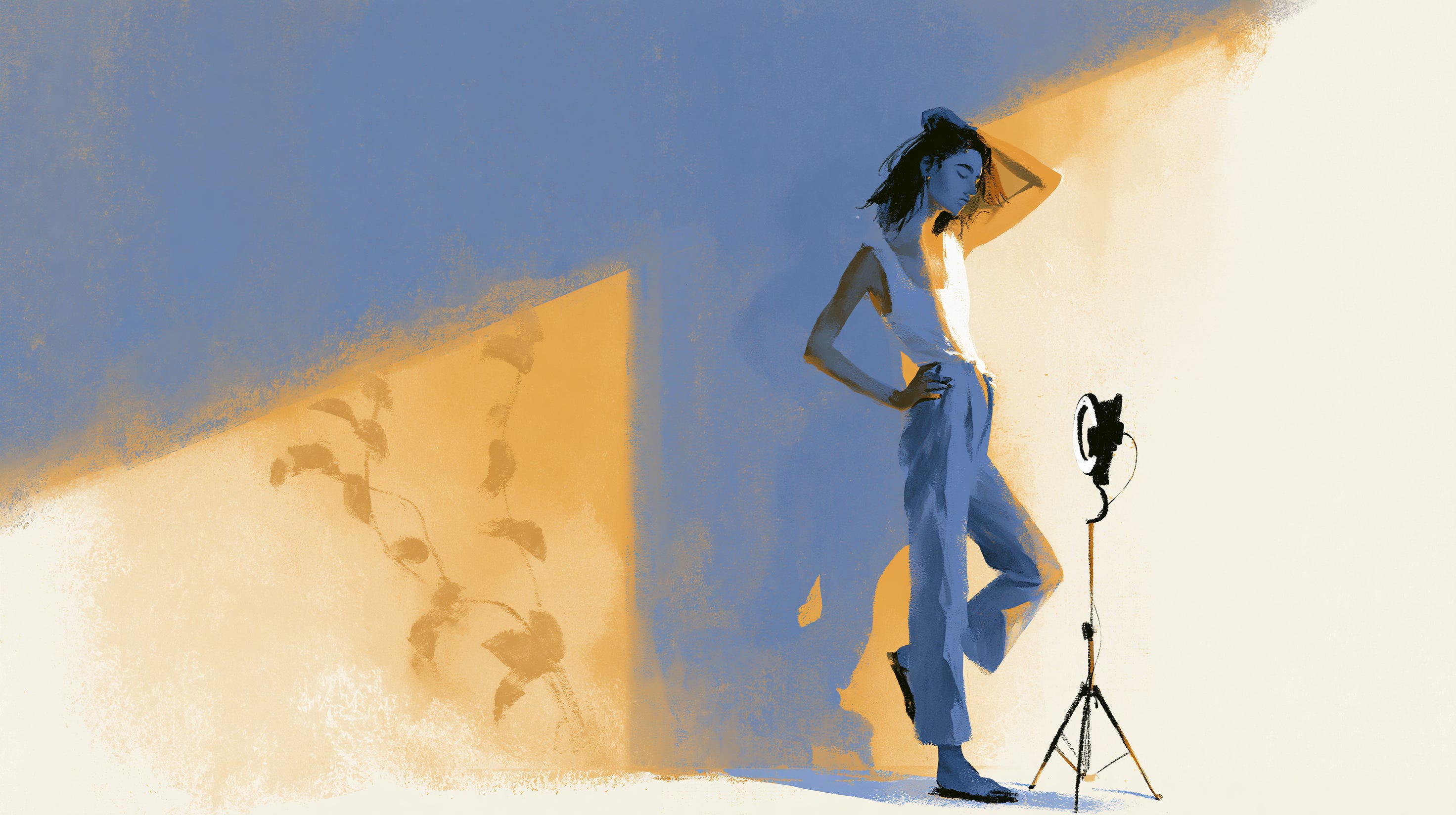
Visibility is an acquisition function. It brings people in, and it can be counted at the end of the month. Credibility governs whether any of those people are still paying attention a fortnight later, and whether they ever say your name to someone else in a meeting you’re not in.
We have started reading the evidence of the first as proof of the second. An audience of forty thousand demonstrates that forty thousand people arrived. Whether they were right to is a separate question, and one almost nobody asks, largely because arrival is countable and rightness isn’t.
A blue tick, a badge, a place on the rising list. There is an entire visual grammar of validation now, and almost none of it survives a follow-up question. Validated by whom, exactly, and against what. A blue tick certifies that you exist and that your card payment cleared.
The rising list is the better example, because it looks the most like merit. Yet JHong pulled the Substack algorithm apart in her brilliant article Groundhog Day and found the ranking runs on growth rate and very little else. Not whether anyone read the thing. Not whether anyone stayed. A publication climbs on how fast its subscriber count moved, which makes the list a precise instrument for measuring arrival and blind to everything that happens afterwards. It is, in other words, a leaderboard for the wrong quantity, published in a font that suggests otherwise.
Which is the whole problem with treating visibility as the proxy. It can be bought outright, or gamed with enough patience, or handed to a five-year-old with a ring light. If credibility were the same substance, it would be for sale on the same terms. It isn’t, so it must be something else.
Ask most people what makes someone credible and you’ll get a description of a CV. Years in the role, companies worked for, the logo bar at the bottom of the website.
David Maister, who spent a career studying why clients trust some advisers and not others, wrote trust as an equation. Credibility, reliability and intimacy sit on top. Underneath, dividing all of it, is self-orientation: how much you appear to be in this for yourself. The arrangement is what makes it useful. Everything a person brings gets divided by how obviously they want something from the room, which means someone can have the qualifications, deliver on schedule, know the client’s business intimately, and still be worth very little.
Credentials sit at the bottom of that, holding it up. They’re also the most easily matched thing about anyone. Somewhere there is another CV with roughly the same shape as mine, held by someone perfectly capable of doing what I do.
So the seven unicorns aren’t really the point, though I’ll admit to being pleased about them. They get us a meeting. What has kept anyone in the conversation since is the part with nowhere to sit on a slide: we watched people build the exact thing we built, and lose things they hadn’t thought to count, and we decided we weren’t going to sell anybody that trade. That knowledge came from the same experience as the credential. Only one half of it is legible to a recruiter.
Here is where the standard version of this argument stops being useful, because credibility on its own doesn’t narrow the field very much.
At any given level of expertise there are dozens of people who clear the bar. They’ve all done the work. They’d all do a competent job. Competence stops functioning as a differentiator at more or less the moment you’d expect it to start mattering most, which is a genuinely odd thing about expert markets and one nobody writing about personal branding seems to want to sit with.
What breaks the tie is resonance. You stay with the person who described a Tuesday you have actually had. Who’s stood roughly where you’re standing and can describe the view without needing you to explain it first. The recognition happens somewhere below argument, and it happens fast.
That makes credibility relational rather than personal, which is inconvenient if you were hoping to build it in private and then deploy it. The question underneath has never really been whether someone is good. It’s whether they’re good for you, and a person can pass the first test spectacularly while failing the second.

Which brings me to the problem with everything I’ve written above.
That specific, they-get-me kind of credibility, the sort that actually moves someone to act, is almost always discovered through visibility. Nobody has ever felt understood by a person they haven’t encountered.
The expert was right about the mechanism. You do have to be seen. Presence requires being present, and being present now runs through a profile, an algorithm, and somebody’s thumb at eleven o’clock at night. Every reader who has ever thought this is exactly the thing I needed to read this week found the thing first. Something put it in front of them. Resonance can’t do its work on a person who never arrives, and the arriving is precisely what visibility is for.
So they were never opposites, which is unhelpful for the shape of this essay. Visibility is the delivery mechanism for the very thing it keeps getting mistaken for.

He was half right, then, this expert. We aren’t famous, and there’s every chance we never will be. But the requirement was never fame. It was being findable by a fairly small number of quite specific people, which is a different project altogether and a considerably less glamorous one.
The order is what matters. Visibility in the service of credibility, running that way round and not the other, which sounds obvious written down and is almost impossible to hold in practice. Optimise for reach, let the substance become something you’ll get back to, and you’ve quietly imported the influencer’s bargain into work that was supposed to rest on something sturdier.
What I can’t tell you is where the line sits. The sequence reads cleanly enough on paper, and it holds right up until a post does unusually well and you catch yourself wondering why, and then working out how to do it again. Nobody announces the crossing. There’s no particular morning when the work stops being the point and becomes the thing you do in between posts about the work.
The influencer kit, at least, is honest about what it’s for.
If this landed, you might want: Would We Find Each Other Boring? — on why the visibility economy overlooks careful thinkers, and why it isn't anyone's fault in particular.
No posts
Comments
Nothing yet. Say the first thing.
Sign in to join the conversation.