
Artificial intelligence is reshaping the global economy. Some argue that AI will essentially replace human labor and that it will fundamentally reshape the way we work. In doing so, AI may lead to most income eventually being generated by computation, leaving workers with a very small share of total income. While this somewhat pessimistic take is not shared by all (see this very nice list summarizing the view of economists and AI insiders), it seems clear that a lot of skills may depreciate in value with AI. As a consequence, we might need to rethink the labor market and indeed the education system (Tobias Tröger has written about AI and law education, for example).
So how can workers protect themselves against the risks of AI? Much of the current debate seems to be about learning different skills or learning how to complement AI, so that you are not substituted. Learn how to do creative work, or develop some leadership skills, or become a plumber. I’m not here to talk about that. Instead, I wanted to think about another part of the answer: if labor is no longer valued, is it time to become a capitalist?
If AI is going to replace your job, you may want to make sure you own some of the profits it generates. This is where becoming a capitalist comes in. When companies deploy AI successfully, the hope is that their costs will fall and their productivity will rise. This would translate into higher margins, faster growth, and rising valuations. Workers who own stocks are capitalists and capture part of this upside. In effect, you are insuring (or hedging, in more formal terms) your labor income with capital income. This is not unlike the old advice for farmers in industrializing economies: don’t just work the land—own shares in the railroads and factories that are transforming agriculture.
Now, owning stocks isn’t a perfect hedge against job loss—getting displaced is largely a personal risk that markets don’t insure. But it is a way to participate in the profits if AI shifts income toward capital, as one paper suggests. If robots earn more of the pie, broad stock ownership is one of the only scalable ways most households can claim a slice.
In essence, the idea is that if our robot overlords will make all the money, you should make sure that you own some robots (this is not investment advice). Modern capital markets are actually pretty great for doing so. It has never been easier or cheaper to invest in a broad stock index fund through an ETF or index fund, which would give you exposure to all firms that could potentially benefit from AI. And you should really be investing broadly instead of into “AI-themed stocks”, for two reasons. First, it’s a lot of effort to keep track of everything that goes on in financial markets, and you might not want to do that. Time is costly, and can be spent on doing more fun things than reading business newspapers (citation needed). Second, it is really difficult to figure out which companies will benefit from AI in the long term, and you are very unlikely to outperform the market by choosing your favorite AI companies. Even Nvidia, the poster-child for the AI boom, is down about 20% from their peak. So instead of spending money and effort to figure out which company will benefit from AI, why not just buy them all? After all, if AI is so transformative, it will likely benefit all of them in some way.
An interesting question is whether households will actually invest more in stocks now that AI is here. If one had some data, one could run a study where households are ranked based on AI exposure and then examine whether they invest more or less in stocks now. Unfortunately, I am currently busy trying to find a job and complete my papers, so I am not able to do this study (yet). But I think you could have two competing hypotheses: First, AI exposure leads households to hedge their labor income risk by increasing their stock market exposure. Intuitively, it seems that professions exposed to AI should have relatively high financial literacy, so they should know how to manage it. Unlike some other risks, AI is potentially hedgeable. The other hypothesis is that workers at risk of AI now have a higher labor income risk (they may have a hard time finding a job) and so will naturally decrease their stock market investments. This seems to have happened with robots, and this is what standard financial theory would predict.
Regardless of what happens with stock market participation in the future, we can say something about what is happening now: Higher-income households tend to invest a lot more into stocks. The figure below is from the Survey of Consumer Finances, high-quality data from the US. In 2022, 96 percent of households in the top 10 percent of the income distribution held stocks (either directly or through e.g. retirement accounts). In comparison, about 60% of households in the middle of the income distribution (40-60th percentiles) did the same. There is a clear distributional aspect to AI, beyond just job displacement. If AI shifts income toward capital, the benefits mechanically flow to the people who already own capital—unless ownership broadens.
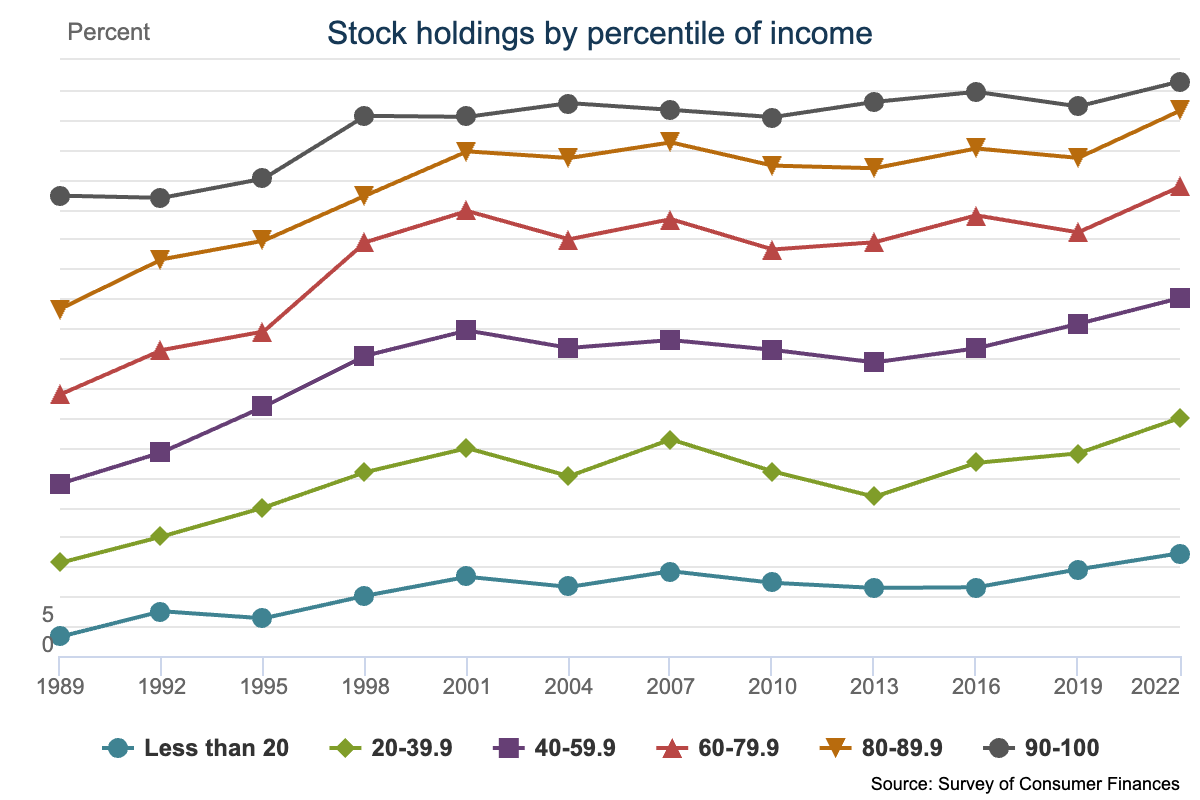
Since stock market participation rates seem very slow-moving (basically flat since 2001), and since we know that financial literacy is a real impediment to accessing financial markets, asking households to start investing may not be feasible. One solution is to have governments invest in what Nicolas Berggruen and Nathan Gardels calls Universal Basic Capital. I think that’s a nice idea, one that we should think about more. The other option may be to improve financial literacy and encourage more people to invest. This comes with risks, though, and we should probably be humble about the extent to which financial literacy education can improve our prospects. In addition, low-income households are unlikely to have sufficient wealth to start with to make an effective hedge against labor risk.
AI is not a passing trend—it’s a structural shift in the way economies organize production. We can either fight to stay complementary through skill differentiation, or we can try to capture profits indirectly by becoming capital owners. The first strategy is personal and requires continuous adaptation. The second strategy is financial and can be pursued in parallel. For most workers and governments, the safest hedge may be to do both.
No posts
Comments
Nothing yet. Say the first thing.
Sign in to join the conversation.