
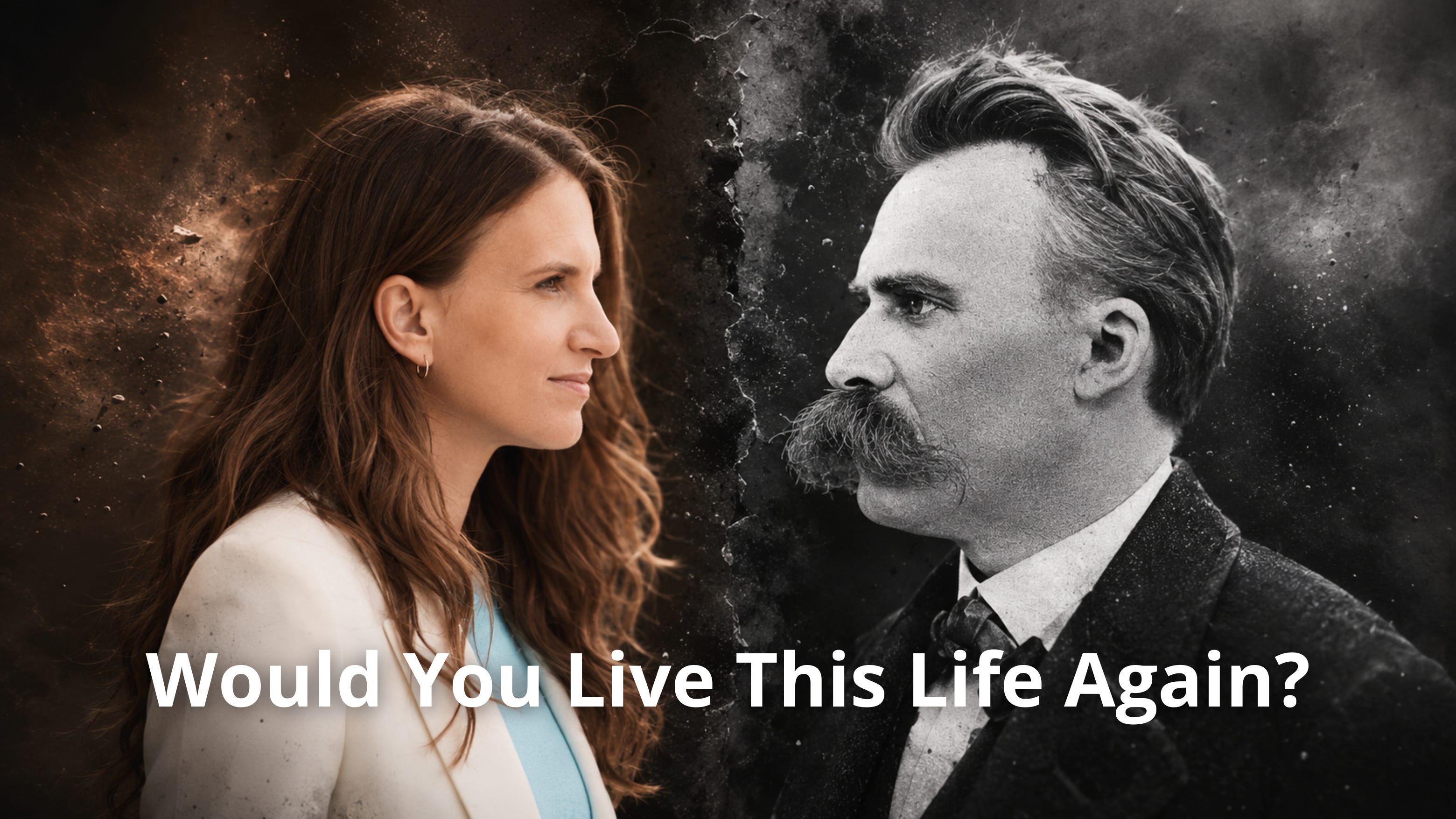
Imagine a demon slips into your room late one night, when you are most alone, and says this:
This life you are living, you will live again. Every detail of it, in the same order. Every joy, every humiliation, every loss and trauma and every boring Tuesday.
The same, endlessly, for eternity, with nothing new in it ever.
Nietzsche asks one question about that.
Would you collapse in horror? Or would you say yes, and want it all again, exactly the same?
He called it the eternal return, and he meant it as the ultimate test of a life.
People get stuck on whether Nietzsche thought the universe literally repeats. He did not, and it does not matter.
The recurrence is a device. Its job is to strip away every escape.
Look at how you actually make a hard life bearable. You point somewhere else.
Religion says this life is a rehearsal for the next one.
Progress says the grind pays off eventually.
Hope says it will get better next year, after the promotion, once the house is paid off, when things finally settle.
Quest or healing narratives suggest that everything will make sense and be worth it in the end.
Every one of these borrows from the future to make the present tolerable.
The eternal return shuts all of it off. If this exact life repeats forever, there is no next life to redeem it, no later payoff, no arrival.
Nothing outside this life is coming to justify it. It has to be worth living now, as it is, or never.
He called the yes amor fati. Love of fate.
To be so reconciled to your existence that you would will every second of it back, forever, and mean it. He thought that was the highest a human could reach.
I would have replied yes to Nietzsche’s question for the first few decades of my life. I was just incredibly lucky. Healthy parents, healthy body, living away from wars and abuse, with food always on the table.
It is true that growth in nature happens through challenge. When I saw baby sea turtles being born, they very slowly and with great challenge, walked towards the water. It is a dangerous time when they can be attacked by birds and other animals.
Tourists were tempted to pick them up and put them in the sea. But if they did that, the little turtle would not be able to survive. That torturous walk towards the beach is what makes it strong.
Just like the micro-tears in our muscles make them grow.
So, yes, challenges make us stronger. More people experience post-traumatic growth than post-traumatic stress.
And we have a psychological immune system that, after a failure or disappointment, will get into gear to make us feel better.
We will see the positive side. We will minimize it. We will rationalize it. We will even forget it.
Many people, in hindsight will say their challenges are the best thing that happened to them. They redirected them to a more aligned and truthful life. They helped them grow and become more compassionate.
So, in a sense Nietzsche is right.
You would have to relive the whole package to be who you are. If you skip the hours lifting weights, you won’t have the muscles; if you skip life challenges, you won’t have the wisdom.
Yes, my university crash breaking my heart was a blessing, as that trajectory led me to my husband.
Having a soul-crushing split with my youth group of friends led me to eventually have deep, fulfilling friendships with other women.
Yes, me not getting my dream job at NBC Universal was one of the best things that happened to me as I got an even dreamier job at Google.
So, grateful for all of that adversity. But hey, those were microtears that only helped the muscle grow.
They were not amputations.
When I interviewed my client and resilience coach Orsi Temesvari, she told me she did not believe in acceptance. That there are some things in life that are unacceptable.
Orsi had an accident that left her paralyzed from the neck down. She is a light in the world, having a great impact, and she grew through her adversity. But she does not have to accept it.
When I heard Orsi say that to me, I felt a sense of relief. Is it OK if I cannot accept my own unacceptable things yet? (You can watch our conversation on YouTube below)
Other clients of mine lost their parents when they were kids. They lost kids and spouses. Suffered abuse.
Many people have experienced things they would never, never want to experience again, despite all the growth that came from them.
Right now, I would also fail Nietzsche’s test. Repeat all of it? No, thank you.
Yet there is something useful in Nietzsche’s eternal return experiment. Something I was unknowingly using in my vision work with my clients.
Do not ask whether you would relive your fate. Ask whether you would relive your current choices.
Not the accident, the loss or the trauma. There is not much you can do now about those, other than feel your feelings and try to heal what can be healed.
Ask instead about the life you are actively building.
Would you like to be in your relationships, exactly as they are now, forever?
Would you like to do your work, as it is now, eternally in a loop?
Would you repeat your week ad infinitum? Same hobbies and activities? Eating the same foods?
All of that, unchanged, for eternity. How does that land?
This question is useful, because every part of it is something you can change.
You cannot change your past. But you could do something about your present.
I do not ask you like Nietzsche to love your fate. I do ask you, though, to connect to your vision.
While you cannot change your past, you can redesign a calendar, a career, a set of relationships, and a way of treating yourself.
For most people, the honest first answer to the narrowed question is still no.
They are living a life they chose at 22 and never revisited, or someone else’s idea of success, and some part of them has been waiting years for the real one to start.
You might have been busy meeting everyone’s expectations, possibly including your own. But through all the hustle and distraction, you might have been burying a voice that has been calling you towards something else.
If that is you, the question has done its job. It made you pause and reflect.
It has shown you a potential gap. Now, it is time to start vision work. And if that is the place you are at, I do have something special landing in August.
My mini-course, Life Vision Blueprint, helps you connect with your inner direction, so you can start turning the nos into a hell yeses.
It has 3 modules, about an hour each.
First, you find out where you actually are. Most people are in one of four places: drifting, grinding, upleveling, or living connected to their vision. Identifying yours is the moment the fog clears, because you stop treating a structural problem as a personal failing.
Then you find what is holding you there. Module 2 reveals 4 limiting beliefs and 2 obstacles that keep people disconnected from their vision. You will immediately identify your barriers, and many people recognize more than one.
In the 3rd module, you learn how to connect to the vision itself, in 3 steps. Connect to the life that is already pulling at you, that you have been too busy to hear.
And while a S&P 500 company hired me for several thousand dollars to deliver a fraction of this course in September, it is available inside the Leaderpath Substack membership during August for €25 a month, €15 if you commit for the year.
The demon’s question shows you that you are waiting. The work is to stop waiting and start making the choices you would repeat forever.
So tell me in the comments. Not the whole of your fate, only the part you can change: your relationships, your work, your days, exactly as they are now, forever. Would you live them again?
This post is public so feel free to share it.
Take care,
Caterina
Comments
Nothing yet. Say the first thing.
Sign in to join the conversation.