
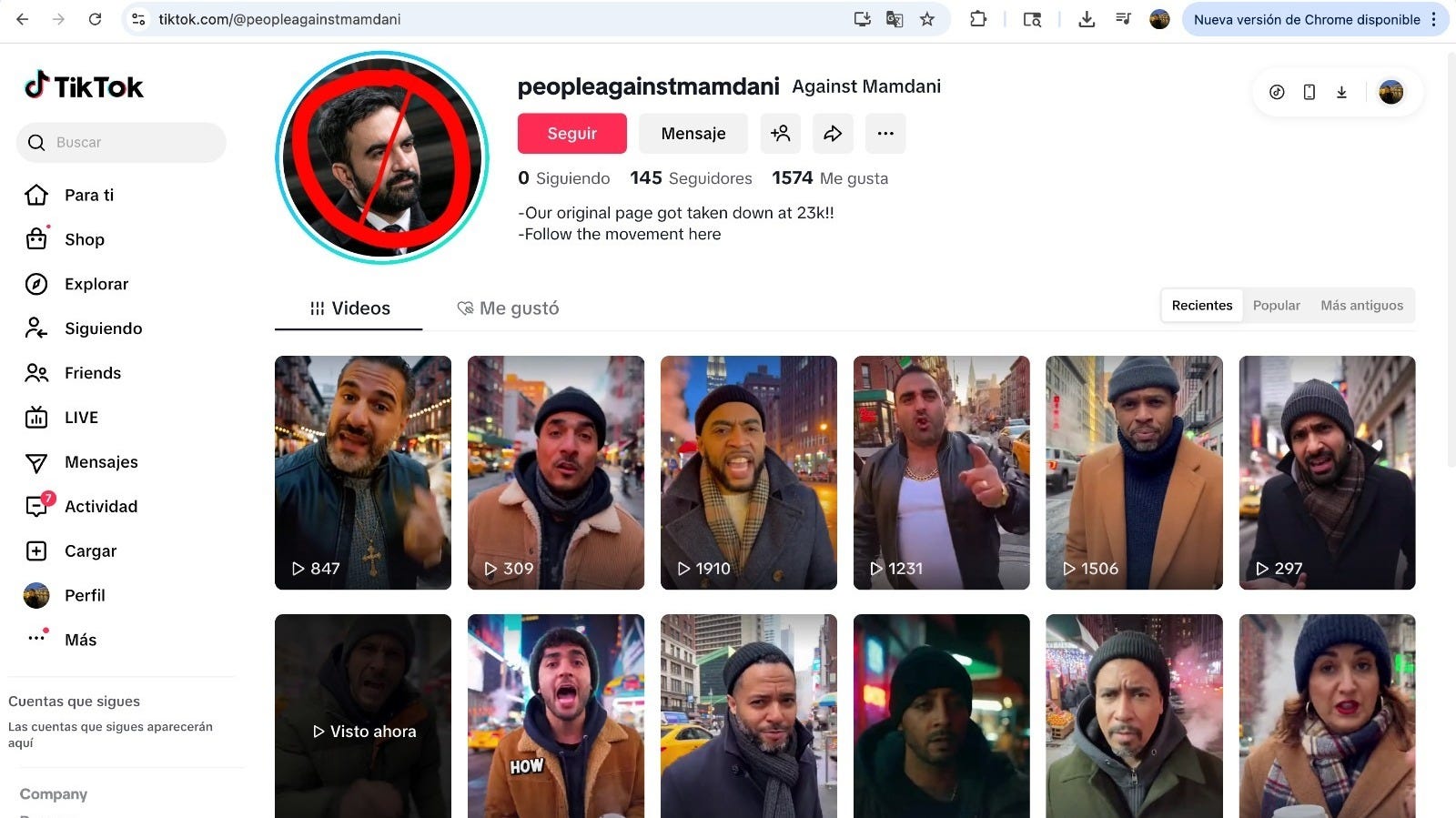
“Nobody wants socialism here in New York City,” yells an angry man in a distinctively New York accent somewhere in Midtown Manhattan in a TikTok video posted by People Against Mamdani.
It’s just one of many similar clips generating thousands of views on the popular social media app: average-looking New Yorkers, speaking directly to the camera, strongly criticizing Mayor-elect Zohran Mamdani and his supporters.
The twist? They are AI-generated deepfakes.
“We are putting people in danger,” said Melissa Leone, founder of Hu-GPT, an artificial intelligence startup focused on developing tools to identify deepfakes.
The videos, along with others from the same account, have gathered hundreds of likes and thousands of views, with engagement increasing in recent weeks. One clip featuring an AI-generated Black New Yorker insulting supporters of Mamdani has received over a hundred comments and around 3,000 views. The account has more than 500 followers; a previous version reached 23,000 followers before it was taken down.
People Against Mamdani is just one of the several accounts publishing deepfake content targeting the mayor-elect. A video depicting Times Square projecting an Islamic flag, with people dressed in traditional Muslim clothing, also went viral. Fox News reporters reacting dramatically to the election results garnered hundreds of views.
These anti-Mamdani deepfakes were widely circulated during the mayoral campaign. Former Gov. Andrew Cuomo’s campaign even reposted a video depicting New York City in flames as the supposed aftermath of a Mamdani victory. The post was later deleted after criticism, but by then, it had already generated thousands of views.
The impunity with which these narratives are created and spread on social media appears to be at the root of the problem. The lack of effective action to curb this content threatens the already fragile trust in democracy, according to experts.
“Imagine the chaos that a well timed deepfake video that New York has been put under martial law can cause if a million people actually believe it,” said Jay Townsend, a political consultant and campaign strategist.
While deceiving voters and the public with misleading or false information is a long-recognized political tactic, experts say this new generation of video content poses a different kind of threat.
Carine Roos, researcher and consultant working on democracy, digital sovereignty, and gendered disinformation, explained in an email interview that deception is most effective when it blends fiction with recognizable cues from reality and existing prejudices.
“Realism has the ability to have an impact on a deeper level than most people realize,” Leone said.
Combined with the fact that humans often process video more intuitively than text –and that studies show most people are unable to reliably identify deepfakes– these videos become a near-perfect tool for malicious actors.
The creators of this content are often difficult to identify. Lincoln Mitchell, a political consultant and political science professor at Columbia University’s School of International Public Affairs, said in an interview that they can range from aspiring influencers to powerful state and non-state actors.
Social media platforms such as TikTok –and X– ultimately bear responsibility for the dissemination of these videos. Indeed, Leone argues that platforms have an obligation to ensure users are not misled by inauthentic content.
In a statement, a TikTok spokesperson said that some videos portraying New York City as resembling Middle Eastern countries were removed for violating the platform’s hate speech and hate ideology policies.
Another video showing Fox News anchors reacting dramatically to Mamdani’s win was taken down after TikTok determined it was deceptive, AI-generated content impersonating authoritative voices.
All of these actions only occurred after this publication reported them to the TikTok’s communications team.
The People Against Mamdani account remains active because, according to TikTok, it does not violate platform policies. The videos express political criticism and include a label identifying the content as AI-generated.
Experts believe those safeguards are insufficient. Mitchell notes that both the social media platforms and the artificial-intelligence companies enabling this content are run by people with explicit political interests.
“The people behind it are bad actors trying to destroy democracy,” he explained.
Stricter regulation of AI-generated political content appears unlikely in the near term. President Donald Trump himself has reposted AI-generated material mocking political opponents, and his administration is pushing legislation that would prevent states from enacting their own artificial intelligence regulations.
Leone argues that the problem is not technological but political.
“We always found ways to contain the downside of technology. But we are now seeing that this is not touchable, and that we are not regulated at any pace or form,” said Townsend.
A recent New York Times investigation found that artificial intelligence has been used in over 50 countries around the world to mislead voters through deepfakes, underscoring how unregulated technology is already shaping democratic processes worldwide.
“Elections of the future will likely be a constant battle for the truth,” said in an email interview Juan Iramain, political consultant and campaign specialist.
Comments
Nothing yet. Say the first thing.
Sign in to join the conversation.