
[A NOTE TO OUR READERS: Zach Silk is out of the office this week, and so we’re presenting an essay from Civic Ventures fellow Paul Constant in place of our usual format. Zach will return next week with all the latest economic news and analysis.]
This week, New York City Mayor Zohran Mamdani followed through on one of his highest-profile campaign promises. At a press conference on Monday, Mamdani announced that New York City was on track to open five new municipal grocery stores, with the first set to open in late 2027.
Mamdani ran on the idea of government-run grocery stores as a way to combat food deserts in low-income neighborhoods. At the press conference, he announced exactly how the grocery stores, which will be called N.Y.C. Groceries, would bring prices down for New Yorkers: “a core basket of everyday groceries will be 30 percent cheaper” than in other grocery stores. The discounted products include “all fresh produce, meat and seafood, along with roughly 20 additional categories of pantry staples, dairy and refrigerated goods.”
Importantly, this isn’t some means-tested program that low-income New Yorkers will have to fill out forms in order to access. That 30% discount “will apply to all regardless of income, with prices locked in and predictable rather than fluctuating week to week as is the case at private grocers,” the press release explains.
For regular N.Y.C. Groceries shoppers, “savings are projected to cut New Yorkers’ average grocery bill by 15 percent, about $90 a month, or roughly $1,000 a year.”
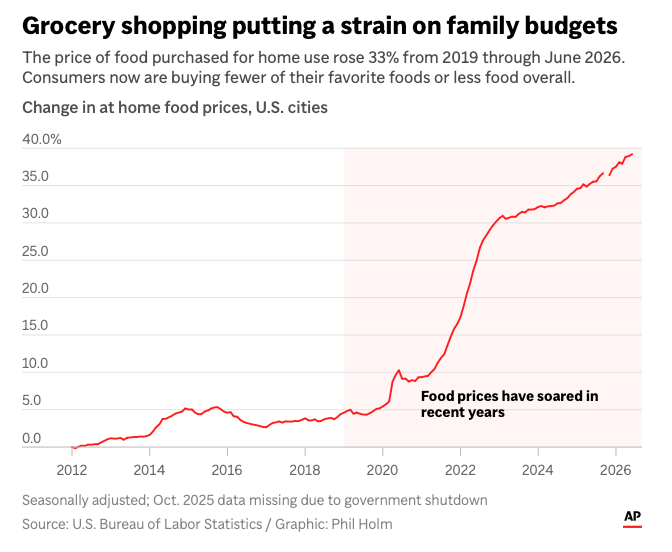
Obviously, this is a big deal. Grocery prices in America have increased by 33% since 2019, meaning that all the items in a hundred-dollar grocery bill from before the pandemic now total an average of $133.
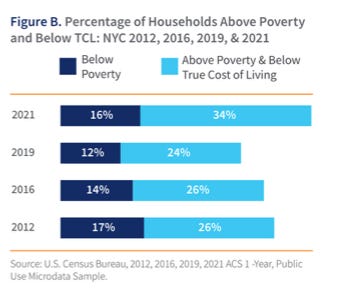
The cost of living has increased everywhere in the United States, but it’s especially high in New York. The city recently released a report (PDF) showing that 16% of all NYC households are below the poverty line and 34% of households have fallen below the true cost of living for the city, meaning that roughly half of all NYC households are struggling to make ends meet.
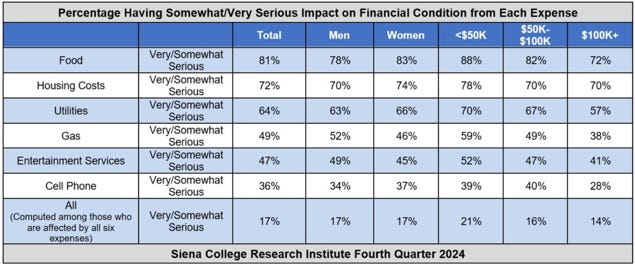
Even seemingly comfortable middle-class New Yorkers are sensitive to skyrocketing grocery costs. A Siena University poll found that 81% of all New Yorkers report rising food costs are having a “serious impact” on their financial conditions.
Government-owned grocery stores aren’t exactly ubiquitous in the United States, but N.Y.C. Groceries wouldn’t be the first of its kind. The federal government has been in the grocery business for over 150 years on military bases around the world: “Military commissaries are an excellent example of how storefront collaboration can keep prices competitive. By having their network of stores share suppliers, they are able to maintain prices 25-30 percent lower than retail stores,” report Omar Ocampo and Maya Khadr at Inequality.org.
Sparsely populated rural areas around the country, even in the reddest of red states, have had to devise new ways to bring healthy groceries to the people. “The St. Paul Supermarket, a grocery store owned and operated by the city of St. Paul in Kansas, is a successful example of a city-owned shop,” Khadr and Ocampo write. “After the retirement of Joe and Sue Renfro, the city government decided to purchase it. The grocery store is now in its twelfth year of operation as a city-owned enterprise.”
No.
I repeat: No. That’s the short answer.
But if you’re really concerned about this, here’s the long answer: The media seems to be trying to gin up a socialist scare right now. This week, Jim VandeHei and Mike Allen of Axios published a histrionic post warning that the Democratic Party is already halfway down the six-step path to socialism, which they equated with the Republican Party’s descent into Trumpism. I can’t recall reading anything quite so panicky published in Axios since the site began in 2017.
Because he’s a high-profile elected official with ties to both the Democratic Party and the Democratic Socialists of America, Mamdani and his grocery stores are a common target of the media’s socialist panic. Fox News rolled out the “s”-word in a story about N.Y.C. Groceries, warning that they will kill competition and wipe out for-profit grocery stores on the taxpayer’s dime. Back in April, the local ABC affiliate warned of creeping socialism and the death of private business if Mamdani’s grocery store plan became real.
This obviously isn’t socialism. For one thing, Mamdani’s grocery store plan is a public-private partnership with for-profit grocery vendors. It pays for-profit suppliers for groceries that the stores will then sell to customers in exchange for money. This is the most basic definition of capitalism. I also want to note that Mamdani’s last major initiative before announcing N.Y.C. Groceries was a plan to slash regulatory red tape to make it easier for small businesses to operate in the city—not exactly the height of Marxist economic theory.
It’s true that the Mamdani plan for N.Y.C. Groceries will put $70 million of government funds toward setting up the stores and subsidizing the stable low prices for eggs, meat, vegetables, and other staples. Governments subsidize all kinds of goods and services all the time for the American people.
The federal government subsidizes American farmers to the tune of tens of billions of dollars every year, for instance, averaging out to about 13% of every farm’s net income. We do this because it would be a bad thing if our farmers were unable to produce food due to financial strife, and we can’t trust the free market to ensure that Americans have enough food to eat—especially during financial downturns and other emergencies like the pandemic.
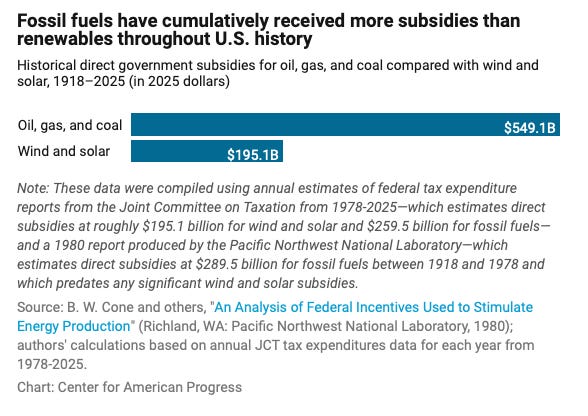
Libertarians who want to whine about Mamdani’s grocery stores choosing winners and losers in the free market should turn their eyes to the energy industry, where the federal government has for a century and a half had its thumb on the scale on behalf of the biggest polluters on the planet. The Center for American Progress estimates that the federal government has delivered some “$549 billion in direct tax subsidies” for the oil, gas, and coal industries over the past 150 years. It’s delivered less than a third of that amount for renewable, clean energy over that same time frame.
It’s not just Big Oil and Big Ag. Unemployment insurance is a government subsidy. So are Obamacare plans for low-income Americans, and SNAP food assistance programs and free school lunches. Plenty of states and localities have government-owned or supported utilities that are proven to keep bills lower and services better. One group found that publicly owned power companies charge customers 14% less than private utilities, and offer more reliable service than private electric companies.
As Zach is fond of saying here in The Pitch: This is exactly what government is supposed to do! Capitalism uses markets to pit businesses against each other, and that competition brings prices down for consumers and wages up for workers. But capitalism doesn’t always run smoothly. Some markets simply don’t deliver the best outcomes.
Government subsidies are especially important in cases when the free market fails. No corporation has yet figured out how to profitably deliver food to rural Americans in far-flung outposts in Kansas and North Dakota, so those communities have created government-run grocery stores to pick up the slack. Food deserts exist in urban areas because grocery chains don’t want to serve certain impoverished communities—often due to systemic racism.
What about the claims that by selling a market basket of staple goods for 30% less than other grocery stores, Mamdani’s grocery stores will put bodegas and corporate grocery chains out of business? Isn’t he picking winners and losers, here?
Not at all. That argument only works if everyone is, as Econ 101 has argued for decades, a perfectly rational consumer who always finds the lowest available prices. In reality, not everyone chooses to shop at Grocery Outlet or Family Dollar because their prices are lower than Whole Foods. Human beings are complex creatures who often behave irrationally, and we respond to billions of different inputs when making decisions.
Put another way, all of New York City’s 8,584,629 residents aren’t going to shop exclusively at the five N.Y.C. Groceries locations because their prices are lower on beans and bread. But the 77% of families in the Hunts Point neighborhood of the Bronx who are struggling to make ends meet and don’t live within walking distance of a grocery store will likely be happy to have the option when the first N.Y.C. Groceries opens there in 2027.
What Mamdani is doing is creating competition that will likely bring down prices among other grocers and suppliers, too. Nobody expects Whole Foods to match the 30% discount at N.Y.C. Groceries, but they will likely lower some prices on specific staples in an effort to attract shoppers. It must also be said that many of these grocery prices were artificially high, to begin with. Don’t forget that the biggest egg producers in the United States colluded with each other to raise their prices and take their profit margins to record-high levels before they were sued and forced to stop.
It’s also a big deal that Mamdani is requiring grocers who participate in N.Y.C. Groceries to “deliver quality jobs alongside affordable groceries. Operators will be required to provide family sustaining wages and benefits and commit to a Labor Peace Agreement so that workers who want to organize can do so without interference.”
Remember, it’s not just prices: Labor markets need robust competition in order to push worker wages higher, too. The lack of competition in the grocery space, with a handful of big corporations owning a huge chunk of the national market, has held wages too low for too long. Even worse, it’s also emboldened grocery chains to illegally repress wages. Big grocery chains Kroger and Albertsons secretly entered into a “no-poach” agreement that said they wouldn’t compete to hire each other’s workers, which forced all grocery worker wages lower.
For the last 50 years of trickle-down economics, grocery store retailers have swallowed each other up in a never-ending game of Monopoly, and they’ve passed the cost of those mergers and acquisitions on to everyone else. The Biden administration stopped the merger between Kroger and Albertsons, and Mamdani’s high-profile New York grocery stores are the beginning of an attempt to grab some of that power back for customers and workers.
This is how we improve industries that are in desperate need of repair: By encouraging change through competition. There’s nothing socialist about that.
We need to keep in mind that the N.Y.C. Groceries experiment could very well prove to be a failure. There are a lot of moving parts in the plan, public-private partnerships are always sticky, and maybe customers will reject the stores when they finally open. That’s okay. The thing about new policies is that they don’t always work.
What does matter is that working New Yorkers see that someone is out there fighting for them, taking big swings to bring down the cost of groceries to the tune of a thousand dollars a year. Notably, none of the people or organizations ringing the alarm bell about socialism have offered an alternative policy to lower prices for consumers. That’s because they’re not on the side of working Americans—they’re arguing on behalf of the fat cats who are benefitting greatly from the system as it is.
City-owned grocery stores aren’t the only solution to the problem of skyrocketing grocery prices. In Mexico, President Claudia Sheinbaum, one of the most middle-out national leaders in the world right now, negotiated with food producers and grocers to keep a basic “market basket” of 24 essential grocery items below the equivalent of 50 American dollars.
Canada passed a Grocery Code of Conduct that installs rules to ensure that all participants in the grocery supply chain, from producers to distributors to grocery stores, behave in a manner that benefits the community and encourages “reciprocal trust and collaboration.”
And Australia recently banned price-gouging by major grocery retailers, with “Penalties for breaches…set at a high of A$10m ($6.8m), three-times the financial gain from the breach, or 10% of the retailer’s annual turnover in the previous 12 months.”
Most of the world is currently wrestling with high grocery prices, and leaders everywhere are experimenting with ways to get food costs under control. The likely solution will involve many of these policies working in tandem. But the one thing I can say beyond the shadow of a doubt is that grocery store chain CEOs are not going to solve this problem out of the kindness of their hearts. When free markets fail, we turn to the government to fight on our behalf. Thankfully, leaders like Mayor Mamdani are doing just that.
Comments
Nothing yet. Say the first thing.
Sign in to join the conversation.