

In these desperate partisan times, activists on the Left and Right seem ready to kill each other, even while monstrous behemoths have swallowed up the republic we all share.
Too many political partisans now believe it’s appropriate to effectively disenfranchise one’s neighbors. A thin majority of Virgina voters, presumably all Democrats, approved redrawing their state’s US House district map from five Republican majority districts to a map with only one.
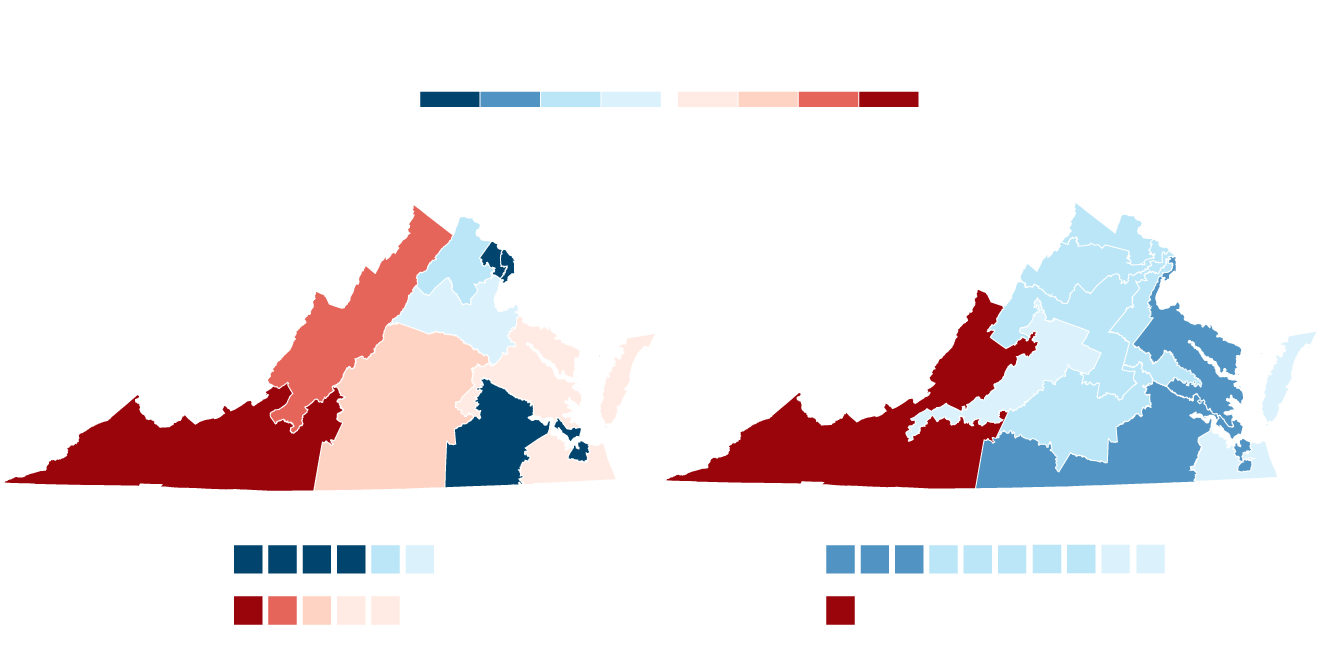
Not to be outdone in the race to disenfranchise voters, Republican-majority states are proposing new maps to disenfranchise Democrats. In Florida they plan on eliminating four Democratic Seats.
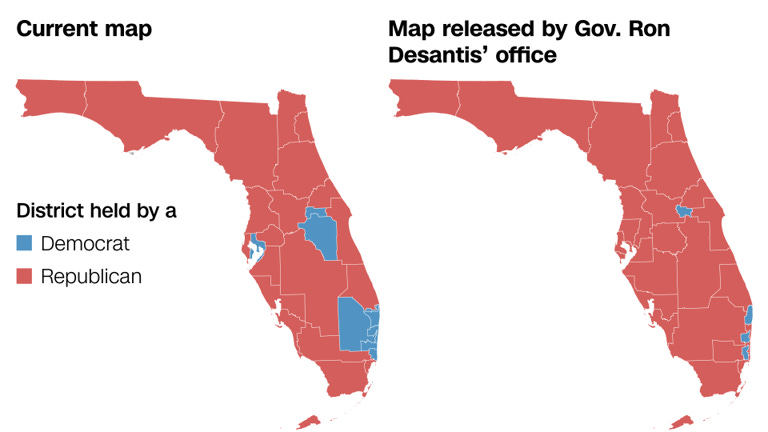
(State maps illustrations by CNN)
While the gerrymandered Virginia map has been thrown out in court, red and blue states everywhere are racing to the bottom to cheat the other party’s voters.
Memo to the political class: Normal citizens don’t want this. We want reasonable and competitive elections everywhere, and we want everyone fairly represented in government.
Gerrymandering would be easy to solve if normal Americans were actually in charge of their own governments. We would agree to a universal formula for political districts drawn by artificial intelligence that would honor traditional political boundaries but also favor competitive districts. We would find the right balance.
But normal people are not in charge, which is why our political system fails at everything.
In fact, for a US House of 435 members, perfectly “fair” districts are impossible because—at an average of 770,000 inhabitants each—electoral districts are much too large for representative government to work.
Ginormous and ever-growing political districts are deadly to democratic representation for a number of reasons.
First, as the above district map manipulations illustrate, large districts can disenfranchise large numbers of voters from the minority party, who might live a lifetime in an electoral district artificially drawn to permanently keep them powerless.
Some might say that disenfranchised Democrats in red states like Florida and Texas are balanced by disenfranchised Republicans in New England and California. This sort of supposed “representation by faraway people” was a grievance that caused the American Revolution.
To disempower southern Democrats and northern Republicans, who tend to be more moderate, is to lose the sensible ballast in American politics, and encourage government by the most extreme elements in each party. Even “fairly” drawn large districts will result in such a tendency.
But the toxic nature of large districts for democratic health goes far beyond voters stranded in a sea of the opposing party.
To win a typical US House race costs millions of dollars. No normal person has a chance of winning. The system favors the rich and those who are obsessed with power. Career politicians elected from vast and expensive electoral districts will often be narcissists or other unhealthy personality types.
Our best would-be public servants—who quite reasonably want no part of what the American political system has become—are on the sidelines watching the train wreck.
The high costs of elections are mostly paid for by special interests, who effectively buy the people’s government. Special interests donate primarily to incumbents, who have the power the special interests wish to exploit. This system of de facto bribery and extortion hopelessly corrupts legislation.
Fortunately, there exists an astoundingly good solution that can address all of the above failings in our political system, including those caused by the ongoing fits of gerrymandering.
Take, again, the state of Virginia. Imagine if its US House districts, rather being drawn like above, were the size recommended by the great Virginian, George Washington. If so, each district would be no more than 30,000 inhabitants each. The map would look something like this:
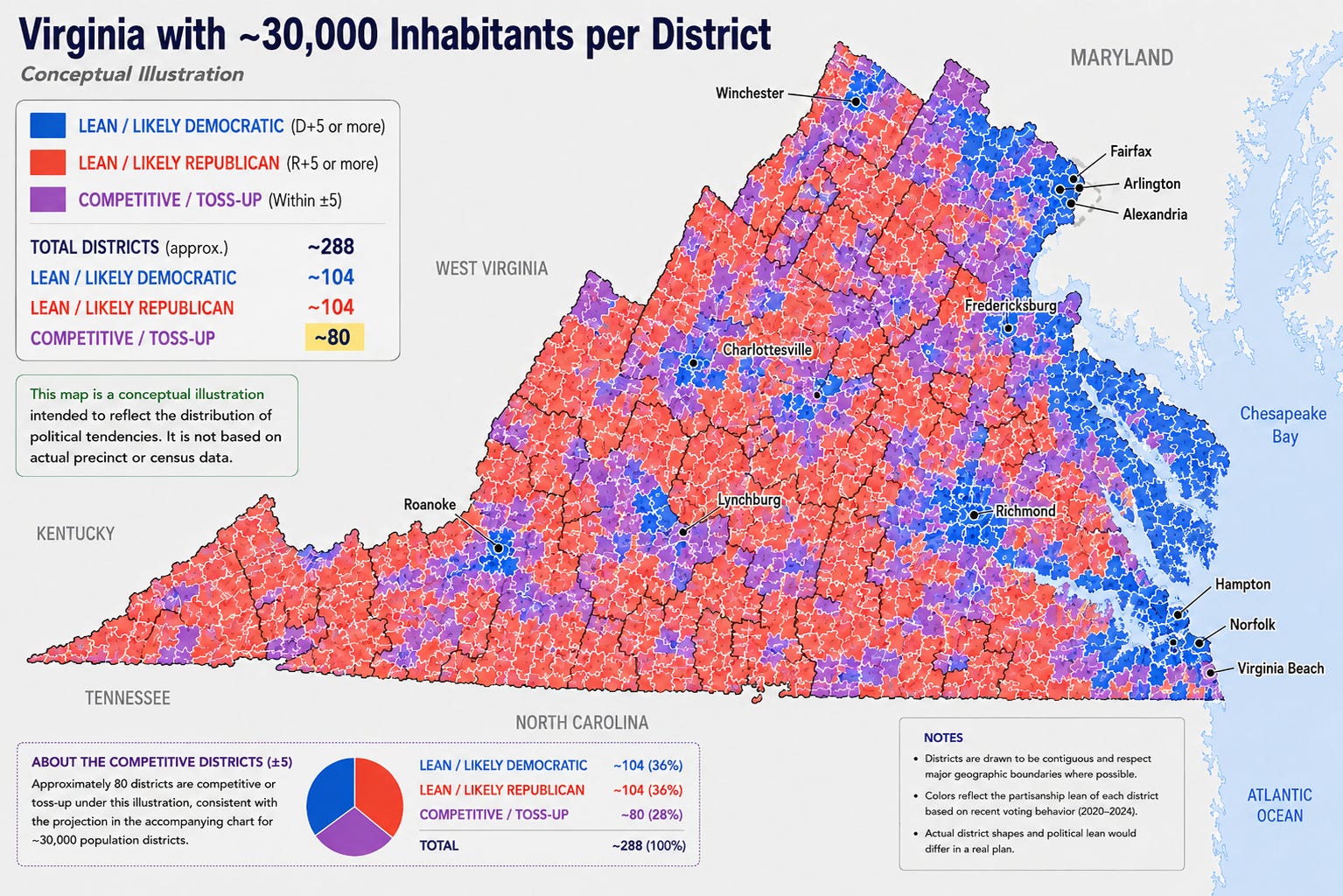
The AI generated map above is imprecise, but conceptually sound. At a glance, it’s far more representative than the Virginia maps above.
Now let’s see how small Virginia districts massively help solve nearly all of the existing problems with American democracy.
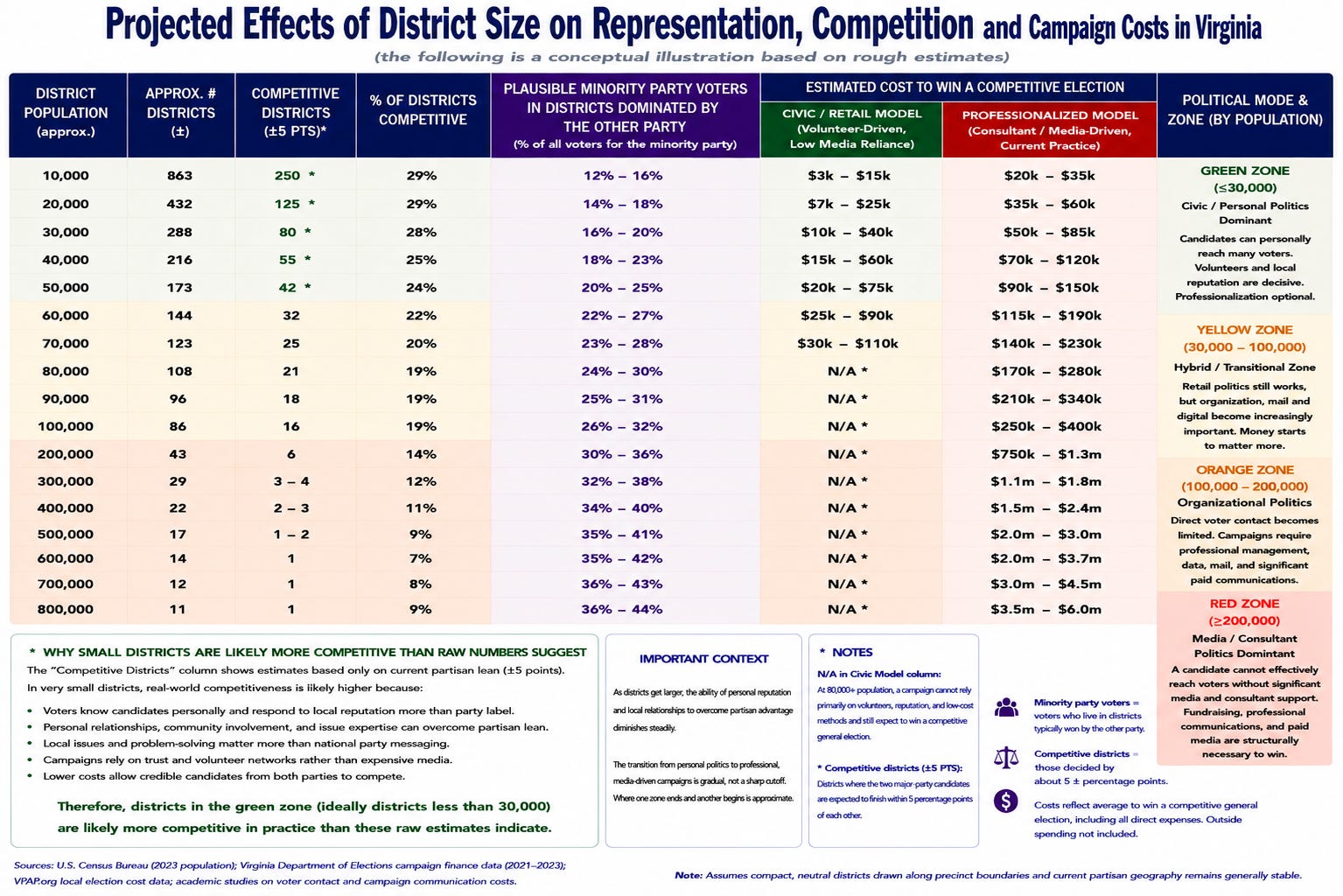
The above chart is a little busy, so let’s go through it, column by column.
Potential sizes for electoral districts are listed in the first column, on the left. Current US House districts average 770,000 inhabitants, near the bottom. The second column indicates how many legislative seats would exist in Virginia at the various district population sizes in the first column. Currently the state has eleven US House members. If districts were reduced to 30,000 inhabitants each, then Virginia would have 288 members.
The data in the third and fourth columns illustrates how many more competitive districts are created as the size of legislative districts becomes smaller. This is a natural anti-gerrymandering effect of reducing district sizes.
As noted, the chart probably underestimates the percentage of competitive districts when districts become small enough. In small populations, a candidates’ personal reputation—known within a community—can often overcome marketing and mindless partisanship.
Moreover, the label “competitive” here is a little misleading because it refers exclusively to the ability of one party to defeat another. Many districts are uncompetitive because like-minded citizens are grouped together, particularly Democrats in cities and Republicans in rural areas. In such cases where one party is naturally dominant, elections will often be competitive in primary contests. Small districts permit insurgent candidates to more easily defeat the preferred candidates of party elites.
A few small districts will likely produce representatives from minor parties: Democratic Socialists, Greens and Libertarians. Others will elect Independents.
The fifth column, in purple, illustrates the anti-gerrymandering effect in another way. As districts become smaller, fewer voters of the minority party are stranded in districts in which they have no hope of ever electing a representative of their own party. In cases of small deep blue or deep red districts, it’s likely that a political dissident can at least look to a relatively nearby district to find a representative with a compatible point of view.
The sixth column, with the green heading, suggests the costs of winning an election using grassroots retail politics. Money is far less important in small districts, which can be won with fliers, yard signs and volunteers. Money becomes more important as districts increase in size. At population levels between 50,000 and 100,000, winning a political race without significant fundraising becomes increasingly difficult to nearly impossible.
The seventh column, in red, illustrates the typical cost of a political campaign based on money and marketing alone.
The final column, on the right, groups district sizes into four generalized zones. The boundaries for these zones are debatable, but the general tendencies are not.
The last—but far from the least—benefit of small electoral districts are the lower costs of campaign finance. Critically, keeping the corrupting influence of money out of elections—and therefore out of legislation—means keeping district sizes in the green zone on the chart. No political district in the United States should be greater than George Washington’s recommendation of 30,000 inhabitants.
The mechanics of a very large and decentralized US House naturally give people pause. How would a system with so many elected officials actually work? Those questions and concerns are addressed here, but generally, in a system of massively expanded representative democracy, elected officials would serve part-time, from home, and keep their day jobs. Each representative would sit on only one committee. Many hands make light work. (There are also solutions, in keeping with historical precedents, to reform the US Senate.)
Public-spirited citizens would find the time to govern because they love their communities and their country. The primary motivations of most elected officials would shift from the desire for perpetual reelections and power to true public service. The key to it all is to reduce the size of electoral districts everywhere and massively expand representative democracy. In this way, we can save our republic.
Here is the guide to the Citizens Rising series of 9 essays that argue for replacing our system of professional politicians with a massively expanded representative democracy of everyday citizens, who would serve parttime and mostly from home.
Read about Citizens Rising founder Stephen Erickson.
No posts
Comments
Nothing yet. Say the first thing.
Sign in to join the conversation.