
Many people everywhere are losing faith in representative democracy. Who can blame them?
We live at a time when “representative” government seems some dreadful combination of incompetent and corrupt.
Here at Citizens Rising, I have argued that the problem is not representative democracy, itself. Rather the problem is 1) professionalism in elected offices and 2) the enormous size of electoral districts, which distances elected representatives from the people they are supposed to serve; huge districts make elections all about money and marketing, paid for by special interests.
Small-district representative democracy permits citizens to elect trusted neighbors. Not everyone has the time or desire to study public policy, but those citizens who are otherwise preoccupied are fully capable of choosing neighbors they trust to represent them in government.
The very large sized legislatures that small district democracy produces are a feature, not a bug. The complexities of the Information Age require more citizens of goodwill, and more citizens with specialized knowledge, to study public challenges and propose solutions. The danger springs from government of the few, not government of the many.
Direct Democracy
The ultimate “democracy of the many” is direct democracy. Direct democracy is when every citizen participates directly in making laws. It’s the form of democracy practiced in ancient Athens, a society that produced achievements unparalleled in history.
The Founding Fathers were nevertheless not fans of direct democracy. When they disparagingly referred to “democracy,” direct democracy is what they meant. Stressing its weaknesses while undervaluing its strengths, the founders of the United States were much too tough on direct democracy. In fact, arguably the most successful country in the world today—Switzerland—relies on direct democracy for nearly every major decision that country makes.
Direct democracy works very well in many circumstances, and in the United States we do not have enough of it. What we do have was incorporated into our political system during the progressive era as a means of taking government back from corrupt party bosses. The first progressives put power directly in the hands of the people through citizens’ initiative and referendum processes, which we must rely on to fix our corrupted political systems today. In most municipalities, and at the state level in 24 states, the people have the right to make and pass laws all on their own.
The most important form of direct democracy allows citizens—without the interference of sitting politicians—to change municipal charters and constitutions. We can imagine a day when representative democracy completely fails (due to the professionalization of elected offices and overly large electoral districts!). Without the sort of direct democracy that permits the people to circumvent the political class by amending charters and constitutions, the only recourse left might be violent revolution. Fortunately, we are not there yet.
Currently, 17 states have citizens’ initiative processes that permit the people to change their own constitutions directly. There is no popular process whatsoever for amending the US Constitution. Citizens Rising #9 outlines a strategy for taking the system back from the existing political class with the tools and systems we have; it would be easier if we had more direct democracy.
Though direct democracy is, or should be, a vital tool in our political system, it has its limitations. It’s not good for addressing complex policy questions with intricacies unfamiliar to most voters. For example, asking the public to decide on a reform of the US healthcare system probably would not go well. The proposal would likely be written by corporate or ideological interests. Those interests would then bankroll an expensive advertising campaign to sway the public one way or another.
On the other hand, issues like a balanced budget amendment, term limits, gay marriage, or a cap on property taxes are more easily understood by any citizen. Election outcomes on issues like these are less subject to manipulation through money and advertising.
Deliberative Democracy
In all cases, however—and particularly when the issues are complicated—it’s best when people of diverse perspectives decide together through research and deliberation.
In fact, for hundreds of years, citizens have been deliberating with one another in the form of jury trials. We trust our fellow citizens, selected at random, in matters of life and death when it comes to capital crimes. When a jury decides “guilty” or “not guilty,” it is following a tried-and-true process of deliberative democracy.
All over the world today, reformers are experimenting with deliberative democracy as a means of deciding open-ended questions. Could deliberative democracy ever replace representative or direct democracy? So far, the results are not particularly promising.
In 2019/2020, 150 French citizens, chosen as a representative sample via lottery, were asked to develop solutions for climate change, which were then supposed to be voted on by the French parliament. The participants of this “climate assembly” (for some strange reason such groups gathered via lottery are not called “juries,” which would be clearer) were given wide latitude to consider the issue of carbon emissions, though they were specifically allowed to balance climate policy with “social justice.” The problem here—as honest advocates of deliberative democracy should admit—is that agenda-setting controls outcomes. The alleged ability for France to do something meaningful to impact the earth’s climate was prebaked into the process. “Social justice” could be considered, but not, apparently, a whole range of other related topics, like economic costs, productivity, or other environmental concerns that might be more immediately pressing or easier to address than climate change. As it turned out, none of this mattered, as the group went far beyond its mandate and called for a rewriting of the French Constitution. Most of the assembly’s recommendations were quietly shelved.
Two years earlier, an assembly of ordinary citizens in Ireland was tasked with reviewing that country’s then-restrictive abortion laws. The end result was a legalization of elective abortion in Ireland up to 12 weeks after conception, a relatively moderate standard that is fairly consistent in Europe. On the one hand, abortion is such a purely values-based subject that it’s hard to imagine anyone being persuaded of anything in deliberation. At least the climate question was how to best accomplish something. On the other hand, deliberative democracy in Ireland did produce a mainstream solution, while other forms of democracy often produce radical outcomes when it comes to abortion.1
Recently, the Los Angeles City Charter Commission called an assembly of random yet demographically representative residents to consider the size of the city council. LA currently has 15 city councilors, each one allegedly representing 265,000 Los Angelinos, which is a crazy-large number. City council elections can cost $2 million to win per seat. The assembly of ordinary city residents met over the course of 2 weekends and ended up recommending an addition of ten new seats to the council, which would mean one councilor for every 170,000 inhabitants. It’s hard to see this as an improvement. Ten more districts might reduce the cost of elections to, maybe, $1.5 million per winning candidate. What would this really accomplish other than provide more opportunities for professional politicians?
During the proceedings in LA, I was called as an expert witness to testify about more democratic systems used in foreign cities controlled by large parliaments of ordinary citizens, not professional politicians. Out of the two-weekend time frame, I was given ten minutes to speak to the assembly. What if instead, the more status quo advocates had my ten minutes and I had two whole weekends (minus ten minutes) to bring in witnesses that showed how some of the most livable cities in the world were governed by everyday people? Would not the results have been quite different?
Deliberative democracy still holds promise, but as the above illustrations suggest, the power to manipulate a lottery-selected body through agenda-setting and witness selection corrupts the process. Traditional juries work because the choice (guilty or not guilty) is binary and the system is designed so that each side can make the most powerful argument possible. Deliberative democracy could be used effectively in public policy making if these strengths of the traditional jury trial were applied to new deliberative systems. That might mean simpler, non-open-ended choices. It would certainly mean processes that allow lottery-selected assemblies to hear a full range of balanced testimonies from every conceivable point of view. That would definitely require a process longer than two weekends.
The place to begin with deliberative democracy is to use empaneled groups of politically balanced and demographically representative citizens, selected at random, to decide on issues in which elected representatives have inherent conflicts of interests. For example, in the United States today, partisan actors each accuse the other side of manipulating voting processes, either through alleged fraud or alleged voter suppression. It’s no wonder, since we permit political actors to oversee elections. Instead of allowing partisan foxes to guard hen houses, elections officials could be hired by a unanimous jury of citizens balanced on the Left and Right. The same jury could certify the elections run by the officials it hired. Making elections more trustworthy is extremely important. Putting in place systems in which normal citizens thoroughly oversee elections would go a long way toward reassuring the public and stabilizing a vital pillar of representative democracy.
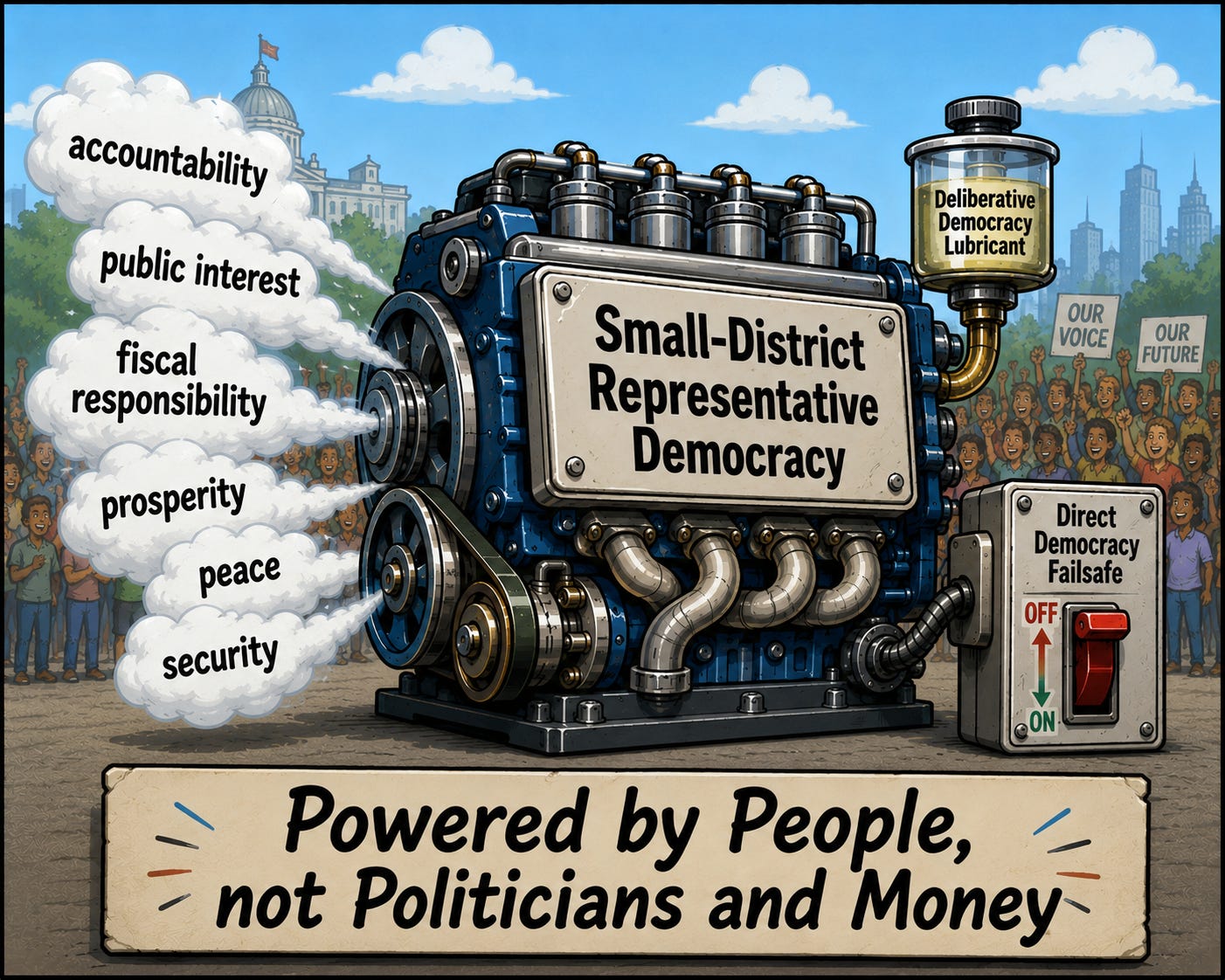
Political reform is really all about utilizing the best democratic machinery for the right function. As suggested above, direct democracy can act as an emergency break when representative democracy fails or becomes corrupted. The people, in their sovereign capacity, should always have the power to directly fix broken political systems.
Meanwhile, deliberative democracy might be used in situations where elected officials have inherent conflicts of interests, like when it comes to their salaries or election security. Open-ended local questions have also been successfully decided through lottery-selected groups.
Nevertheless, small-district democracy, without professional politicians, should be the political engine of our republic. Small-district representative democracy permits mass participation in government, encourages deliberation, and has the potential to select a community’s most able and trustworthy leaders.
A public fed up with our corrupted system of professional politicians, special interests and overpowered ideological zealots is understandable, but abandoning representative democracy would be a catastrophically wrong response.
In Florida, for example, voters are faced with a choice of the six weeks abortion limit passed in the state legislature, or a proposal for practically unlimited abortion up until birth, put on ballots in referendum for citizens to accept or reject, with no moderate option available.
No posts
Comments
Nothing yet. Say the first thing.
Sign in to join the conversation.