
Last month, Justice Gibson ruled that the Region cannot evict residents from the encampment at 100 Victoria unless it provides viable alternatives such as shelter or public tenting options.
How did we get here?
Individuals began tenting at 100 Victoria late in 2021. Since then, the number of people residing at the encampment has changed over time. The Region tried to evict residents in 2022, but in early 2023, Justice Valente ruled that people could not be removed from the site unless other shelter options existed.
“Region of Waterloo councillors passed a site-specific bylaw for the encampment site near the Kitchener train station in April 2025 and updated it this past January. It aimed to move people off the encampment site by April 1 this year.”

Justice Gibson’s ruling
Last month, Justice Michael Gibson reached a similar conclusion as Valente, stating that “the region cannot clear the encampment unless the region can house everyone who is homeless or creates a tenting protocol that would allow people to put up tents on some regional properties.”
Justice Gibson believes that the encampment is not ideal shelter, but it serves an important purpose. “No one should romanticize or be starry-eyed about the encampment. It is a miserable and desperate place. But it represents the only remaining safety valve for the region’s homeless as a refuge of last resort,” said Gibson.
The site-specific bylaw the Region passed in April 2025 was determined to violate residents’ Charter of Rights. That bylaw was then amended in January “to defer the vacant possession date, remove a financial fine for people who didn’t leave the site on time and establish a transition policy to provide alternative accommodations for people living at the encampment.”
Simon Guthrie recently wrote that while Gibson’s decision is a good one, “it won’t solve homelessness (because) courts simply can’t do that.” However, the decision, “reminds us that people have rights, whether they have shelter or not.”
Guthrie encourages each Waterloo Region leader and resident to reflect on Justice Gibson’s statement that, “the homeless are not Other. They are Us. They are rights bearers no less entitled than any other Canadian citizens to the full benefit and protection of the Charter.”
Justice Gibson’s decision declares that the region may not evict anyone, stop others from using the site, prohibit entry to anyone and must not dispose of anyone’s personal belongings.
Ashley Schuitema, executive director of Waterloo Region Community Legal Services, called Gibson’s decision precedent-setting, saying the agency “is deeply proud of this result for our vulnerable clients and people experiencing homelessness in the Region.”
What about the Transit Hub?
The Region owns the land at 100 Victoria and intends to use the gravel lot for storing “construction vehicles and supplies when the future central transit hub is built at King and Victoria Streets nearby. The lot would later be turned into a parking lot.”
Some residents and elected officials have framed this issue as supporting either encampment residents OR the building of the Transit Hub. Justice Gibson agrees that the Transit Hub “constitutes a genuine public interest,” but that the project can move forward “while respecting the rights of encampment residents.”

Simon Guthrie writes that “the Kitchener Central Transit Hub matters. Good transit matters. Climate-responsible infrastructure matters. Connected, equitable, and lower-carbon communities matter.” However, it’s important to note that, “the Gibson ruling does not stop the transit hub. It tells Waterloo Region how to proceed lawfully: create a safe tenting protocol, provide a lawful alternative site, honour the Plan to End Chronic Homelessness, and stop treating enforcement as housing policy.”
A way forward
“Justice Gibson’s ruling is not the end of this story. We can pursue a safe tenting protocol. We can stop spending public money trying to litigate our way out of homelessness. We can implement the Plan to End Chronic Homelessness. We can build the transit hub without abandoning the people living nearby,” says Guthrie.
Gibson’s decision stated that currently, the only place where homeless individuals can set up a tent is at 100 Victoria. He encouraged the Region to create designated encampment areas, following the lead of places like London and Thunder Bay. These sites “would give residents access to essential services and health care like the current encampment to an accommodation plan.”
CBC also notes that, “although not mentioned in the judgement, the City of Guelph also passed a bylaw in October 2024, which sets out rules on how city-owned spaces should be used by the public.”
However, Waterloo Region, “has clearly stated that if the encampment is cleared, it is not prepared to allow homeless people to shelter outdoors anywhere in the region property,” wrote Gibson.
Regional Councillor for Cambridge, Pam Wolf, advocated for a safe tenting protocol, but it failed with a tie 8-8 vote by Council in January. “Realistically we have so many people that are homeless, more than just the 20 or 30 that are on the site, so we do need a place of last resort. That is why we need a structured, safe tenting protocol,” Pam Wolf said.
Wolf argued that, “A structured tenting policy can set standards around spacing distance from schools, number of tents, fire safety, sanitation and access to basic supports. This helps reduce risks both for individuals experiencing homelessness and for the broader community.”
But what about the province?
Premier Doug Ford did not hide his feelings about this ruling, calling it, “the most ridiculous ruling I’ve ever seen.” In what seems, at best, an oversimplification, and at worst, a fundamental mischaracterization of the judge’s ruling, Ford claimed, “they’re going to hold up … transit, for what, 30 people? They’re going to hold up millions and millions of riders, communities and everything saying you can’t go in there, you can’t touch them.”
And in classic Doug Ford style, in which every perceived problem is fixed with a hammer, Ford says he would be willing to “intervene” and consider using the notwithstanding clause to clear the encampment. “Another crazy decision by the courts. We’re going to deal with it, hopefully the region is going to appeal it. We’ll intervene and stay tuned because that’s the reason they have section 33 of the notwithstanding clause,” he said.
Ford has used the notwithstanding clause twice before: “Once in 2021 to deal with a court ruling on a third party election financing law and again in 2022 to ban a CUPE education workers’ strike. The use in 2022 was later repealed.”
University of Ottawa law professor emerita Martha Jackman said, “The idea that an appropriate government response would be to invoke the notwithstanding clause and strip people of their Charter rights rather than making any kind of effort to address the underlying problem is really, really shocking.“
Ashley Schuitema seems to agree. “I think we’re at risk of being a society that I wouldn’t want to be in if we have government leaders that can override people’s rights whenever they want using this clause,” she said.
Simon Guthrie argues that our local leaders should make clear, “that they will not participate in any attempt to override the ruling through section 33 of the Charter (the notwithstanding clause). Using the notwithstanding clause here would mean deliberately setting aside the life, security, and equality rights of unhoused people. It would be a statement that the province is prepared to suspend fundamental rights rather than require governments to do the hard, practical work of creating lawful alternatives.”
Regional Councillor for Kitchener, Michael Harris, seems to welcome Ford’s approach though. “I’m thankful he is worked up about this. The region is spending $800,000 a year just to maintain services at the encampment at Weber and Victoria streets,” Harris said. “Every individual is important. But we’re talking about 30 people and that amounts to $800,000. We’re at a crossroads where, pretty much, this is a last resort. We have to have provincial tools at the table to put an end to this.”
So, what’s next?
The Region is reviewing Justice Gibson’s decision. “We remain committed to providing outreach and supports to those experiencing homelessness across the region,” said a Regional spokesperson.
In Justice Gibson’s ruling, he made clear that “the Region could still approach the court to clear the site in the future, if it provides alternative places where people can set up a tent legally on regional land.”
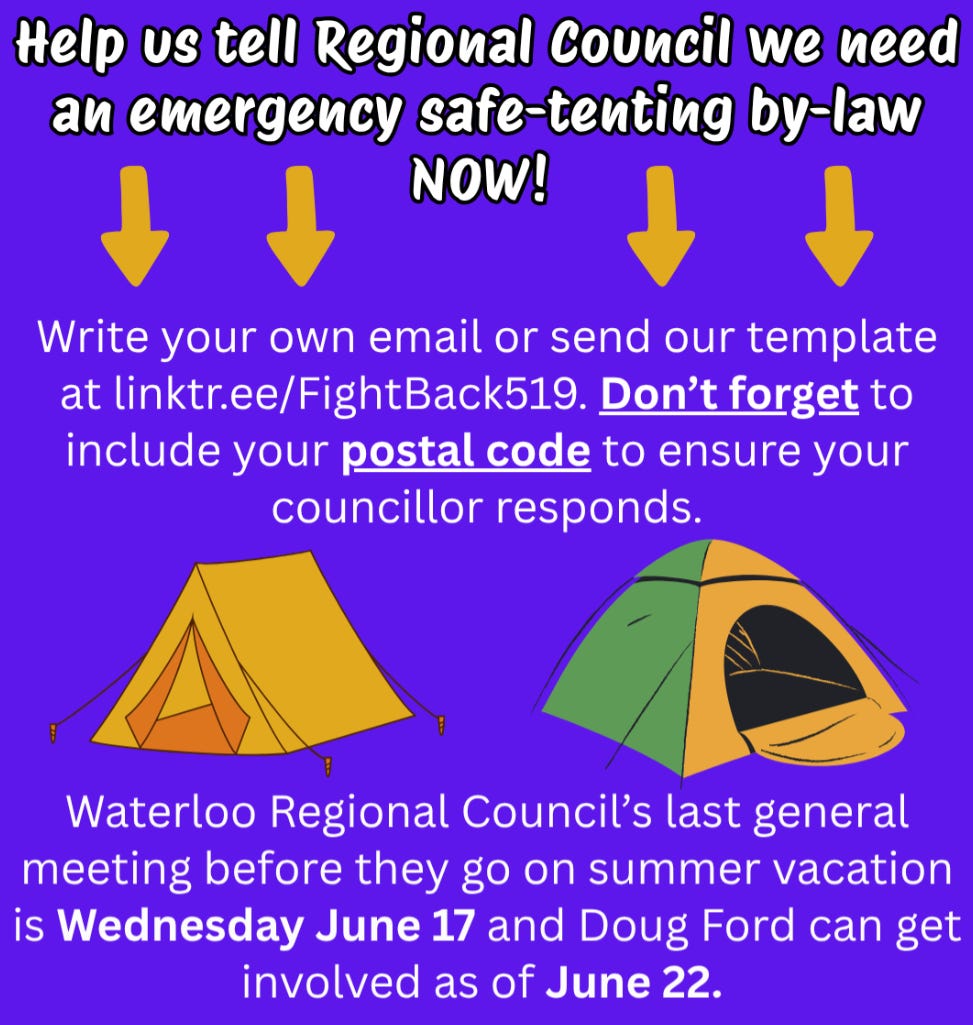
FightBackKW is encouraging residents who support a tenting bylaw to reach out to Regional Council and/or delegate at the June 17th Council meeting. Update: According to FightBackKW, “Council rescheduled everyone who wanted to delegate about safe tenting at the regular meeting on Wednesday June 17th to Tuesday June 16th at 9am.”
Additional Reading:
Click to read more about people’s reflections on Justice Gibson’s ruling.
Written submission to Regional Council from the Realizing the Right research team
What Doug Ford Should Know About Encampment Residents from Press Progress
Encampment lawyers dispel myths about Victoria St. ruling from City News
Premier Ford doubles down on ‘cockamamie’ Kitchener encampment decision by Justin Koehler
I don’t want to live in a community where survival is a crime by Leah Connor
Comments
Nothing yet. Say the first thing.
Sign in to join the conversation.