
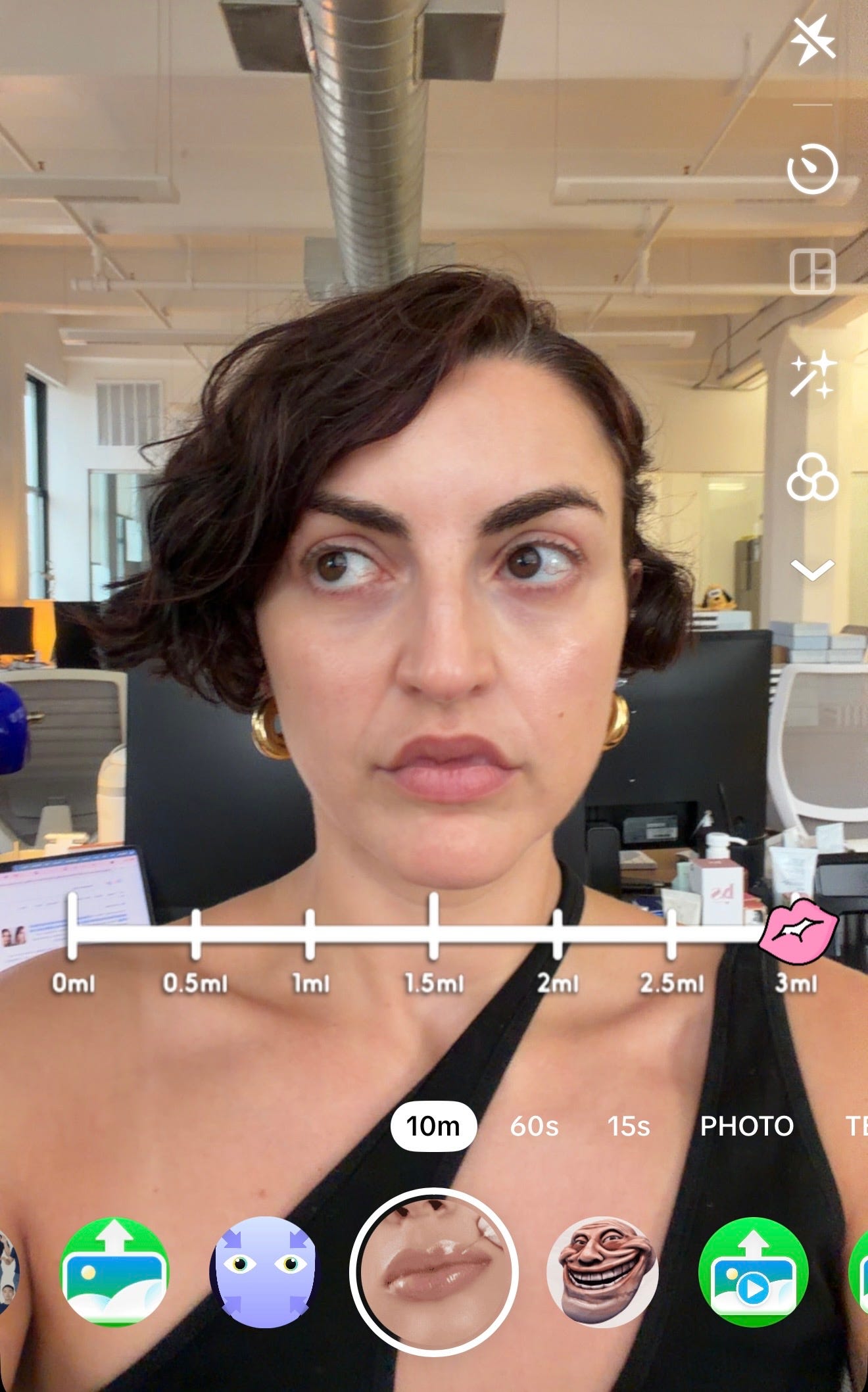
Whenever I see an essay on beauty, I’m suspicious. For one, I work in beauty, and of all the journalistic beats, beauty can publish egregious misinformation with very little pushback. Lest we forget, “non-toxic beauty” and “clean” wellness helped pave the way for MAHA, which is decidedly making our lives shittier. Yet beauty, and its pursuit, is rarely treated as a subject worthy of political or intellectual discussion. Jia Tolentino’s essays are among the exceptions.
Her latest piece for The New Yorker is an update to her widely read 2019 piece “The Age of Instagram Face.” Seven years later, we see in “Our Plastic Surgery Nightmare” exactly how much has changed in the world of ever-rising beauty standards. Namely, Botox is table stakes; now the “aspiration” is a facelift; undetectable work is the new trend (I have thoughts here because the Love Island aesthetic begs to differ); men are now part of the fold with the supremely misogynistic and toxic “looksmaxxing,” and AI has added a new layer of dystopian hell for us mere mortals. The takeaway was, unsurprisingly, that the arms race to be the hottest girl on the algorithm shows no signs of slowing down and will likely become further desensitized to ever more extreme forms of “work.”
And why would these trends slow down? Shame (obviously) doesn't work. We've been trying to shame women for existing since time immemorial and yet, here we are. The other option — tech regulation — well, that hasn't been tried. When I open my apps and see perfectly smooth, angular, repetitive "hot girl" faces, I know enough about cosmetic procedures to understand that many of these creators are editing their faces digitally, or collecting procedures like a weapons stockpile in an arms race. The more “hot girl” ammunition you get, the more visible you are in the algorithm, and the more attention you can monetize. This is where Tolentino's essay left me wanting: the diagnosis is on point, but do we have any solutions? Are we doomed to increasingly aggressive but undetectable beauty procedures?
Good Noticing’s podcast also asked this question. Compare the world of beauty in 2019 to Clavicular’s bone smashing in 2026, and the overuse of lip filler is almost quaint. Beauty extremes are obviously escalating in the attention economy, but do we have any solves? While it’s validating to read that internet beauty is alarming, many essays feel resigned to the hamster wheel of increasingly insane beauty standards. We’ve now reached the point where being human isn’t extreme enough; AI is the new standard.
Thanks for reading Citations, Please! This post is public so feel free to share it.

Elon Musk@elonmusk
Grok Imagine prompt: She smiles and says “I will always love you”
9:20 AM · Nov 8, 2025 · 11.6M Views
9.69K Replies · 4.28K Reposts · 40.7K Likes
I think we can all agree it cannot be good for our brains to see so many before-and-after face-lift videos, but would everything change if we "went back" to "real beauty"? Probably not, because what even is that? Take the beauty standard of youth: how one ages “in a real way” varies wildly between individuals. It's no wonder that largely white women openly protest unfair beauty standards around youth; we are the most impacted by it.
When I was running a clinical trial for my skincare brand Dieux, we had to open recruiting to people over 60 to find Black women with deeper fine lines and wrinkles. Pale women? We were recruiting people in their late 20s. What's "real" is individual. The standard — and holding women against it — is the problem: it will always praise some faces while punishing others. That’s the patriarchy. There is no portrayal to get right. The only real liberation is to stop judging our faces at all, positively or negatively. And while beauty standards are getting increasingly bizarre, expensive and risky, it's not like women in the 1790s (lead face cream), 1890s (corsets), or even 1990s (heroin chic) had it healthy. What's new is the unregulated delivery system: technology built to escalate whatever gets your attention, no matter the psychic cost.
A few weeks ago, Meta launched a wildly unpopular AI feature called “Muse Image.” The gist? You were automatically opted in to anyone using your likeness in their AI-generated content. That’s right, anyone on the internet could use pictures of you, your kids, your life for whatever they wanted. Reminder: generative AI uses more energy than other forms of computing, and for what? Slop? My energy bill is going up because someone wants to use my face in their content? Our lakes are getting zapped because a creep wants to use your kids in a video?
I wasn’t alone in my outrage. The online backlash was so intense that Meta reversed the feature almost immediately.
So now that we know platforms do react to critique and coordinated action (please read that sentence a few times if you think the way AI is being released and foisted on us as “inevitable,” it’s all planned and not in the average person’s favor), there may be actual solutions to dismantling Instagram Face. Some suggestions for everyone to bring out the digital guillotines over:
Black-bar label all AI avatar content. I’ve seen too many mega-viral posts from “Korean Beauty” influencers only to realize the creator isn’t real. It’s already against Facebook’s T&Cs to leave AI content unlabeled; why are there no ramifications for this? Pitchfork protest outside Meta until this is rectified.
Stop juicing AI content in the algorithm. We know “Instagram Face” performs well on social media; make the AI versions perform less well or seriously throttle performance when it isn’t labeled properly. Same goes for content around disordered eating and pro-ana content. Some days I swear I’m in a Tumblr post on Instagram, and I hate it.
Make it easy to opt out of beauty and aging content entirely. Controversial as a beauty founder, I know. But plenty of people aren’t vain like me (I’m shallow when it comes to my epidermis; I want to know how to preserve it; it’s OK to say that). And one more important gate: STOP SHOWING KIDS ANY BEAUTY CONTENT. That includes lifestyle influencers. GRWMs are ads, and I won’t hear it differently. Before someone says, “If you try to stop kids from seeing it, they’ll find a way.” OK, then, I guess you’re one of those parents who lets your kids smoke cigarettes. From my POV, you don’t make things that we know are bad for children easily available. We have an overwhelming amount of evidence that platforms like Meta can hurt children and are harmful to them, so... IDK... maybe we try some things? The lawsuits are being won!
Like AI, black bar disclosure on skin-filtered or augmented feature content if you’re promoting skincare or beauty products.
Screens. I’ll leave this to the educators and parents (or maybe I need to interview some), but the tablets, phones and laptops are not exactly proving to be a net positive. Let’s revisit how we use them, and when.
After a few decades, legislators are finally understanding that Big Tech is acting a lot like Big Tobacco, and we need to regulate it. So, let’s give them some ideas.
It’s important to protect girls. It’s important to be aware of the problem. And, it’s important to be honest that participating in beauty is not some grand feminist act; it is vanity. It’s also important to think about what we can actually do before the next deranged iteration of “Instagram Face” arrives. These same techbro billionaires—who, interestingly, go through their own glow-ups with very little commentary on their obsession with youth and beauty1—are monetizing our time and attention. They then take those profits to manipulate politics, build data centers, destroy the environment, and keep us distracted.
I’m working on some letters to send to your representatives to change how beauty is being shown to us online, and collective ways we can complain to get tech companies to change. If Muse Image could get rolled back in a day, surely Meta can start labeling AI “content” in such a way it’ll be too embarrassing for people to post in the first place. Below: a bill I'd love to see become law, and a win in New York worth copying elsewhere.
Encourage your senators to back Bernie Sanders’ sovereign wealth fund for AI. And, before you balk, Norway does this for oil, and their people are doing just fine. If we don’t do it for AI, maybe we can do it for our oil and gas industry :)
Encourage your local state representatives to consider statewide moratoriums on data centers. If you need an example of a state that did this, New York just implemented one.
Probably because men have actual power and when they participate in beauty it isn’t as moralized as when women do it :) I mean, what does it say that trillionaire men are all getting yassified? Where are all the think pieces.
Comments
Nothing yet. Say the first thing.
Sign in to join the conversation.