
On the last day of Women’s History Month, we’re digging into the personal nature[s] of literary recovery. Who preserves and amplifies the voices from the past—and why?
In this issue:
Exploring the literary recovery of writer, filmmaker, playwright, and activist Kathleen Collins, as stewarded by Nina Lorez Collins, her daughter.
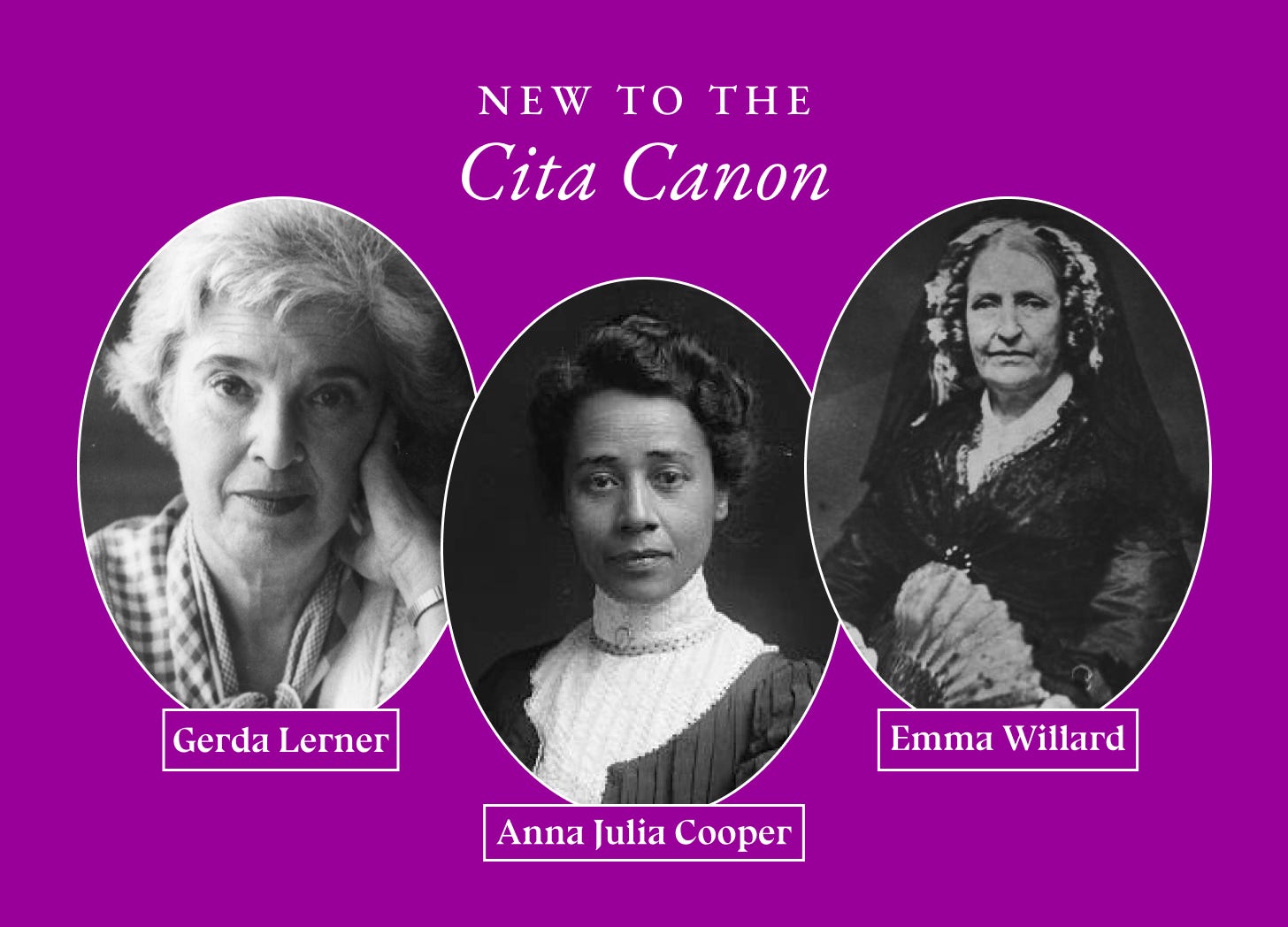
New to the Cita Canon, three who shaped women’s history:
Anna Julia Cooper, a forebear of intersectional feminism;
Emma Willard, who invented a new visual language for her theory of history;
Gerda Lerner, who established women’s history as a field of study.
News and upcoming events at the end!
Thank you to Nina Lorez Collins and Ruby Rose Collins for sharing their work and insights with us. We’re grateful for everyone who labors to keep women’s creative work alive our present. If there’s a project you’d like to highlight, write to us at info@citapress.org.
“We can’t fight time. We can’t get over anything faster than we’re supposed to. Whatever we have to live through we have to live through until its time is up. I’m saying all of this to say that I think my present sense of clarity is not my victory, but time’s.”
—Kathleen Collins, ~1975, from Notes from a Black Woman’s Diary (Ecco, 2019), edited by Nina Lorez Collins
The mainstream canon is historically homogenous, but this isn’t because marginalized people haven’t been producing great literature for a long time. The work itself has existed, and much of it was originally rejected, ignored, or locked away. But obscurity isn’t a permanent condition, even after death. New life comes in the form of literary recovery: the process of bringing unknown or “forgotten” works of literature back into circulation, giving present-day audiences a chance to read and engage with them.
Literature requires minimal tools to be copied, printed, or put online, making its recovery relatively accessible. A rediscovered text can feel like a direct, unmediated transmission from the past: “here is what this person had to say; here is how they said it.” From there others may share, translate, and/or adapt it, further amplifying its reach. Thus literary recovery can forge afterlives, especially for creators whose contributions previously went unrecognized due to race, gender, socioeconomic status, and other overlapping, frustrating factors.
In the foreword to Whatever Happened to Interracial Love? Stories by Kathleen Collins, Elizabeth Alexander writes:
The very existence of this book feels to me like an assurance that while we may think we have done our archival work and unearthed all the treasures of black thinking women, there is always something more to find. We have literary foremothers who are not just the ones we know we had, who continue to remind us of ourselves: Our minds are intricate. Our desires are complex. We are gorgeously contradictory in our epistemologies. We were not invented yesterday.
Alexander is discussing the specific lineage of Black women writers, but her argument aligns with the general experience of finding communion with words you didn’t know existed, the “gorgeous contradictions” that previously felt unacknowledged. In these instances one feels joy, recognition, and perhaps even new longing—a sense that even more is out there, just out of reach.
Though literary recovery is inherently collaborative—involving publishers, libraries, scholars, estates—individuals often serve as catalysts. Alice Walker’s search for the resting place of Zora Neale Hurston provides a famous model for how a solo project can transform into a multifaceted resurgence. Often literary recovery starts from an intimate place, with a family member bringing light to a person they loved, and lost.
Nina Lorez Collins was studying abroad in Vienna when her mother, Kathleen, called to share that she had breast cancer. Two weeks later, she was gone. Teenage Nina immediately became her mother’s steward, filling a trunk with manuscripts, screenplays, tapes, notebooks, letters, random scraps of paper. Though she couldn’t face the trunk for decades, when she did start bringing out its treasures she set off a recovery that has been fruitful for over a decade.
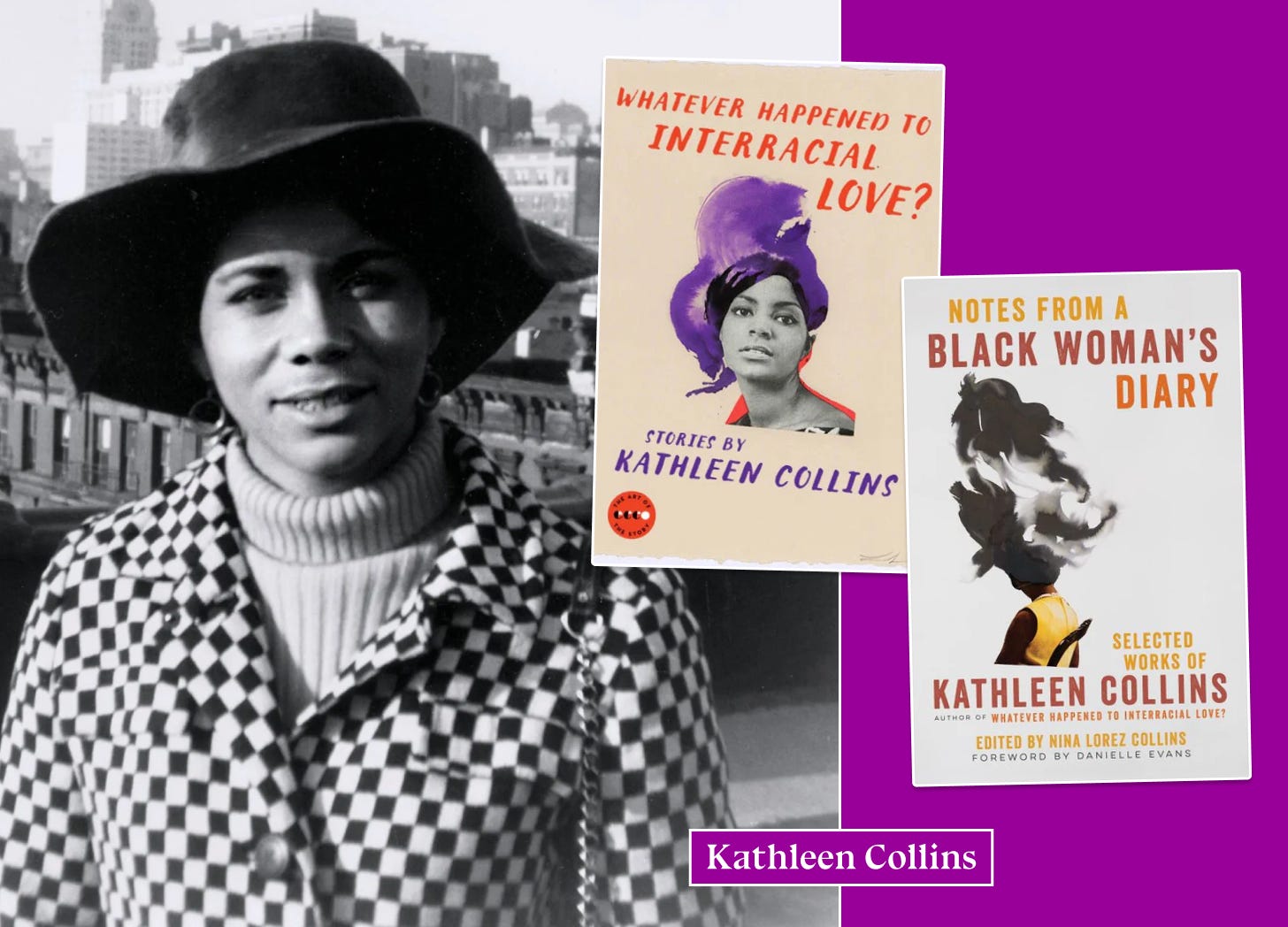
“Polymath” is an identity most often associated with historical men, the kind immortalized in hundred-year-old statues in public parks. Indeed, on the Wikipedia list of “well-known polymaths,” four of the seventy examples are women.1 But when it comes to defining Kathleen Collins (1942-1988), the title that refers to “an individual whose knowledge spans many different subjects, known to draw on complex bodies of knowledge” certainly fits. As a filmmaker, fiction writer, and playwright, Collins made singular, groundbreaking work. As an activist and educator, she influenced the trajectories of students, farmworkers, churchgoers, and beyond.2 Yet the general public had few opportunities to know her until decades after her death at just forty-six years old. Today, at last, we can read her stories, watch her films, stage her plays, and even glimpse into her diary—all thanks to the catalytic work of her daughter.
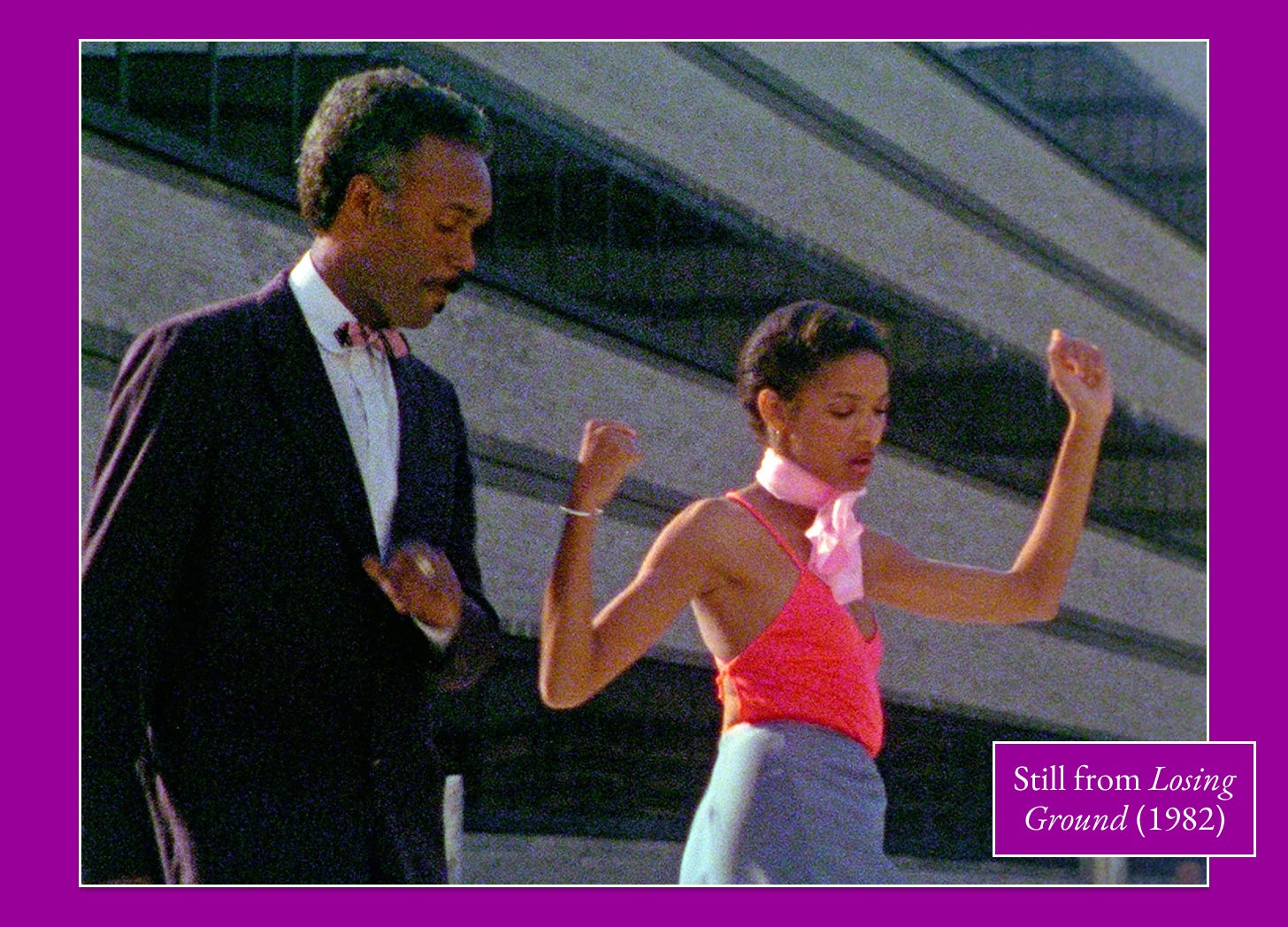
The first contact Nina’s recovery work made with the public came through Kathleen’s second film, Losing Ground, which she wrote and directed. The story follows Sara Rogers (Seret Scott), a philosophy professor, and members of her immediate circle: her actress mother, Leila (Billie Allen); her artist husband, Victor (Bill Gunn); and Duke, an alluring new acquaintance (Duane Jones).3 As Sara’s research on “the ecstatic moment” evolves across a summer, she grapples with her understanding of marriage, desire, and creative fulfillment.
Losing Ground was one of the first feature-length dramas directed by a Black American woman. Collins pulled it off with a crew made up of mostly students, modest grants, and willpower. She edited the film with her longtime collaborator and former student Ronald K. Gray, who also served as cinematographer. It played festivals, winning first prize at the Figueroa International Film Festival in Portugal in 1982. Despite international praise, Losing Ground had no official release during Collins’s lifetime. After Nina had it restored, however, the film opened the 2015 series Tell It Like It Is: Black Independents in New York, 1968-1988 at the Lincoln Center. Its run was extended due to popular demand, and it has since been released on DVD and streaming.
As a former literary agent, Nina didn’t originally see potential when it came to the other works she’d preserved in the trunk. “I had read my mother’s stories and knew they were good,” she told us, “but I also knew that no one would ever publish them. Literary short stories by a dead, unknown Black woman from the seventies were not something that publishers in say, 1990, or 1995, or 2005 were ever going to take on.” But, after the successful release of Losing Ground, things started to shift. A Public Space editor Brigid Hughes reached out after seeing the film, and “Interiors” became the second of Collins’s stories to be published—ever—in late 2015. From there Nina managed to secure a deal with Ecco Press and the foreword by Alexander, and Whatever Happened to Interracial Love? was finally published in December 2016.
Once the book was in people’s hands, Collins’s words finally had a platform from which to reverberate. Early readers like Zadie Smith, Miranda July, and Margo Jefferson celebrated the discovery of a nearly-lost voice, while also lamenting the earlier obscurity.4 Acclaim opened up further possibilities for Nina to expand the scope of Kathleen’s legacy. “At that point I felt somewhat guilty,” she explained, “because I felt like I had presented a version of my mother to the world that was not quite complete—she was not just an artist who had written one story collection and made one movie. She had done so much more than that…”
In 2019, Ecco published Notes from a Black Woman’s Diary: Selected Works of Kathleen Collins, edited by Nina Lorez Collins. It was the realization of Nina’s idea to share “a complete taste of [Kathleen’s] entire oeuvre.” In the foreword, Danielle Evans describes the author as the “master of the moments when the interior becomes exterior, when all pretense drops away and the unsayable is given words and said out loud.” Indeed the collection exemplifies how her writing establishes an uncompromising channel between the private self and the society in which one operates. It includes three stories, an excerpt from an unfinished novel, diary selections annotated by Kathleen, letters to friends and family, five one-act plays, and two screenplays. Whether she is writing as herself or as a character, to her daughter or for an actor, her distinctive candor comes through. “I don’t write to hide from the world,” she explains in her diary. “If I write because of some illusion, it is not that illusion.”
Today, the contents of Nina’s trunk continue their journey from interior to exterior. Dozens of plays and screenplays, an unfinished novella, and more now live at the Schomberg Library, accessible to researchers. A complete collection of her plays will come out in 2027, and several have been performed across the US in recent years. While grief permeates any discussion of Kathleen Collins’s legacy—given the dearth of recognition while she was alive, the fact that her time was cut so short—more and more people are hearing her voice. Her story reveals the degree to which one determined artist with a determined steward can live forever in our collective culture.

Nina Collins hesitates to draw a strong connection between her mother’s relationship to writing and her own, stating, “I don’t think of myself as a writer the way my mother was a writer. I think she was truly an artist, by which I mean someone who absolutely NEEDS to put pen to paper every single day…” Yet Nina’s voice balances honesty, nuance, and wide-ranging curiosity in a way that recalls her predecessor. She has written movingly about her family history and the process of tending to a layered legacy. She is also the author of What Would Virginia Woolf Do? And Other Questions I Ask Myself as I Attempt to Age Without Apology—a book inspired by an online community she founded around the same time she began shaping her mother’s resurgence. It draws from her own experiences and those of her fellow “Woolfers,” with wisdom from literary feminists like Doris Lessing, Stevie Smith, Nora Ephron and Virginia Woolf herself.
Meanwhile, Nina’s daughter has also built a creative career that corresponds with her heritage. A director and producer who has worked for ABC News, A&E, and CNN, Ruby Rose Collins has made two independent shorts: My Abortion Saved My Life (2022), a documentary about the experiences of Black trans activist Cazembe Murphy Jackson (he/him), and all the love i could handle, a narrative.
Last year all the love i could handle debuted at the New Black Film Collective in London before traveling to festivals like Blackstar (Philadelphia), the American Black Film Festival (Miami), the Chicago International Film Festival, and Hollyshorts (Los Angeles). The film reimagines the day that Kathleen Collins finished making Losing Ground from the eyes of her two young children. Drawing from her mother’s memories and her grandmother’s art, Ruby created her own work—one that “lingers in the quiet spaces between devotion and distance, presence and absence.”
That lingering in the in-between seems to flow across generations in the Collins family, alongside pursuit of slippery truths. Reflecting on making all the love, Ruby says: “I was surprised by how much longing the process left me with. Longing to know my mother as a young girl, longing to keep trying to bring memory back to life. What feels both beautiful and painful is that there will never be a single true version of Kathleen, or of my mother’s childhood. There is only memory, reshaped memory, and the individual interpretations we make from it.”
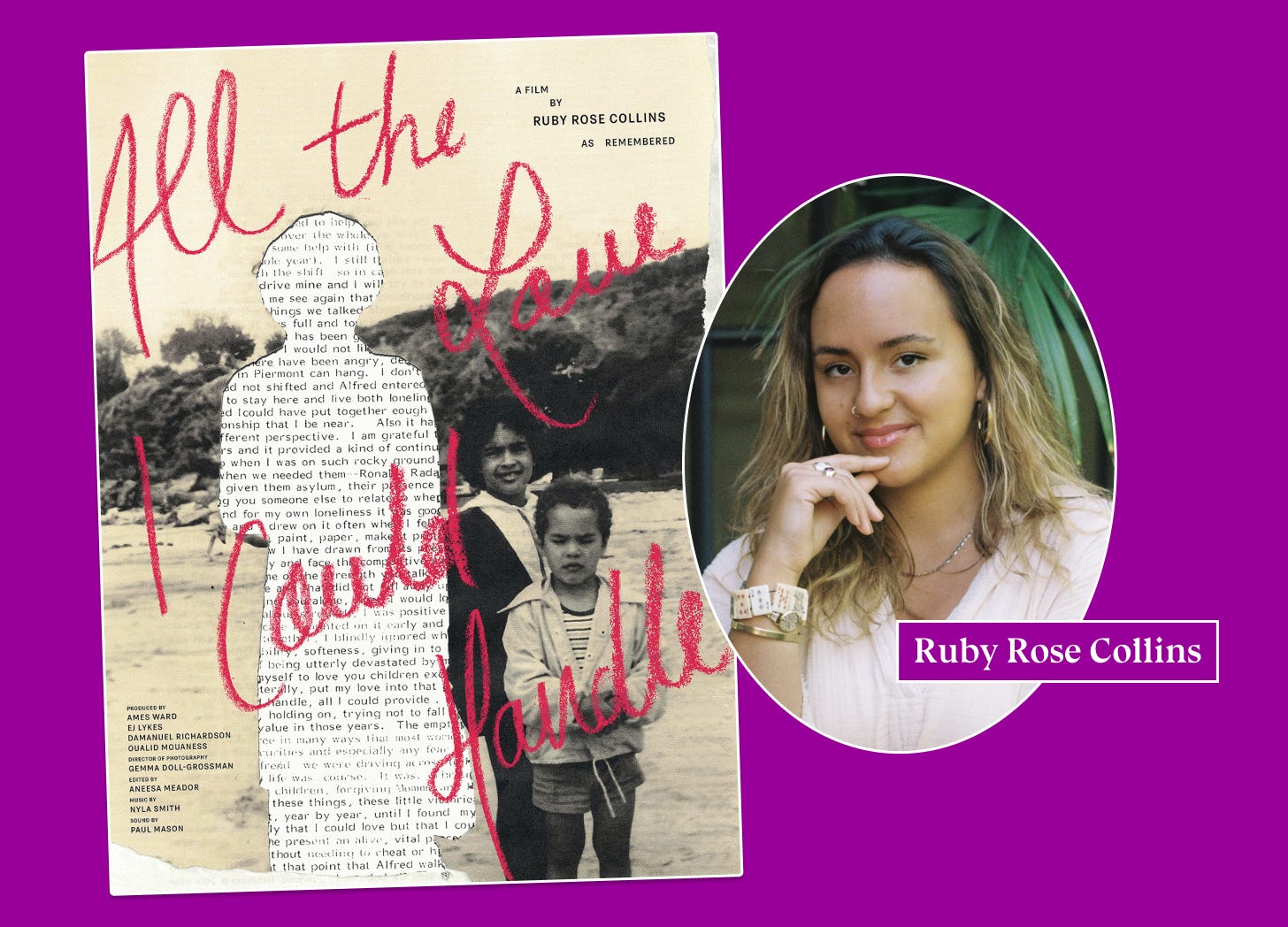
Ruby continues to interrogate memory through her projects. She is currently developing her first feature, WANT ME, based on her own childhood and mother-daughter dynamic. She is also co-producer on the second season of Netflix’s Forever, a loose adaptation of Judy Blume’s beloved, controversial 1975 novel. The series, created by Mara Brock Akil, brings the book’s insights about first love and budding sexuality into this century while adapting the characters’ experiences to reflect Black life in the US.
Over the past half-century, three generations of Collins women have used language to explore who we remember, how we remember them, and how we understand ourselves in relation to each other. “As my mentor [Brock Akil] says, we are all striving to tell the truth” Ruby explains. “That’s the most powerful thing we can do with our pen. I feel deeply honored to explore that in my own personal work while also contributing to the vision of one of the most truthful storytellers of our time.” Through its intimate constellation, the Collinses’ collective work has plenty to teach us about our connection to the past. Perhaps we are all inheritors of the legacies of feminist trailblazers; maybe we share the responsibility of keeping their ideas and stories not just alive, but active—of creating sites for reimagining, debate, and inspiration. Perhaps literary recovery depends on, and generates, something like love.
all the love i could handle takes its name from a letter from Kathleen to seventeen-year-old Nina, which is included in Notes from a Black Woman’s Diary. Collins writes:
“Often while I was raising you alone, when I would look at both of you—and this refers again to your remark about strength—I was positive that both of you had just that: strength. I think in your case I counted on it early and because it was only my strength that was holding me together, I blindly ignored what a crippling, empty thing strength is without vulnerability, softness, giving into love. I couldn’t possibly allow myself to love you children except by being a good caretaker and a good provider. I, literally, put my love into that and kept my heart closed. It was all the love I could handle, all the love I could provide.
At the end of the letter, following a meditation on intergenerational pain, Collins concludes:
Now when I experience myself it is as if the center of me had light constantly cascading through it. I draw those I love close to me simply by breathing and when I breathe fully those I love—you, Emilio, Alfred—pass through me full of light. We bless each other. We ask and receive forgiveness. We go on with our separate lives but they are changed, shaped, sustained, supported by this love that is as light and free as fine-spun gold…
Follow Kathleen Collins’s ongoing recovery via her website, maintained by Nina Lorez Collins.
all the love i could handle will be screened at several film schools this summer, including UCLA, and other chances to see the film are in the works. Stay updated via @alltheloveicouldhandle on Instagram.
Ruby Rose Collins is fundraising for her next short: squatter, a dark comedy about a nineteen-year-old whose attempt to protect her mother from domestic violence sets off a chain of events that veers into the grotesque, the liberating, and the unexpectedly funny.
Learn more about Nina Lorez Collins’s work, which focuses on narrative medicine, community building, and the emotional lives of women over forty.
“…to have a project come full circle from a writer who helped me understand who I am is just — I’m really grateful for that.” Mara Brock Akil on reinventing Judy Blume’s Forever, via Indiewire.
“I am not interested in mythology. I am interested in ideas.” Watch a recording of a Howard University class with Kathleen Collins from 1984.
On “knowing of each others’ existence,” from the June 2025 Cita Press Bulletin.
“…I took to the reading of memoirs…it was one of my finer moments when I discovered that no human life escapes the tribulation of solitude…to the Claudes and Johns and Marthas and Henrys of past lives I owe my first real penetration of life’s lamentations, passed on from father to son and then back again…I lay collapsed on a bed of sorrowful immersion and discovery from five thirty Friday evenings until eight thirty Monday mornings…other souls had suffered such extremes of of separation and abandon, and in theory wit and irony and quaint homiletic posturing I momentarily lifted myself out of myself and onto a plane of spiritual lamentation…”
—Kathleen Collins, “Interiors,” Whatever Happened to Interracial Love? (Ecco, 2016)
Emma Willard (1787-1870) founded the Troy Female Seminary, the first school focused on higher education for women in the United States. She believed in giving girls the same learning opportunities as boys, challenging the view that girls were only fit for subjects centering “the charms of youth and beauty." In A Plan for Improving Female Education, which she presented to the New York Legislature in 1819, she asserted: “Another errour is, that it has been made the first object in educating our sex, to prepare them to please the other.”
Willard authored of several history and geography textbooks. Though she viewed American history through a nationalistic lens that feels quite retrograde today, her communication methods were innovative on a visual level. Her approach to cartography was introduced in A System of Universal Geography on the Principles of Comparison and Classification, the first mainstream historical atlas in the U.S. With experimental maps that draw a graphic connection between ancient and modern times, Willard managed to simultaneously emphasize and collapse the expanse of time. Describing her “Temple of Time,” Susan Schulten writes: “The design is complex and unwieldy, but the goal is intriguing: an interactive exercise for students to integrate history and geography in order to understand how the past had—quite literally—taken place.” In Willard’s words: “At a time when the accumulated mass of knowledge is great, beyond the human capacity, service is done to science, by clear arrangement and devices addressed to the eye.”
[“Emma Willard’s Maps of Time” by Susan Schulten for Public Domain Review]

As an activist, educator, public intellectual, and writer, Anna Julia Cooper (1858-1964) spent decades advocating for race and gender equality, earning her the moniker of “the mother of Black feminism.”
Born into slavery, by age nine Cooper was a star student at St. Augustine’s Normal School and Collegiate Institute. There she petitioned for permission to take classes—like Greek and Latin—outside of the “Ladies’ Course.” Her pattern of breaking down gendered educational barriers continued at Oberlin, where she earned a B.A. and an M.A. in mathematics. Later, in her sixties, she became the fourth African American woman to earn a PhD when she graduated from the Sorbonne. She worked on her dissertation, “L‘Attitude De La France A L ‘Egard De L‘Esclavage Pendant La Revolution” (“The Attitude of France Toward Slavery During the Revolution”), while also teaching full time. At seventy-two, she became president of Frelinghuysen University.
Dr. Cooper’s writings complemented her teaching and activism, articulating ideas about history, identity, and social change that influenced thinkers like W.E.B. DuBois. Her book A Voice from the South is considered one of the first Black feminist texts. It argues that equal access to education and opportunity for Black women will help all African Americans, and, by extension, all of society. The text highlights other Black women who accomplished great feats despite overwhelming obstacles, including activist Sojourner Truth, poet Phillis Wheatley Peters, and sculptor Edmonia Lewis. A quote from A Voice from the South now appears in the pages of the U.S. Passport: “The cause of freedom is not the cause of a race or a sect, a party or a class—it is the cause of humankind, the very birthright of humanity.”
[Anna Julia Cooper at the Black Women’s Organizing Archive; “A Voice from the South: Dr. Anna Julia Cooper” by Jennifer Davis, Library of Congress Blogs]
Gerda Lerner (1920-2013) is known as the “godmother of women’s history.” Arriving in the US in 1939 after fleeing Austria, she worked a range of jobs while also writing poetry and fiction and participating in political activism. While an undergrad at the New School, she taught what is considered the first regular college course on women’s history. She then established the Master of Arts Program in Women’s History at Sarah Lawrence and the first PhD program in women’s history at the University of Madison, Wisconsin.
In addition to writing seminal books like The Creation of Patriarchy (1986) and The Creation of Feminist Consciousness: From the Middle Ages to 1870 (1993), she edited the landmark anthologies Black Women in White America (1973) and The Female Experience (1976). In 1979, Lerner chaired The Women’s History Institute at Sarah Lawrence, where, inspired by successful organizing in Sonoma County, CA, participants decided to advocate for a “National Women’s History Week.” Their efforts led to President Jimmy Carter issuing a Presidential Proclamation declaring the week of March 8th, 1980 as National Women’s History Week. Eventually, Women’s History Month became an [inter]national reality.
[“Gerda Lerner (1920–2013). Pioneering Historian and Feminist” by Linda Gordon, Linda K. Kerber and Alice Kessler-Harris, from Clio (38, 2013)]
Earlier this month, we held a “Transcribe Harper Pizza Party” at the Sitting Room Library. On April 30, we’re doing it again at The Ruby in San Francisco, in partnership with Christie George and Aku Ammah-Tagoe. Prepare for some “SWT, or smiling while typing,” as Christie put it. Details coming soon; write to info@citapress.org with questions in the meantime.
April 15 is the deadline to submit to The Sitting Room’s 2026 Anthology: Who is She? Remarkable Women You Want to Know. A perfect way to get started on a recovery project of one’s own!
On May 2, we’ll be at the Santa Rosa Zine Fest!
For more women’s history, read our free book: On the Equality of the Sexes by Judith Sargent Murray (1790)—the first published call for gender equality in the US. Foreword by Bonnie Hurd Smith and cover by Natalia Rojas.
More links from our research; track the Cita Canon.
The next Cita Press title is coming later this spring! Please share this newsletter with anyone who might be interested in diving into a new translation of an essential Latin American feminist text…
“...’tis woman’s strongest vindication for speaking that the world needs to hear her voice. It would be subversive of every human interest that the cry of one-half the human family be stifled. Woman in stepping from the pedestal of statue-like inactivity in the domestic shrine, and daring to think and move and speak,—to undertake to help shape, mold, and direct the thought of her age, is merely completing the circle of the world’s vision.”
–Anna Julia Cooper, A Voice from the South (1892)
Thanks for reading the Cita Press Bulletin! Visit citapress.org for free books, zines, etc.
Hypatia (c. 350/370 – 415), Hildegard of Bingen (c. 1098–1179), Mary Somerville (1780–1872), &Agnes Forbes Blackadder (1875–1964).
A speech she gave to hundreds of people at Mt. Pisgah A.M.E. Church in 1962 is cited as a possible inspiration for Martin Luther King, Jr.’s “I Have a Dream” speech. At the time, Collins (then Conwell) was a Skidmore College student active in the Student Nonviolent Coordinating Committee (SNCC). [More via an interview with Nina Lorez Collins in Filmmaker Magazine.]
Billie Allen was one of the first Black performers to appear on television in the U.S.; she also directed a production of Kathleen Collins’s play The Brothers in 1982. Bill Gunn was the director of cult classic Ganja & Hess (1973). Duane Jones remains widely known for his role as Ben in Night of the Living Dead (1968).
“From the first page you know you’re in the hands of an exceptional writer, and this would be an undiluted joy if not for the fact that Kathleen Collins’s voice wasn't ever fully heard in her own lifetime. To be this good and yet to be ignored is shameful, but her rediscovery is a great piece of luck for us. Collins’s stories are passionate and light-footed, angry but also delicate —they move like quicksilver... She’s deliciously funny. She speaks of the many-sided lives of black women with care and intelligence. I adored this book.” - Zadie Smith on Whatever Happened to Interracial Love?
Comments
Nothing yet. Say the first thing.
Sign in to join the conversation.