
We are celebrating the release of We Tried to Tell Y'All: Black Twitter and the Rise of Digital Counternarratives (Oxford University Press) by Meredith D. Clark!
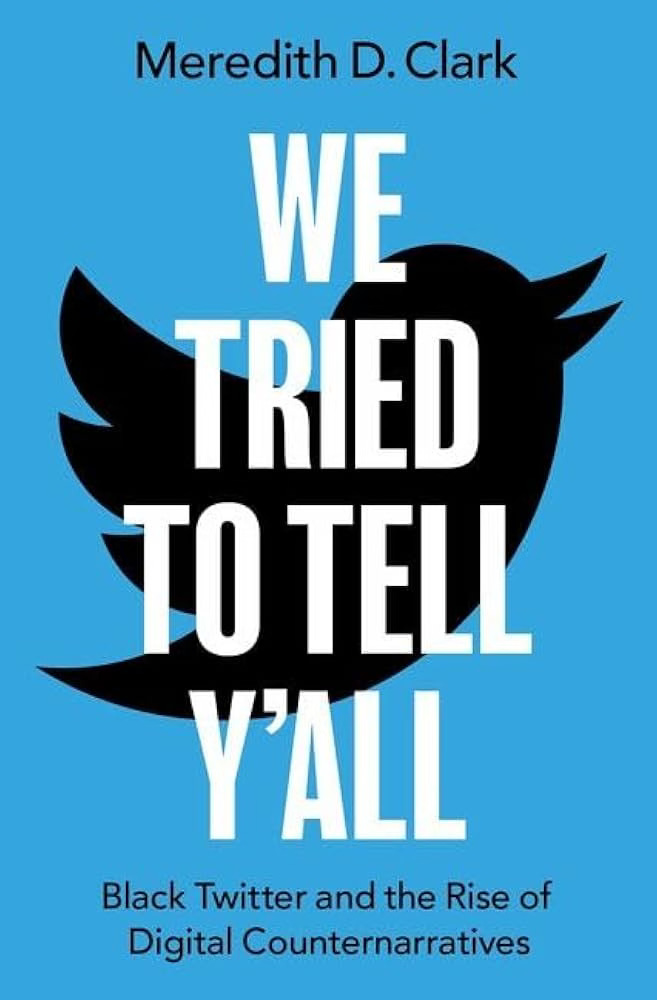
This groundbreaking book examines how Black Twitter has carved out a vital space for incisive commentary on Black life in America, countering mainstream media narratives. Through interviews, news analysis, and personal observation, Clark explores Black Digital Resistance and the ways Black social media users have leveraged the platform to document and discuss everything from cultural moments to social movements. This ethnographic study provides a compelling examination of how digital spaces continue the legacy of the Black press and social advocacy.
As J. Wortham writes in their New York Times review,
Black Twitter’s most lasting legacy, according to Clark, is pulling off a “full-scale revolution” in how American news media reported on Black people — which she correctly argues has a direct correlation to how people perceive the value of Black life and govern it. She intends the book as a warning: To continue on in the tradition of white media elites will lead to a further disenfranchisement of nonwhite people (and working-class white people, too) and will lead to the collapse of the country. Her warning has prescience: It’s here..
Join us in congratulating Dr. Clark and celebrating the release of her new book!
On a recent episode of Fresh Air, Tressie McMillan Cottom reflects on the intersection of Martin Luther King Jr. Day and Donald Trump’s Inauguration Day, examining the complex contradictions within American history and politics. She critiques the idealized, sanitized version of Dr. King that has been co-opted for political purposes, arguing that the real King—an organizer, radical thinker, and philosopher—was much more than the figure we remember today. Tressie emphasizes the importance of grappling with the contradictions inherent in the U.S. narrative and acknowledges that meaningful change requires understanding these complexities.
CITAP is thrilled to celebrate the appointment of our own Shannon McGregor as an Associate Editor for The International Journal of Press/Politics. Shannon joins a group of scholars, including Hsuan-Ting (Ting) Chen, Curd Knüpfer, and Patricia Rossini.
We are proud of Shannon’s contributions to the field and look forward to seeing her impact in this new role!
In a New York Times conversation, Tressie McMillan Cottom offered a sharp critique of the public response to the killing of UnitedHealthcare CEO Brian Thompson and the subsequent lionization of the alleged killer, Luigi Mangione. She argues that the widespread reaction exposes deep-seated frustrations with a healthcare system that prioritizes profit over people’s well-being, creating what she calls a “moral economy of scam culture.”
Cottom emphasizes that this incident reveals broader systemic failures, where institutions meant to provide care instead function as barriers, leaving many Americans feeling trapped and exploited. She notes that healthcare is one of the few vulnerabilities that cuts across education and class lines, stating, “Only the very rich can buy their way out of our health care morass.” This sense of powerlessness and frustration fuels public outrage and, in extreme cases, leads to the glorification of figures like Mangione.
Ultimately, Cottom cautions that the reaction to Thompson’s killing will likely lead to increased security for the wealthy while justifying further systemic abuses against marginalized communities. Unless meaningful reform is pursued, such incidents will continue to underscore the widening gap between the public’s needs and the profit-driven motives of the healthcare industry: “The only question is whether such a person or party or movement will move us forward or further into authoritarian waters.”
In a New York Times column, Tressie McMillan Cottom explores the deeper implications of the looming TikTok ban, arguing that it threatens the economic survival of many young Americans who see the platform as their best shot at financial security.
“TikTok and other social media platforms — and the influencer fantasy — seem like they are spackling over the deep cracks in our social mobility ladders,” she writes. Cottom critiques the influencer economy as a “Ponzi scheme,” where a few success stories sustain the illusion that financial stability is within reach, even though most users will never profit from their online presence.
Beyond the legal and geopolitical debates surrounding the ban, Cottom emphasizes that for many, the potential loss of TikTok exacerbates their anxieties about economic opportunity and generational stagnation. She argues that banning the platform won’t solve the larger systemic issues facing young people—it may only make them feel more trapped in an economy that offers few alternatives.
In an article for Tech Policy Press, authors David Lazer and Sandra González-Bailón analyze Meta’s controversial decision to eliminate its independent fact-checking network in favor of a crowdsourced system akin to X’s “Community Notes.” They express deep skepticism about this shift, arguing that it weakens Meta’s ability to curb misinformation and leaves the platform vulnerable to manipulation. The authors emphasize that while Meta claims fact-checking mistakes have unjustly penalized users, their research from the 2020 U.S. election shows that a small fraction of "supersharers" were responsible for spreading the majority of misinformation.
By removing penalties for misinformation, Lazer and González-Bailón warn that bad actors will now have greater reach, making it harder to contain the spread of harmful falsehoods, such as misleading health claims or disinformation about voting. Ultimately, they caution that without independent oversight, the full impact of these changes may never be known.
Appalachian State University seeks a tenure-track Assistant/Associate Professor in Electronic Media/Broadcasting and Digital Journalism. Applicants must have a Ph.D. or terminal degree in mass communication or a related field, with the degree to be completed by July 31, 2025. Professional experience in media production, journalism, radio, podcasting, or similar fields is preferred. Responsibilities include teaching undergraduate courses, advising students, conducting research, and engaging in university and professional service.
Comments
Nothing yet. Say the first thing.
Sign in to join the conversation.