
The legal landscape for cybersecurity professionals is shifting beneath their feet, often faster than corporate policy can keep pace. While mainstream news focuses on the technical mechanics of the latest data breach, the more profound danger for leadership lies in the evolving legal definitions of “consent” and “authority.”
Cybersecurity leaders must now navigate a reality where “expired” laws continue to function with full force and where the “voluntary” use of technology no longer automatically implies legal consent for data collection. Are you prepared for a regulatory environment where the rules of engagement are being rewritten by court precedents and “zombie” statutes?
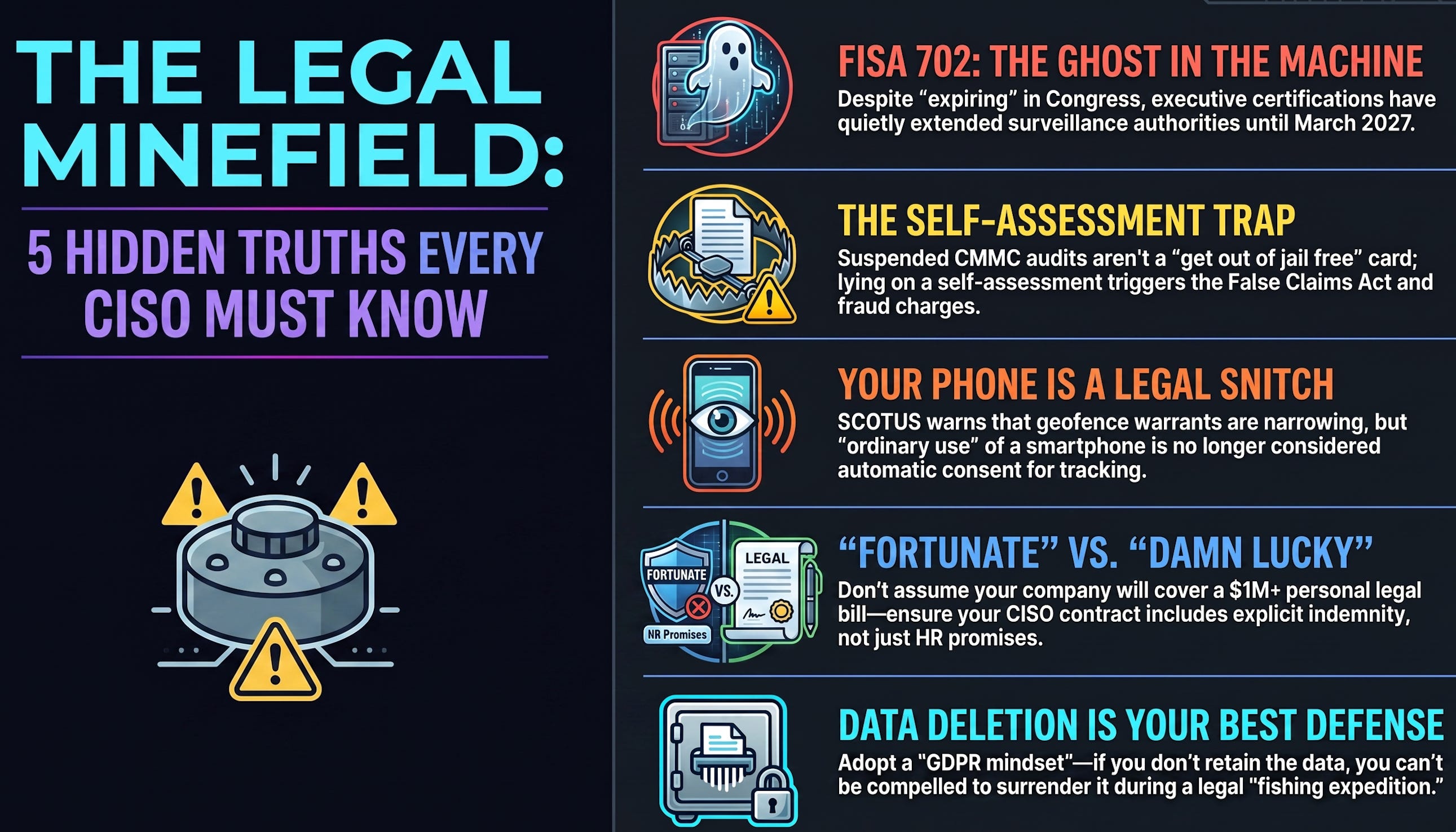
Section 702 of the Foreign Intelligence Surveillance Act (FISA), designed to allow intelligence agencies to collect data on non-U.S. persons outside the country, has become a flashpoint for legal gridlock. Although the law officially expired on June 12 of this year due to Congressional division over warrant requirements, it remains effectively active.
Through a “backdoor certification” secured on March 17 (the “St. Patrick’s Day certification”), the executive branch ensured that FISA 702 authorities will continue until March 2027. This allows for the continued “hoovering” of massive amounts of data into databases that are often accessible to domestic law enforcement without a traditional warrant.
Adding a layer of modern complexity, there is a rising risk of “AI-driven blamelessness.” Law enforcement agencies may increasingly point to impartial AI tools like Gemini or ChatGPT to justify data searches, effectively using a “the dog ate my lunch” defense to appear blameless in Fourth Amendment bypasses.
“The Hoovering of the data has scooped it up, and there’s a significant database. So if I’m Special Agent Deets... I can do a search into the database as an FBI agent and look up who’s in there without ever doing a warrant. And so some argue that’s a breach of the Fourth Amendment... it is fruit of the poisonous tree.”
For the CISO, this means that even when a law is technically “expired,” the surveillance mechanisms it authorized persist, creating a minefield for data privacy and compliance.
The case of Chatry v. United States has fundamentally altered the legal understanding of location privacy, building upon the precedent set in Carpenter v. United States (2018) regarding historical cell site location information (CSLI). In Chatry, law enforcement used a “geofence warrant” to identify suspects in a bank robbery through a three-stage winnowing process: first, obtaining anonymous data for everyone in a specific area; second, reviewing movement patterns; and third, identifying specific individuals.
The court ultimately found that this detailed, intrusive location information constituted an unreasonable search under the Fourth Amendment. The most critical takeaway for tech leaders is this: Ordinary use of a smartphone is not consent to be tracked.
Because smartphones act as “homing beacons” documenting every movement, the court ruled that users maintain a reasonable expectation of privacy that isn’t waived just by turning the device on. In a direct response to these mounting legal pressures, Google has announced that by 2025, it will no longer store location history in the cloud, moving it instead to on-device storage to limit its role as a “tattletale” for subpoenas.
The Department of Defense recently suspended the transition to “Phase 2” of the Cybersecurity Maturity Model Certification (CMMC). This move temporarily removes the requirement for third-party C3PAO audits, reverting instead to “self-assessments.”
While this may seem like a reprieve for contractors, it is actually a high-stakes legal trap. While the audit requirement is on hold, the underlying standard, NIST 800-171, has not changed. Moving to a self-assessment model places the entire burden of truth on the organization’s leadership. Under the False Claims Act, “attesting to 1,000 pushups” without actually performing them is no longer just a failure of security, it is legal fraud.
Material Misstatement: Falsely representing that your organization meets the 110 controls of NIST 800-171 is a misstatement of material fact.
Reliance: The government relies on this self-assessment to grant contracts and issue payments.
Liability: Knowingly violating cybersecurity requirements while seeking government payment opens the door to severe litigation and personal liability.
“Fraud [is a] material misstatement of a material fact made for the reliance by that other party... if you say, for example, ‘We are using umpty-ump encryption’ and you’re not, that’s a fraud... you would be on the hook. Clearly on the hook.”
The complexity of these developments proves that a CISO cannot operate in a vacuum. Modern security is an interdisciplinary “team sport” that requires constant “bantering” and collaboration across departments to maintain due diligence. To navigate these risks effectively, a CISO must partner with:
Legal: To interpret the shifting definitions of warrants, authority, and the “fruit of the poisonous tree.”
Privacy Officers: To align data retention with global standards like GDPR and ensure data is deleted once its specific purpose is served.
HR: To manage the implications of employee data use and the potential for personal indictments.
Purchasing/Procurement: To ensure contract language accounts for regulatory shifts and covers the CISO in the event of litigation.
Regulatory suspensions and statutory expirations are often illusions of safety. As recent developments show, “surveillance has not ended,” and the legal requirements for “reasonable” security continue to evolve through court rulings rather than just legislation.
Leaders must ask themselves a difficult question: Is your current data retention policy a necessary business record, or is it a “tattletale” waiting to be subpoenaed in a future where the definition of consent has completely changed? Keep a close watch on the pulse of legal precedent; the rules of the game are being rewritten in real-time.
Comments
Nothing yet. Say the first thing.
Sign in to join the conversation.