
One of the most common misunderstandings about meditation is that it is somehow a failure for the mind to wander, and that the point of meditation is to control or silence our thoughts. In part this comes from a mis-translation of the word samadhi as concentration - which seems to imply a tight, unbroken focus. The appropriation of mindfulness into the capitalist productivity machine also doesn’t help - it reinforces the idea that we meditate in order to become more focused and efficient.
My experience of samadhi is that it is much softer in nature - it’s a gathering together of the pieces of myself in a way that is open and easeful. A moment, however fleeting, when breath, body, heart and mind are in coherence with each other.
One of the wisdom gifts of Buddhism is non-dualistic thinking. Whenever I notice that I feel like I need to choose between A and B / this and that, I allow myself to open up to paradox and other possibilities (often called the middle way). When it comes to the how of meditation, the dualistic trap that we tend to fall into is that we either:
Allow our mind to do its usual incessant, noisy jumping around and allow ourselves to be caught and swept around by the thoughts and feelings that arise; or
Banish our thoughts, and chastise ourselves every time we realise we’ve gotten lost in thought - struggling though our meditation, convinced that we just aren’t made for this meditation schtick.
When we come out of this either/or trap, there are many doorways that open up. I want to share a few of these with you.
There’s a beautiful story that Sharon Salzberg tells about Dipa Ma1 on the topic of beginning again. The story is about her facilitating a long retreat in the US, and one of the participants who was really struggling. He leaves the retreat, checks into a hotel, watches football and orders room service. He then returns to the retreat but is ashamed to tell Dipa Ma about what happened. When he eventually gathers the courage to tell her, she responds with gentleness and compassion, welcomes him back and provides encouragement. We can learn from Dipa Ma and practise welcoming ourselves back every time we realise we have wandered away. The dance of wandering and return is alive and dynamic - much more in tune with the nature of life which is always in motion and subject to change.
I recently heard someone describing this moment of return. They said that they internally say: “It’s ok sweetie”. I was surprised and asked: “Do you call yourself sweetie?”. They laughed and nodded. It has never occurred to me to have a term of endearment for myself. Sure, I try to not use the inner-critic voice (I have a RANGE of not-nice ways of talking to myself) - but an endearment?
When I was little and couldn’t say my name, I would call myself nani. This morphed into the nickname honey (and then honey-pies). I’ve been testing out welcoming myself back in my meditations with a “welcome back honey”. Weirdly, there’s a Texan drawl that has snuck in but I don’t mind, it makes me smile and softens the whole moment.
The crux is that if your meditation consists of more moments of return than anything else, that’s more than ok. Each time we return is a moment of awareness that we can celebrate. It is a chance to practise welcoming ourselves, to notice what reconnecting feels like, and to practise kindness and grace.
I love it when ancient wisdom and contemporary science affirm each other.
The ancient wisdom: The Buddha taught, thousands of years ago, that the “self” that we treat as fixed in nature is actually an emergent process arising in each moment, in relationship with the conditions that are present.
The contemporary science: I’ve recently been reading Ed Yong’s book “I am Multitudes” about microbes and metagenomics (the genomics of communities) which puts forward a similar disruption of a distinct and fixed self - but from the perspective that we are more an ecosystem than an individual. We have more microbes residing within our bodies than we do our own cells. By some estimates we are so outnumbered by microbial cells that “we are rounding errors in our own bodies”. (I have much more to say on this topic - for another post.)
These ideas about a mutable self, whilst potentially disconcerting, are also wildly hopeful because they introduce so much possibility: of leverage points for change, of our old stories to fall away, of healing.
Our meditation practice is likely to be what reveals the illusion of fixed self to us - slowing us down enough to be able to perceive both the interconnectedness that Ed Yong points to, and opening up those cracks and crevices we can slip into to shift what is seemingly stuck.
What I’ve recently been playing with is using the idea of myself as an emergent process as a thought experiment. If I am arising in each moment, then expecting continuous presence or focus is slightly ridiculous. Within this frame, the practice IS to return and to begin again. And it becomes obvious that I need to extend grace every single time I get lost, distracted, disconnected or snagged in a thought or feeling.
How to work with this in your own practice:
Connect with your inner Dipa Ma: that part of you that is filled with warmth, kindness and compassion.
Get curious about the dance between wandering and return: where do you go when you disconnect? Which thoughts are you most likely to get lost in? What works for you as the point of return - is it the breath at your nostrils, the feeling of the seat beneath you, the resonance of your heart?
Develop a term of endearment that you can use to welcome yourself back and to extend grace.
Play with the thought experiment of yourself as an emergent process. What would be different if I knew I was arising in this moment?
Invite in softness whenever you can - release tension in your body, drop your shoulders, release your jaw, let your tongue be heavy, soften the insides of your cheeks, encourage your breath to smoothen and lengthen.
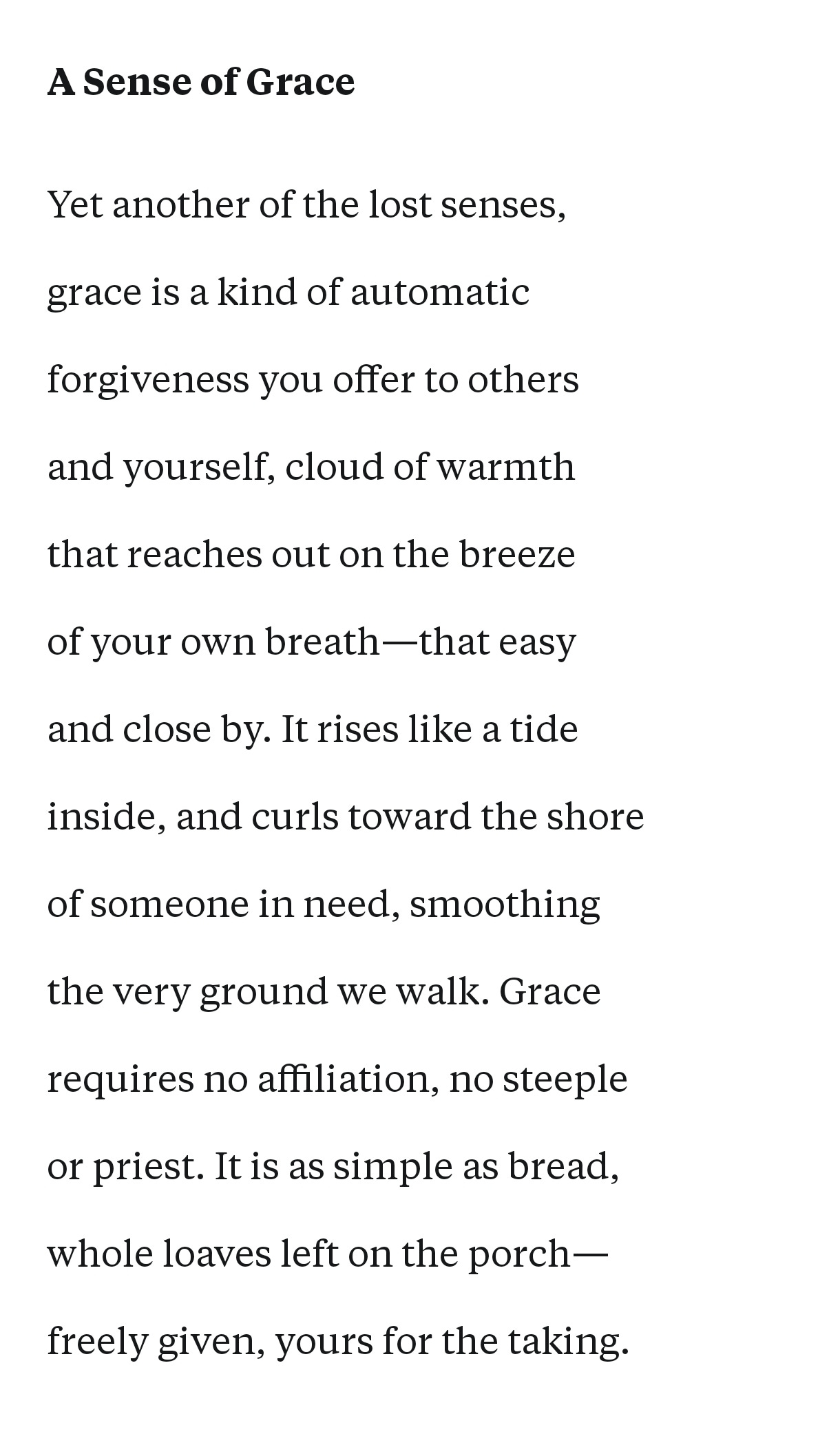
A poem from James Crews:
Dipa Ma was an incredible Indian woman who, unusually for a woman of her time, became a meditation master in the Theravadan tradition of Buddhism (this is one of the traditions that has influenced my own practice). There’s a wonderful book about her life by Amy Schmidt that we have in the circanow library: https://circanow.my.canva.site/library
Comments
Nothing yet. Say the first thing.
Sign in to join the conversation.