
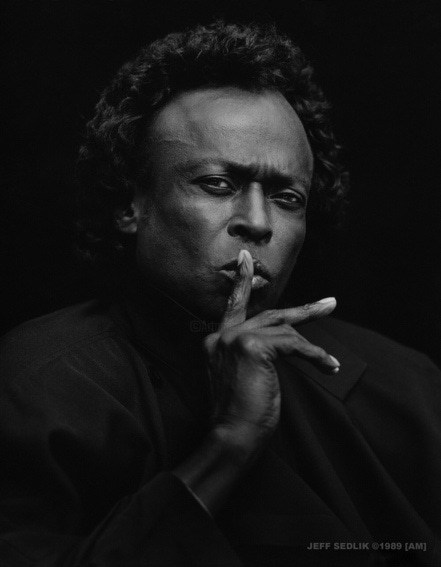
Here is a picture taken by professional photographer, Jeff Sedlik.[1] As you may recognize, the subject of the photo is the late jazz musician, Miles Davis.
This is a tattoo drawn by well-known tattoo artist, Katherine von Drachenberg (a.k.a. Kat von D).
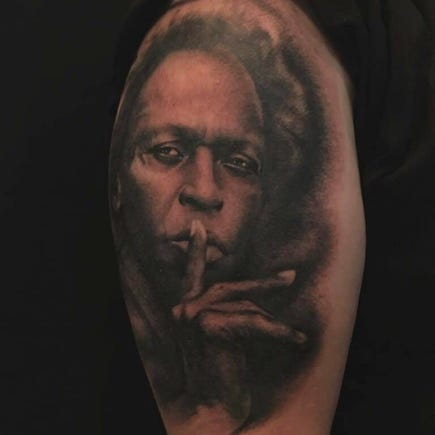
Just based on your first impression, does this look like copyright infringement?
What if I told you that Kat von D had a copy of Sedlik’s photo when she was drawing the tattoo? What if I told you she not only admitted copying from the photo, but posted a video of herself doing so? What if I told you when she was done she declared publicly that her work was “100% exactly the same as the reference”?
Now what if I told you that when Sedlik sued Kat v D for copyright infringement, even after all that, the jury decided the tattoo was NOT copyright infringement and when Sedlik appealed, he lost?
All of those are the true facts in the saga that is Sedlik v. von Drachenberg. Sedlik has now been granted a re-hearing of the entire panel of the 9th Circuit Court of Appeals and this case has brought out the copyright commentators in droves because of the unique terminology the 9th Circuit uses to assess copying. I have my own thoughts about this.
What is Going on in the 9th Circuit?
The legal standard for determining copyright infringement via direct copying entails two parts. First, the alleged infringer must have had access to the original. Here, that is not in dispute. Second, the alleged infringer must have copied enough of the copyrightable elements of the original work that the new work is at least “substantially similar” to the source. All of this is uncontroversial. Yet, the 9th Circuit articulates the test in a unique way, inviting juries to consider the “total concept and feel” of the two works. Most everyone agrees that this broad phrasing tempts juries to consider either too much (“concept” sounds a lot like “idea,” and it is a cornerstone of copyright that ideas are not protected) or too little, as appears to have happened in this case.
It strikes me that the “total concept and feel” doctrine is conceptually akin to the principles of copyright protection for a compilation. Compilations may be copyrightable if the selection, arrangement, and coordination of elements is creative, even if the elements themselves are not copyrightable.[2] The most typical examples of compilations are collections of data. There is also a subset of compilations in which the individual items are also copyrightable works. A typical example of these “collective works” is a poetry anthology.
But compilation copyrights can apply in other instances. In theory, almost any work can be viewed as a compilation. A literary work is a creative selection, arrangement, and coordination of letters, words, and punctuation. A motion picture is a creative selection, arrangement, and coordination of images and sounds. A song is a creative selection, arrangement, and coordination of notes and timing. So how does one know when to look at a work in the traditional way and when to look at it as a compilation?
In many cases, there is already commonplace parlance for compilation in more traditional contexts. In the case of a novel, script, or movie, the plot is the selection, arrangement, and coordination of characters, scenes, dialog, etc. In music, it is the melody, harmony, rhythm, and so on.
Importantly, copyright protection for compilations is “thin,” meaning infringement can only occur when a large portion of the compilation has been copied. Copying less than that means the creative aspects – selection, arrangement, and coordination – have not been infringed because too little was taken.
The phrase “total concept and feel” lacks the precision of “selection, arrangement, and coordination” and thus invites jurors to stray from the principled application of copyright law into subjective impressions. There is little doubt that every juror’s personal impression is part of that juror’s assessment of the case. The role of the law is to direct that into a more principled set of factors so that the analysis and results are more likely to be consistent with the scope of protection under the law, which in turn increases predictability.
Application to this Case
Photographs have certain inherent limitations in what aspects are copyrightable. The fixed features of the subject of a photo are not copyrightable, both because they are facts and because the photographer did not create them. That is true for a mountain, a rabbit, the Capitol dome, or a person’s face. However, the creative choices the photographer did make are copyrightable: a pose, the angle of the photo, the lighting, the setting, and even the timing of the photo can be protectable.
So, the features of Davis’ face and hand are not protected. But his pose, the angle, the low lighting and shading were apparently all choices made by Sedlik and therefore copyrightable. I find it plainly obvious that von Drachenberg copied those protectable elements. My opinion is reinforced by her own statements. Stepping back from the nuances of the law, I think any judicial doctrine that leads to such an absurdly wrong result in inherently suspect.
Conclusion
A lot of people are calling for the complete elimination of the 9th Circuit’s approach by referring to the labels – the “extrinsic” test, the “intrinsic” test. I am less concerned about the doctrinal labels and more focused on the substance of the standard and how it is communicated to a jury. The direct copying of specific elements is the first step. If the 9thCircuit wants to consider aspects of a work beyond that to a more holistic view, I think the “selection, arrangement, and coordination” protection from compilation jurisprudence is an established and reliable avenue to do so. I hope the outcome of this case provides that sort of approach that is both consistent with the bounds of copyright protection and useful to guide juries’ assessment of infringement.
[1] Disclaimer: I know Jeff through my work on copyright policy. Neither he nor any of his legal counsel had prior notice or input of any kind into this post. I did read their brief to the court in this case, as well as many other briefs that were submitted. I have no stake in the outcome of this case beyond my general interest in the application and interpretation of copyright law.
[2] I discussed this in the context of AI prompts in a prior post.
No posts
Comments
Nothing yet. Say the first thing.
Sign in to join the conversation.