
The Copyright Office has issued registration “Guidance” on submitting works containing AI-generated material. There has already been a significant amount of criticism of that document. I don’t mean to pile on, but I have concerns that are not commonly mentioned. I believe the Copyright Office is going beyond its proper role and that it is unnecessarily complicating and hindering registration applications.
Disclaiming AI Material
In this Guidance, the Copyright Office asserts that “applicants have a duty to disclose the inclusion of AI-generated content in a work submitted for registration and to provide a brief explanation of the human author’s contributions to the work.”[1]
In general, I have no objection to the first part of that. Applicants must disclose the inclusion of AI-generated content. The Copyright Office already requires applicants to exclude from their registration claims material that is not their original authorship, whether it is public domain, another author’s protected work, or even their own authorship from a previous work. That is done by a simple check-box. So, for example, a biographer who included other’s photos of his subject would check a box to disclaim those photos in general and another check box to assert his authorship in the text. No elucidation is required nor does the applicant have to itemize. It is simply a categorical exercise with the understanding that if the work is ever the subject of litigation, those particulars will be worked out by the court as part of its fact-finding function.
Describing Human Authorship
Why, then, should applicants be required to provide an explanation of the human author’s contribution to the work” in the context of AI? That is beyond the requirement for the inclusion of any other uncopyrightable material and I think it is inappropriate for the Copyright Office to require it at all, and certainly inappropriate to require it with regard to just one form of technology.
The Copyright Office’s registration examination function is NOT a fact-finding exercise and the Office is not equipped to take on that role. A registration applicant is properly required to provide the relevant facts and the Copyright Office takes those as truthful. There are penalties for fraud, ranging from invalidation of the registration to criminal prosecution in extreme cases. Creators are not and should not be required to describe their creative process to the Copyright Office, in instances involving AI or otherwise. It should be enough that the applicant excludes some material in the same categorical manner as they would any other material in the work that is not their original authorship.
Standard Form Required
As part of its Guidance, the Copyright Office says applicants must use the Standard Form. In a footnote in the Guidance, it is asserted this requirement is because “[t]he Office’s other types of application forms do not contain fields where applicants can disclaim unprotectable material such as AI-generated content.” As I have written before, the limits of the technology should never dictate procedures and/or policy. Because the Copyright Office does not control its own IT, I certainly don’t blame the Office for trying to fit a square peg in a round hole. That doesn’t change the fact that this is not the way the copyright system should be governed.
The Guidance directs applicants to use the “Author Created” screen and the “Limitation of Claim” screen to describe the human authorship and disclaim AI material. This is confusing, at best. As you can see in the screenshots below, what is provided are just check-boxes and a tiny text field under the heading “Other,” which could be used to provide some text descriptions, although it is far from self-evident that is its intended purpose. Rather, it appears to be an alternative to indicate a type of work not already listed – musical composition, for example. My point here is that the Standard form is not a particularly good fit for this purpose, so I don’t think the rationale given is compelling.
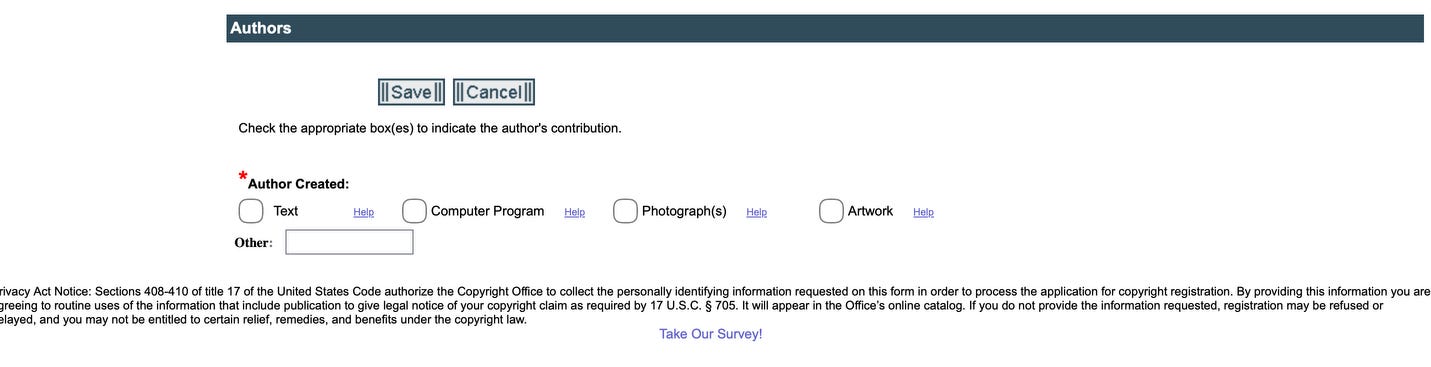
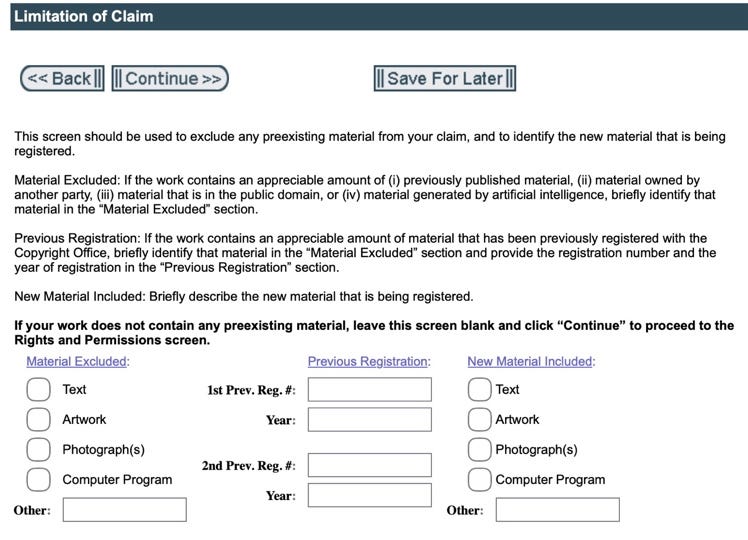
I note that every Copyright Office form has a larger box on one of the last screens for “Notes to the Examiner,” which could be used to provide text descriptions regarding limits of the claim and/or new authorship. No, “Notes to the Examiner” isn’t a particularly intuitive place for that information. Neither is a tiny nondescript box labeled “Other.” I fail to see why it was necessary to limit applications for works containing AI-generated material to the Standard form when that form does not appear to be substantially superior for that purpose.
Eliminating Group Registration
This is far more than a bureaucratic technicality. Limiting applicants to the Standard form excludes the Office’s group registration options. Without group options, registration is utterly impractical for large swaths of professional creators. Photographers, who would otherwise be able to submit groups of up to 750 images in a single application, would have to submit hundreds of single-image applications at $65 per photo. Other group options allow up to fifty works, and still others allow up to twenty or ten in a single application. In every instance where there is more than a negligible amount of material created by AI, the Copyright Office has effectively multiplied the time and expense of registration by 10, 20, 50, or even 750. All to force people into using a form that isn’t much better than the group forms.
Conclusion
It is undoubtedly the case that generative AI is complicating copyrightability analysis. I appreciate that the Copyright Office is grappling with that and trying to find a way forward. Still, I think it is important the Office remain true to its expertise. There are lots of people there who understand copyright law very, very well. But the Copyright Office does not have the capacity to parse the creative process for each of the millions of works that are submitted for registration every year. Further, the limited utility of restricting works containing AI material to the Standard form is far outweighed by the harm arising from the elimination of group registration options for those works. These departures from prior Copyright Office practice are neither necessary nor appropriate, and they further complicate an already burdensome registration system.
[1] https://www.copyright.gov/ai/ai_policy_guidance.pdf at page 4.
No posts
Comments
Nothing yet. Say the first thing.
Sign in to join the conversation.