
“The stories […] are richly imagined mysteries. They could be fairly equated with the works of Kafka or Borges if their prose were not so luxuriant and surprising at every turn. Contemplating the mood and storylines of these arresting pieces, a quote from Poe’s The Narrative of Arthur Gordon Pym comes to mind: ‘My visions were of shipwreck and famine; death or captivity among barbarian hordes […]’”
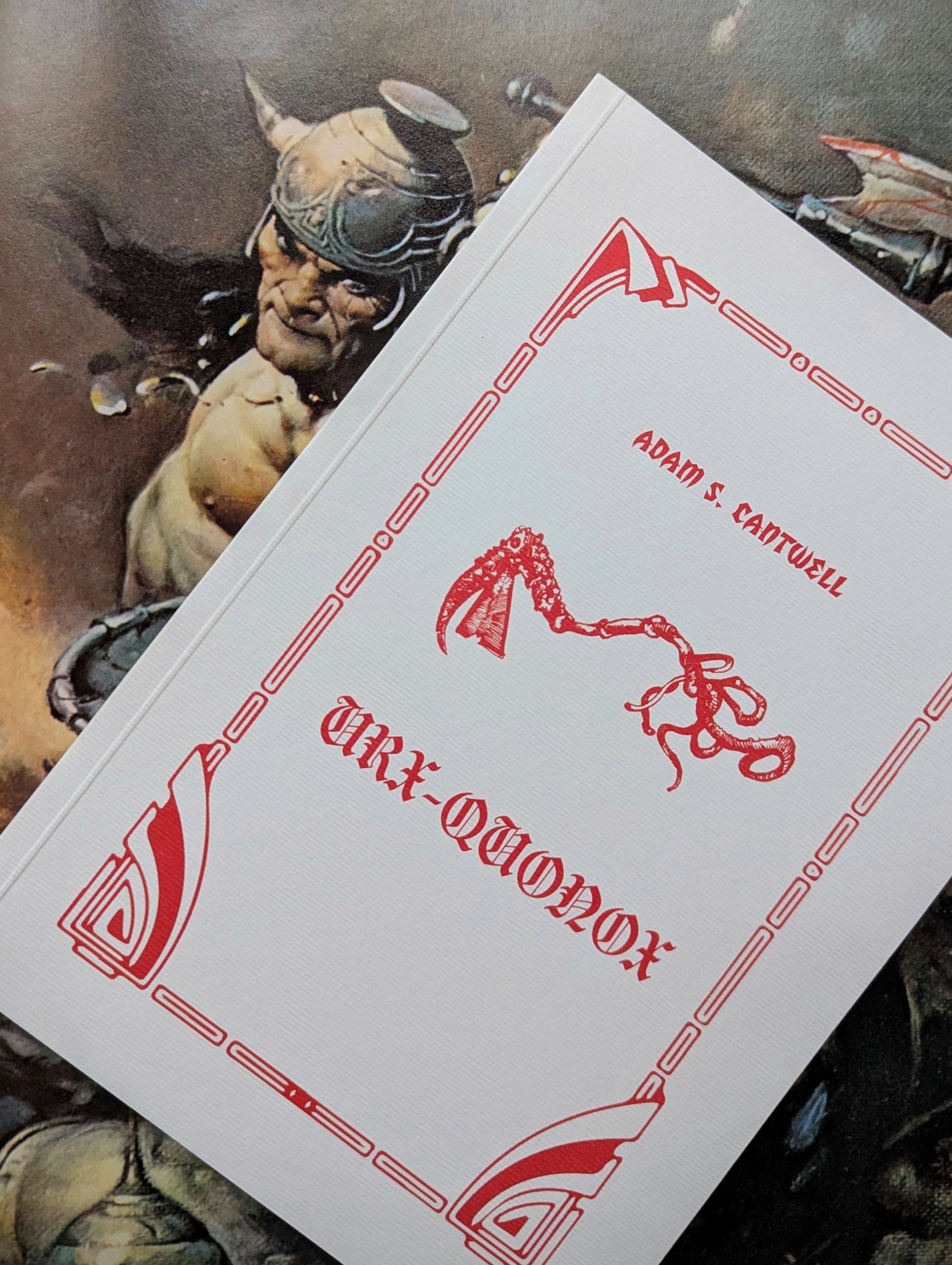
Barbarian hordes. With this vision in mind, Ligotti (or a time-travelling Poe) could have just as easily been describing Cantwell’s sword & sorcery collection, Urx-Quonox. First published by Mount Abraxas in 2021, and republished in a new edition by Occult Press in 2025, the stories concern Grasm, a “barbarian” who occupies a landscape both strange and familiar. A limited supply of Urx-Quonox paperbacks are currently available from Church Ghost, so I spoke with Cantwell over email about this specific collection… and other topics in the orbit of fantasy and sword & sorcery. Our conversation, slightly edited for length and clarity, provides some insight into the background and motivations behind this curious foray into what is an often questionable or boneheaded genre.
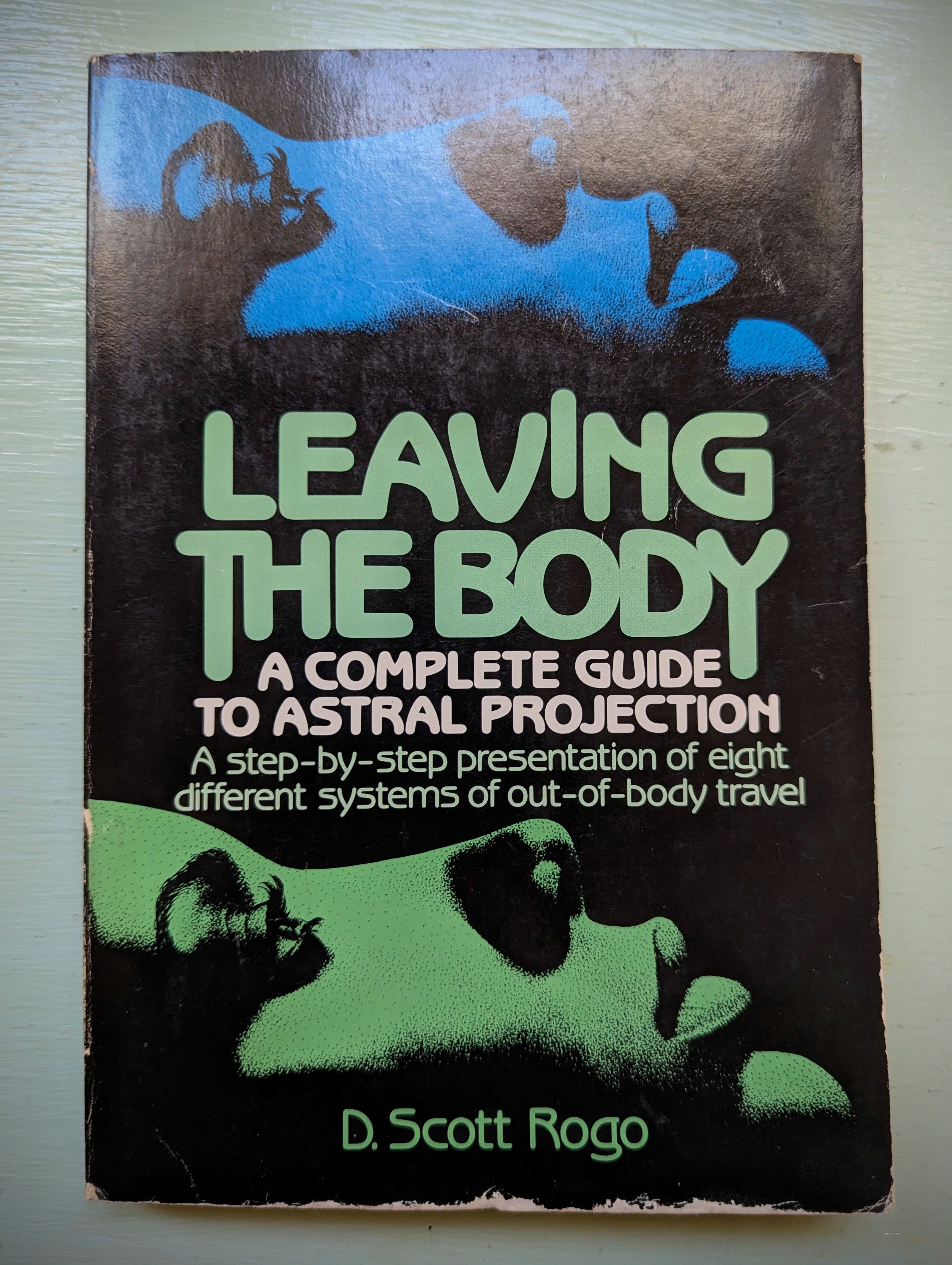
Lange: Your biography states that you have an interest in “oneiromancy, astral projection, and ‘paramentals.’” Oneiromancy is a form of dream interpretation, or divination, and reading Urx-Quonox I definitely felt the workings of what could be described as dream logic, so I see the connection. But what about astral projection and paramentals? (I’m not even sure of the definition of the latter term.) Can you explain how these concepts inform your writing? And are you experienced at astral projection?
Cantwell: The bio you mention, that Occult Press used for their edition of Urx-Quonox, was originally specific to an anthology of occult stories that I was a part of (The Onyx Book of Occult Fiction), so I was playing to that theme a bit. I’d say I’m very interested in the occult as a subject for literature and as sort of a device for philosophy and understanding the world. So I try to do the reading and understand it and take it seriously, but I wouldn’t say that I have a practice. However, the bio is kind of alluding to a time period when I was a teenager and I was interested mainly in lucid dreaming and then astral projection, and oneiromancy maybe ties into that. I found out that there’s a great deal of intention and attention required to practice this kind of self-engineering. I didn’t have this discipline so it sort of floated away. (Even my high-school-suburban-Wiccan girlfriend was a more dedicated and serious practitioner than I was.) I was also heavily under the influence of William Burroughs at that time; he has his idiosyncratic approach to divination and whatnot. The psychedelic experience was also part of my ensemble at that point, and of course Lovecraft. Since that time, I’d say all these subjects are still of varying interest but have kind of been folded into literature and books for me. I’m going to use the subjects you mention as a way into a limited definition of the occult, since the occult is a big, contradictory subject and we are talking the inward-journeying, seeing-beyond piece, not the (possibly more germane) pieces about summoning and binding spirits. In that frame, seeing and going beyond is necessary in part because consensus reality doesn’t come near to describing the world we find ourselves in, and that individuals always have found themselves in, especially those with different sensibilities. And it never can. That’s the connection to my writing. So I tend to follow after the example of writers who are reshaping perception, inviting deep associations, even on the level of the sound and sense of the sentence—maybe with old, estranging vocabulary and full of unexpected, unexplained abstractions. Maybe that’s the dream quality you picked up on? Like, I may write about the current day sometimes, not a fantasy world, but I see no other honest way to do it than to kind of hand-make the unfolding reality, avoiding stock phrases or ways of thinking.
I’m not aware of any definite astral projection on my part. The more I’ve thought and read about it, the most relevant seeming part is where it’s actually super dangerous and that your “silver cord” can be cut or might just break. I imagine mine being quite brittle. Back then I wanted to be like Randolph Carter and have the wild visionary experiences, almost like with psychedelics; I was sort of looking for creative material as well but more so I just wanted the experience. Looking back, I wonder, why did I care so much about having a subjective experience that can’t be artistically or socially manifested? But I also didn’t think I was a writer back then.
Paramentals: This is a concept from Fritz Leiber where there are elementals but of things like trains and electrical wires and I guess buildings, etc. As a teen I was interested in how the shabby, drab, built environment of unincorporated San Mateo County where I grew up could be re-inhabited with dark wonder.
There’s an uncanny quality to Urx-Quonox, which is to say that if feels both familiar and unfamiliar. I’m not particularly well-read in the field of fantasy, but there are still all sorts of recognizable genre tropes, which can feel familiar even from secondhand sources like old comic books, Conan movies, video games, etc. Despite these clichés, Urx-Quonox also feels completely fresh and difficult to pin down. Were you trying to deconstruct or comment on the barbarian fantasy genre, or simply inject your own aesthetic sensibilities?
I don’t know that I read much actual Robert E. Howard prose in my formative years but I was well-versed in the Elric books and in all the secondary Conan material. Before I started Urx-Quonox I was writing weird fiction mostly in a kind of pre-war European decadent vein. Then I had a peak experience on vacation, high on a beach, reading REH. Some time later, on a different beach, made of black volcanic stones on the big island of Hawaii, I decided my next book for the publisher Ex Occidente/Mount Abraxas would be sword & sorcery. I didn’t start it right away, and then I tacked on the conceit that the book would be somehow Bataillean, after another peak reading experience with big Georges. So in that sense the book comes directly out of Howard but quickly lands in this mire of more consciously literary directions. I wasn’t so much interested in critiquing or deconstructing the S&S genre as I think its weaknesses or problems are already pretty manifest. And it’s just as diffuse as anything else these days—
maybe S&S was part of American outlaw culture in the ‘70s, but now you have quite conscientious young people reviving it with up-to-date interpersonal politics. It’s considered mainly maybe problematic but at the same time it is very mainstream. (Why shouldn’t REH be in the Library of America? He was a better prose writer than Philip K. Dick…) So it’s more my own use of the genre, which I found stimulating and compelling because of qualities of sweep and cinematic-ness. I’m in the camp where it needs monsters and wild sorcery. I don’t like world building or magic systems. I’m sorry to even use those anti-literary terms. I will say I wanted to inject my aesthetics into the genre but I also thought that to do it justice I needed to stretch my ability to basically write action, which is where REH can be straight-up sublime. I tried, but I still have a way to go.
You’re also associated with the “weird fiction” genre, of which H.P. Lovecraft is a patron saint. There’s a very blunt and literal connection here as REH and Lovecraft were famously pen-pals; do you see any deeper thematic connections that link “cosmic horror” with sword & sorcery?
Deeper thematic connections… aside from all the overlap, if you take each of them more to their essence… I don’t know, they are very much linked, on all levels, and more or less consciously, even explicitly. What are their themes? Estrangement, alienation? But in one case it’s estrangement from the societies and the unknowable powers in a world, but that implies freedom to act on the part of the barbarian; and in the other case, it’s an estrangement from reality, the universe itself, leaving the actors with more of a negative capability, which is maybe why so many weird fiction protagonists come to self-inflicted bad ends or undergo complete dehumanization. This is not to say that S&S is necessarily less profound than weird fiction, not only because of course they can be mixed but also because structurally and in genre terms, but I’m comfortable with saying that S&S is more of an entertaining and less of a reflective genre. They just have different purposes and scratch different itches. But as you say, those two dudes really are it. Their extended conversation says more than any other effort possibly could about the subjects. And it’s all in print. I’ll probably dig into it someday, but frankly, it seems overwhelming and possibly paralyzing to the actual practice of humbly trying to do some justice to these traditions.
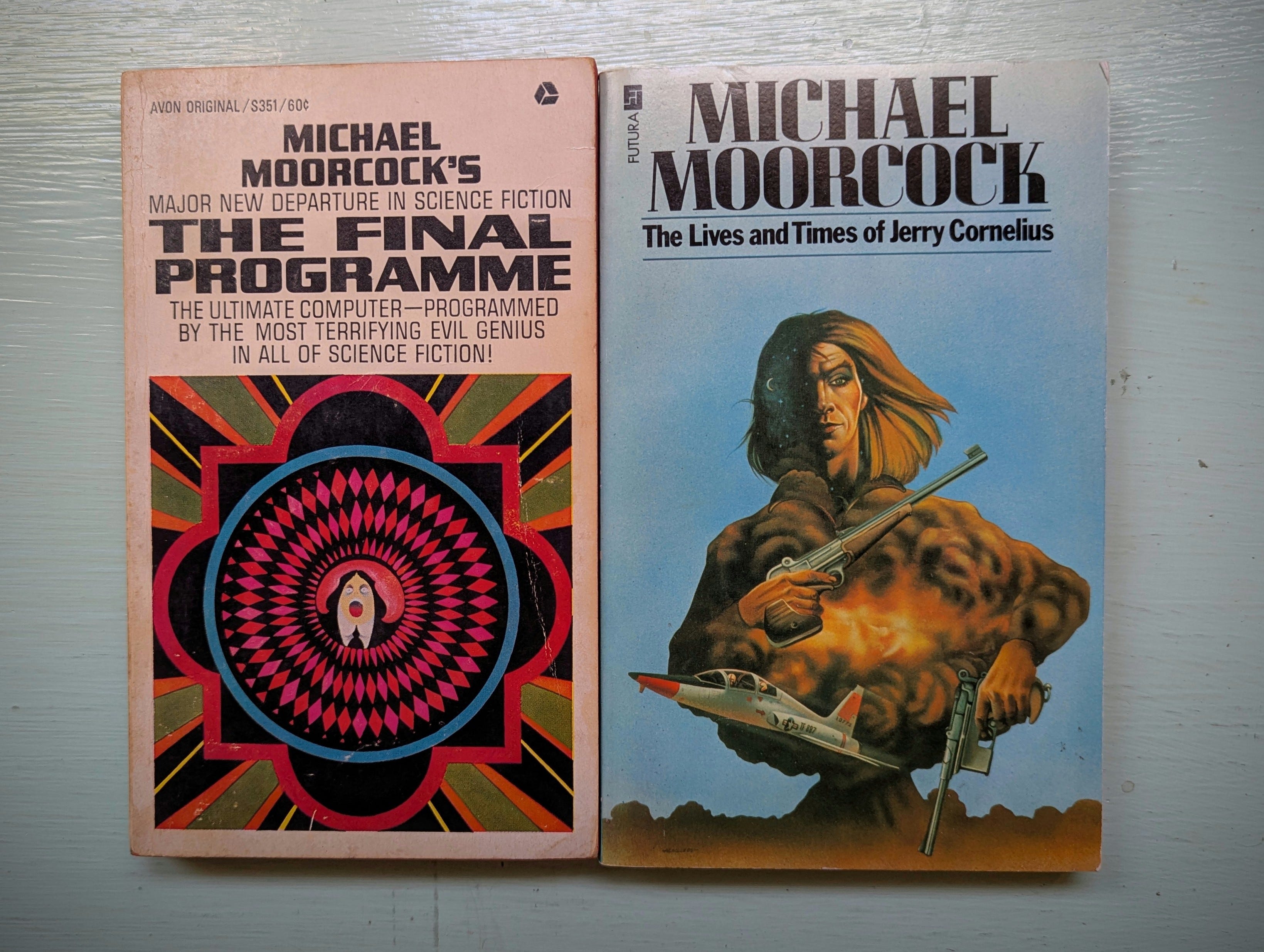
Michael Moorcock is a fantasy writer that I am quite familiar with, having gone on a long jag in my 30s where I tore through piles of his books. There were bits and pieces in Urx-Quonox which reminded me of some of the stranger moments in Moorcock’s Elric and Corum books. You mentioned Elric earlier; does Moorcock’s sprawling “Eternal Champion” opus inform your own writing at all?
Yeah, I really love and respect Moorcock as a writer. I read Elric, Corum, Hawkmoon, a couple standalone novels including the great Behold the Man, but not far past that. I’m glad you brought him up because I don’t want to take him for granted. It’s just that influence is a hard thing. I want to be well-read in the genres I’m dealing with but I’ll struggle with creating original effects if I’ve got some other writer’s style of weirdness too much in mind. (By the way, the Moorcock I’m most interested in at present are the Jerry Cornelius stories, the psychedelic ones that are set in the ‘60s UK…)
A very tasty world.
As a young comic book reader I became a fan of Frank Frazetta’s paintings, which are intimately connected with Conan and REH. There’s a certain unquestioned belief in fan circles that Frazetta was “the best,” and that his work rose to another level while other fantasy illustrators were operating as kitsch. To me, Boris Vellejo—who trafficked in similar imagery—embodied this kitsch idea. But at some point, I realized I was wrong, and that Vallejo was doing something different but equally potent. Frazetta’s work has a rough masculinity, or even a hyper-masculinity, but Vallejo is the opposite; his work has a mercurial fluidity, and despite all the muscles and phallic swords, there’s a powerful feminine quality. Once I realized this, his paintings no longer looked like kitsch to me, but instead joined Frazetta’s work to form a yin-yang of solar and lunar approaches to fantastic imagery. Reading Urx-Quonox I felt a similar pull of competing solar and lunar currents, so I have to ask if these illustrators informed or inspired your work at all.
There would have been a S&S genre without Frazetta but it would be so so different. As you know, he also did all kinds of exquisite stuff in other genres—western or historical adventure or whatever. What he captures in his most “Conan” art is a very tight-in-time moment where the struggle is to survive—life is in the balance, but at the same time, the moment is sublime and exalted. It’s savage, if there’s a sense of the word that’s not fascist but instead conveys man in his moment of being a dangerous animal. The effect needs to reach beyond rational thought or below it.
When I look at Frazetta I’m like, “hail, staunch fellow ass-man! Respect the ass!” But looking at Boris he’s more engaged with both male and female figures and I at least really feel the presence of the model in the room. (Someone could probably sit me down and show me some less fleshy and more trippy Boris art but nevertheless, this is my impression.) My book does deal with sex and gender, and therefore I suppose the solar and lunar, though I think I’m missing some subtext there, but without a program or particular point of view other than the bewildering mess of Sex that I found distributed amongst myself, this book, the containing genre, and this sick society. Coming as I do from the mental confines of a patriarchal society I hesitate to characterize some putative freer, more essential, sense of sex that’s balanced in tune with nature and magic, but it’s a beautiful idea.
I’m also pretty nuts about Jeffrey Catherine Jones too, and how she pushed the ephemeral quality of the style. I love the watercolor washes and vignette compositions that embody mystery and distinguish her work from the Master’s. I’m probably closer to the cliche position on Boris, though I have long ago given up hating on him. I can appreciate the work, but you’re unlikely to find a Jones-style vignetted, off-balance composition in Boris because the lushness has to go to the edge of the canvas. Maybe that’s the enveloping fluidness that you’re talking about?
Another way I tried to get unconventional with Urx-Quonox, in the context of the Mount-Abraxas-style stuff I was steeped in at the time, was with explicit sex—especially in the first section. It was also the hook on which I hung the Bataillean label, which is a bit bullshit on my part. I read a ton of Battaile around the (extended) time of writing UQ but I did not know how to truly make a fusion work. Still, the other writers in that Mount Abraxas “scene” were not much writing about sex at all, so I took my stab at it.
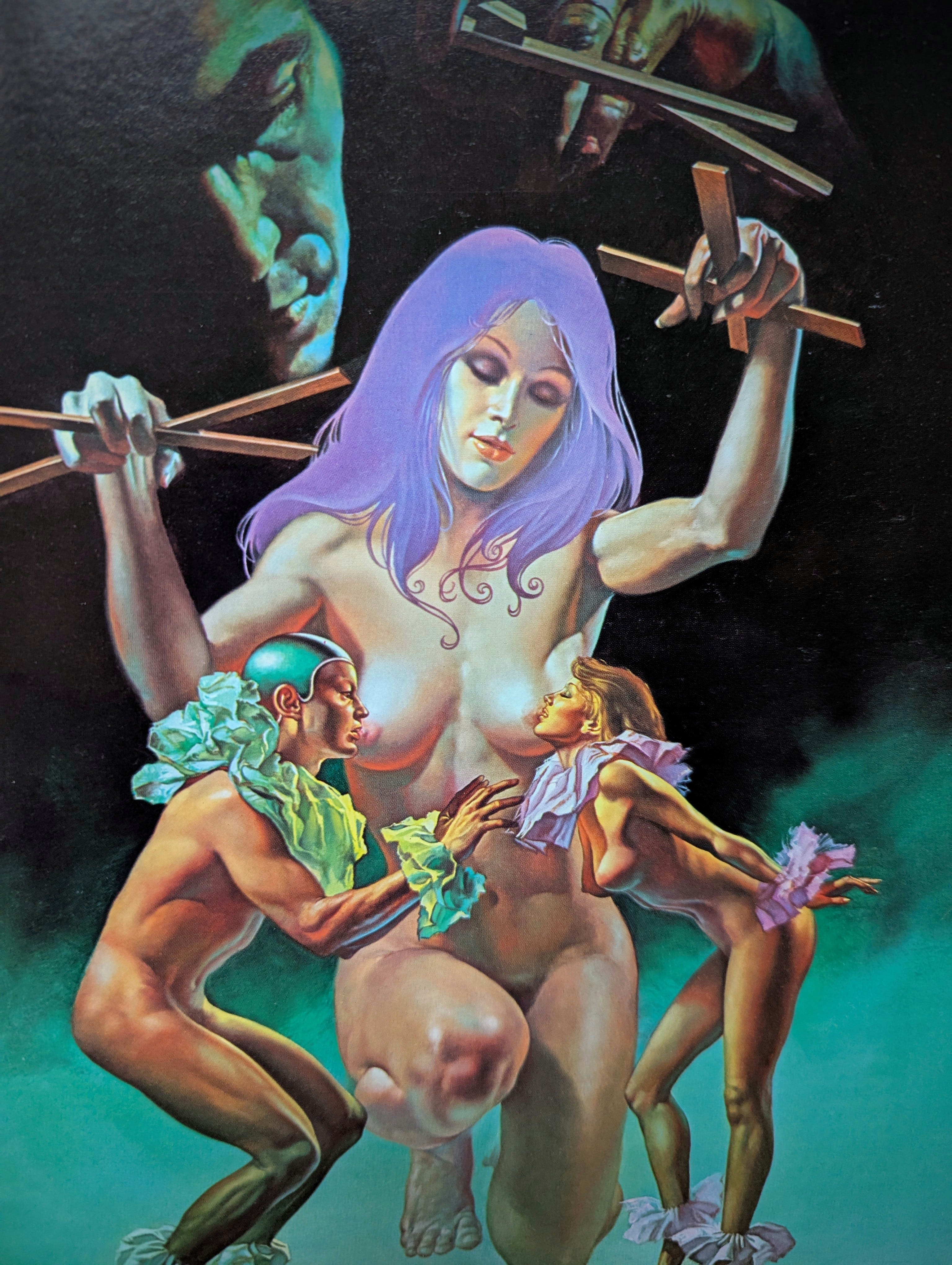
Vallejo
There’s often a lot of fantasy and S&S imagery in heavy metal lyrics and album art. Were you listening to metal as a teenager? Are you listening to it now?
I didn’t quite grow up with metal, but yeah, I have listened since I was a teen. I played in heavy bands for many years, with stuff out on Southern Lord, Nuclear War Now, etc. I collect records, but metal’s not a very fun genre to collect these days. (I bought and long ago disposed of all my ‘90s death metal on cassette.) But I’m not a lifer, I played other styles as well, and sadly most of the scene people are just not my kind of people. If I listen to metal now it’s old shit, reissues, or a handful of bands like Aluk Todolo, Python, Autopsy, maybe Pan-Amerikan Native Front. I went to hear Tormentor and at another gig last year, Dead Congregation. Both brilliant bands.
Neo-Paganism, as it relates to inhabiting the modern world, has some crossover with what we’ve broadly discussed as “occult,” while also sharing some aesthetic and thematic concerns with fantasy and S&S—though the comparisons might work better with Tolkien than REH. Also, your description of Lieber’s “paramentals” sounds animist in a way that’s Neo-Pagan, but which also aligns with loose Shinto ideas that can readily be witnessed in the day-to-day activities of contemporary Japan. Is paganism something you’ve explored at all?
I reserve judgment on Neo-Paganism as a practice; I guess I know a practitioner or two but I haven’t discussed it with them. As a scene or aesthetic—not my cup of tea. I actually know nothing about Shinto practice but if you bring up daily life in Japan, I’m intrigued since I feel that J culture has a far better spiritual relationship with objects and the material world than the western stuff. I freaking love Tokyo. I’m overly hung up on the question of primary vs subsequent derivative sources, so as much as I might be interested in my own folkways or someone else’s, I’d be unable to parse out the received wisdom in any kind of way that would feel solid. I’d be super hard pressed to join any extant spiritual tradition at all—mine is books.
Earlier you alluded to a possible “Fascistic” quality in Frazetta’s paintings. Obviously, this isn’t an overtly political Fascism, rather it is the Fascist-adjacent celebration of the strong body (as can be seen even in the later African-set works of Leni Riefenstahl). With this in mind, I’m curious as to what your thoughts are regarding the 1982 Conan the Barbarian film, which opens with the modified Nietzsche quote, “That which does not kill us makes us stronger.”
Additionally, director John Milius has referred to himself as a “Zen Fascist.” People hear this “F-word” and completely shut down, but I think Milius—somewhat hilariously—was getting at an idea (or ideas) that are not so easily reduced, and which go beyond the typical Right and Left-wing binary. Does the Conan film, Nietzsche, or samurai-style “Zen Fascism” play any role in the genesis of Urx-Quonox?
I reached for that word to qualify the word “savage” which is just so apposite for Conan and Frazetta but I feel now has strong connotations to hegemonic civilizations slandering other outside civilizations. I actually don’t think there’s much if any Fascist tendencies in Frazetta or REH, or for that matter in the bare concept of “might makes right,” or praising power—none of those are it, to me Fascism requires a mass polity and it requires mass bullshit, neither of which have a place in the Conan stories. Yeah, I wouldn’t call what Frazetta was doing Fascistic. Like the Milius Conan, Frazetta’s is a loose adaptation full of its own distinct influences, discarding elements from Howard as it suited. I admire the film but it is its own thing. These factors do underlie the genre, and I had to consciously, especially in the first piece [of Urx-Quonox], keep saying to myself, “this character needs to disdain this civilization, that’s why I’m even doing this and calling it barbarian fiction or S&S and not something else,” because I guess I tend to be drawn more toward the decadent city! I don’t want to dodge power politics in my S&S, or pretend it’s a nice genre, but generally where I want to go is toward the even more “widescreen” elements of Howard, or KEW’s Kane books with these huge set pieces of armies clashing, or of my favorite proto-S&S work, Flaubert’s Salammbô. Here we would have several varieties of strange, violent, oppressive warlike regimes and cultures clashing, on all different scales, and maybe we see other strange ways of community life as well that are farther still from Fascism. (I haven’t read my Nietzsche but I was stoked when I cracked one at random and it was in the form of these quasi-heroic prose poems, not straight philosophy, so, someday.)
What are you currently working on? And can readers expect you to ever return to the protagonist or world of Urx-Quonox?
I most recently finished a piece for an anthology on the theme of Hasan-i Sabbah for Raphus Press out of Brasília. I am currently only working on my notebooks. Often I get my prompts from being invited to a themed collection, which I love, but I’m super slow so deadlines are a problem for me. I want to write a properly occult weird or horror piece at a longer length than short story. I’d like to write a fun pulpy shitty barbarian novel more on the level of a pastiche of the Thongor novels which are pretty badly written but have some cool set pieces and the kind of audacity that comes with just crapping it out. And finally yes, I have a ton of notes and concepts for another Urx Quonox book again featuring Grasm as protagonist.
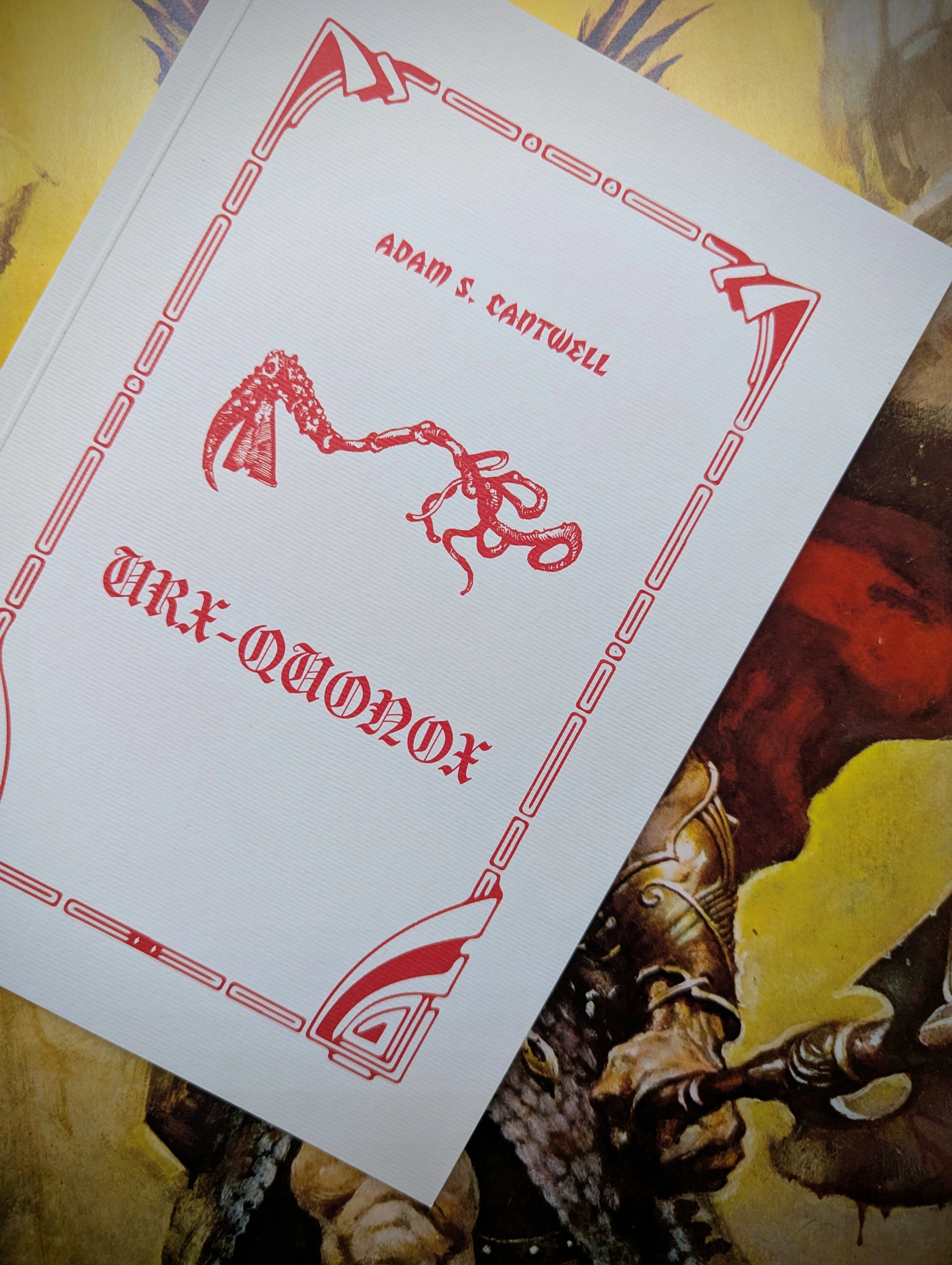
Backdrop on this and top image: Frazetta
Comments
Nothing yet. Say the first thing.
Sign in to join the conversation.