
Welcome to Stablecoin Blueprint, the weekly analysis about the opportunities and growth strategies in Stablecoin Payments and Onchain Finance
Got feedback or suggestions? Reply to this email or find my contact details online.
A few weeks ago, I argued that non-USD stablecoins will remain small relative to USD in the short term. The logic was simple: stablecoin market cap reflects demand for permissionless money. Today that demand is mostly dollars, driven by crypto trading (still the largest stablecoin use case) and by people escaping volatile currencies in places like Argentina, Nigeria, and Turkey.

Chuk@chuk_xyz
Why non-USD stablecoins won’t take off (anytime soon) Everyone asks: why are almost all stablecoins in U.S. dollars? After all, the dollar isn’t 99% of global trade or money supply. But that comparison misses the point. Stablecoins don’t mirror the world’s GDP, they mirror

2:18 PM · Nov 7, 2025 · 57.7K Views
54 Replies · 47 Reposts · 279 Likes
The feedback spanned a range of inputs: cross-border trade, tokenized local-currency investments, regulatory incentives, and programmability. But the question came down to how much those inputs translated into sustained balances, not just flows. The conversations lacked a shared model, so I’m introducing one that stablecoin issuers already know well:
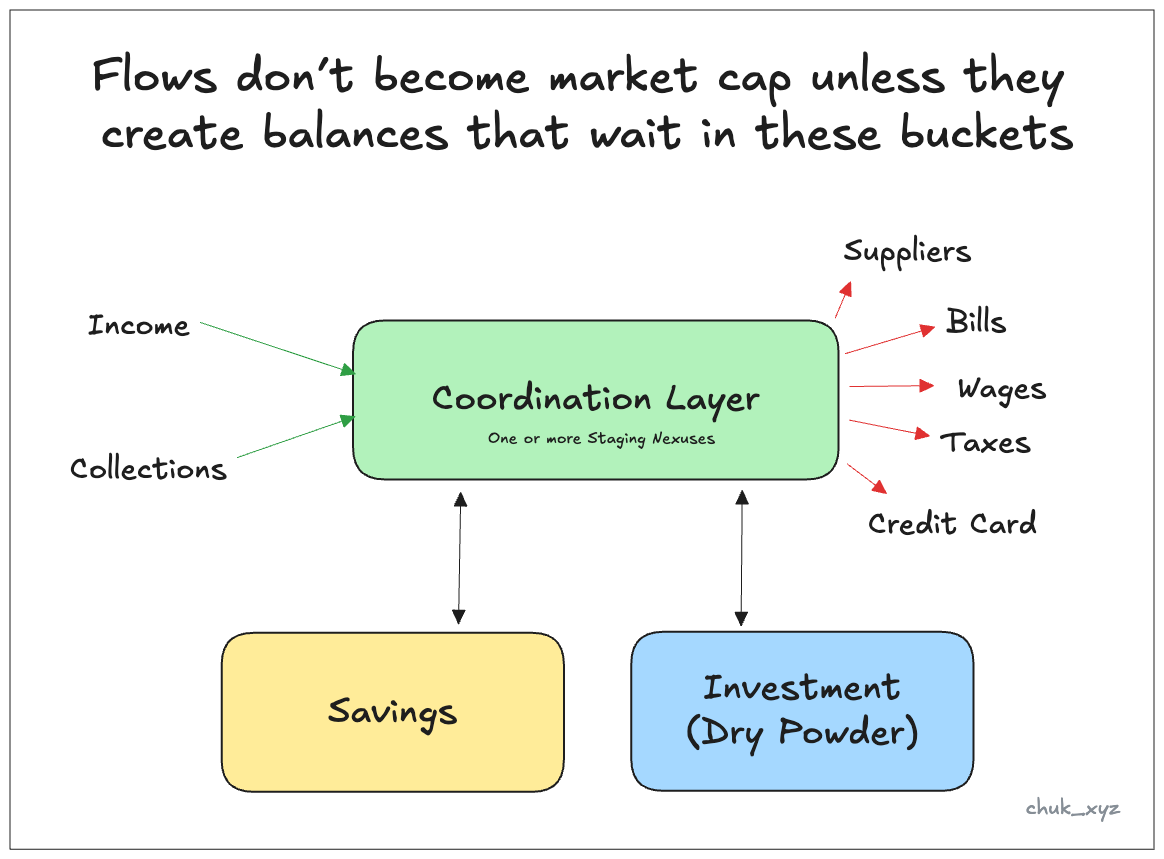
Flows don’t accumulate into balances unless they create a place where money waits.
Balances only exist in a few layers—coordination, savings, and investment—and each has different requirements. Once that’s clear, the argument reduces to timelines and probabilities.
Non-USD “stablecoins” are a messy bucket. Here I’m including (1) payment stablecoins (par instruments for payments/settlement) and (2) yield-bearing onchain cash products backed by high-quality liquid assets.
The distinction matters because payment stablecoins are usually regulated like e-money (1:1 redeemable, no or limited issuer-paid yield), while yield-bearing “stable” products tend to be treated as securities/collective investments, with tighter distribution and holder constraints.
I’m excluding tokenized deposits: they will drive large non-USD onchain cash, but they’re permissioned bank liabilities, not stablecoins.
The first balance layer is the coordination layer. It’s made up of staging nexuses, places where money sits between receiving and spending, while waiting for the next action. For retail, it’s checking accounts or wallets. For businesses, it’s operating cash that must be ready for payroll, suppliers, and tax. For institutions, it is operational liquidity tied to capital markets: prefunded balances and inventory. A staging nexus doesn’t have to be a bank account (Kenya’s mobile money float shows wallets can hold meaningful balances even at zero yield).
These balances persist for boring reasons that matter: obligations plus friction. Cutoff times, settlement delays, reconciliation, and “pull” mechanisms mean it’s risky to be in the wrong place when payments are due. Treasurers therefore keep enough in the staging nexus to meet near-term needs and buffers, and only move excess into higher-yield instruments. The coordination layer is optimized for reliability and control, not return.
This has a direct implication for non-USD stablecoins. If they are just a transfer rail that starts and ends in fiat, they can generate flows without creating durable balances. This is where “FX is huge” gets overstated. The BIS 2025 survey puts global OTC FX turnover at $9.6 trillion per day, with spot accounting for roughly 31% ($3 trillion) and the U.S. dollar on one side of 89% of trades. But turnover is not the same as cash that must sit somewhere to settle. Once multilateral netting is applied, the required funding collapses: CLS, the main payment-versus-payment (PvP) settlement system, reports that netting cuts gross payments by ~96% and total funding needs by ~99%. Most of that activity is institutional and still balance-sheeted in fiat. Moving the settlement leg onchain therefore requires two reinforcing shifts; more participants willing to hold non-USD balances onchain, and enough onchain FX liquidity to make doing so cheaper and operationally safe. Early on, that chicken-and-egg dynamic limits how much balance can “stick.”
To grow through the coordination layer, a non-USD stablecoin has to become the place money waits before it acts: collections in, payouts out, and liquidity managed 24/7. That requires becoming a more convenient staging nexus than banks and wallets, overcoming inertia and network effects, and meeting the bar for compliance, accounting, and operational risk. If that bar isn’t met, the stablecoin remains plumbing and the balances remain off-chain.
The second layer is the savings layer: money held to preserve purchasing power over time. In many emerging markets, this layer already splits by currency. People can earn and spend in local currency, while saving in a harder unit like USD. The “spend” rail and the “save” rail don’t have to be the same.
For non-USD stablecoins to scale here, they need to be a genuinely attractive savings instrument in that currency. Yield matters, but so does time-to-liquidity. Traditional savings products can be slow to enter and exit (cutoffs, T+1, holding periods). An onchain cash product competes by making savings mobile: easy to move, redeem, and rotate 24/7. Foreign demand can also matter: portable access to local money-market rates can attract non-resident balances.
Yield is an obvious wedge, but product form matters. As mentioned earlier, yield-bearing products can be securities-like, so they need to scale through regulated platforms or account-layer reward programs.
The third layer is the investment layer: “dry powder” parked at brokerages, exchanges, and investment apps between allocations. This pool is structurally persistent because investing is lumpy, settlement isn’t instant everywhere, and users value optionality. Even when cash is only a single-digit to low-double-digit percentage of customer assets, it becomes enormous at scale. For example, Schwab reports client cash at 9% of client assets at quarter end. Brokerages and crypto platforms alike often carry single-digit to low-double-digit cash-like balances as a share of customer assets.
For institutions, this layer also includes collateral and margin posted against positions. As tokenized funds and securities grow, onchain cash increasingly becomes the collateral and settlement asset. This is one of the biggest existing pools of cash-like balances that could migrate onchain with relatively little end-user behavior change, because platforms and custodians can shift the default. How far it goes depends on how much the onchain cash leg reduces end-to-end friction for a given market relative to implementation and coordination costs.
The common thread across all three layers is that balances don’t move onchain because people wake up wanting “stablecoins.” They move when the onchain cash leg unlocks higher utility density at lower friction. That’s the BaaS 2.0 story: if it becomes cheaper and faster for fintechs to build compliant financial workflows on top of onchain rails than legacy cores, users may never notice the stablecoin, but they will start keeping balances there.
Distribution is the second enabler. Platforms that already custody customer assets (brokerages, exchanges, wallets, custodians) can shift defaults and migrate balances with relatively little user behavior change. Infrastructure is the third: reliable on/off-ramps, 24/7 liquidity, and compliance and accounting tooling. Without these, money won’t “wait” onchain even if the tech works.
A plausible sequence: start with savings-style onchain cash (yield + time-to-liquidity), typically distributed through regulated platforms or account-level wrappers; then reuse that same onchain cash as the investment cash leg and collateral as tokenized assets and onchain markets mature; finally, coordination balances follow once onchain workflows are reliable enough to handle recurring obligations at scale.
Non-USD stablecoins are not missing demand for “better rails.” They’re missing durable balance sinks. Until non-USD onchain cash becomes the default staging asset for recurring actions, a credible savings wrapper, or the cash leg of investment platforms, it will stay plumbing. The path is clear: utility density pulls balances, platforms flip defaults, infrastructure removes friction. After that, the question isn’t “can it happen?” It’s “where first, and how fast?”
Thanks for reading!
Found this helpful? Let me know by clicking the like (🤍) icon and share it with someone who might find it helpful too.
Comments
Nothing yet. Say the first thing.
Sign in to join the conversation.