
There is a temptation whenever an insurgent candidate wins an election to assume voters have embraced the insurgent’s ideology.
And here we go again.
A socialist wins somewhere nobody expected a socialist to win. A progressive candidate runs better than expected among voters who don’t look particularly progressive on paper. A Muslim candidate succeeds with voters who, according to our increasingly rigid demographic theories of American politics, aren’t supposed to vote for him.
And immediately the ideological interpretation begins.
See? The Democratic electorate is moving left.
Socialism is having a moment.
The old Democratic Party is dying, and a new, more progressive one is taking its place.
Maybe.
But I think there is another possibility we ought to consider before declaring an ideological revolution:
Donald Trump is so unpopular that even socialist candidates who are Muslim can win.
And that’s a statement about Trump and the political system he’s dominating at least as much as it is a statement about socialism.
I don’t believe half the Democratic electorate has suddenly become socialist. I don’t believe Grand Rapids, Michigan, the city Gerald Ford represented for a quarter-century, suddenly became a hotbed of socialism.
I think Grand Rapids is simply pissed.
Those are very different conclusions.
So when somebody like Abdul El-Sayed attracts voters outside what we would normally consider the progressive base, my first question isn’t: When did all these people become socialists?
It’s: What is he saying that they desperately want somebody to say?
And I think the answer begins with something much simpler than ideology.
This isn’t working.
The people running things screwed it up.
The institutions aren’t listening.
Something has to change.
Right now, the people most willing to say those things forcefully are disproportionately coming from the ideological edges of our politics.
On the Democratic side, it’s the progressive and democratic-socialist insurgents.
On the Republican side, it has been Trump and the nationalist right.
And this is where I expect to irritate committed partisans on both sides.
The progressive left will say I’m minimizing an actual ideological realignment. There goes “both-sides Chuck Todd” again, refusing to acknowledge that voters actually want the progressive revolution. Doesn’t he realize how popular some of these ideas are?!?!
The Trump right has spent a decade making the mirror-image argument essentially: You still don’t get it. Trump fundamentally remade the Republican electorate. Voters want America First nationalism. They want the revolution.
Maybe the most committed voters in both movements really do.
But intensity isn’t the same thing as size. And an election result isn’t an ideological survey.
In a two-party system especially, voters are constantly forced to choose between imperfect vehicles. If you believe the status quo has failed and only one candidate seems willing to say so, voting for that candidate doesn’t mean you have adopted everything that comes afterward.
Sometimes you’re simply voting for the person who noticed the fire while everyone else was arguing about why it was suddenly getting so hot.
American political history is filled with winners who mistook that vote for something much larger.
The Biden Warning
Democrats don’t have to travel very far back in history to see how easy it is to misread an election this way.
Just go back to 2020.
Remember what Joe Biden actually represented during the Democratic primaries.
Biden wasn’t the candidate of progressive revolution. Quite the opposite. Democratic primary voters eventually turned to him after deciding that defeating Donald Trump mattered more than conducting an ideological experiment.
His general-election proposition became simpler still:
Enough.
End the chaos.
Restore some competence and normalcy.
Get Trump out of the White House.
Biden won.
And then, following the surprise Senate wins in Georgia on Jan. 5, followed by the attempted insurrection on Jan. 6, too many people around Biden interpreted that victory as something larger: a mandate for a more transformational presidency and an electorate prepared to move substantially further left than the coalition that had actually elected him.
To be sure, there were reasons for this. The pandemic had transformed the role of government. Democrats controlled Congress. Progressives had become more influential inside the party. And Biden himself wanted a consequential presidency.
But none of that changed the most important message voters had actually delivered in November.
They had simply fired Donald Trump.
That wasn’t necessarily the same thing as endorsing everything Democrats wanted to do next.
Four years later, voters fired the Democrats.
And now Trump is making precisely the same mistake.
Americans were furious about the chaos at the border. They thought Biden had lost control of immigration. They were angry about inflation and the cost of living. They were exhausted by a presidency they increasingly viewed as feeble and ineffective.
Trump heard all of that.
What isn’t remotely clear is that those voters therefore wanted to end immigration as we’ve known it, embrace every maximalist version of mass deportation, or construct some nativist vision of America in which anyone who wasn’t born here is regarded with suspicion.
Nor is it clear that a voter who thought globalization had damaged American manufacturing was casting a ballot for a sweeping trade war and dramatically higher tariffs so that the cost of living would rise even higher.
Maybe some were.
Certainly some in the ideological MAGA movement were.
But the election itself doesn’t establish that.
It establishes that voters preferred Trump to the alternative.
That’s it.
And before Democrats decide that the success of progressive insurgents means voters have now endorsed a socialist transformation of their party, they might want to consider the possibility that they are about to make the same mistake.
The Governing Class Forgot How to Campaign
There is another reason the revolutionaries keep getting an opening.
The governing wings of both parties have forgotten one of the most basic rules of politics:
Campaigning is mostly about agreeing with voters. Governing is frequently about persuading them.
Somehow our political establishment has managed to reverse the two.
During campaigns, the governing class spends way too much time explaining or, to be more generous about it, “educating” voters.
The economy is actually better than you think!
The legislation we passed was more consequential than you realize.
The border isn’t quite what you’re seeing.
Inflation is coming down.
Crime statistics don’t support your perception.
The experts say this.
The data says that.
Sometimes those things are even true. It doesn’t matter.
If a voter is telling you, “My grocery bill is killing me,” beginning your response with a chart showing that the rate of inflation has declined isn’t persuasion. It’s an argument over whether the voter’s experience is legitimate.
And, well, guess what you just did?
You insulted the voter’s intelligence.
You’re going to lose that argument every time.
This is where insurgents have an enormous advantage.
They agree with the voter.
“Yeah, groceries are too expensive. Yeah, buying a house has become absurd. Yeah, Washington isn’t listening to you. Yeah, the border became a mess. Yeah, the people running this party screwed up. Yeah, something is wrong.”
Now you’ve established trust.
Only then do you get to argue about what to do about it.
Think of it as a visit to the doctor.
You know something is wrong.
You see three doctors.
Two tell you the tests look pretty good, and perhaps you are imagining your symptoms.
The third says: Yeah. Something doesn’t look right here.
Which doctor are you going to keep talking to?
You may eventually decide his treatment is nuts.
But at least he’s looking at the same patient you’re looking at.
That’s what Donald Trump understood instinctively in 2016.
Forget for a moment whether his diagnosis was accurate in every particular instance. Politically, he understood that millions of Americans believed the system wasn’t working for them.
He didn’t tell them they misunderstood the economy.
He told them: You’re right.
They’re screwing you.
And once he established that agreement, voters gave him extraordinary latitude on the cure.
Progressive insurgents are now discovering the same thing with Democratic voters.
The Democratic establishment wants to talk about all they really got done during the Biden years.
The insurgent says:
They screwed this up.
And the frustrated Democratic voter says:
Finally. Somebody sees what I see.
The irony is that governing requires almost the opposite skill.
Once you’re president, sometimes you have to tell people things they don’t want to hear.
You can’t have every government benefit you want without paying for it. You can’t fix a housing shortage without building things somewhere people would rather you didn’t. You can’t control a border without making choices that will anger parts of your coalition. You can’t eliminate every economic disruption with a tariff. You can’t simultaneously promise Americans inexpensive goods and make imported goods dramatically more expensive.
Governing requires persuasion. Campaigning requires listening.
Yet our establishment politicians increasingly lecture while campaigning and pander while governing.
It’s almost perfectly backward.
And it helps explain why insurgents have become so powerful.
They’re doing the first part correctly. They’re acknowledging the anger and validating the diagnosis.
The question voters often don’t confront until later is whether the insurgent’s treatment bears any relationship to the illness.
And this is hardly a new phenomenon.
Voters Send Telegrams. Politicians Read Love Letters.
Start with 1932, because it’s the case everybody remembers backward.
Franklin Roosevelt did not run for president promising the New Deal we now associate with his presidency. The Democratic platform actually promised “an immediate and drastic reduction” in federal expenditures, including a 25 percent reduction in the cost of government, along with a balanced federal budget. Roosevelt himself repeated the 25 percent pledge during the campaign.
Obviously, circumstances intervened. Roosevelt inherited a banking catastrophe and an economic emergency that demanded action and, well, not reductions in spending.
But whatever voters thought they were ratifying in November 1932, they weren’t voting on the New Deal. They were firing Herbert Hoover.
Four years later, there was much less ambiguity.
Americans knew what Roosevelt had done. They reelected him with more than 60 percent of the vote.
That’s a mandate.
And even that mandate had limits.
Roosevelt subsequently tried to expand the Supreme Court. The Senate rejected the court-packing plan 70–22, with dozens of Democrats opposing their own president. Then came the 1938 midterms and the loss of 72 Democratic House seats.
Voters had endorsed Roosevelt. They had endorsed relief, Social Security, and much of the New Deal.
They hadn’t handed him a blank check.
Lyndon Johnson discovered something similar.
Johnson won more than 61 percent of the vote in 1964 and proceeded to enact one of the most consequential domestic legislative programs in American history: Medicare, Medicaid, federal aid to education and much more.
Then came 1966.
Republicans gained 47 House seats, three Senate seats, eight governorships and hundreds of state legislative seats. Of the 38 House seats Democrats had flipped in the 1964 landslide, only 14 remained Democratic two years later.
The Great Society survived.
The mandate to keep expanding it did not.
Ronald Reagan provides an even more revealing example because the resistance came almost immediately.
Reagan’s 1980 victory is remembered as the beginning of the Reagan Revolution. But there was an argument even then over whether voters had embraced conservatism or simply rejected Jimmy Carter amid inflation, economic stagnation, and the Iran hostage crisis.
Within months, Reagan found one boundary.
His own Republican-controlled Senate voted 96–0 for a resolution rejecting proposals that would “precipitously and unfairly penalize early retirees.”
Ninety-six to nothing.
Apparently the Reagan Revolution had a Social Security clause.
The 1994 Republican Revolution may be an even better example of what voters actually do when they want change without surrendering the system to one side.
Republicans captured the House for the first time in four decades. Newt Gingrich and congressional Republicans interpreted that result as a mandate for sweeping change, pushed their confrontation with Bill Clinton into two government shutdowns, and picked a politically dangerous fight over Medicare.
Then voters did something revealing in 1996.
They reelected Bill Clinton.
And they kept the Republican Congress.
In other words, voters didn’t exactly repeal the Republican Revolution. They put a governor on it.
They hired Clinton to restrain Gingrich and Gingrich to restrain Clinton.
That may be one of the purest expressions of what I mean by a reset rather than a revolution: voters deciding that neither side should get everything it wants.
Barack Obama won decisively in 2008 with large Democratic congressional majorities. Democrats enacted the Affordable Care Act.
Then they lost 63 House seats in 2010.
Trump ran in 2016 promising to repeal Obamacare. Republicans won.

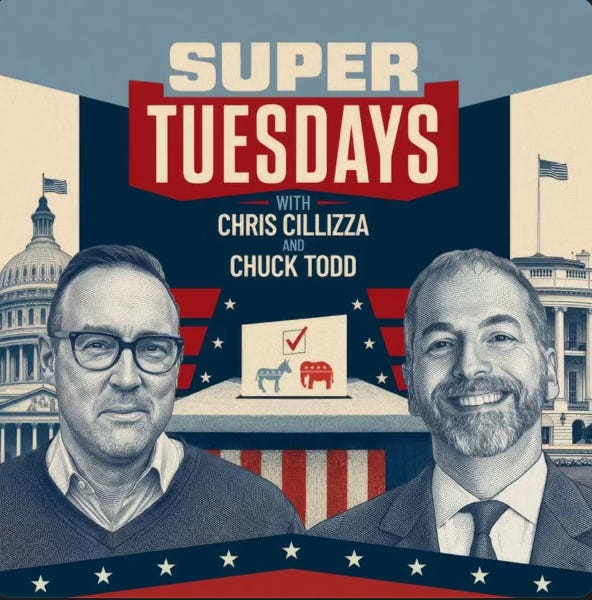
With 84 days until the midterms and a six-state primary night ahead, Chris Cillizza and I open with what may be my least-hedged take of the cycle: Democrats haven’t had a great summer, but Republicans have had a worse one, and nearly every macro trend points toward Democrats picking up something in the neighborhood of 30 House seats and six or seven Senate seats. The only thing keeping me from calling it a complete pasting is the Democratic brand problem, so we dig into the polling behind it—including why I think Hillary Clinton’s warning about attacks tying Democrats to socialism and communism deserves more attention. We also discuss whether Abdul El-Sayed needs to directly address questions about his faith, why I think the traditional advice to ignore the issue is misguided, and whether candidates like Josh Shapiro, Jon Ossoff, Rahm Emanuel, or JB Pritzker could eventually face similar questions about balancing loyalty to the Constitution with support for Israel.
In the second half, Chris and I break down how to read political spin in today’s environment. We discuss Tim Scott’s prediction that Republicans will hold 54 Senate seats, why politicians are increasingly punished for telling uncomfortable truths, and how the media sometimes reinforces that dynamic. We also unpack AOC’s eventful weekend, what it says about positioning for 2028, whether parenthood remains an underrated political asset, and what we’re seeing from potential Democratic contenders like Ossoff and Shapiro. We wrap up with a spirited conversation about Bill Cassidy’s Blanche vote, the pressure senators face today, and—because we can’t help ourselves—a detour into Nationals and Reds baseball.
Listen HERE.
No posts
Comments
Nothing yet. Say the first thing.
Sign in to join the conversation.