
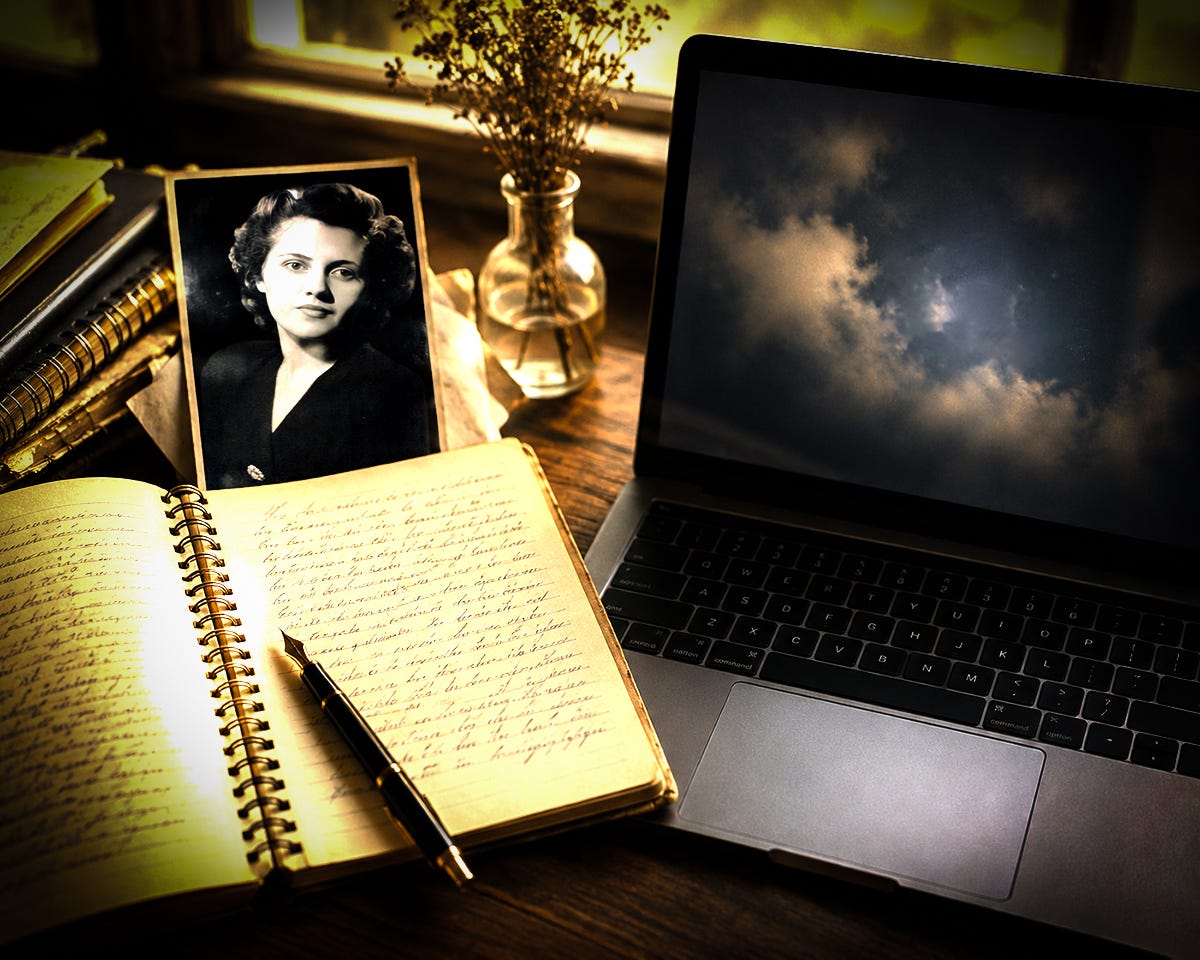
When my mother died, I discovered she had spent a lifetime writing, fully expecting that her private thoughts would remain private. Knowing that, I've watched the public dissection of Anthony Fauci's diaries with growing discomfort. His most personal reflections are now public, mocked by people determined to destroy him.
Clearly, Fauci is human and made mistakes—perhaps his biggest was putting his most private thoughts in a place that others could access. A reminder to all of us who write and store our work “in the cloud.” Ain't nothing private up there—which is to say, it's not really "up there" at all, but stored on giant servers all over the world.
I have a sense that Fauci, as do many others, writes to make sense of the world. I do; my mother did. Below is a blog post I wrote about her when she was dying—and I was invading her privacy when I started cleaning out her overstuffed storage areas and finding a lifetime of her writings.
Here’s what I shared publicly about it:
I began going through my mother’s correspondence yesterday—three crates full of copies of letters she had written, along with many that had been written to her.
It is dawning on me that my mother may have been what is called “hypergraphic.” It appears she documented nearly every detail of her life. She wrote pages and pages each day, first by hand, then later transcribing much of it onto her trusty typewriter, and eventually onto a computer.
I remember her delight when she first got that electric typewriter after years of carbons on the old manual one. In time, my brother, sister and I provided her with a computer. She never quite grasped the mystery of saving documents on it, but she loved the freedom of simply printing two copies of everything—one to send and one to keep. Or pile, more accurately.
Hundreds of spiral notebooks have already gone into the recycle bin. I am not a careful historian. For the sake of my own mental health—and the need to bring some order to all of this—most of it must go. My mother was not a public figure whose every word will be archived. She was ordinary—in her own unique and extraordinary way of being ordinary.
I Googled her yesterday: “Eileen H. Thomas.” The only place she appears is in the obituary that ran last week.
Before Google, there were clipping services—people who combed through newspapers and saved any mention of a name. I found a small folder of yellowed articles: her early job as a nurse’s aide, her recognition as a beauty queen, her engagement, her wedding. These fragments remain. The rest fades quickly.
I know I cannot keep all these letters. Even organizing them would take days—time and energy I do not have. In an ideal world, they would be scanned, preserved, perhaps even shaped into a book.
But I know myself.
I am my mother’s daughter. This would likely become one more unfinished project, something begun with good intentions and left incomplete. And then someone else would one day have to sort through my leavings, just as I am sorting through hers.
But there was a great deal more that I never shared with anyone, even my siblings. I saw her private agonies, her unending distress over her nightmarish marriage to my father, that outwardly sophisticated, urbane man, and the private mean, often nasty person who heaped upon my mother the worst of himself.
I read of her pain over the decisions her three children made, particularly as we aged into our later teen years and then into young adulthood. I wept as I noted how difficult it was for her to care for her own mother, a dear, sweet woman but with many limitations who lived with my parents from the time I was four years old until her death when I was thirty.
I saw her many attempts to remake herself so she could find a way to avoid the pain of her marriage. I began to understand her addiction to romance novels—they gave her a place to escape.
She died thirteen years ago. There are times when I deeply regret my decision to dispose of most of those memories, but I also realize I would prefer that my own children dispose of my memories, preferably unread.
Some I’ve already purged: private moments of agony so deep I did not think I would survive, written with graphic descriptions. But I’m nearly as hypergraphic as my mother—only my mountains of words are electronic, stored in endless online files, rather than endless spiral notebooks. Do I want them to stay private? You bet I do.
What is being done to Dr. Fauci is a national disgrace—he is being treated in a way that no one would choose for themselves.
Rand Paul and others of his ilk are seeking to drag Dr. Fauci’s most private thoughts into the public square for ridicule. This is just sick, and a symptom of how degraded our society has become.
How would you want someone to treat the words you wrote on your very worst day?
Who among us has not made the occasional mistake in judgment? Who among us has lived in utter purity and perfection of motive and deed? Who among us desires this kind of mistreatment? Not a single one.
Please let us return to decency by remembering that every human being deserves a private place to wrestle with the hardest parts of life.
Let me ask: How do you want your private words treated?
Comments
Nothing yet. Say the first thing.
Sign in to join the conversation.