
Increase your understanding of art and gain access to new art history insights each week by becoming a paid subscriber:
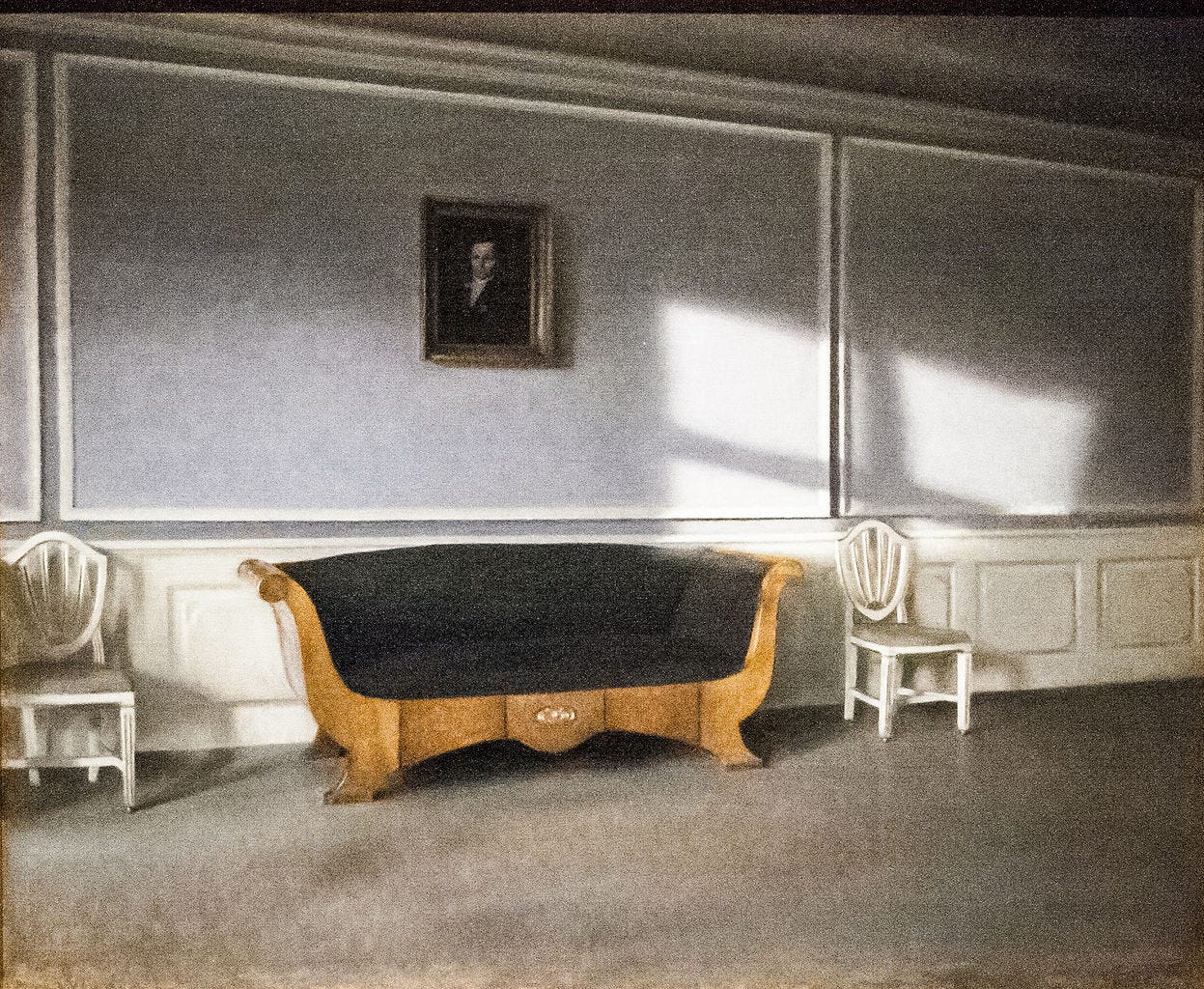
Some artists paint in order to add spectacle and drama to the world; others use their art to connect to silence. Vilhelm Hammershøi was one of the latter.
Hammershøi invested so much meaning into the quietude of an empty room. His paintings consist of half-fogged interiors that draw our attention to the benefits of simply being, so that we might notice more and at the same time find our own internal noise calmed.
His paintings are the opposite of the modern-day selfie photograph. Instead of saying “Look at me and what I’m doing”, their claims are in support of introspection, along with a plea for modesty in the act.
Why we should wish to linger over the sight of an empty couch or a moonlit window his paintings answer by insisting — implicitly — that some of the most meaningful encounters we might have occur in our most private moments.
As Hammershøi said, “I have always thought there was such beauty about a room even though there weren’t any people in it, perhaps precisely when there weren’t any.”
On display, therefore, is a sensibility: an artist’s wish to see the world as a series of opportunities for what solitude and reflection can bring.
Hammershøi was born in Copenhagen, Denmark, in 1864. He spent most of his life in the city of his birth. He trained at the Royal Danish Academy of Fine Art, taking lessons from the painter Niels Christian Kierkegaard — notably, the cousin of the philosopher Søren Kierkegaard.
Many of his most effective paintings were completed inside his Copenhagen home, with his wife Ida acting as the model, whom he married in 1891.
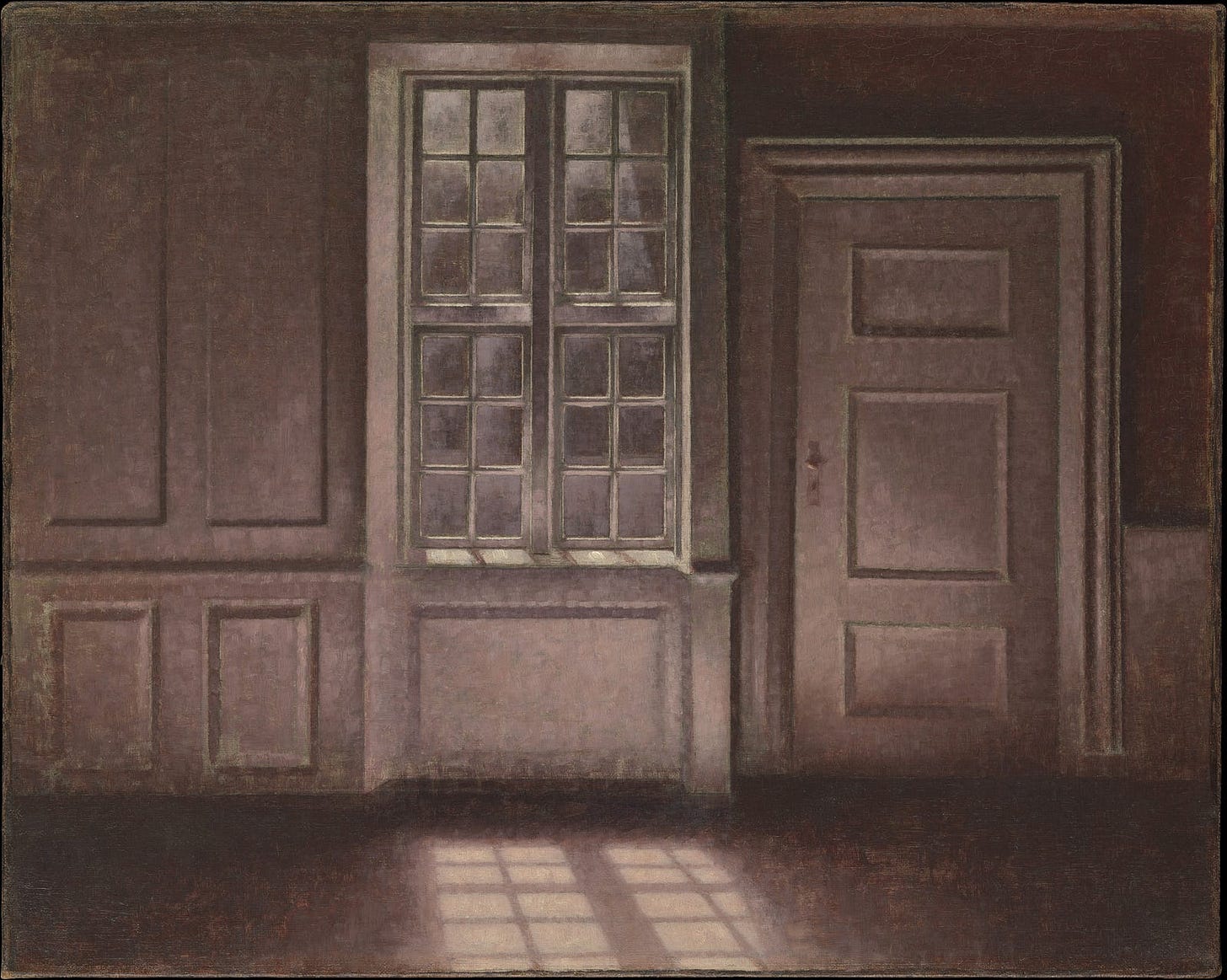
In these images we encounter little but the empty spaces of a well-to-do homestead. The feeling is both pensive and, I think, uplifting. Part of the reason for this is that you can sense Hammershøi’s deep affection for his subject matter, his keen eye for composition and design, and his masterful command of the subtle qualities of paint.
These are paintings that revel in the act of noticing the smallest shift of light and shade. Rays of light penetrate a room through the restricted aperture of a windowpane. Shadows fall according to the location of a doorframe or a piece of furniture.
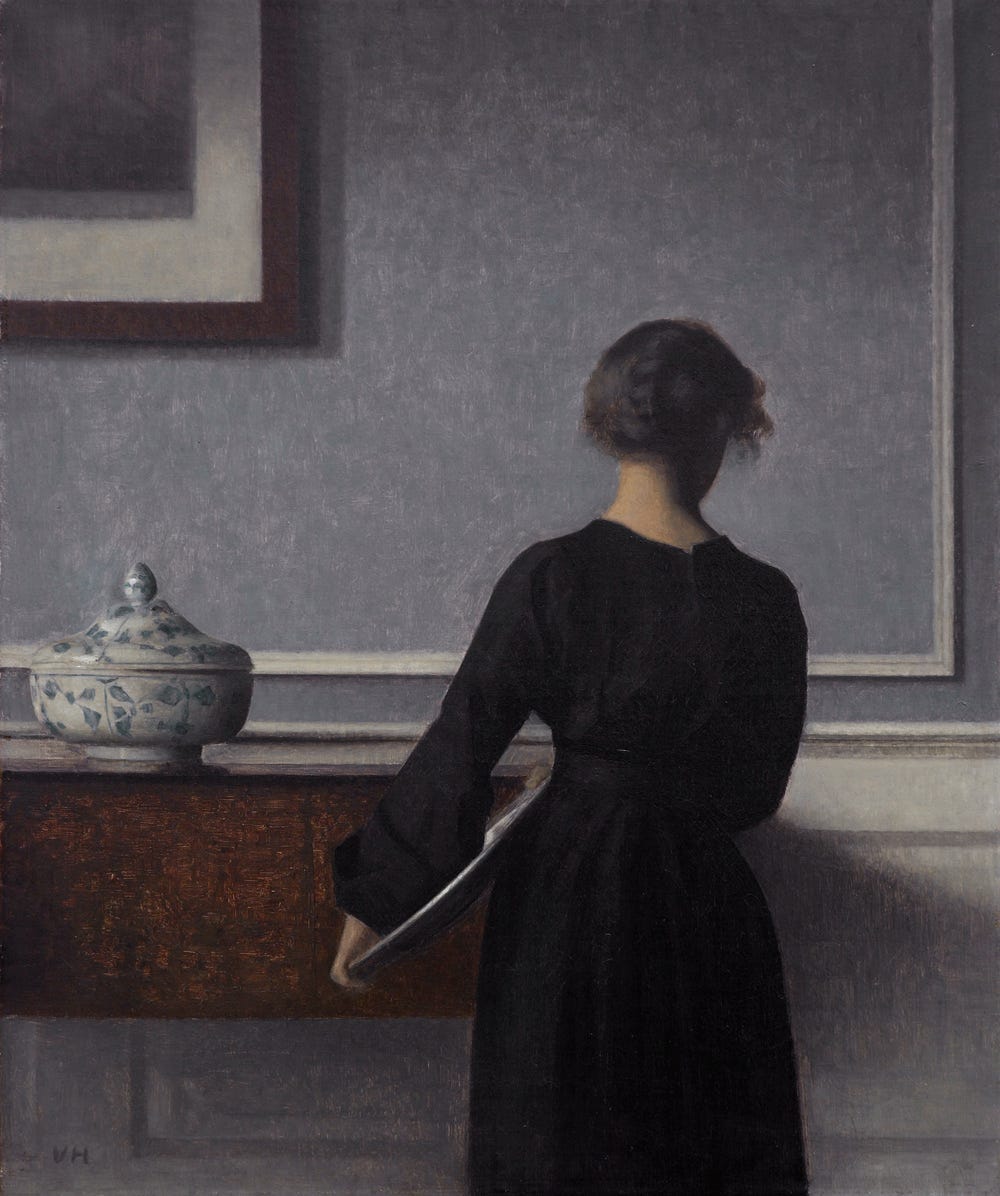
One important tradition in Northern European art is the figure seen from behind, usually peering out over a far-reaching landscape, as one finds in the paintings of Caspar David Friedrich.
Hammershøi adopted the same method, but instead of standing before an open vista, his figures tend to be turned towards a blank wall. The painting shown above, Interior with Young Woman from Behind (1904), has Ida holding a silver tray, paused before a sideboard. She is all but expressionless, until we notice her gentle tilt to the right, counterbalanced by the diagonal shard of silver from the tray.
The formal design is elemental: a sequence of nested rectangles, of horizontal and vertical lines broken by the figure’s organic posture. Light falls across her neck, skin and shadow standing out against the pale background.
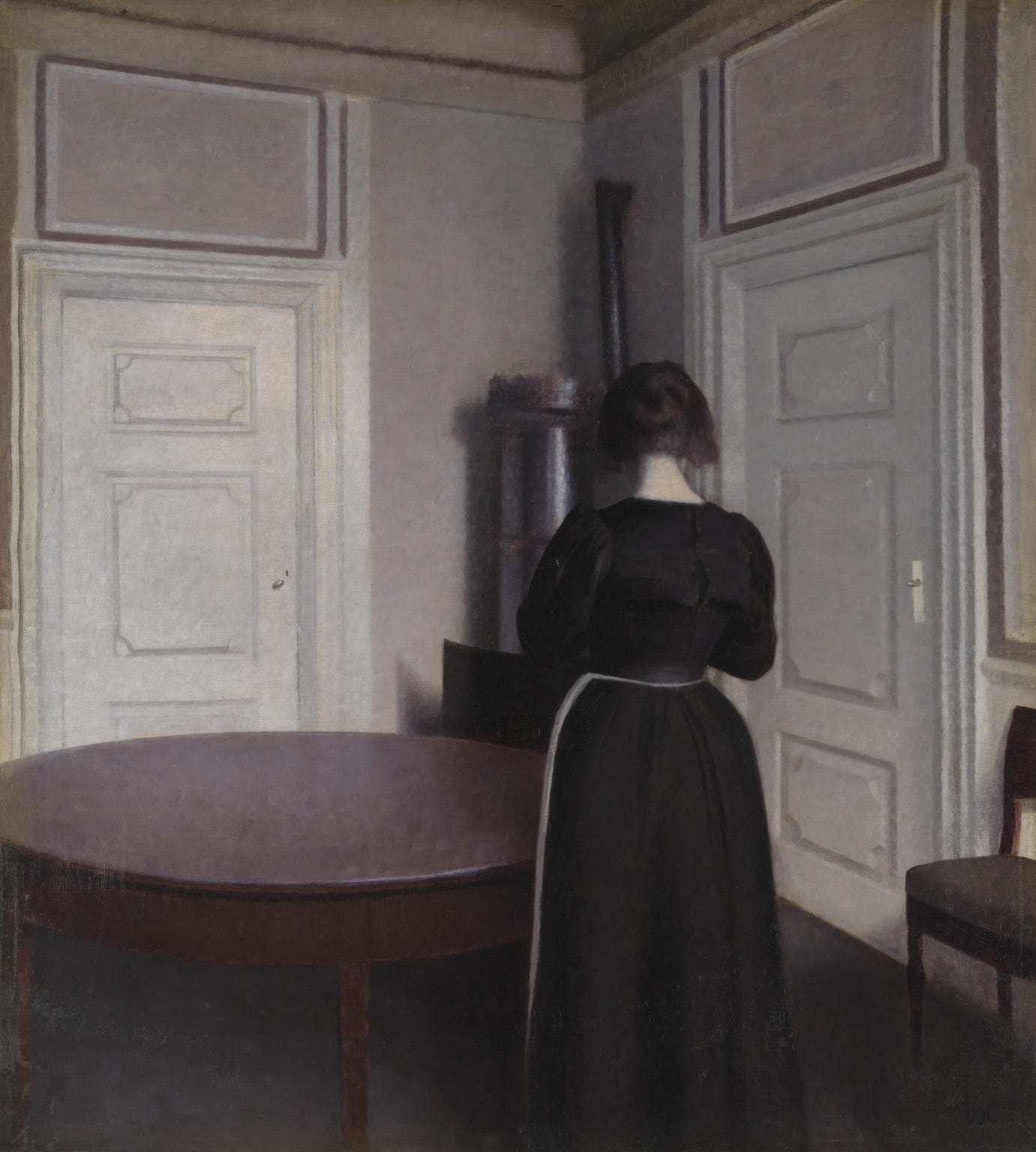
Ida’s exposed neck often appears as a small A-shaped area of light. Whilst melancholy is clearly in the air, for Hammershoi solitude appears to have provided something nourishing too. These paintings honour the virtues of silence, patience and the capacity to be alone.
Later in the century, the American artist Edward Hopper would do something similar. But whereas Hopper sought to elucidate the spectrum and frequency of American alienation, Hammershoi’s concerns were more existential — you might say more Scandinavian.
It was an atmosphere that brought him critical and commercial success. Over the following decades, he grew a following of artists and intellectuals, which included Rainer Marie Rilke and Emil Nolde among his admirers.
Hammershøi’s work was substantially at odds with the avant-garde of his time. Contrary to the Modernist methods of the early 20th century, which tended towards a bright colour palette, his tones were nearly always muted and his style avidly representational.
Yet despite the controlled range of his palette, Hammershøi’s use of colour was in fact remarkably subtle. Exploring shades of mauve, pale yellow and grey, he created beautiful and sophisticated vibrations of tonal harmony.
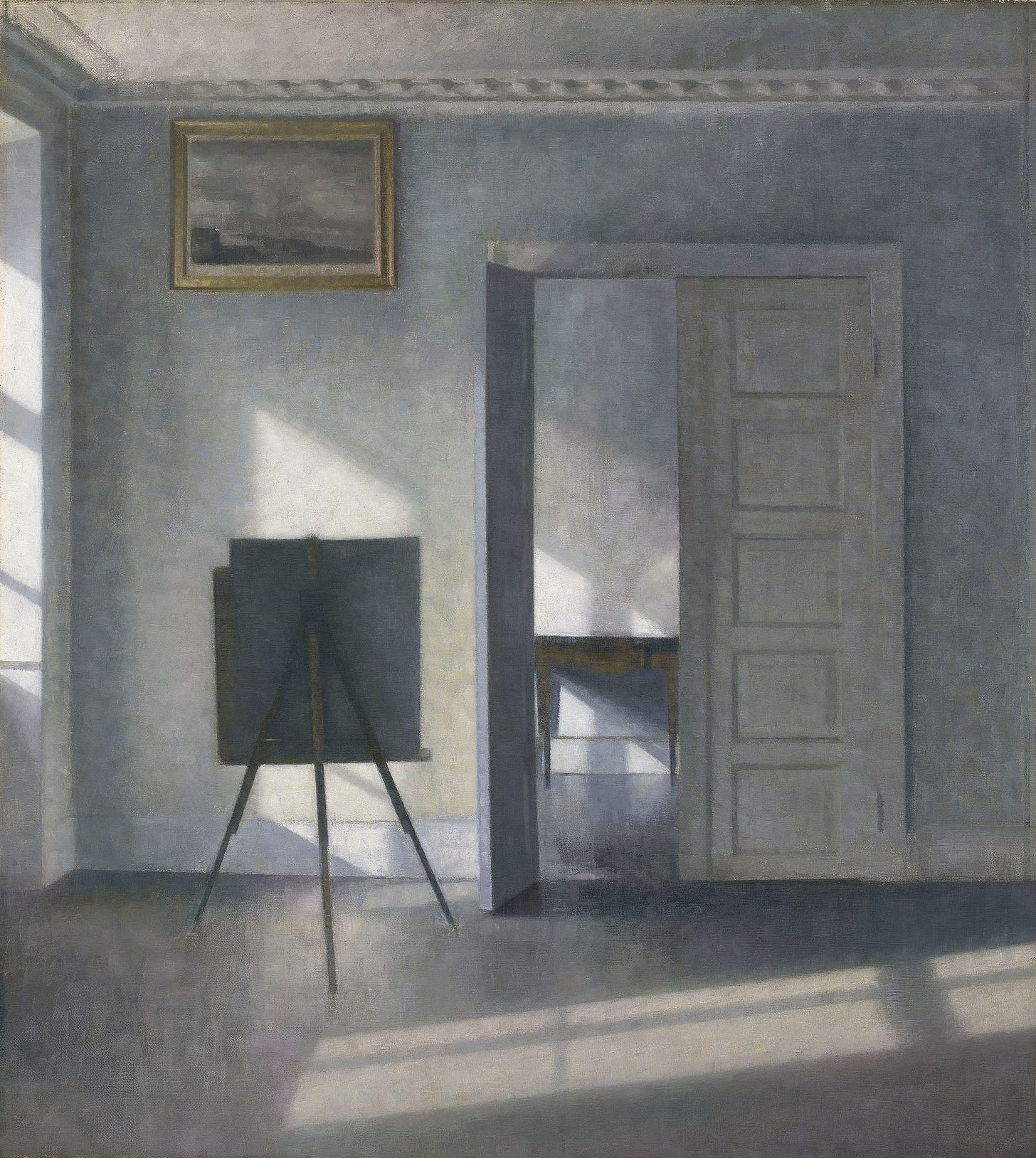
This is perhaps most clearly seen in Interior with an Easel (1912), where multiple light sources slice through the space in dynamic prisms, intensified by the strict rectilinear lines of the architecture. The painting hums with subtle experimentation in tone, contrast and modulation.
These artworks, I think, sum up Hammershøi’s proposition as an artist: the ability to look and appreciate what others tend to miss. Hammershøi’s paintings remind us that solitude can also be a presence: a state in which attention deepens and the mind finds room to settle.
I wish you well,
Chris
P.S. Want to become a paid subscriber to get more posts like this? Increase your understanding of art and gain access to new art history insights each week.

I’m Christopher P Jones — art writer and author of the Looking at Art series of books. You can find out more at chrisjoneswrites.co.uk and my regular blog on Medium.
No posts
Comments
Nothing yet. Say the first thing.
Sign in to join the conversation.