
Before we begin, why not become a paid subscriber? You’ll get more art history insights and support me to create future editions of this newsletter.
Dear Reader,
One of the biggest cultural events happening in London this summer is an exhibition of paintings by Frida Kahlo at Tate Modern.
Yet, I admit, I’ve felt a degree of ambivalence about the prospect. Let me explain.
Kahlo’s face is now so familiar that it adorns t-shirts, tote bags, coffee mugs and pyjamas. She has become one of those rare figures whose image threatens to overwhelm her achievements. When an artist becomes a global brand like this, the intricacies of their paintings can get diluted by commercialisation.
Coming to write this piece, however, I found myself changing my mind. What strikes me was the sheer force of her creative drive. Again and again, physical suffering and personal upheaval threatened to curtail her work, but instead they galvanised her.
Her urge to create seems to have been irrepressible, giving rise to her own artistic language that leaves an indelible mark…
Anyone acquainted with Kahlo’s work will also be aware of the defining event of her life. Just over a hundred years ago, on 17 September 1925, she was returning home from school when the wooden bus she was travelling on collided with an electric trolley car. She was eighteen at the time.
After the crash, rescuers found her impaled by a metal handrail that had passed through her pelvis. It had punctured her abdomen and uterus in the process. She suffered multiple fractures, including to her spine, collarbone and right leg. Her right foot was crushed, her shoulder dislocated, and doctors later discovered that several vertebrae had also been displaced. She never fully recovered and would undergo more than thirty operations while spending much of her life in orthopaedic corsets, some made of plaster (which she decorated), some made of steel, and others of leather.
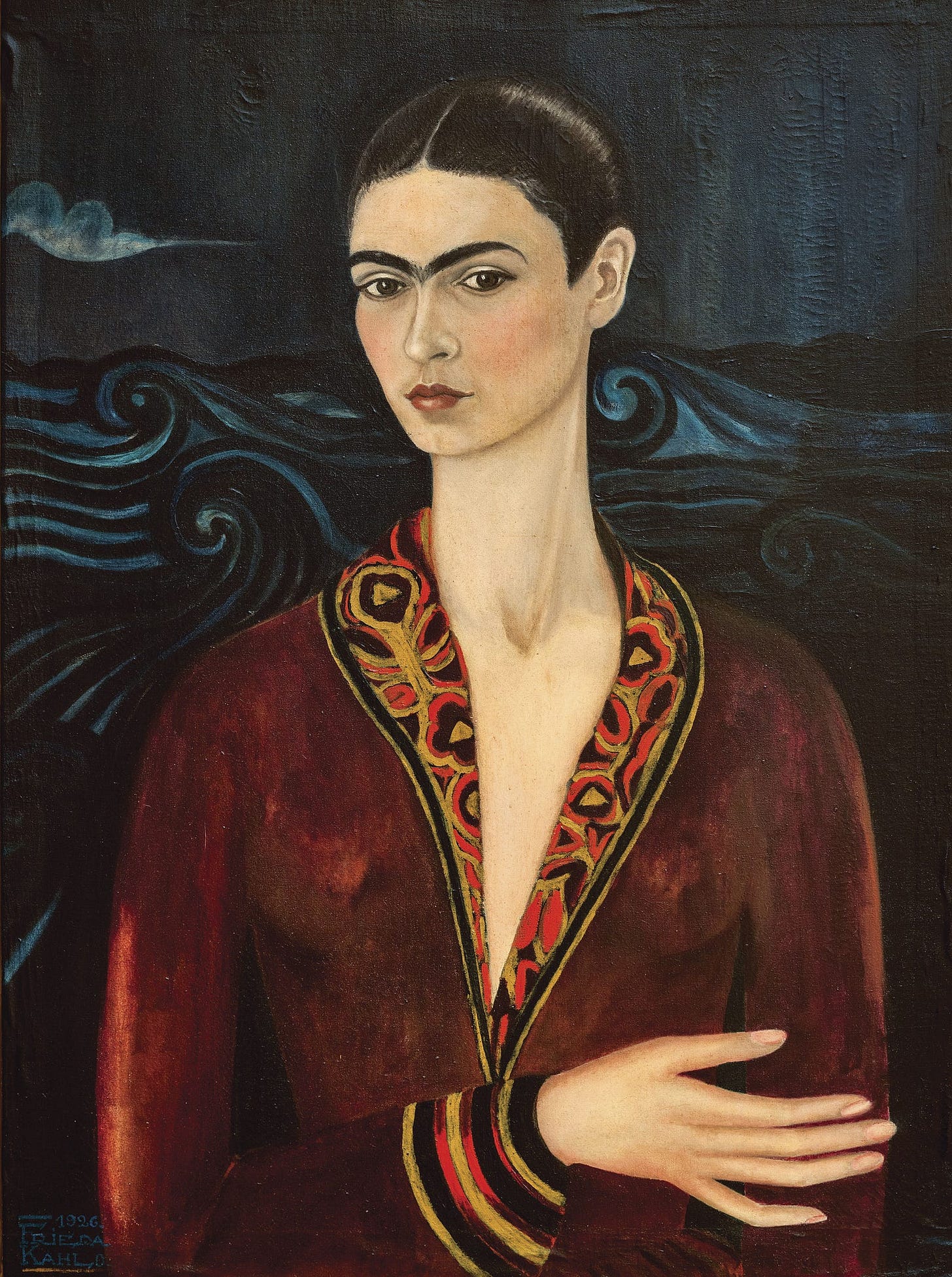
After the accident, bedridden for months, Kahlo passed the time by painting. At some point, her mother fixed a mirror above her bed and she began to paint herself.
In 1926 she produced Self-Portrait in Velvet Dress, considered her first serious work, which she gifted to her then-boyfriend, Alejandro Gómez Arias, who was also on the same ill-fated bus. With the sonorous reds of her coat and the rolling deep blue waves of the backdrop, it feels like an optimistic, even auspicious portrait. The future has not been degraded — so the image seems to declare — despite the damage done.
If the prospect of reinvention through art had now entered Kahlo’s consciousness, then it was a seed likely planted many years before.
At the age of six she contracted polio, a disease that left her right leg weakened and gave her a lifelong limp. She was mocked by other children and was reportedly nicknamed “Peg Leg Frida”.
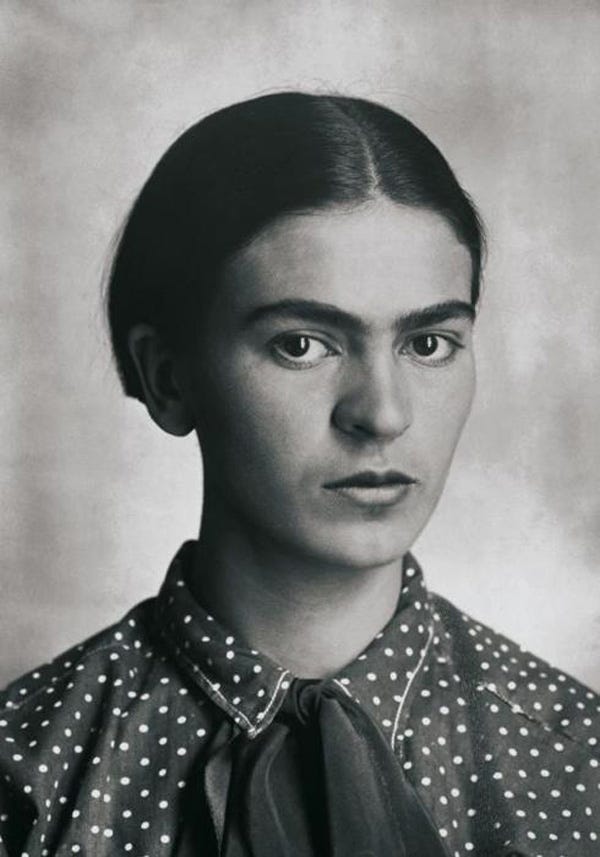
Her father, a professional photographer, often captured Frida and himself, turning the camera inwards. Frida was initially shy, but this hesitancy gradually gave way to an awareness of the possibilities of controlling her own image. In these early encounters with photography, it seems she learned that appearances were provisional and that a surface layer could be revised or embellished.
When she began making art, it quickly became a way of reclaiming her own image, of controlling the exact degree of light and dark she wanted others to see.
Self-portraiture became Kahlo’s principal idiom, and few artists have explored their own image with such an unsparing eye. Over one-third of her entire output was self-portraiture, and it is impossible to understand her art without reference to the adversities they depict.
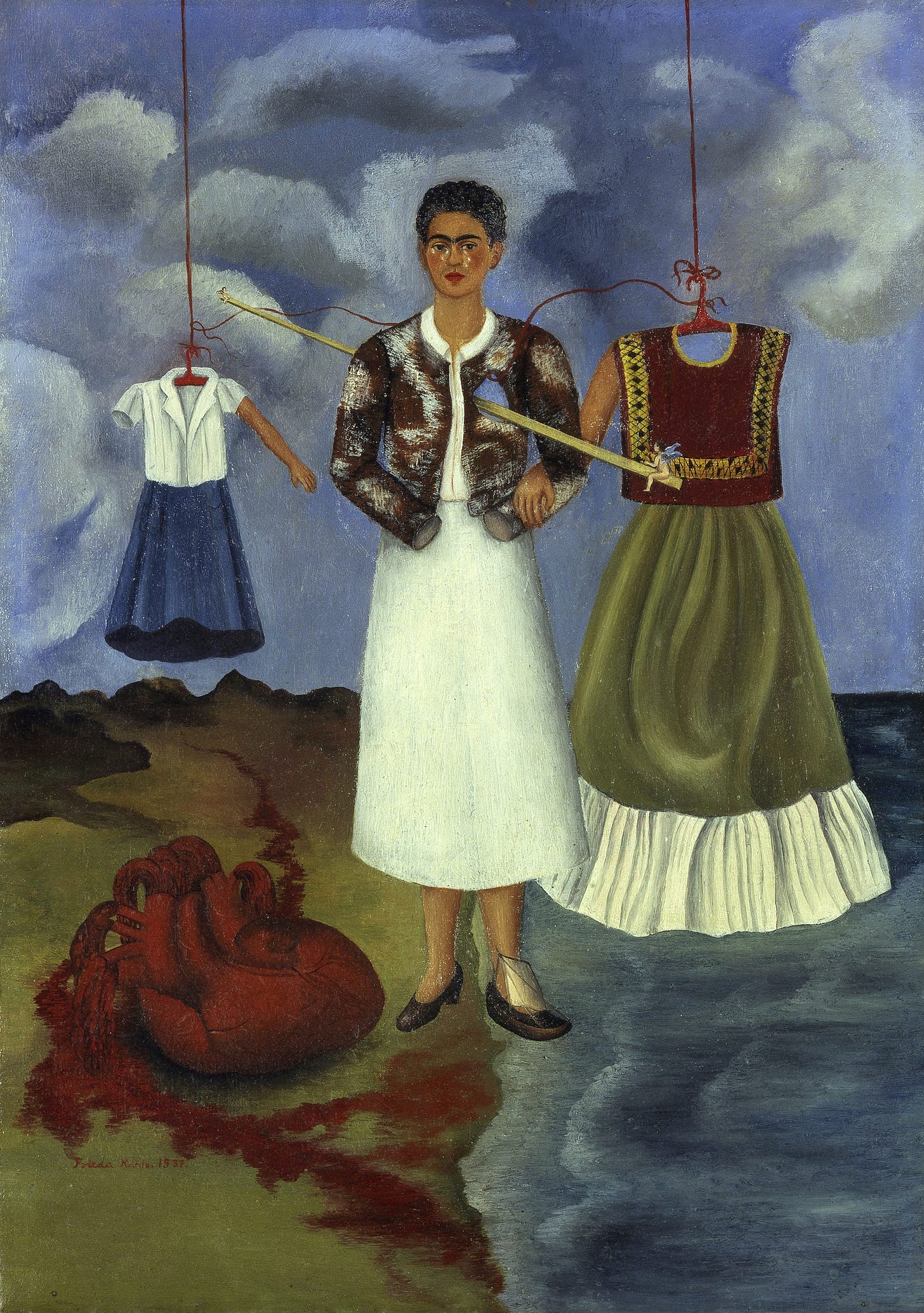
Take a painting like Memory, the Heart from 1937. It came after she had her heart broken by a lover’s infidelity, and the resulting artwork is ruthless in its elucidation. A cold metal rod impales her through the empty chest, with tiny Cupids on either end sitting on a seesaw. Meanwhile, the clothing references her shifting identity, from schoolgirl to self-conscious Mexican woman.
And even when she didn’t portray herself, her subject matter was almost always woven out of the threads of her own identity, personal and political.
Following the Mexican Revolution of 1910, she embraced the Mexicanidad movement that rejected European elitism in favour of promoting indigenous Mexican traditions.
As the art critic Laura Mulvey pointed out, Kahlo worked in a “dialect” rather than the conventional language of high art. The signs and symbols of her paintings were largely of her own creation, sometimes deeply personal, sometimes inspired by Mexican folklore and pre-Hispanic culture, Nayarit sculpture and Aztec cosmologies.
The weaving together of these themes became a mainstay of her artistic programme. What makes her work so intensely compelling is that even when replete with a plethora of esoteric symbols, her paintings still seem to tell a relatable truth, keenly and without barriers.
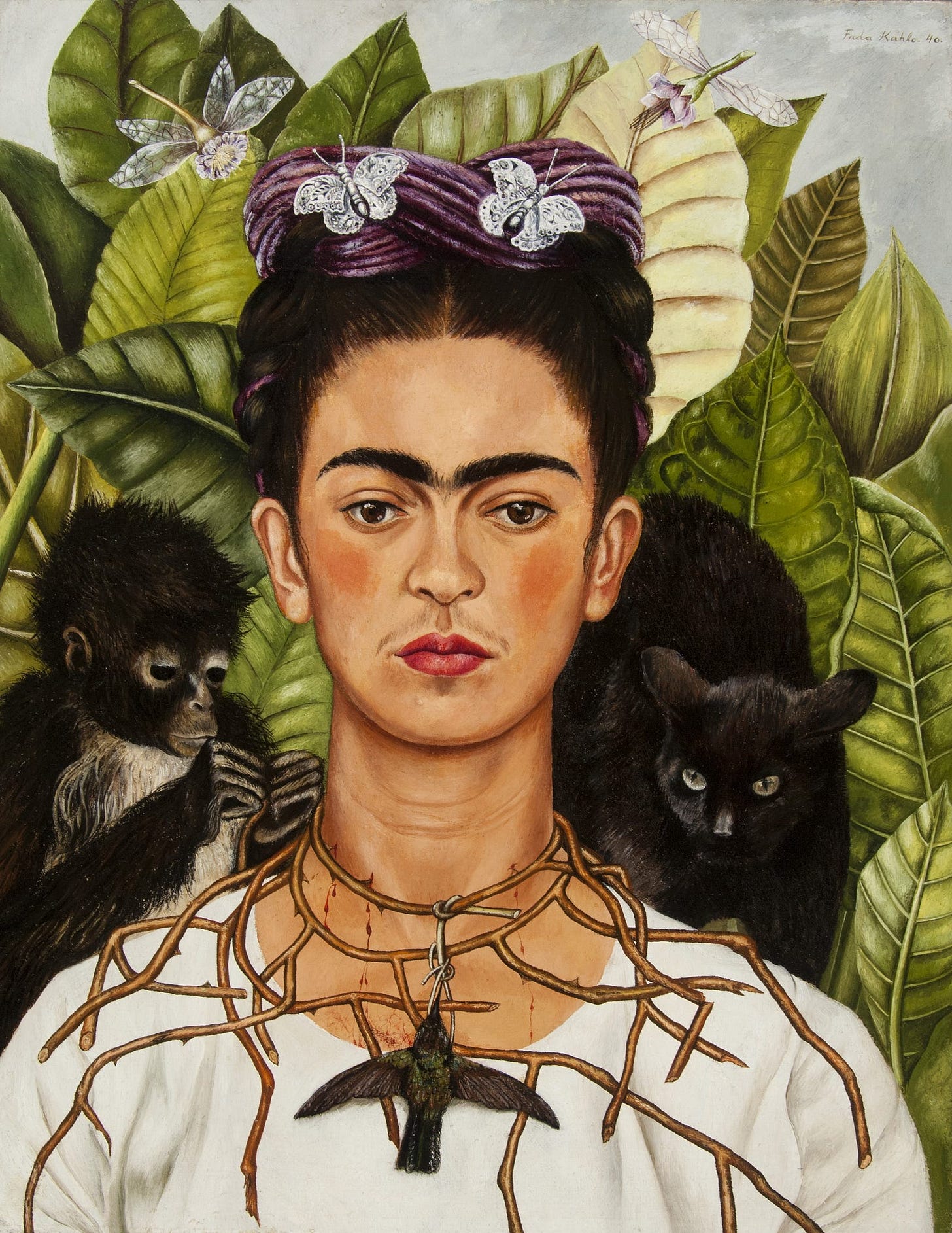
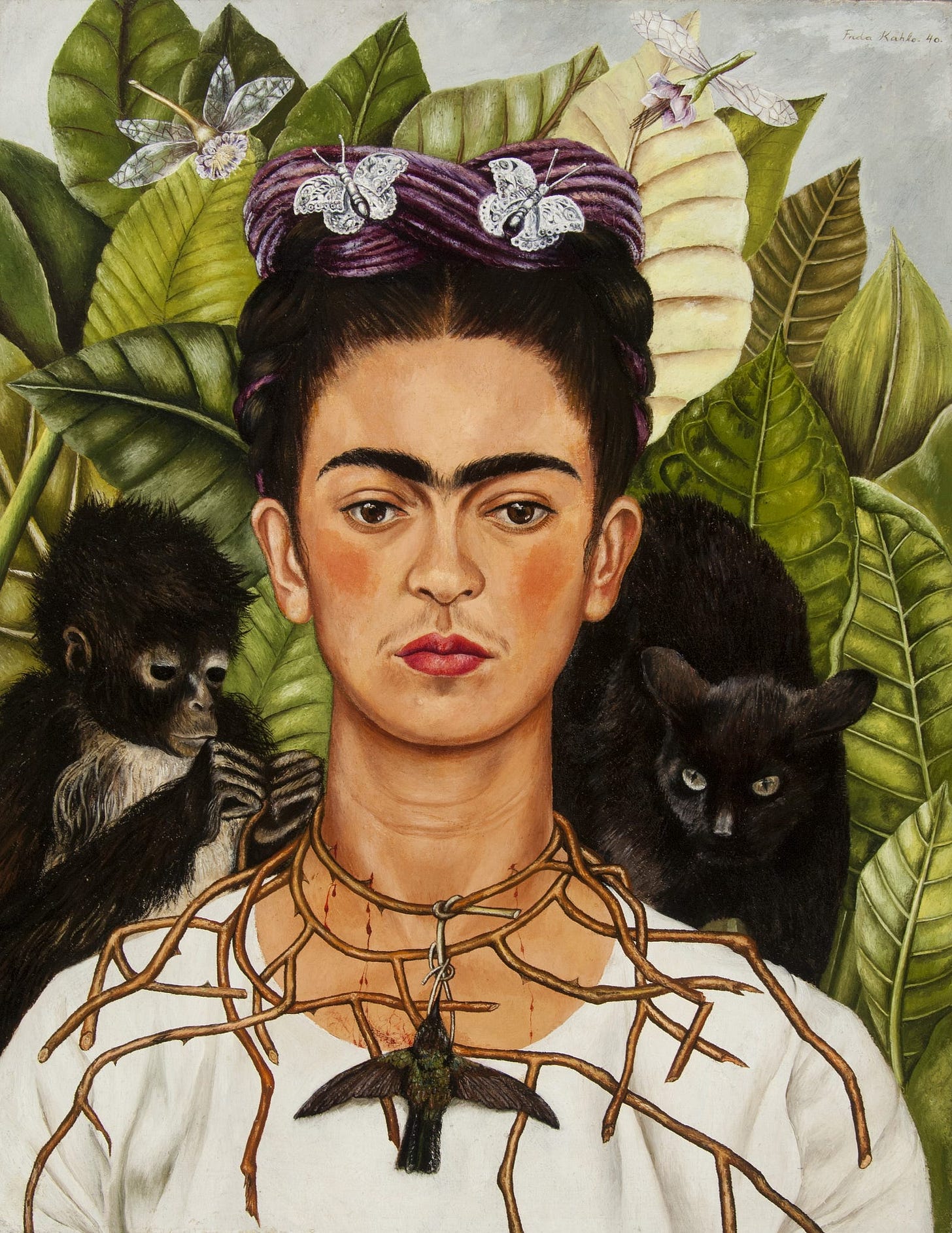
Take another example. In her Self-portrait with thorn necklace and hummingbird from 1940, Kahlo shows herself wearing a barbed necklace with a lifeless hummingbird attached. A black cat and a spider monkey sit on her shoulders, against a backdrop of tropical foliage. Flowers and butterflies appear to rain down on her from above.
What she is communicating is harder to define. The monkey and cat in Kahlo’s images tend to sit at opposite emotional registers, the monkey suggesting attachment and intimate dependence (she had a monkey as a pet, given to her by her husband Diego Rivera) while the cat carries a more ominous charge, often read as a sign of threat or death. The hummingbird, traditionally linked to vitality and love in Mexican symbolism, perhaps implies the collapse or suspension of emotional life under strain.
Such a personalised collection of symbols aligned Kahlo with the European movement of Surrealism. The French writer André Breton, who encountered her work in Mexico, described it glowingly: “The art of Frida Kahlo is a ribbon around a bomb.” Frida herself resisted the label of Surrealism, preferring to insist that she painted not dreams but her own reality.
But there seems to me something else too, an aspect of her work that appeals directly to a modern audience. It is, I think, the unflinching poise that many of her paintings exude. Numerous self-portraits show her in a firm, upright posture; words such as imperturbable, impassive, enduring and resilient come readily to mind.
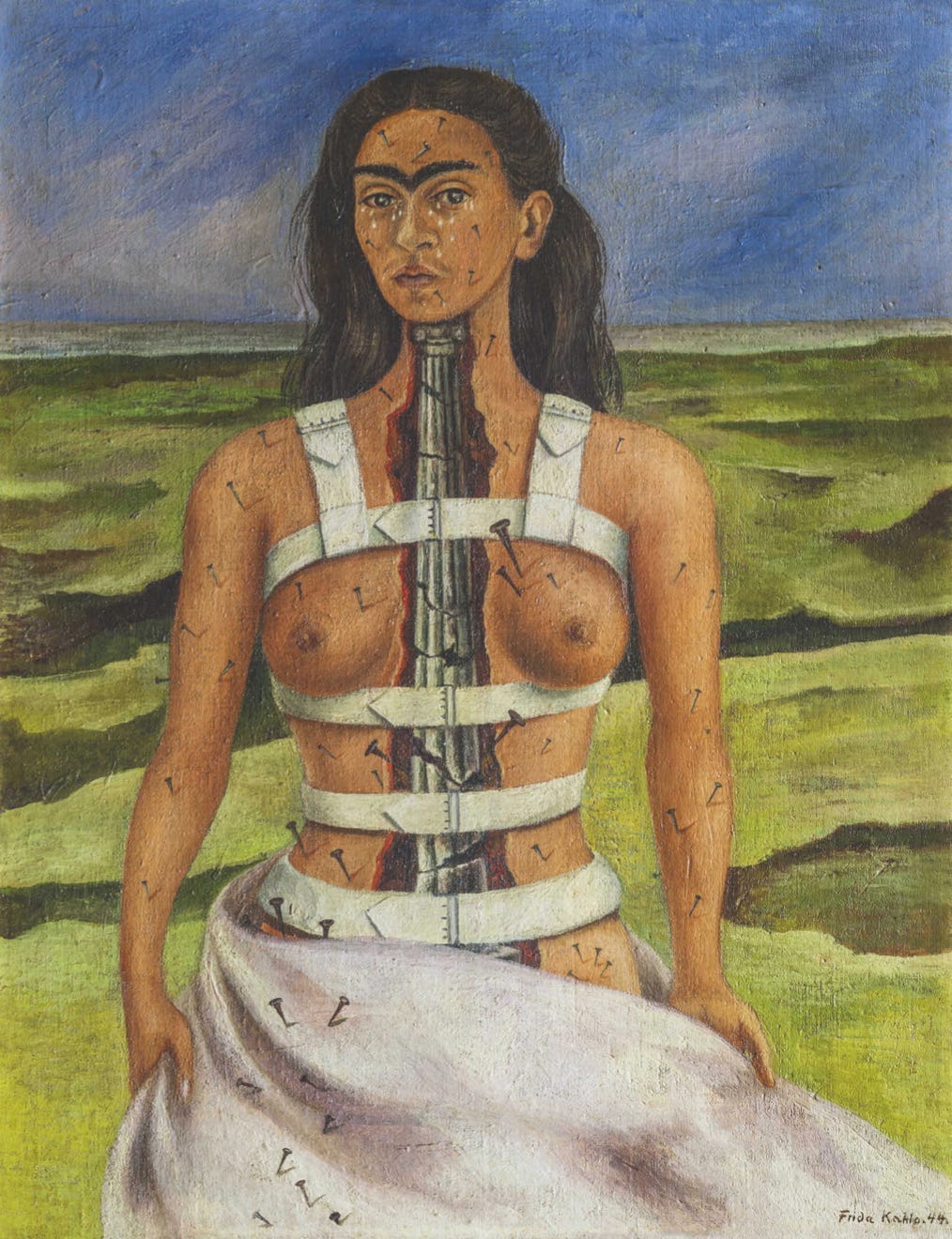
One of her most famous paintings, The Broken Column, painted in 1944, nearly twenty years after her accident, shows herself unclothed and severed down the middle of her torso.
The title refers to her shattered spine, which is shown in the painting as a disintegrating stone pillar inside her chest. Wearing a surgical brace and bearing dozens of nails across her body, Kahlo amply — even crudely — expresses the extent of her suffering, where the physical and the psychological merge into a kind of hallucination of damaged bodies and falling tears.
As viewers, we are faced again and again with images that keep a record of deep and prolonged suffering, yet which preserve a stoic equanimity.
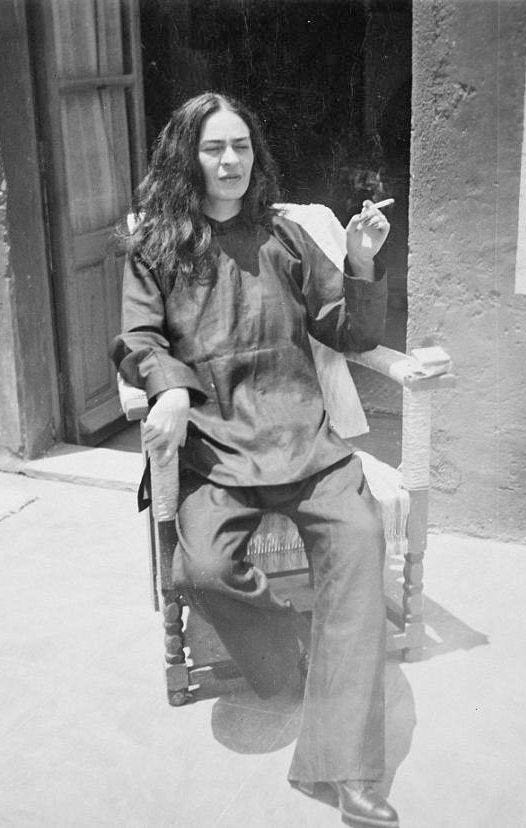
The story of Kahlo’s life suggests she was deeply engaged with current affairs, politics, the plight of other women, as well as the relationship Mexico had with its dominant neighbour to the north.
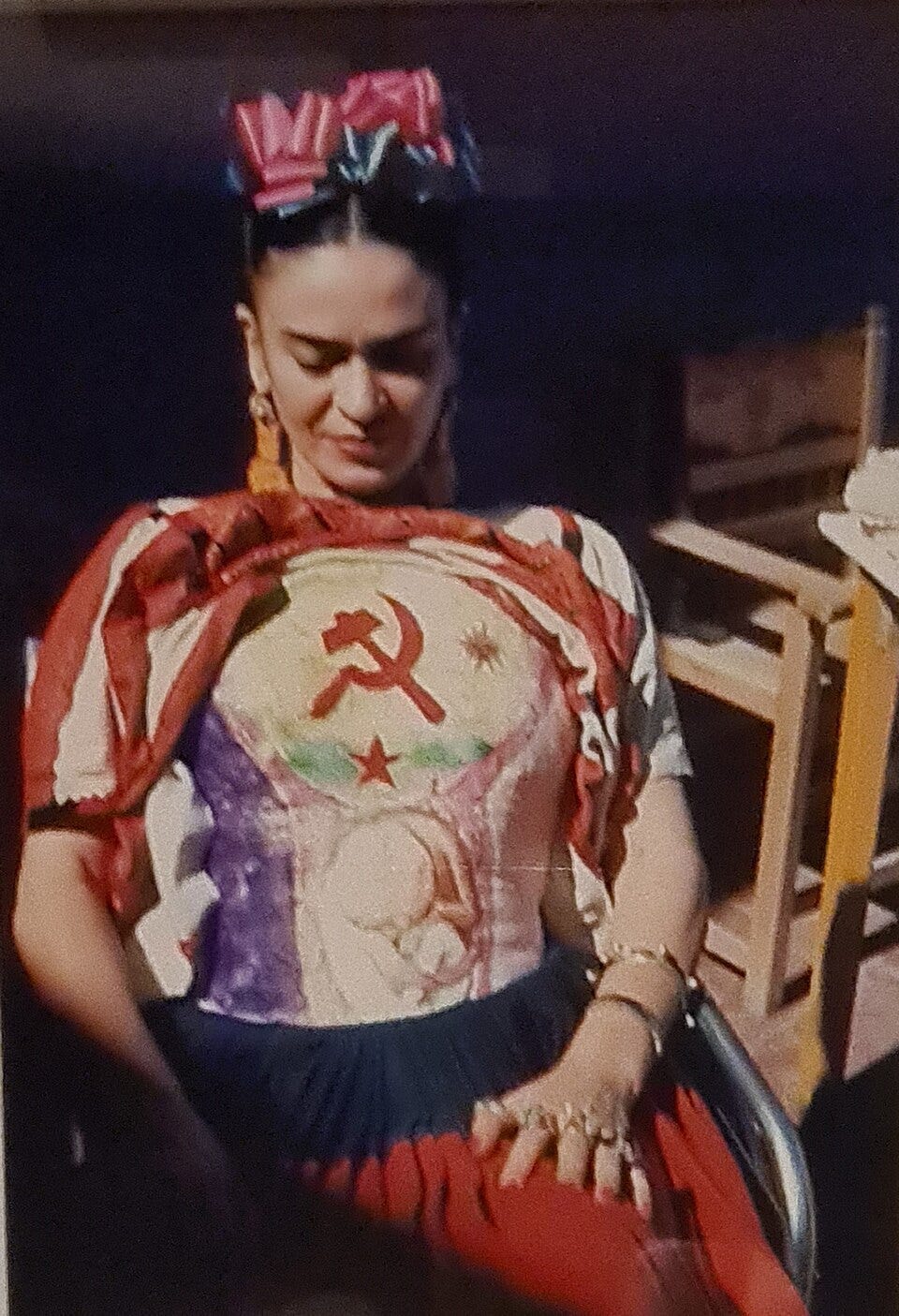
In this fullness of life lived, the personal look she cultivated was malleable. She was often dressed up, performing versions of herself. She began wearing traditional Tehuana dress, a style associated with the Zapotec women of the Isthmus of Tehuantepec. For Kahlo, the clothing carried associations of female strength, indigenous identity and Mexican nationalism.
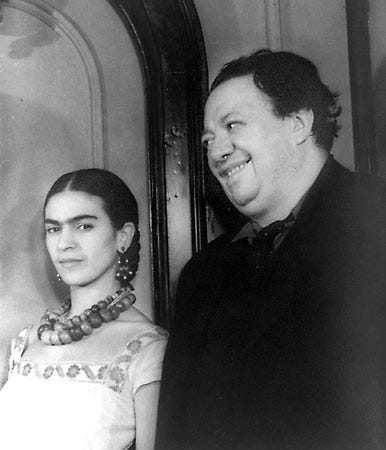
Famously, the great relationship of her life was with Diego Rivera, a monumental figure in Mexican art who made his name as a muralist, making grand wall-mounted images that tended to glorify labourers, farmers and indigenous people.
Kahlo and Rivera became a couple when he was forty-three and she was twenty-two. Her parents referred to them as “the dove and the elephant” — not without a hint of dismay at the obvious discrepancy in age and comportment.
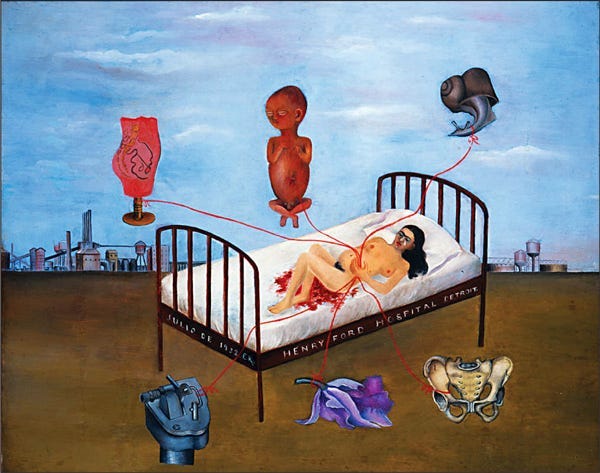
Their relationship was both deep and turbulent. After they married, she travelled with him across America, where in Detroit she suffered a miscarriage. In Henry Ford Hospital, Kahlo depicted her experience, showing herself lying on the bloodied sheet of a hospital bed, surrounded by floating objects including a pelvis with metal pins.
In Mexico, the couple lived together in Kahlo’s house built by her father, La Casa Azul (The Blue House) in Coyoacán, Mexico City. It was a house full of colour and music. Flowers were everywhere; cats, monkeys and dogs were kept as pets. Traditional Mexican sculptures filled the garden. Visitors came and went, including Leon Trotsky, who lived in exile in Mexico after being expelled from the Soviet Union. Both Kahlo and Rivera were members of the Mexican Communist Party.
Both were unfaithful. Rivera embarked on an affair with Kahlo’s younger sister — the affair that led to the Memory, the Heart painting — while Kahlo herself had extra-marital relationships with both men and women, including a brief liaison with Trotsky. She and Rivera divorced and later remarried.
When she died in 1954, he was devastated and survived her by only three years.
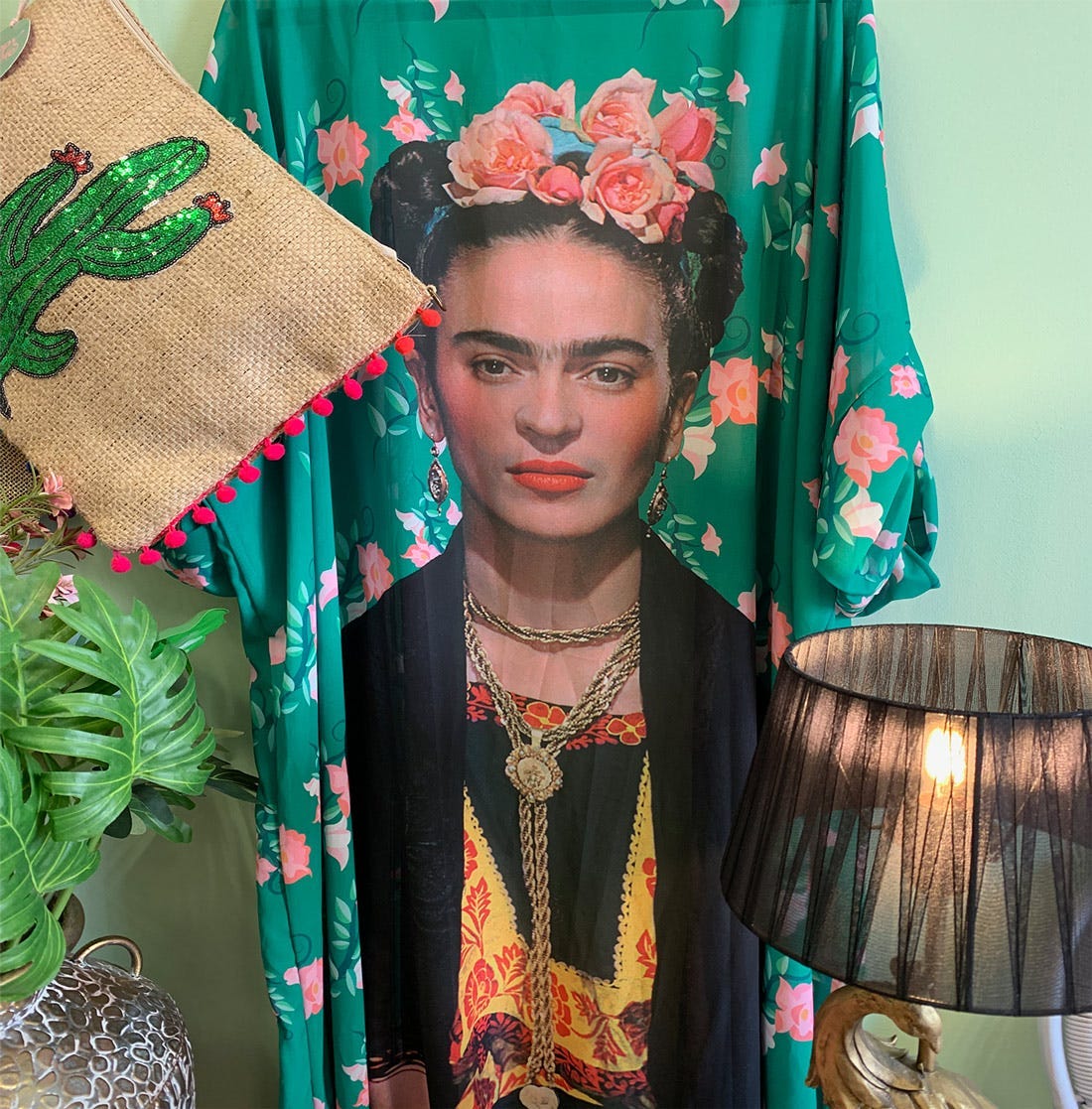
In the 21st century, Kahlo’s image has been co-opted by fashion brands as an identifying badge of self-determination and non-conformity. With her cool-headed gaze, she can be found adorning thousands of t-shirts, shoulder bags, dresses, coats, cushions, mugs, enamel badges, flower pots and countless other objects.
What surely underpins Kahlo’s immense appeal is a picture of a woman who boldly claimed her right to be seen. And though there is often a sense of melancholy in her paintings, the firmness of her composure remains appealingly defiant.
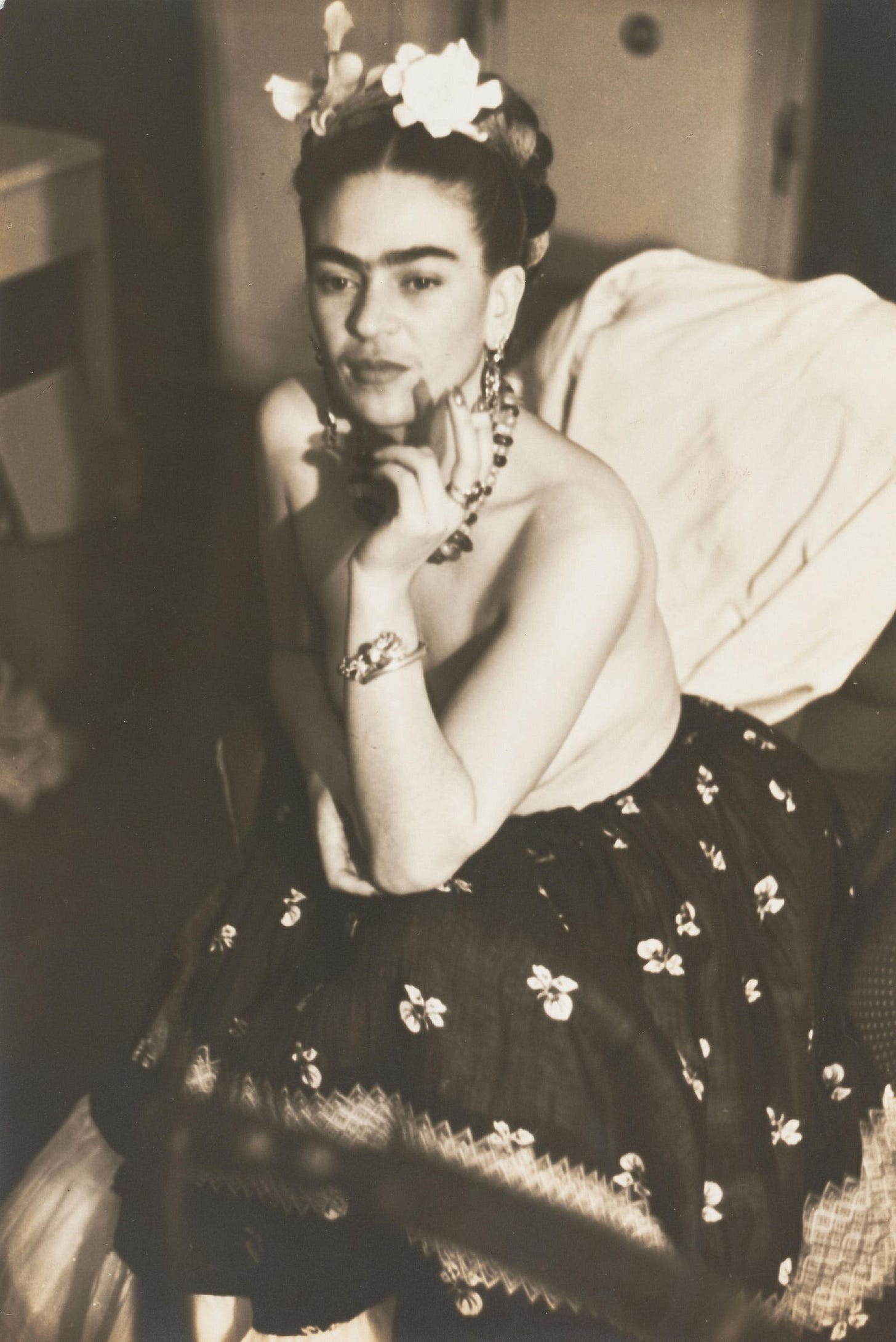
Today, she stands as a bulwark against a way of seeing that privileges European ideals of feminine beauty and gender roles. She was openly bisexual, honest in her art about abortion, miscarriage, birth and the sometimes despairing terrain of true love.
Her pictures, in other words, give us an artist whose visual preferences and strategies were forward-thinking, prescient even, predicting the changes that are only really coming to fruition in the 21st century.
It is this attitude of courage and self-expression that perhaps more than anything else continues to radiate from her paintings and win her new admirers — including me.
Tate Modern’s Frida: The Making of an Icon, is in London and runs until 3 January 2027.
I wish you well,
Chris
P.S. Become a paid subscriber and you will support me in creating future editions of this newsletter.
I’m Christopher P Jones — art writer and book author of Great Paintings Explained. You can find out more at chrisjoneswrites.co.uk and my regular blog on Medium.
No posts
Comments
Nothing yet. Say the first thing.
Sign in to join the conversation.