
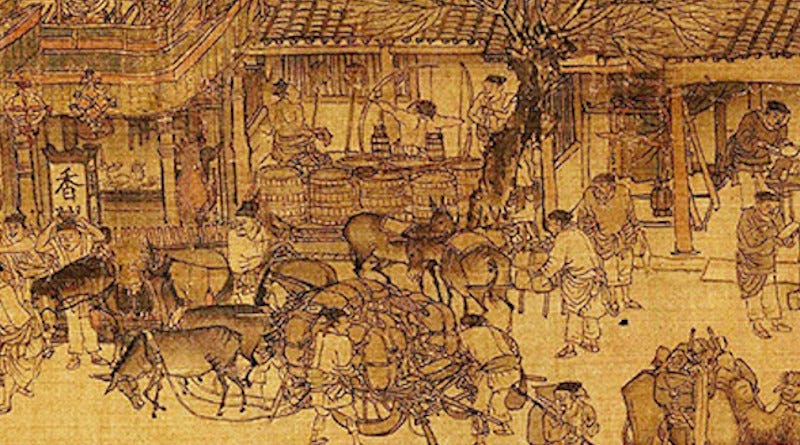
The Year 1000: A small portion of the Qingming Scroll from the Song Dynasty shows vibrant trade in a Chinese community.
“Imitation is the sincerest form of flattery.” Charles Caleb Colton in Lacon: Or Many Things in Few Words, 1820.
“There is no such thing as a new idea. It is impossible. We simply take a lot of old ideas and put them into a sort of mental kaleidoscope. We give them a turn, and they make new and curious combinations.” Mark Twain to Helen Keller, 1902.
“To learn broadly from many masters—that is your true teacher.” Du Fu, Six Quatrains Composed in Jest, 761 AD.
“Imitate, Assimilate, Innovate.” Clark Terry, Jazz legend, Elmhurst College Jazz Festival, 1991.
It is in the nature of revisionist history to focus more on that we got things wrong rather than why. In a town like mine where people prefer to say, “mistakes were made” rather than “I fucked up,” this may come as little surprise. But the focus on and/or denying blame misses the power of dispassionately absorbing lessons learned.
The provocative journalist and podcaster Andrew Keene recently toured the world with me from war in Russia and the Middle East; to European years-in-the-making reliance on one country for energy; to all of our years-in-the-making reliance on one island for chips and more. He asked: Why do we miss these things so often?
My answer was twofold: we too often tend to think against all evidence that the next five to ten years are like the last; and we rarely truly understand the ground.
I also shared what Laura Blumenfeld, a special friend and great journalist covering the Middle East and more, once called the “third cappuccino” phenomena. She often noted in her world travels, including war zones, while political uncertainty, chaos or unrest could be brewing here, only a few blocks away cafes were filled with people drinking their third cappuccino. Standing up takes work – and risk – and against great odds and momentum sometimes it’s just easier to sit down.
Oriana Skylar Mastro of Stanford reminded me of perhaps the most important answer of all in her wonderful, provocative book I finally read, though it came out in 2024: Upstart: How China Became a Great Power. Too often we miss things because we assume that, deep down, others are and will act just like us.
Mastro argues that China did not simply copy or challenge the U.S. head-on across the board. Instead, it followed a smart, selective “upstart” approach—acting like a startup disrupting an industry—by choosing where and how to compete based on what would build Chinese power while minimizing direct confrontation or alarm.
The strategy rests on three key components:
• Emulation: China copies or pursues similar strategies to the U.S. in areas where the U.S. is already dominant, when doing so helps China gain strength and reassures Washington that its intentions are not immediately threatening. This builds power without looking overly aggressive.
• Exploitation: China adopts approaches similar to the U.S.’s but applies them in new or different domains/areas of competition where direct rivalry is lower risk. It takes advantage of strategies that have worked for the established power without fully mirroring them in sensitive spots.
• Entrepreneurship: When straight emulation might provoke a strong negative reaction from the U.S. or others, China innovates with new, creative, or asymmetric approaches tailored to its strengths. This allows it to carve out advantages in novel ways.
This mix, she compellingly argues, decided case-by-case depending on the domain (economic, technological, political, military, etc.) enabled China to grow rapidly in influence and power while avoiding the kind of unified international opposition that might have “stemmed its rise.”
In short, when Mastro talks about China “pursuing an upstart strategy,” she means Beijing has strategically blended imitation, opportunistic adaptation, and innovation to climb the great-power ladder cleverly, rather than through outright confrontation or pure replication.
It is the assumption of emulation that has really stuck with me. When I was in business school in the 1990s it was an all but unarguable that economic growth could only happen sustainably over time with Jeffersonian democracy. That after the collapse of the Soviet Union there would be one play book of success and that was the play book of our rise. I remember participating in a debate around then about Singapore which, of course, took a very different path to economic security and governance that delivers enviable services as “the exception that proved the rule” or “could not scale beyond a small city island. “
Cut the camera to my journeys in global startups and especially rising markets. There was an assumption that any great company abroad could only rise by localizing that which had already thrived in the West. That entrepreneurs would build “copycat” companies. Didi or Grab or Careem would emulate “Uber” in China, Southeast Asia and The Middle East respectively maybe with some local language, culture, and regulatory nuance. That, similarly, Mercado Libre and Alibaba were merely localized “Amazons.”
We missed that emulation is not an end, but a means.
Yes, ride sharing and ecommerce to pick two examples of course would build off the success of American juggernauts. One of the local builders at the time told me, “Entrepreneurship is risky enough. Building a tech company outside of Silicon Valley is viewed as risky enough by investors especially in emerging markets. So why not imitate? Then we will innovate.”
WeChat and Alibaba embedded payments, credit and financing within their experiences in a way American apps did not. “But they pretty much used our payment technology” one Silicon Valley friend dismissed. And they did, with their own technological innovation and adapted it all to local user experience and needs and brought hundreds of millions into banking services many never had previously.
In Latin America, instead of pure replication, Mercado Libre built a hybrid ecosystem with heavy fintech integration (Mercado Pago for payments and credit), loyalty programs, and localized services that addressed gaps Amazon didn’t prioritize in the region. It’s often described as blending Amazon-style e-commerce with Alibaba-like ecosystem thinking, fueling faster growth in key metrics and market dominance despite Amazon’s entry. It remains larger than its next 14 competitors including Amazon, though interestingly fastest headway has recently come from China. Emulation got them in the door; innovation in payments, financing, and regional tailoring let them leapfrog and sustain an edge.
By the way, enterprises like these with millions of customers, local know-how and national/regional regulatory navigation and massive unique data sets could not be better positioned for whatever may come in AI. Integrated behavioral data from super apps gives Chinese, Asian and Latin American platforms richer, more real-time training signals for recommendation engines, fraud detection, personalized services, health, education and now agentic AI (where AI handles tasks like shopping or bookings end-to-end). U.S. companies, fragmented across separate apps with privacy walls and legacy payment rails, may have a harder time achieving the same closed-loop depth. Both may win. But for different reasons.
I adore that we believe “innovation” is about the massive, new shiny invention. We are seeing more nations like China, India, Brazil, the Gulf and more do the same on their terms. At the same time, for billions these enterprises innovated their societies. We westerners too often missed the deeper adaptation and context-specific innovation.
Emulation was the entry ticket—starting with proven models to reduce risk and gain traction—but it was rarely the endgame. It was a means. Smart players – in governance and business --use emulation as a scaffold, then build something better suited to the terrain.
Mastro’s upstart strategy argument explicitly frames this in great-power terms, drawing from business analogies (China as the agile “startup” disrupting the incumbent U.S. “established player”). Emulation happens when mirroring the leader in familiar domains builds power and reassures the incumbent that you’re not an immediate existential threat. But China (and its companies) frequently shifted to exploitation (applying similar tactics in new or ignored arenas) and entrepreneurship (creating asymmetric, tailored solutions where straight copying would fall short or provoke backlash).
In both the China great-power context and the startup trenches, emulation is tactical—it de-risks entry, buys time, and lets you study what works. The real alpha comes from audience-centric innovation: deeply understanding your users’ context (infrastructure gaps, behaviors, pain points) and building products that solve for them, not just transplanting a Silicon Valley or Western template. As I wrote here, the case study of China’s strategy and building embedded advantage in manufacturing, manufacturing tech and lowest cost energy access is a playbook of its own.
The absurd part of the copycat accusation – what blinds us from seeing beyond our core view of what is required to succeed – is the implication of lack of originality or even laziness. In practice, fast followers who execute with local insight frequently become category leaders or create new ones (super apps being a prime case). Now, with AI accelerating everything, those data-rich, integrated ecosystems have compounding advantages—something U.S. incumbents are racing to address through embedded finance, agentic tools, and cross-app experiences.
It’s a reminder that in competitive strategy—whether nations or companies—rigid “original vs. imitator” framing misses the dynamic reality.
The north star is not the playbook per se. It is steely focus on what works. And massive, competitive execution to that end.
No posts
Comments
Nothing yet. Say the first thing.
Sign in to join the conversation.