
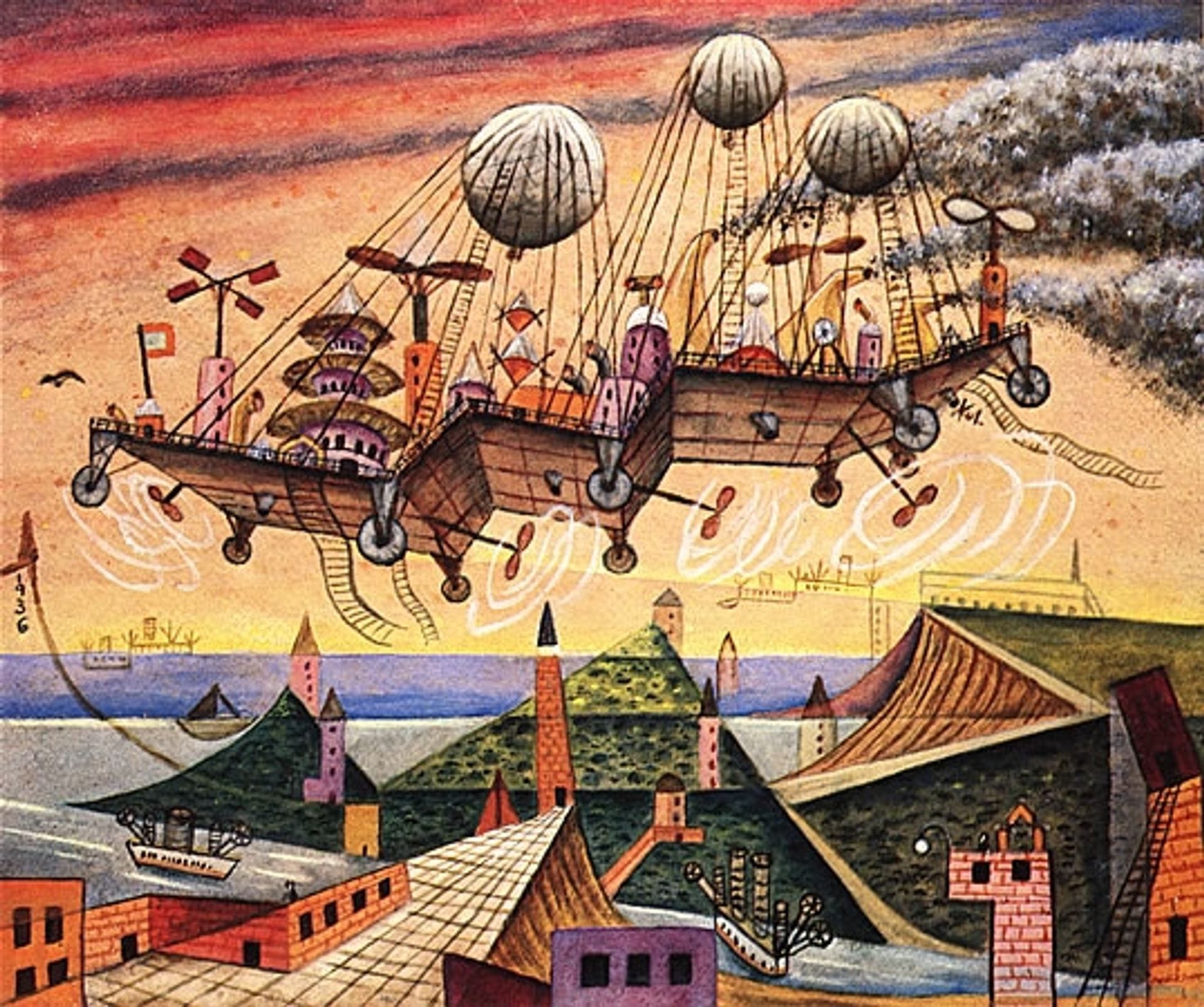
(Vuelo Villa, by Xul Solar — 1936)
“All is vivacity, gracefulness, and sparkle to the eye; but, ah, what fires are smoldering below?” – Harriet Beecher Stowe, during her first trip to Paris in 1853.
“Hope is something that you earn. We got our hope because of the hard work we put in every single day. Don’t borrow our hope. Hope with me.” Wanjiku Gatheru in August 2023.
“”We know in the short term the situation will worsen but then we will see the fruits of our efforts.” – President Javier Milei in 2023
“How does an outsider with 10-15% congressional support get all this done?” – Argentinian private equity investor in March 2026.
Unpacking a predictable path of successful governance has proven, in all my travels, too often illusory. But three interconnected themes seem quite clear.
First, successful politics is not a predictor of successful governance. In fact, in the performative social media world we live in globally, the former optimizes for the viral, short-term hit while the latter requires hard work over time.
Second, related to this, and certainly in America, if we think of our governance as at best incompetent and at worst an insider’s rigged game, we should be unsurprised that populism rises at scale both right and left.
Third, this is because, among other things, if you marry such suspicion with massive societal change at home, in revolutionary tech advances, and shifting relations abroad, simplicity of message is very appealing. As the great 20th century theologian Reinhold Niebuhr said of orthodoxy: “[It] is never rooted in faith but in doubt. It is when we are unsure that we are doubly sure.”
No wonder, at least in the west, we seem to be in an age of anti-incumbency.
I thought about all this during my week in Buenos Aires meeting with a wide array of senior executives, tech founders, policy makers, journalists, analysts and young people. Because something is happening here if, to steal from an old Buffalo Springfield song, “what it is ain’t exactly clear.”
Anyone having strong views on a politician in this era, and in Argentina in any era, is unsurprising. President Miele is either a chain-saw wielding extremist, aligned with MAGA, and one step away from being an authoritarian. Or he is exactly the right combination of willful unpredictability, courage and conviction required to change a long-struggling country that has all the resources which once, in the last century, made it one of the top five global economies.
But facts are stubborn things, and even his greatest critics concede that inflation has dropped from over 200% to 30%; the budget has been balanced in six months; significant business regulation has been eliminated; bi-partisan labor laws viewed once as untouchable have been passed cross party. Freedom House has taken it in two years from 140th in ease of doing business to nearly 100. After surging to over 50% during the first months of President Milei’s term, Argentina’s poverty rate plummeted by more than 21 percentage points to 31.6% by mid-2025, its lowest level since 2018.
In less than three years.
As one politician said to me, “It reminds us that ideas matter. But decisions and conviction for those ideas matter most. We have gone from one of the most closed economies in the region to the most open through tireless follow-through.” Most staggering and perhaps encouraging for those of us who believe that gridlock, campaign finance and identity politics makes change impossible, no one I met – not one at any age or party – thought what has happened in Argentina was possible three years ago.
Many will say bluntly that the significant wins for the Milei team in the regional and local elections last fall were boosted – some said even won – by last minute financial aide granted by the United States. But the local polls overall were clear: most voters were unwilling to go back. “What is happening here is at the cultural level,” one political analyst said to me. “The culture is changing because people are seeing they have a shot and we all must participate. Transparency, economic freedom, serious respect for rule of law, respect for institutional predictability; assumption one can get their money out – these are re-engineering our DNA.”
I never quite received a clear answer as to why now. A combination of exhaustion at business as usual among the electorate, a feckless opposition who had lost touch and took voters for granted, and a mercurial leader of no party with both ideas and the conviction certainly have been essential. For even older Americans who can recall the prime rate hitting over 21% in 1980, 200% is incomprehensible. Every person I met had a story of they or their families bringing duffle bags of cash to a restaurant or grocery store knowing it might be insufficient within hours.
Argentina has slashed or eliminated over 20 different taxes in two years, bringing the national tax burden to its lowest level in two decades at 21.4% of GDP. By removing major barriers like the Impuesto PAIS – an attempt to stem loss of foreign reserves -- and lowering export duties, the government has pivoted toward a fiscal model that prioritizes international competitiveness over state revenue. While unions remain funded with mandatory dues intact, small business will benefit from the 2026 Labor Modernization Law – the first in 45 years and surprisingly bi-partisan – which slashed hiring costs by replacing unpredictable severance payouts with a pre-funded insurance system and extending probation periods to give companies more time to evaluate a hire before committing to a permanent, protected contract.
It doesn’t hurt to have a weak opponent. Former President Cristina Fernández de Kirchner was held to account for her inability to control soaring inflation and a series of high-profile corruption scandals. After years of legal battles, she was sentenced to six years in prison and given a lifetime ban from public office for fraudulent administration, having been found guilty of steering massive public works contracts to a family friend. As one politician said to me, “They got so bad it was a treat to be against them.”
The greatest question none of us have clarity for is two-part: is this time different, and will it hold? Most remember the hopes during Peronist shift to neo-liberalism in the 1990’s under President Carlos Menem and the more recent attempts at reform of President Mauricio Macri. After hopeful beginnings, concrete and sustained success never took root.
To many, this time feels different, but many don’t want to make the call yet. One local executive told me, “If you don’t get in (and invest) in the next two years you will miss it. Think still Christina [Kirchner] prices with a Milei system.” That level of conviction, however, was rare. Investors and operators there and abroad need to see more and see that it holds. One US oil executive said to me, “We won’t bet big here for years.” I asked whether that means should President Miele win re-election in two years, and he said, “I was thinking 15 years.”
The government, in the meantime in word and deed, declares it is open for business, especially in energy, mining, finance and AI.
The stories of regulatory capture and corruption that have historically weighed on their potential were legion. One expert in mining noted that Argentina shares the same mountain range as Chile, and the latter has mined $50 billion in copper to Argentina’s $5 billion – the difference being primarily in over-regulation. There is opportunity here and beyond. The country is the world’s fourth-largest producer of lithium. Much enthusiasm was shared for the multi-billion-dollar deal to build data centers for Open AI in the South.
It was jarring, compounded by the perfectly good weather in one of the world’s most beautiful cities, that war in the Middle East and Ukraine was all but undiscussed. When it was, it was more about macro uncertainty generally and the challenges to inflation for a country seeming to tame it. At the same time, the country is the largest producer in Latin America of natural gas; top five in oil production, third in electricity, third in renewables. Higher energy prices thus cut two ways. Over time, low energy costs will be the sine-qua-non for the future competitiveness of both manufacturing and tech and the country intends to be the low-cost provider in the region.
China, however, was in every meeting. Clearly the people I spoke with knew their audience. They underscored how important America was to the future of Argentina and South America; that we share values and ambitions that matter. “I think we can create with the region and America truly western values supply chains,” one trade expert noted. Several people told me that Argentina does not have the navy or coast guard to adequately patrol its long shores, and as much as $3.5 billion a year is lost to China over-fishing its waters.
At the same time, one CEO with assets across the country told me – and I’ve heard a version from Singapore to Saudi Arabia to Nigeria – “Look, the Chinese are extremely smart; they do their homework; they ask what we want; they listen; the execute in a fraction of the time of most global competitors including America; all at 30% off. What do you expect us to do?” Another said, “They are patient, pragmatic, hard working and not concerned with losses. They have built ecosystems of parts and supplies around their main efforts in mining, agriculture and more.”
In his focus to instill competition and best pricing for Argentinian consumers, President Milei has opened the door more for BYD. And Temu, Shein and especially Shopee have made more in-roads in Argentina than Amazon. China has an operational space station in southern Argentina since 2018.
With all this, overall, it is no surprise that China remains Argentina’s number one trading partner, perhaps switching periodically with Brazil, representing up to 20% of their total imports in machinery, electronics and fertilizers and over 22% in exports including soybeans and pork and over 80% of their beef exports.
Argentina leaders believe it will be part of a regional political trend – mostly recently in neighboring Chile. Inaugurated on March 11, 2026, Chile’s new president, José Antonio Kast, mirrors Argentina’s leadership through his landslide victory on a platform of radical state reduction, aggressive anti-immigration measures, and a commitment to free-market “shock” policies to revitalize a stagnant economy. They watch carefully Colombia and other countries and note that both Mexico and Brazil have moved more pragmatically and regionally market oriented. In any event, one journalist told me: “We have no war; no narcotics; no migration issues. Wherever the region goes politically we are in a pretty good place.”
* * * * * * * *
My first trip to Argentina was almost exactly 22 years ago. It was on that visit that my admiration for Jorge Luis Borges began. One line among many returned to my memory: “Nothing is built on stone; all is built on sand, but we must build as if the sand were stone.”
The challenges for Argentina are legion and success can be, and has been, ephemeral. One energy CEO paused amidst some happy talk at breakfast: “I’ve found what can change for the positive very quickly can change for the negative quickly.” Nearly half of the country did not vote for Milei. The elite in Buenos Aires have one perspective that has not necessarily had direct impact on people in the other 22 provinces. In fact, the region of Buenos Aires itself voted against Milei’s candidates’ last fall.
Over 1/3 of the economy is informal. A friend got his shoes repaired and spoke to a small shop owner: “All this talk of change hasn’t affected me at all; prices are still too high.” One reporter smiled when I shared this and shrugged: “The fiscal performance is staggering, and nothing touches more people than taming inflation. They will feel some of that. But they are also experiencing job losses, and bumps and uncertainty. It’s all less about what politicians say, and what charts they show, and all about what they do that people can feel within the next two years.” The Labor Law suggested Milei and his team can work across the aisle, and the election results should help. But time will tell.
Perhaps the great surprise to many was how much the young came out in droves to support Milei. One person told me, “He is the Mamdani of Argentina” meaning he mastered social media, fired up the young voters and got them out to vote. Of course, what the young voted for in Argentina is distinctly different than in New York City. Though what is perhaps shared is an adamant “no” to business as usual.
Some argue that for the young there is simply no turning back, “We like living in a country back to modern” said one young person at dinner who noted that until recently nearly every transaction had to be paid in cash as credit cards let alone mobile money was all but impossible. The Peronists – once the dominant among 39 national parties – seems crushed and without an alternative plan.
But political history is made of people rising without prediction – no one more so in recent years than Milei himself. The winds of change are real but often shift.
At the same time, something has happened here that no one predicted.
And the west should take note of it if for no other reason to call into question the belief that our systems and democracy itself -- encumbered by years of short-term political incentive, social media ADD, identity politics and apathy -- is unfixable.
No posts
Comments
Nothing yet. Say the first thing.
Sign in to join the conversation.