
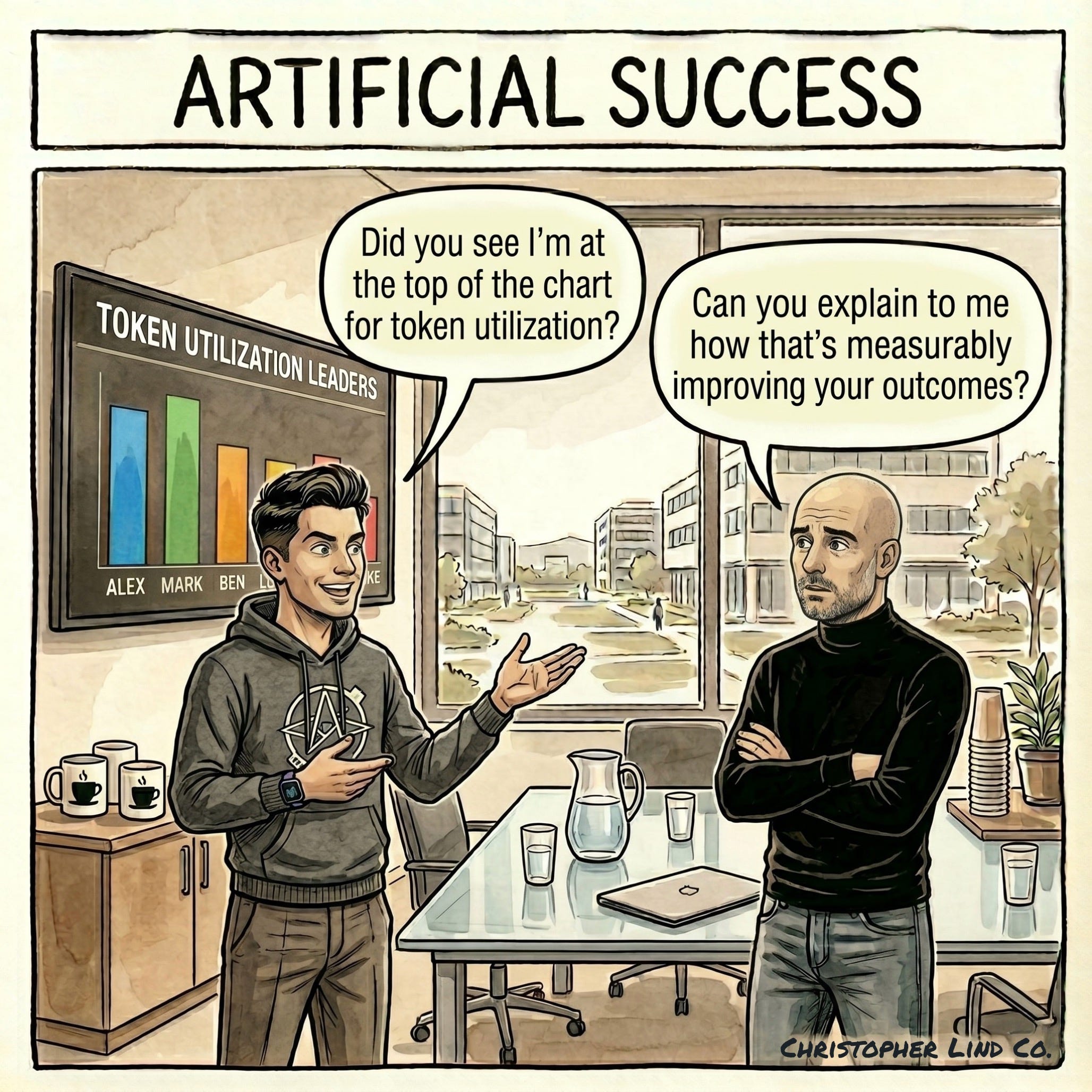
Have you heard the trendy new tech term, tokenmaxxing? It’s fueled by the belief that raw, untethered AI consumption is the only way for companies to survive. And, according to the Wall Street Journal, it’s gaining momentum. Companies all over are rolling out token-tracking dashboards, gamified leaderboards, and top-down mandates designed to push employees to burn through as many AI tokens as humanly possible.
If that feels a bit dystopian to you, that’s because it is. Behind the beautiful dashboards, reality packs a punch. What’s positioned as a hyper-productive future is actually people gaming a broken system to survive. Many are admitting that their “maxxing” is nothing more than agents completing meaningless tasks on loop to inflate their token consumption and stay at the top of the leaderboard. It’s pure, unadulterated AI theater.
In this week’s episode of Future-Focused (check it out on YouTube, Spotify, or wherever you listen to podcasts), I dug deeper into the tokenmaxxing trend and explained why telling your workforce to “maximize AI usage” is a foolish move.
However, I can’t stop thinking about the deeper, systemic rot it shines a light on. It’s more than a temporary symptom of tech-bro culture. It’s not a brand-new problem born from LLMs. It’s poor leadership rearing its ugly head in a new wardrobe, measuring vanity inputs rather than doing the hard work of defining, measuring, and leading toward actual value. Unfortunately, this one comes with the bonus consequences of financial liability that could quietly bankrupt organizations before leaders even realize they’re in debt.
With that, let’s get into it!
“When vanity metrics become a target, performance becomes nothing but theater.”
Countless leaders are enforcing AI usage mandates, believing the promise that increased utilization translates to productivity and organizational performance gains. However, this isn’t cutting-edge leadership; it’s short-sighted management in a cutting-edge wardrobe. I remember experiencing a version of this early in my career when a mandated time-tracking initiative promised to improve productivity. Did it make me better at my job or improve my productivity? Absolutely not. Instead, I wasted time in group chats coordinating how to fill out spreadsheets so they “looked right” for leadership, feeding a total nonsense machine to ensure my dashboard looked green.
Given the prevalence, it’s worth everyone looking in the mirror. When we look to vanity metrics, it’s often because we’re avoiding the hard work of defining and measuring actual business outcomes. However, I promise that if you tell people that their survival is tied to maximizing AI, they’ll focus on raw consumption, not strategic improvement. They’ll spend time building agents to do administrative theater while productivity silently goes backward faster than ever. Keep in mind that AI use is the most powerful amplifier and accelerant we’ve ever experienced. So, if you apply that powerful technological amplifier to this bad management habit, you’re scaling corporate fiction at speeds and volumes that will terrify you.
Don’t accelerate the quiet cultural rot in your organization. Address it before it not only amplifies your worst but actively breaks and alienates your best.
“We are treating our best liars as top performers while pushing top talent out the door.”
The greatest tragedy of tokenmaxxing is that it pressures employees to design unproductive workflows in order to survive. Look at what’s happening at Amazon. Workers openly admit to looping AI agents on continuous, meaningless cycles. They’re having them write code, review it, make changes and run it all over again. Why? Because the pressure to maximize AI utilization is so immense that burning through tokens on a loop is the only way to keep the dashboards green and stay at the top of the leaderboard. Meanwhile, efficient high performers with integrity are being penalized because their work shows up at the bottom or not at all.
This is “alignment-crisismaxxing.” Executives hypnotized by the tech are failing to recognize the employee who can achieve a business outcome with the fewest inputs is the person you should be modeling things around, not the resource hogs automating their deception. However, the problem continues. When top talent watches scammers win awards and receive celebratory emails for their fiction, organizational trust falls through the floor. Eventually, your best will reach a breaking point, and they’ll either take their talents elsewhere or stop being high performers and adopt the toxic theatrics.
Adopting this kind of performative culture won’t result in a forward-thinking workforce. It leads to an ecosystem overloaded with bad actors. And, just wait until you’re faced with the jaw-dropping invoice that comes with it.
“Tokens aren’t arcade tickets; they’re unmonitored capital flowing directly out of your business.”
To many, AI “tokens” feel like an abstract, mythical concept, like Monopoly money floating around in a mysterious IT budget line. However, let me put to bed the myth that AI is a cheap utility by breaking down the math. A power user can easily rack up $100,000 a year in token consumption. And if you think token usage will settle down soon, organizations are burning through 13x more tokens today than a year ago. Let that sink in for a moment. When you push broad-stroke usage mandates down the chain and gamify utilization, you are pushing your entire workforce toward that six-figure range, a number that could easily eclipse their actual salary and benefits.
Now, what makes this trend truly lethal is that it’s structurally rigged against you. These AI tools are intentionally designed to maximize token consumption because that is how the companies that make them make their money. Advanced reasoning models include a heavy “reasoning tax,” costing upwards of 30% more tokens because of the backend cycles they run to generate a response. Furthermore, your employees have been conditioned to believe advanced models are always better, so they’re likely burning premium compute on basic, everyday tasks. Hopefully, you can see how you can quickly find yourself trapped with tech eating more resources, workers incentivized to waste them, and AI vendors being the only ones profiting.
Oh, and don’t think you can avoid it because the line item currently sits in IT’s budget. Eventually, the bill will come due, and the cuts will eventually hit your ledger. But wait, the fun doesn’t stop there. If you look at the macroeconomic horizon, all that pricing we just discussed is built on heavily subsidized pricing that is about to vanish.
“You’re building corporate infrastructure on a subsidized lie that’s about to vanish.”
One of the main reasons tokenmaxxing hasn’t already sent shockwaves through quarterly earnings reports is because a massive chunk of the premium compute your teams are burning through is being artificially deflated by venture capital cash and tech firms willing to sustain eye-watering burn rates just to hook enterprise clients. However, that wild-west window of funny money is rapidly slamming shut. Major tech firms and AI vendors are facing enormous pressure from investors to prove they can establish a genuine path to profitability that doesn’t rely on another funding round. This means they have to generate real revenue from their customers, which means the abstract, subsidized token rates you enjoy today are inevitably going to skyrocket.
When those subsidies vanish, business physics will win every single time. There’s no escaping the reality that in order to survive, you have to make more money than you spend. Once vendors adjust their pricing to reflect real-world costs, that unmonitored six-figure token consumption you are currently tolerating per employee is going to multiply into a catastrophic liability. That’s why it’s so important to make sure any AI use is adding real, tangible value. If you’re rushing AI adoption without nailing down business outcomes, you are accumulating massive, unhedged AI debt, loaded with waste into your core operational infrastructure and internal processes. When the actual cost of compute sets in, you will be so deeply dependent on broken workflows that you won’t have the time or money to untangle the mess or potentially even keep the lights on.
We are talking about the corporate equivalent of the subprime housing crisis. Don’t be an organization that’s taking out an adjustable-rate digital mortgage you can’t afford just because the introductory rates look cheap. If you continue to incentivize AI theater today, you are quite literally funding a path to financial ruin tomorrow.
As always, thanks for sticking around to the end.
If what I shared today helped you see things more clearly, would you consider buying me a coffee or lunch to help keep it coming?
Also, if you or your organization would benefit from my help building the best path forward, visit my website to learn more or pass it along to someone who would.
It’s easy to read headlines about any of the different “maxxing” trends and scoff. They sound ridiculous, and they are. And yet, if we’re not careful, we’ll inadvertently find ourselves manufacturing a slightly different version of one and convincing ourselves it’s somehow different. The reality is, all of them are rooted in something that seems reasonable, even good. The problem comes when we take that thing to the maxx.
So, if we walk away with anything this week, let’s have it be a universal agreement that taking anything, even good things, to the “maxx” will eventually become a bad thing. Instead, let’s focus our attention on striking a reasonable and healthy balance of whatever it is we’re implementing, not getting wrapped up in vanity metrics that leave us mistaking chaos for progress. I hate seeing any unnecessary damage, and I assure you that “tokenmaxxing” will result in a lot of it.
With that, I’ll see you on the other side.

No posts
Comments
Nothing yet. Say the first thing.
Sign in to join the conversation.