
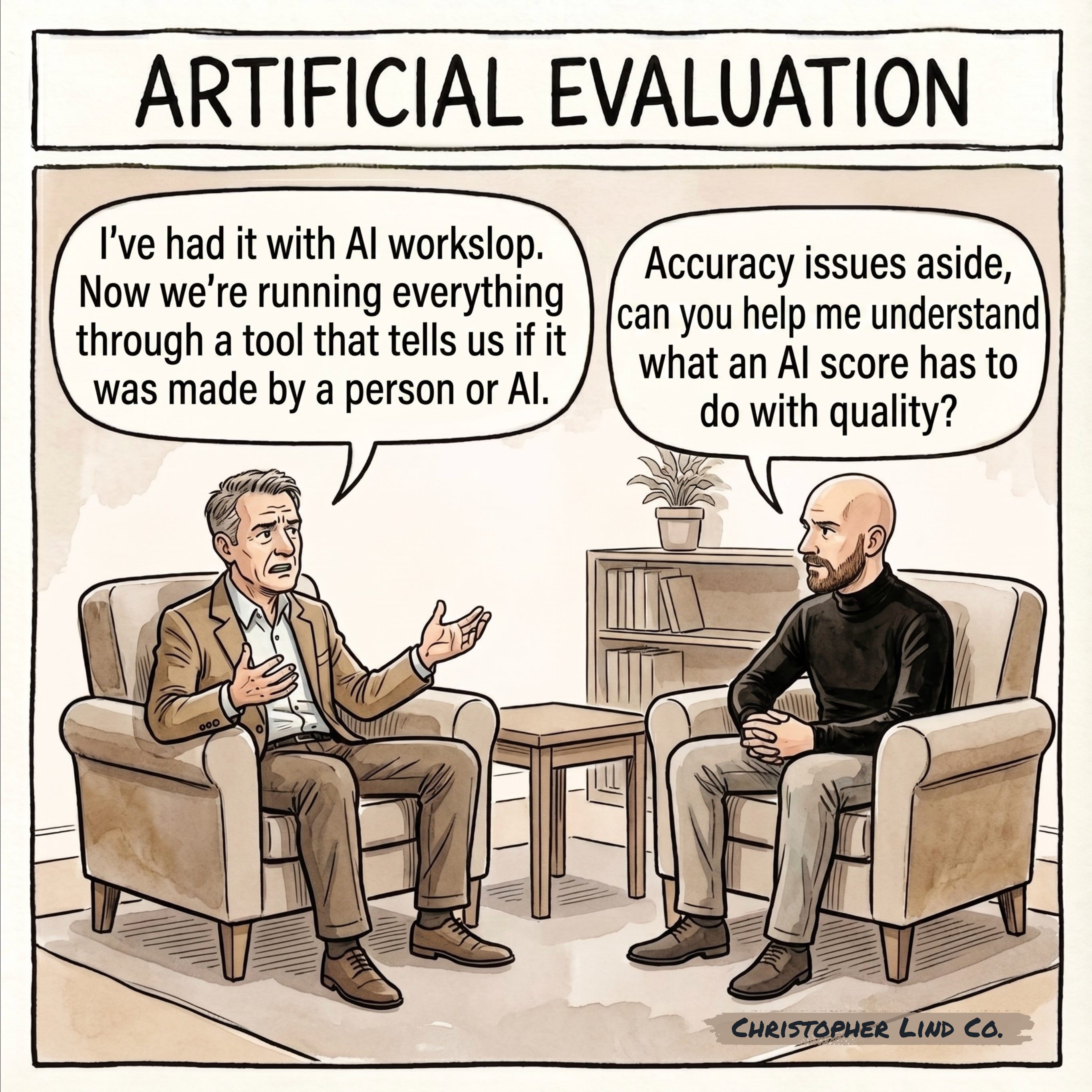
Unless you’ve been hanging out under a rock, you’ve undoubtedly encountered at least one argument about the recent partnership between Substack and Pangram Labs. The AI-generated score assigned to all posts over 100 characters in an effort to combat “claudefishing” has sparked passionate reactions from both ends of the spectrum.
While Substack appears to be the first major social media platform to publicly assign a score directly to people’s work in the name of fighting AI slop, they won’t be the last. LinkedIn has followed suit in a slightly different way, allowing people to at least report what they believe to be “AI Slop.” While I understand the shift, I don’t think many have considered the unintended consequences, which is why I made it the focus of my content this week.
Last Monday on the Future-Focused podcast (which you can check out on YouTube, Spotify, or any of your favorite platforms), I unpacked the flaws behind this compliance reflex and why digital hall monitors fail to solve the quality issue. That sparked a barrage of questions from my community, which I did my best to respond to in my live Q&A last Friday.
And yet, the topic was perfect for this week’s deeper reflection since it’s far more than a social media debate. I find eerily similar patterns in my work with corporate C-suites, leadership teams, and higher education institutions. Burned-out leaders facing low-effort noise are all tempted to reach for algorithmic surveillance tools as an easy button, rather than addressing the deeper alignment and accountability crisis.
Hey everyone, editor Christopher here. Sorry to interrupt the flow. Since you’re my community, I’m giving you an early heads up to something I’ve been quietly working on. More to come soon. However, if you’re interested in securely and confidentially sharing your feelings on AI and work, you can do it here and get a feel for what’s coming.
With that, let’s get into it!
“AI slop isn’t a minor nuisance; it results in real human harm. However, rushing to reactionary compliance only results in a different kind of harm.”
I don’t think most people fully appreciate that AI slop is more than an annoying inconvenience, even though it also checks that box. The mindless creation and unvetted dumping of hyper-generic AI output has catastrophic, downstream consequences in the real world. It’s doing more than creating boring emails or uninspired blog posts. Deepfakes are ruining reputations and dismantling lives. Low-effort algorithmic hallucinations lead to disastrous organizational decisions. Synthetic “ghost” businesses distort economic reality. And don’t even get me started about all the real human beings suffering profound psychological harm from artificial relationships with algorithms. AI misuse isn’t a joke, so having a “who cares” attitude ignores the very real damage being done.
And yet, our reaction to becoming more aware of that reality is what leads us to jump straight to compliance scores, digital hall monitors, and scarlet-letter labels. Unfortunately, that shift ignores the fact that approach is also dangerous. You don’t have to look that far back in history, or even your current newsfeed, to see what happens when outrage and paranoia take the wheel. I assure you that attempting to solve a complex human problem by slapping a statistical guess and implementing algorithmic surveillance onto everything will not solve the problem. Instead, it will create a culture of fear. By triggering witch hunts, we force honest high-performers to waste energy proving their innocence, drive bad behavior further underground, and create a whole new category of institutional harm.
Holding these two polar opposite realities in tension feels uncomfortable, but I assure you it’s a necessity. We can’t let panic push us to choose between passive negligence or paranoid surveillance.
“An AI score tells a small part of the story, but we’re treating it like the entire thing.”
Judging something by an AI detection score is like looking at someone’s kitchen appliances and judging whether or not they’re a good cook. It tells you the tools that were involved while remaining completely blind to the taste, technique, and human effort of a meal. These detection tools aren’t evaluating merit, insight, or utility; they’re assigning a statistical probability of AI’s involvement in a final output. To see how absurdly surface-level this really is, take raw AI “Chain of Thought” content and run it through a detector. I can almost guarantee whatever you test will score 100% human. Yet, somehow, a piece of work that started as a human idea and has been through countless rounds of feedback and revisions will be assigned a 100% AI label if AI was the last thing to touch it, highlighting how the software isn’t really measuring human mind-share or depth of work.
Now, let me be clear. I am not trying to suggest these detection scores are a complete lie or entirely unscientific. They are really good at detecting hyper-generic, unvetted AI. If someone lazily copy-pastes some real AI slop, the tools will catch the patterns. However, we have to always remember that detection of an AI pattern is not proof that human agency was absent from the process. My biggest issue is how quickly this incomplete metric has become a weapon in our tribal and divisive culture. “AI-generated” and “AI Slop” have largely become an insult hurled at anything people dislike, disagree with, or feel threatened by. Ironically, these tools are being used to bypass the very thing people claim to be using them to fight against.
Labeling things “bot content,” slapping a red letter on the creator, and walking away feeling intellectually validated get us nowhere, especially since it seems to be convincing us we’re successfully managing quality as we quietly abandon the conversations that matter. We need to start examining something on its merit or whether it adds real value to the human on the receiving end.
“When used properly, AI is capable of giving a voice to someone who thought they didn’t have one or has been conditioned to believe the one they had wasn’t worth listening to.”
Our default posture is to view the world through our own personal lens. It’s a completely normal human tendency. However, it’s dangerously shortsighted whether we’re talking about AI or anything else. Just because you might not need help structuring a complex thought or finding the right words doesn’t mean someone who uses AI to help them is stupid, lazy, or dishonest. I personally know many brilliant, hardworking people of integrity who have spent their lives feeling trapped in their own minds. To them, AI was never a tool for generating slop. It’s a bridge to something they never believed was possible. They finally feel like they can organize their thinking, overcome deep-seated anxieties, and articulate things like never before. Some of you reading this know exactly what I’m talking about. If you don’t, I’m going to ask that you take my word for it.
This is where AI-detection tools and compliance policing become particularly devastating. While supporters often argue that policing AI involvement is necessary to “preserve human agency” and keep work authentically human, we need to be honest about what they’re often actually doing. Most of the time, they’re doing nothing more than gatekeeping someone’s narrow definition of it. Slapping an arbitrary label or a penalty score on content simply because AI was involved doesn’t stop bad actors. It ends up weaponizing the capability against people who finally found a way to participate. This ends up forcing those individuals to either waste energy gaming an arbitrary system or retreat back into the shadows, resigning themselves to the heartbreaking belief that “this is all I’ll ever be”.
It’s worth taking a long, hard look in the mirror and asking what kind of culture you’re interested in building. If that examination reveals you believe our organizations, platforms, and public spaces are better off when the voices different from your own stay quiet, that valid ideas should only count if they’re produced through a path you’re comfortable with, I frankly don’t know what to tell you. However, I assure you that we’re not better off when everyone in the room looks, thinks, communicates, and operates exactly like the person you see in the mirror. Stripping away people’s agency in the name of “protecting humanity” is nothing more than self-serving conformity wrapped in a compliance badge.
“Impact isn’t determined by a digital tool. It’s a dynamic story written by people traveling along a narrative arc.”
I frequently hear complaints from senior leaders about the growing volume of low-effort workslop flooding their organizations. However, when I ask the uncomfortable questions, “Who’s setting the tone? Who’s setting the pace?” the room has a funny way of going quiet. You may not want to hear this, but if your teams are providing you with unvetted, half-baked AI outputs, it’s probably not because they’re lazy. It’s often the result of them being burnt out from your unrealistic volume demands and operating without clearly defined, measurable targets. When you turn to AI detection tools as the solution, you’re abdicating your leadership responsibility. While the less traveled road, I’d encourage you to pause, look in the mirror, and first examine whether you’ve actually defined what good looks like.
I assure you that a digital tool looking for AI patterns tells you very little about the real work happening in your teams, the thinking behind it, or the human capability required to execute it. That disconnect is why I originally designed and recently overhauled my AI Effectiveness Rating (AER). Having spent my entire career driving performance at the intersection of business, tech, and people, I assure you there’s a better way to measure effective AI use than a measured guess about whether AI was involved in an output. People are already carrying enough. They don’t need fear of a scarlet letter to add even more pressure. What they need is a developmental snapshot designed to build real capability. On that note, I’m actively testing the new intelligence engine right now and am opening up a limited number of free evaluations to members of my community who want to experience what measuring human effectiveness looks like.
At the end of the day, an algorithmic hall monitor should never be cast as the lead character in your organizational story. That role belongs entirely to human capability, leadership accountability, and clear standards. I’d encourage you to take responsibility for the culture you are setting, get crystal clear on your target outcomes, and empower your people to produce work they can confidently stand behind. Oh, and if you’re a leader ready to dismantle the surveillance crutches and do the meaningful work required to build real organizational capability, I’d be more than honored to help you lead that charge.
As always, thanks for sticking around to the end.
If what I shared today helped you see things more clearly, would you consider buying me a coffee or lunch to help keep it coming?
Also, if you or your organization would benefit from my help building the best path forward, visit my website to learn more or pass it along to someone who would.
I think we can all agree the acceleration of mind-numbing, AI garbage is frustrating, even if “slop” isn’t new to the AI age. Given that shared frustration, it’s understandable that AI-detection tools would be deemed a much-needed intervention by so many. However, I hope that between this week’s podcast, livestream, and article, I’ve at least made you think more about why it’s, at best, an extra in the movie.
I certainly won’t be holding my breath in hopes of the crazy cycle these compliance tools create going away. However, I’d invite you to join me in doing all we can to position them as a catalyst for curiosity and understanding of the people they’re assigned to rather than being treated as a comprehensive verdict. And hey, if you’re interested in exploring how the AER tool I designed could be a character in your AI story, let me know.
With that, I’ll see you on the other side.

No posts
Comments
Nothing yet. Say the first thing.
Sign in to join the conversation.