
A fair amount of my content is intentionally designed to highlight the very real risks of modern technology, helping leaders navigate corporate landmines and avoid costly missteps. However, I recognize that regularly pointing out dangers runs the risk of leaving you feeling fatigued, and wondering: “Okay, Christopher, I see the risks. But what DO we actually do? Is anyone actually winning with this stuff?”
That’s why, when I saw the recent headlines about IKEA, I wanted to shine a light on it and break down the details.
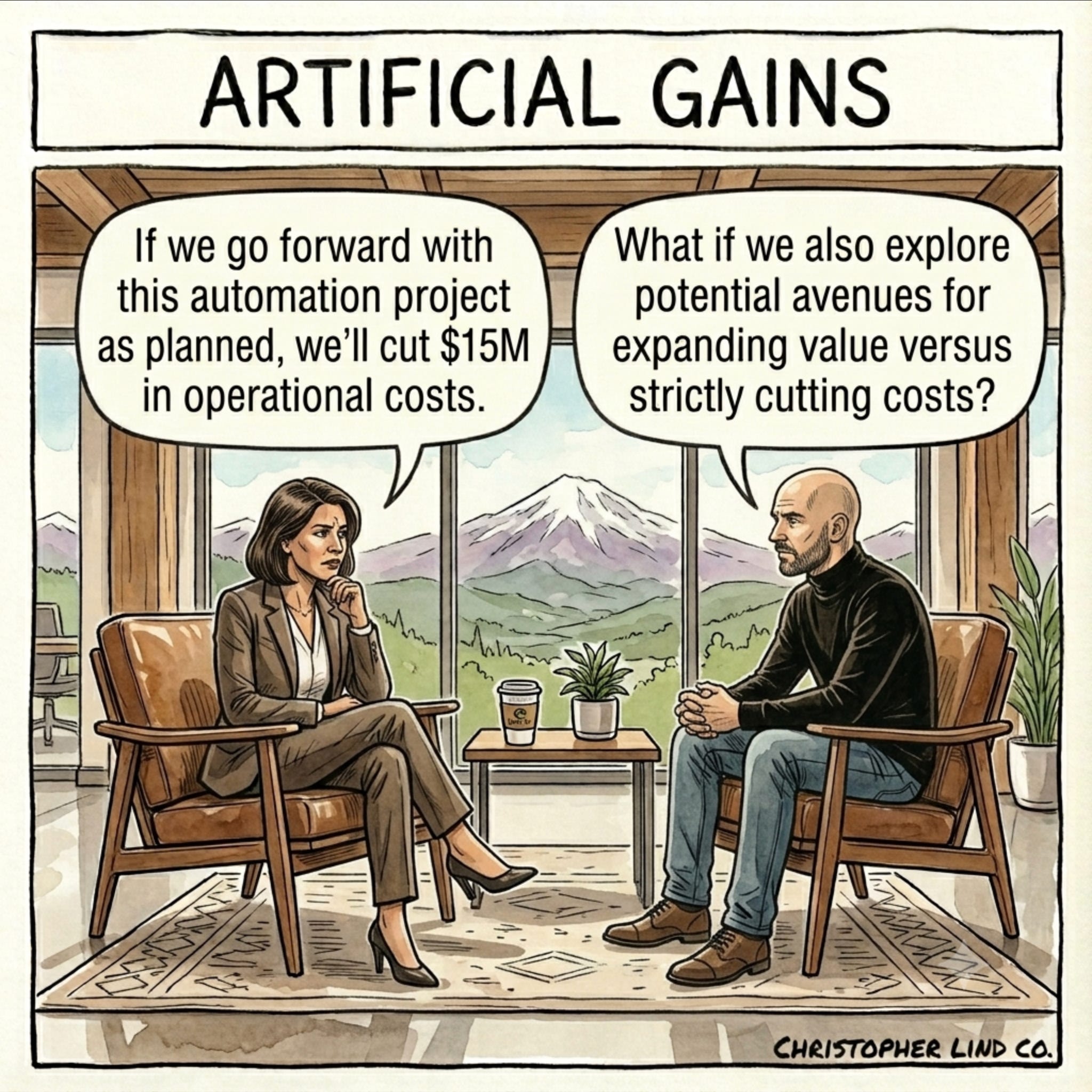
We’re all familiar with the popular narrative that AI’s primary benefits are achieved by using it to reduce headcount and chase short-term spreadsheet gains. That’s the exact opposite of what IKEA did when it deployed its AI chatbot “Billy” to handle routine tier-one queries. Despite it technically being able to pick up the work of 8,500 frontline customer service agents, saving $15 million in operating costs, they refused to take the standard exit ramp. In fact, they didn’t lay off a single person. Instead, they automated noise, systematically upgraded their workforce, and achieved a staggering $1.5 billion in net-new revenue.
In this week’s episode of Future-Focused (check it out on YouTube, Spotify, or wherever you consume content), I dug into the key leadership decisions and operational mechanics of this transition to prove that the math does support the wins when you approach it right.
However, I wanted to go deeper here because a massive breakthrough like this isn’t just a luxury anomaly limited to global retail giants. When you strip away the eye-watering numbers, you can clearly see how their success was the result of an intentional chain of choosing to invest in value expansion over short-term efficiency, which is entirely available to anyone willing to look in the mirror, challenge their assumptions, and put in the work.
With that, let’s get into it!
“The real value of AI is only realized when you choose the harder, more meaningful path of amplifying human capability.”
When you look at the business landscape today, the overriding sentiment isn’t excitement; it’s exhaustion. Leaders everywhere feel crushed by uncertainty, shifting market demands, and the expectation to constantly optimize. As a result, many are operating in survival mode, feeling completely drained by the friction of running complex organizations with their already limited bandwidth. As a result, AI vendors making promises that you can buy their subscription, deploy the tool, and watch all your problems melt away are a tempting siren song. Stack on top of that the non-stop media barrage trying to convince us that these models are already smarter, faster, and more capable than any human on the planet, and you’ve got yourself the perfect storm. It’s understandable why so many leaders gravitate toward the idea of an automated shortcut. They feel like they need it to keep their heads above water.
However, no matter how tempting, I promise you cannot buy your way out of complex operational challenges with a software license. Anyone telling you that AI is a plug-and-play miracle capable of instantly resolving your structural business problems is lying to you. There is no AI magic wand. Artificial intelligence is, and will always be, limited by the quality of the data it’s sitting on and the human expertise of the person sitting behind the keyboard. It will never be a corporate savior or savior of any kind. At its absolute best, AI shifts where people spend their time and provides visibility into how much of your current operation is being lost to systemic waste. It can help clear away your administrative debris, but it will not independently build a successful business strategy for you. It fundamentally cannot make your core organizational problems disappear. Transformation always has and always will require operational excellence and raw business wisdom. Great leadership has never been easy, and it never will be. It’s that simple.
We have to stop viewing this technology as an existential relief valve. We need to stop asking how AI can make our jobs easier and start asking how it can help our teams be better. Start looking for imaginative ways to expand your collective human capability. It’s the only path that will yield sustainable, meaningful growth and unlock the type of exponential value that transforms a company.
“Using AI for the sole purpose of eliminating waste is like owning and maintaining a Humvee but only driving it when you need to run to the grocery store down the street.”
The whole thing started when IKEA used AI to analyze its customer service calls and found that 47% were nothing more than transactional noise. Now, before I continue, one might be tempted to minimize the significance of that achievement, dismissing it as “low-hanging fruit.” I’m going to challenge that tendency by reminding you that low-hanging fruit isn’t inherently easy or fast. In fact, unearthing that metric was a multi-year operational audit of 3.2 million customer interactions. That part alone was a massive undertaking that required patience, infrastructure, and a refusal to operate off assumptions. You can’t map your organization’s systemic noise overnight. Isolating the friction points of any organization requires serious operational grit and a sustained investment of time.
That effort is precisely why so many leaders stop the moment they find the noise. Going through all that and realizing that automating those mundane queries can immediately slice $15 million in operational costs out of the system is a legitimate, hard-fought victory. However, great companies refuse to accept “greater efficiency” as the ultimate destination because they know they’re leaving a fortune of unrealized gains on the table. IKEA pushed forward, evaluating the remaining 53% of the signal and discovered their customers were asking deep, consultative questions that required human empathy, spatial awareness, and problem-solving, so they went for it. They leaned on AI again to help them reskill and transition 8,500 frontline workers to capture that value. This is exactly how AI shifts from a tool of mere efficiency to a strategic vehicle for massive value creation.
When technology successfully absorbs the mundane noise of your business, it hands a wealth of reclaimed human capacity and time. Don’t short-sell that hard-won asset for a quick, defensive gain on a quarterly balance sheet. Reinvest your gains into your people, so you can further drive business expansion.
“AI should serve as a bridge between fractured departments, not a tool that encourages executive isolation.”
The temptation to use AI to build a strategy in isolation is incredibly powerful, and on the surface, it can even feel logical. A frontier large language model that can instantly generate job descriptions, draft operational workflows, and build strategic plans can easily fool you into believing you don’t need anyone else. We justify it by telling ourselves we’re just trying to move fast or that we don’t want to bother other departments with our ideas until they’re “fully baked.” And, if eliminating friction is your only goal, bypassing the messy, slow, political headache of cross-functional alignment looks like business agility. However, this is an insidious and dangerous misunderstanding of how organizational transformation actually works. It’s a subtle trap, and the long-term consequences of walking this isolated path are devastating to a company’s culture and its bottom line.
Ironically, Artificial intelligence works best if you take the exact opposite approach. That’s because it possesses absolutely zero organizational context. It has zero lived experience, which means it can’t fill the gaps in yours. Using AI to bypass your colleagues is a fundamental failure of leadership accountability. Now, I’m not suggesting you shouldn’t use the technology. However, you shouldn’t look for it to take on the subject-matter expertise and lived experience of your peers. You should use it to come to the table better prepared to manage the specific areas you are accountable for. For example, when an operational leader or a tech executive uses AI to draft a massive workforce restructuring plan in a vacuum, without the HR teams in the room, the whole thing will inevitably collapse. IKEA avoided a flaming dumpster fire because they recognized they needed the perspective and expertise of everyone involved with the heavy lifting. They encouraged their technology, operations, and people teams to step out of their respective silos and solve the problem collectively.
Many leaders are using AI to avoid human friction. If we do not actively change course and recognize that AI demands more human collaboration and deeper cross-functional trust rather than less, the corporate world is in for a world of hurt.
“The greatest value of AI is realized when you stop limiting it to increasing efficiency and expand the aperture to exponentially expand what your people can achieve.”
Traditional education has conditioned us to view cost reduction as the apex of business improvement. Nearly every corporate playbook has taught and incentivized executives to view trimming headcount and shrinking the baseline as the cleanest way to demonstrate improved efficiency. As a result, payroll is often treated as a liability to be minimized rather than an asset to be nurtured and grown. Stack on top of that the aggressive marketing around AI. There are countless promises of a limitless digital workforce that doesn’t call in sick, never burns out, and operates with zero downtime (a claim that anyone currently staring at a massive compute bill knows isn’t true), so the logic feels bulletproof. It’s also much easier to measure how much expense you’ve squeezed out of an organization than to assess and measure the long-term gains of capability growth, which is precisely why so many leaders default to it without a second thought.
However, if we want to build organizations that actually scale in a volatile future, we have to shed this scarcity-driven mindset. When you treat automation as an exit ramp for eliminating people, you are abandoning the true source of value. Unfortunately, most leaders were never taught the mathematics of human potential. They’re heavily apprenticed in asset depreciation and cost containment, but they’re rarely taught how to unlock the massive, untapped opportunity that comes when you reinvest your efficiency gains back into the people a company runs on. Now, there’s no denying that human beings appear messy and expensive compared to servers. However, they’re also infinitely more adaptive, creative, and capable of generating value than any software on the planet if you can liberate their cognitive capacity by letting technology absorb the mundane baseline of their job.
IKEA could have been content with the traditional corporate path. If it had, it would have pocketed a safe, predictable $15 million in operational savings. However, by reinvesting their efficiency gains in their people, they generated a staggering $1.5 billion in net-new revenue. How’s that for evidence to stop treating your workforce as an expense to be managed?
As always, thanks for sticking around to the end.
If what I shared today helped you see things more clearly, would you consider buying me a coffee or lunch to help keep it coming?
Also, if you or your organization would benefit from my help building the best path forward, visit my website to learn more or pass it along to someone who would.
With all the chaos and uncertainty, I hope this week’s article ended up being a bright spot in the good things we can do when we commit to taking the less traveled road. I know I’ve said it a lot already, but I’m only going to continue. AI is arguably the most powerful amplifier and accelerant we’ve ever experienced in human history.
Yes, that means it can cause tremendous harm and make problems exponentially worse. However, it also means it can do incredible good and solve formerly impossible problems. Which way it goes is up to us. Given that, let’s do all that we can to make sure we’re taking the time to correct problems, not make them worse.
With that, I’ll see you on the other side.

No posts
Comments
Nothing yet. Say the first thing.
Sign in to join the conversation.