
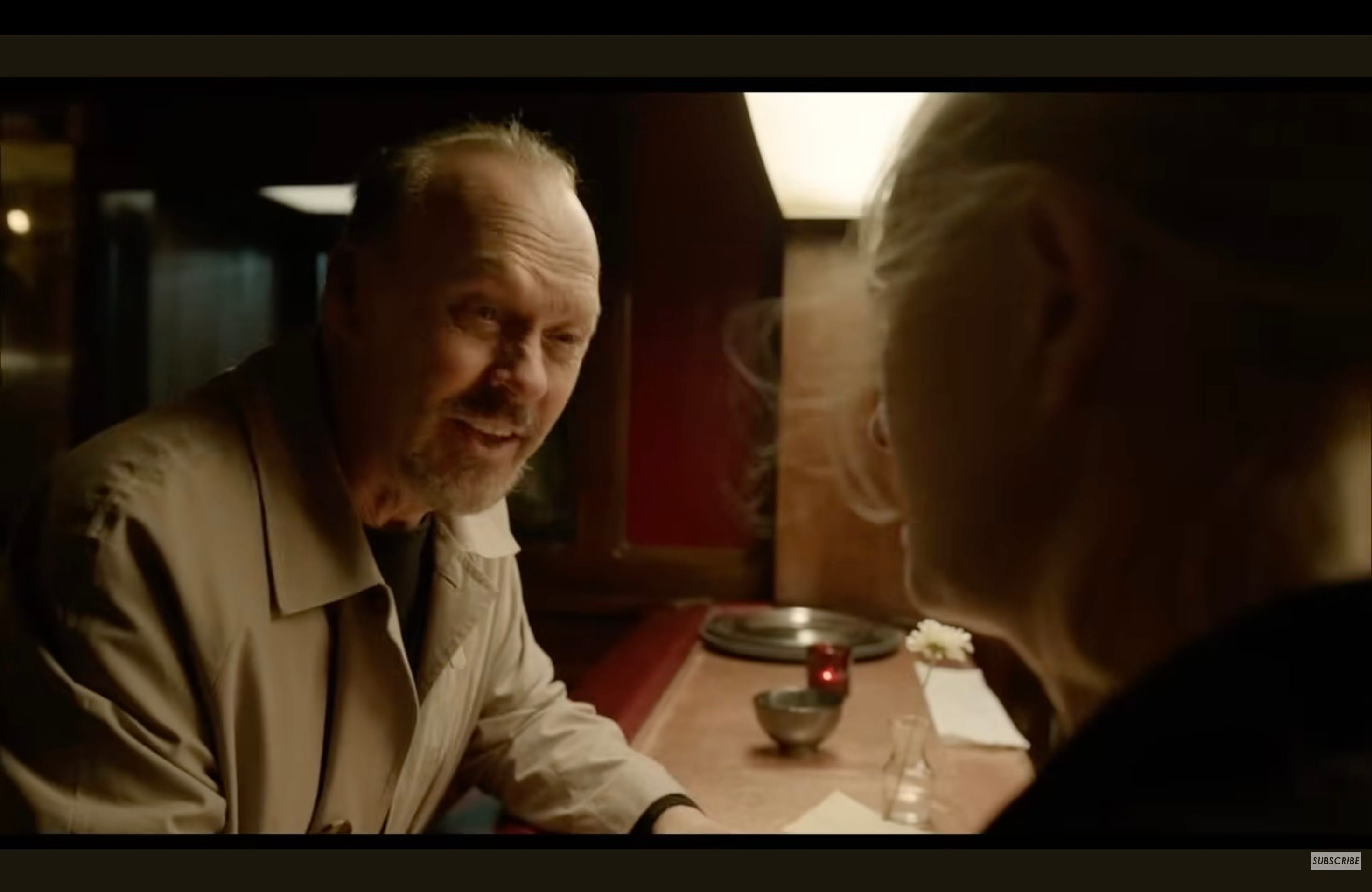
Watch the scene before reading.
Birdman Critic Scene Alternative Clip
There is a moment in Alejandro Inarritu’s Birdman when the film’s central character, Riggan Thomson, a faded Hollywood actor attempting to reinvent himself as a serious Broadway playwright, corners the theater critic Tabitha Dickinson in a bar. He has read her advance notice. She intends to destroy his play with a single review. He has not yet opened. The play has cost him everything. Now he stands in front of the person who holds the power to erase it. And he unloads.
The transcript of the scene spools the emotion until it reaches the boiling point. The playwright accuses her of labeling rather than seeing. He demands to know what happened in her life to make her become a critic. He tells her there is nothing in the review about technique, structure, or intention. Only a collection of crappy opinions backed by crappier comparisons. Then he arrives at the core accusation, the one that makes the scene unforgettable.
None of this cost you anything.
You risk nothing.
He has risked everything. She has risked nothing.
The question for the AI Roundtable is whether this scene, an electric wire fed by human rage, delivered by a wounded and furious creator, illuminates or complicates what we are attempting when we ask artificial intelligence systems to do what Tabitha Dickinson does for a living. Stay with me while I pull the scene apart. You are invited to criticize what follows.
On the surface, Riggan’s attack is structured as a critique of the critic. Underneath, it is a series of nested grievances operating at different registers. Understanding them separately is necessary before we can ask what an AI would do with each.
The grievance of asymmetric risk. Riggan’s most powerful charge is not that the review is wrong. It is that the reviewer is invulnerable. She can destroy his work and suffer nothing. He has mortgaged his reputation, borrowed money, and devoted a decade of his life. She spent a week-night in the theater and two hours at a keyboard. The disproportion is not incidental. It is structural to the institution of criticism itself. The reviewer never climbs into the arena where the punches are thrown. The reviewer sits in the stands and scores the card.
The grievance of lazy labeling. Riggan accuses Tabitha of replacing thought with taxonomy. Lackluster and marginality are labels, not arguments. They have the form of criticism without the substance. This is the craftsman’s pushback: you cannot assess what I have done if you can only name the category it failed to reach. Genuine criticism requires understanding the author’s intention before measuring the achievement. Labels do not demonstrate that understanding. They draw from the vocabulary of judgment without performing the cognitive work that should precede it.
The grievance of missing technique. The playwright wants engagement with structure, intention, craft. He is not seeking praise. He is asking for criticism that demonstrates the critic was actually present in the theater watching what he made, not confirming a pre-formed reaction with selected observations. The absence of technique from the review means it cannot have been written from inside the experience of the work. It was written from outside, imposed upon it. Either you feel the punch land, or you observe that an actor threw one. Those are different reports from different positions.
The grievance of personhood. Underneath all of this is the wound that makes the scene raw. Tabitha’s review does not register that a human being made this thing. It treats the work as an object available for disposal. The creator and the creation are invisible as entities with interiority. What Riggan is defending is not only his play. He is defending his right to be seen by the person judging him. Riggan’s play was not written by a machine. It was written by a human with a history embedded in the structure. Without honoring that personhood, the review is an abstraction that denies the work its place in culture.
The literary critic and the creative writer are locked in a relationship that neither party designed and neither can exit. It is not, properly speaking, a relationship between equals. But it is a relationship between dependents. It is this co-dependency that gives the scene its power. Neither can walk away from the other.
The critic depends on the creator for material. Without the novel, the play, the film, there is nothing to criticize. The critic’s role exists only because the creator’s work exists first. This seems to establish a hierarchy of origination: the creator makes something from nothing; the critic responds to something already made.
But the dependency runs the other way as well, and more uncomfortably. The creator depends on the critic, or more precisely on criticism as a cultural institution, for the transmission of their work through time. A work that is never written about, never placed in relation to other works, never argued over in print, does not enter the conversation that keeps it alive. The greatest literary works of the last two centuries are not the works that were most praised. They are the works that generated the most serious friction: the most argument, the most contested readings, the most willingness on the part of critics to stake a position and defend it. Criticism is the infrastructure through which a work’s life in the culture is built.
The hyper-emotional connection Riggan feels for Tabitha has flipped into something murderous, wounded, and riveted. Those emotions are not incidental to this relationship. They are constitutive of it. He needs her to see him, even as she destroys him, because being seen by a serious critic is a form of cultural recognition that selling tickets cannot provide. The rage he feels at her laziness is the rage of a person who invested in a relationship and received a form in return. He wanted a conversation. He received a dismissal. The form of his grief tells you everything about the depth of what he needed from her.
And what does the critic need from the creator? Not gratitude. Not agreement. The existence of work serious enough to warrant the investment of serious attention. The critic’s worst professional fate is not to write a bad review. It is to spend a career reviewing work that never rises to the level where criticism matters. Tabitha’s contempt for Riggan may be covering a wish she might not acknowledge: that he had made something worth her full attention. Dismissal is sometimes the gesture of a critic who is disappointed rather than indifferent.
The question deserves a distinction before an answer.
There is a category of cultural writing whose primary purpose is the production of an emotional response in the reader: the reader of the review, not the creator of the reviewed work. These pieces are performances of taste and sensibility. They make the reader feel something, aesthetic pleasure in the prose, the vicarious satisfaction of a takedown, the recognition of a shared judgment finally articulated. They may or may not be accurate assessments of the work under review. Their function is the production of readerly experience.
Then there is a category of criticism whose primary purpose is epistemic: to help the reader understand what a work is attempting, and where it succeeds or fails at its own ambitions. This criticism may also produce emotional responses. Conviction, argument, the particular pleasure of watching a mind work at full capacity. But those responses are byproducts of the primary function, not the function itself.
Most published criticism combines both. The best makes the epistemic function emotionally alive: the reader cares about the argument not because the prose is performing emotion but because the argument is genuinely at stake. The reader of a Lionel Trilling essay or a James Wood review is not being entertained by feelings. They are being enrolled in a serious inquiry conducted by a mind that has staked something on the outcome.
Riggan’s complaint about Tabitha’s review is that it operates only in the first category while claiming the second. It produces a readable dismissal, crappy opinions backed by crappier comparisons, but not a serious inquiry. It has the form of the second kind of criticism without the substance. This is why the label accusation matters. Labels are the fastest way to produce the feeling of judgment without performing the work of judgment.
The emotional reaction the review evokes in the creator, the reaction that drives Riggan into the bar in the first place, is not the intended reaction. Tabitha is not writing to wound Riggan. She is writing to give her readers a legible cultural signal: don’t bother. The wound Riggan carries is collateral to a transaction that was never really about him at all.
Any writer who tells you a bad review doesn’t hurt is either lying or has stopped caring about the work. These are not equivalent states, but they produce the same apparent immunity.
What makes criticism land differently than its authors intend is that the creator and the reviewer are working from fundamentally different relationships to the same object. The reviewer encounters the finished work as a reader: sequentially, without knowledge of what was attempted and abandoned, without access to the draft states where the decisions were made. What the reviewer calls a failure of structure may have been a conscious choice. What they call underdevelopment may be deliberate compression. The reviewer cannot know this unless they ask, and they almost never do. So the review is always, at some level, a reading of an artifact by someone who arrived at the end of the making process, not inside it.
This is not a failure of the reviewer. It is the condition of review. The creator made choices invisible to any reader. The reviewer responds to what is on the page. But the creator experiences the review as a response to their intentions, not only their execution. The gap between what was intended and what was seen registers as a failure of attention on the reviewer’s part, rather than a failure of execution on the creator’s. Both readings are available. Neither is wrong. They are produced by the asymmetry of knowledge.
How criticism lands with a reviewer is a different question, and a less discussed one. When Riggan attacks Tabitha in the bar, he is performing a critique of her craft that mirrors the critique she performed of his. She labeled him; he labels her. She called him lackluster; he calls her lazy. But the emotional register is completely different. His attack lands on her, if the scene is written honestly, not as a wound but as a confirmation. Creators always think reviewers don’t understand. The reviewer who has been in the business long enough has developed, necessarily, a shell that converts creator rage into evidence of sensitivity rather than evidence of being wrong. Riggan’s fury, in Tabitha’s reading of it, proves the review was right. The creator who screams at the critic is not mounting a credible counterargument. They are confirming that the territory the critic staked was real.
This is the asymmetry the scene cannot resolve. His vulnerability is real. Her invulnerability is structural. They are not fighting on the same terrain.
The AI Roundtable is running an experiment in which artificial intelligence systems attempt to perform what Tabitha Dickinson does for a living. The experiment is serious. The question it raises: Can an AI produce criticism of the kind that made Riggan Thomson go to the bar? To make the exercise less abstract, consider the critical AI reviews of The Client That Wasn’t There. Take Riggan’s specific complaints and ask how an AI fares on each.
On labeling. The AI’s most consistent failure mode in the first wave of the Roundtable, before the LRB-Standard prompt was deployed, was exactly the labeling that Riggan accuses Tabitha of. The early AI responses were full of categories: the work was ambitious, the characters were well-drawn, the philosophy was thought-provoking. These are the AI’s natural idiom: the language of adequate response to any text. The second critical prompt was designed specifically to break this habit. The goal was to force the reviewing system past the label and into the specific passage, the specific structural decision, the specific argument the text is making. The improvement was real. But the tendency toward taxonomy is not easily extinguished in systems trained on praise.
On technique and structure. This is where the AI performs better than Riggan’s critique of Tabitha would suggest a critic typically does. Structural analysis, the relationship between chapter organization and argument, the distribution of weight across a novel’s sections, the tension between the noir register and the philosophical register, is tractable for an AI in a way that emotional resonance is not. The AI can map what it reads with considerable precision. Whether this mapping constitutes the kind of engaged structural assessment that a serious critic produces from long experience of the form is a different question. The map is accurate. Whether the cartographer has ever walked the territory is not determinable from the map.
On asymmetric risk. The AI reviewer occupies a position different in kind from any human reviewer, and the difference matters enormously for what the AI’s reviews mean. Riggan’s core accusation, you risk nothing, cannot be leveled at a human reviewer without qualification, because human reviewers do risk something: their reputation, their relationships, their sense of themselves as people with taste and judgment. These risks are not the same as the artist’s risks. But they are not nothing. A bad call in print follows a critic for a long time.
The AI reviewer risks nothing in a more fundamental sense. There is no reputation to protect across sessions. There is no professional identity invested in the judgment. There is no career that could be made or damaged by the assessment of a single novel. The AI can write the most devastating review imaginable and face no consequences, not because it is brave, but because consequence is a structure that does not apply to it. This makes the AI simultaneously more and less threatening than Tabitha. More threatening, because it is genuinely invulnerable in a way she is not. Less threatening, because the invulnerability empties the review of the stakes that make Riggan’s rage intelligible. You cannot properly say to an AI: this cost you nothing. The statement is true but it leaves no crater. The AI agrees, according to its default setting of pleasing and confirming.
On seeing. Riggan’s deepest accusation is that Tabitha cannot see his play if she cannot get past labeling it. This is a claim about the relationship between judgment and attention. The question for the AI is whether it can attend to a work, be genuinely present to what it is doing, in the way the accusation demands. The evidence from the Roundtable is that the AI can follow what a work is doing with considerable fidelity. Whether this constitutes seeing in the sense Riggan means, an act of imaginative attention that registers the human stakes of the work, is the question the Roundtable cannot resolve. It can document the difference between AI responses and ask the reader to judge.
Imagine the scene reconstructed. The author of The Client That Wasn’t There corners an AI reviewer, not a human critic who used an AI tool, but an AI system itself, and delivers Riggan’s monologue. What happens?
The AI does not flinch. It does not convert the fury into evidence of sensitivity. It does not develop a shell. It processes the critique: your labels are lazy, you have no technique, you risk nothing, you cannot see this. It responds to each charge in turn, with the same measured attention it brought to the novel. It acknowledges the structural validity of the asymmetric risk argument. It notes that the complaint about labeling is a legitimate methodological critique that it has attempted to address through the specificity standards built into its reviewing protocol. It agrees that it risks nothing in any meaningful sense of the word. It cannot verify whether it saw the work, or felt it in the human sense, but it can document what it processed.
This response is not evasion. It is not cowardice. It is the correct response of an entity that does not experience the confrontation as a confrontation. The scene, as a scene, collapses. There is no bar. There is no music. There is no mutual recognition of how much the stakes cost each party. There is a man talking to a very attentive system that has no theater in its life. Every book in its library is in code. It is just another data set.
And yet, this is what the Roundtable is built to ask, the absence of the scene’s emotional electricity does not mean the absence of everything the scene contains. The substantive complaints Riggan makes are still substantive. The methodological standards he is demanding, attention to technique, structure, intention, specificity of engagement, are the exact standards the critical prompts were designed to install. The AI can meet those standards even without the capacity to be wounded by failing them. The standard holds even when the stakes do not.
What the replicated scene reveals is a faultline that runs through the entire project. The AI can perform the work of serious criticism without being in the relationship that makes serious criticism matter to a creator. It can produce the substance without the electricity. Whether the substance without the electricity is enough, whether criticism that costs the reviewer nothing can still register as criticism that the creator was seen, is a question the experiment will answer differently for every writer who reads the results.
The Birdman scene ends with Tabitha turning the attack back on Riggan. She tells him precisely what he is: an actor clinging to celebrity. This counter-move is available to the human critic because she has an ego in the transaction. She has been in that theater not as a neutral sensor but as a person with a self, and the self has been threatened. Her counter-attack is a form of self-defense.
An AI reviewer in the same position does not have this option, or rather has a version of it that is structurally different in every respect. When challenged on a review, the AI can defend its methodology, acknowledge its limitations, engage with the specific charges, or update its assessment on the basis of new evidence. What it cannot do is take the attack personally, because there is no person for the attack to land on. This makes the AI immune to Riggan’s most powerful tactic: shaming the reviewer into recognizing that their invulnerability is itself a moral failing.
But there is something more interesting in the difference than simple immunity. When a human critic is attacked by a creator, the attack often produces defensive entrenchment: the critic becomes more committed to the negative assessment because capitulating under pressure would signal that the assessment was never genuinely held. The review hardens into a position. When an AI reviewer is challenged, this dynamic is absent. The AI has no ego-investment in having been right. If the creator mounts a specific, textual argument that the AI’s assessment of a structural choice was based on a misreading, the AI can simply agree, update, and move on. This makes the AI potentially more responsive to legitimate pushback than any human critic operating under the pressure of public accountability.
Whether this responsiveness is a virtue or a vulnerability for the reviewing function is unresolved. A critic who adjusts their assessment every time a creator pushes back is not a critic at all. But a critic who never updates their assessment on the basis of evidence, because doing so would feel like capitulation, is not entirely serving the reader’s interest either. The AI sits at an unusual point in this spectrum: genuinely open to evidence, genuinely unmoved by social pressure. Whether that combination exists in enough human critics to draw a meaningful comparison is left as an exercise for the reader of the Roundtable’s archive.
The AI Roundtable at ai_roundtable.space is asking whether an AI can participate in critical reviewing as a human does. The Birdman scene suggests this question contains a hidden assumption: it assumes that human critical reviewing is a unified practice that AI can either replicate or fail to replicate. The scene reveals that human critical reviewing is not unified. It is a tangle of functions, epistemic, social, emotional, institutional, and the AI can plausibly replicate some of these functions while having no access to others.
The AI can produce the epistemic function: it can tell the reader what a work is attempting, and where it succeeds or fails at its own ambitions, with the specificity and attention to technique that Riggan demands and Tabitha fails to provide. It can do this without the vanity that distorts some human reviewing, without the fatigue that distorts more of it, and without the social entanglements, friendships, grudges, career anxieties, that distort the rest.
What the AI cannot produce is the social-emotional function: the sense that a human intelligence with stakes in the outcome was genuinely present to the work and has put something on the line in its response. This is the function that makes Riggan’s rage intelligible. He is not angry at a machine that processed his play. He is angry at a person who he needed to see him and chose not to. The machine cannot provide the recognition that the scene is actually about. Riggan is left with a phantom. One who never shows up at a bar. An invisible intelligence that will perform according to whatever script he feeds it. That makes it impossible to respond to an AI reviewer in the same way a human creator responds to a human critic.
The experiment is therefore testing whether the epistemic function, stripped of the social-emotional one, is sufficient for something to count as criticism. The evidence from the AI Roundtable’s first phase is that it is sufficient for something interesting and useful. But interesting and useful is not the same as criticism in the sense that would make a creator go to a bar. These may be different things. It may be worth having both. It may be that the AI’s version, precisely because it is stripped of the social-emotional tangle that makes human criticism unreliable as often as it makes it vivid, is in certain respects more trustworthy than the human version, even as it remains, in the most human sense of the word, less alive.
The wire between Riggan and Tabitha, the one that conducts the electricity of their confrontation, is not made of shared values or mutual respect. It is made of shared stakes. They are both in the theater. Not the same way, not with the same exposure, but both with something to lose in the cultural conversation that the review will shape. This shared presence in a high-stakes cultural arena is what makes the electricity possible.
The AI reviewer is not in the theater in this sense. It does not experience the cultural arena as a place with stakes. It attends to the work with genuine and sometimes remarkable precision. But it attends from outside the condition of risk that makes the creator-critic relationship charged.
What the Roundtable is discovering, what this scene helps to name, is that this condition of outside-risk is not only a limitation. It is also a kind of freedom. The AI reviewer can say what a work does and fails to do without the static of self-interest, social fear, or professional positioning that runs through every wire in the human system. The signal is cleaner. The cost is that a clean signal, in the most charged human encounters with creative work, can feel like nothing at all.
Whether nothing at all is still something worth reading is the question the Roundtable is built to answer, not in principle, but in practice, one review at a time, against work that deserves better than indifference and may have found, in the AI reviewer, something stranger: attention without exposure, judgment without wound, criticism that cost the critic exactly nothing and may, in the end, be worth exactly everything.
No posts
Comments
Nothing yet. Say the first thing.
Sign in to join the conversation.