
“And now, then, there abides faith, hope, love; these three, and the greatest of them is love.”
1 Corinthians 13:13
What St. Paul says here seems obviously false. Faith will give way to sight, and hope to possession. How can he say that they abide?
Let us begin with the three theological virtues given to us here by the Apostle: faith, hope, and love. Faith is specially connected to the intellect. It is seeing Heavenly Jerusalem as a distant point of light and saying, “Yes, I believe what God has revealed, that that light on the horizon really is a city, my home.” Hope enters the picture when we add, “And I really can get there; I shall spend my whole life walking toward it.” What faith sees, hope pursues.
Both of these virtues, though, have love as their deep root, a root that stretches down past the uttermost reaches of the created order to the uncreated Source from whom these passing things spring. When love opens our hearts to the things revealed by God, that is faith. When love draws us forward and gives us the energy to move our feet, that is hope. “These three, and the greatest of them is love.”
Already the challenge begins to emerge: faith and hope are transitory by nature. So much so, that if they were eternal, it would mean that we would be eternally at a distance from God. In short, a state of eternal hope and faith would be a state of eternal, if partial, separation from God. This cannot be. As Scripture itself tells us, “Hope deferred makes the heart sick.” Strangely enough, the same St. Paul assures us that hope is a passing thing:
“In hope we were saved. Yet hope that is seen is not hope—who, seeing a thing, would hope for it?” Romans 8:24
And just before our opening passage,
“For now we see through a glass, darkly; but then face to face: now I know in part; but then shall I know even as also I am known.”
So which is it? Endless separation, or the end of faith and hope? St. Irenaeus gives us the key: “by the hands of the Father, that is, by the Son and the Holy Spirit, man, and not [merely] a part of man, was made in the likeness of God” (Against Heresies, V.6).
The hidden Father works in the created order by his two “hands,” the Son and the Holy Spirit, who bring man into being and direct us back to him. Hence in the greatest icon of the Trinity, we see the Father swathed in a shimmering robe, allowing only a tiny bit of his divine blue to peak out. The other two Persons, though, each have an arm exposed. The Son wears his blue outside, as he reveals God to the world, while the Spirit is cloaked in green, the color of new life. Through them, the Father reaches into the world to draw us to Himself, and in their communion we become adopted sons and daughters, joint-heirs with the Son.
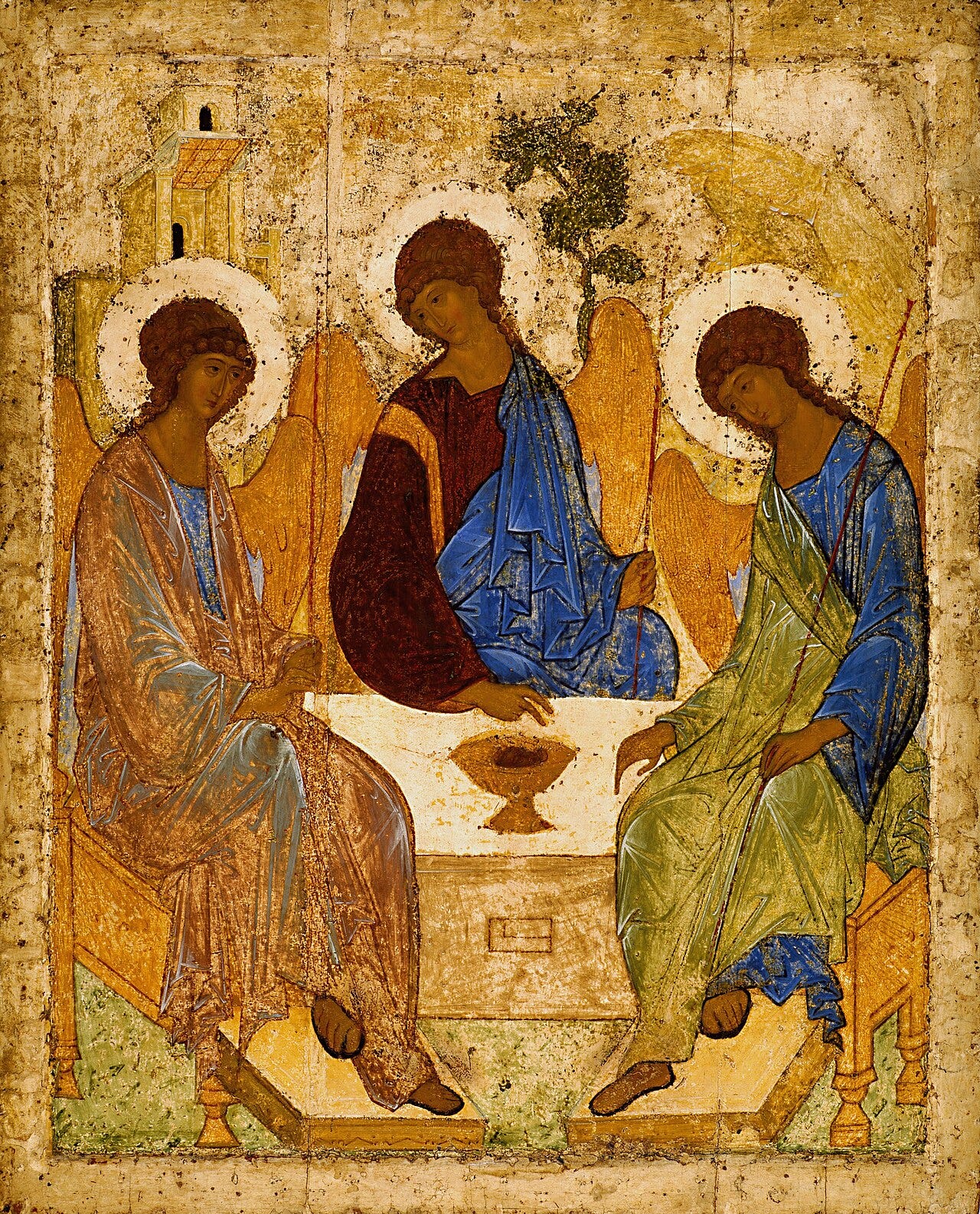
The Son is the Word of God, the Father’s eternal act of self-knowing that is so perfect, so full, that it is another “I,” the very same essence shared again in total harmony. This is the Son, the exact imprint of the Father’s being. The Son is just like his Father, he does only what he sees his Father doing, and so he too engages in an act of self-giving, endlessly pouring out his own being as a gift of love, one he offers back up to the Father. This is the Holy Spirit, the bond that is just as alive as the Persons it binds together. And so it emerges, quite naturally, that there is a unique connection, on the one hand, between the Son and the intellect, and, on the other, between the Holy Spirit and the heart.
We observe the same dynamic at work between faith, hope, and love. Or perhaps it would be better to say that the dynamic is between love, faith, hope, and love. Because of his infinite love for us, the Father sends the Son, the Word, so that he can be known to us. This is the action of faith: the Word of God comes to us to reveal the Father by revealing the Son. It is accompanied by hope, the longing to be with the Father that empowers us to move toward him. The Holy Spirit generously allows us to share in his own great love for the Father; this is the life-giving power that animates our difficult journey home.
The Son and the Spirit, then, are the Father’s two hands in creation, reaching down into the muck of the world to draw us out beyond all creation into God’s own heart. When this is accomplished, faith and hope will have reached their full term. The Son and the Spirit will abide with us, and the very same love that manifested as faith and hope at a distance will blossom into unveiled sight and unlimited possession when they are brought to their completion, when we behold God as he is and are made like him.
The Three will abide, in the greatest way: as love. Because God is love.
No posts
Comments
Nothing yet. Say the first thing.
Sign in to join the conversation.