
If this post resonates with you please consider clicking the like button or leaving a comment. It’s greatly appreciated, and it also goes a long way toward increasing the visibility of this piece.
March was a bit of a doozy for me, but I’m happy to be back to writing after a bout with pneumonia followed up just a short time later by a busted water heater and flooded basement. I’m on the other side of all of that now, and ready to get into today’s post.
I’m working on a writing project that’s given me an excuse to interview a handful of people whose work I’ve admired and respected for some time now. One of those people is Dr. David Lancy, author of nine scholarly books including The Anthropology of Childhood and Raising Children, as well as 75 articles. He’s spent over 50 years studying child development in indigenous communities around the world.
During our interview he said something that struck me, which was that we think we can keep children, “safe and separate,” but this is largely a myth. Isolating children from adventures they may seek out by ensuring they are perpetually supervised gives rise to a more insidious type of threat–the slow and steady deterioration of mental health. He then shared a compelling paper he recently wrote on that topic.
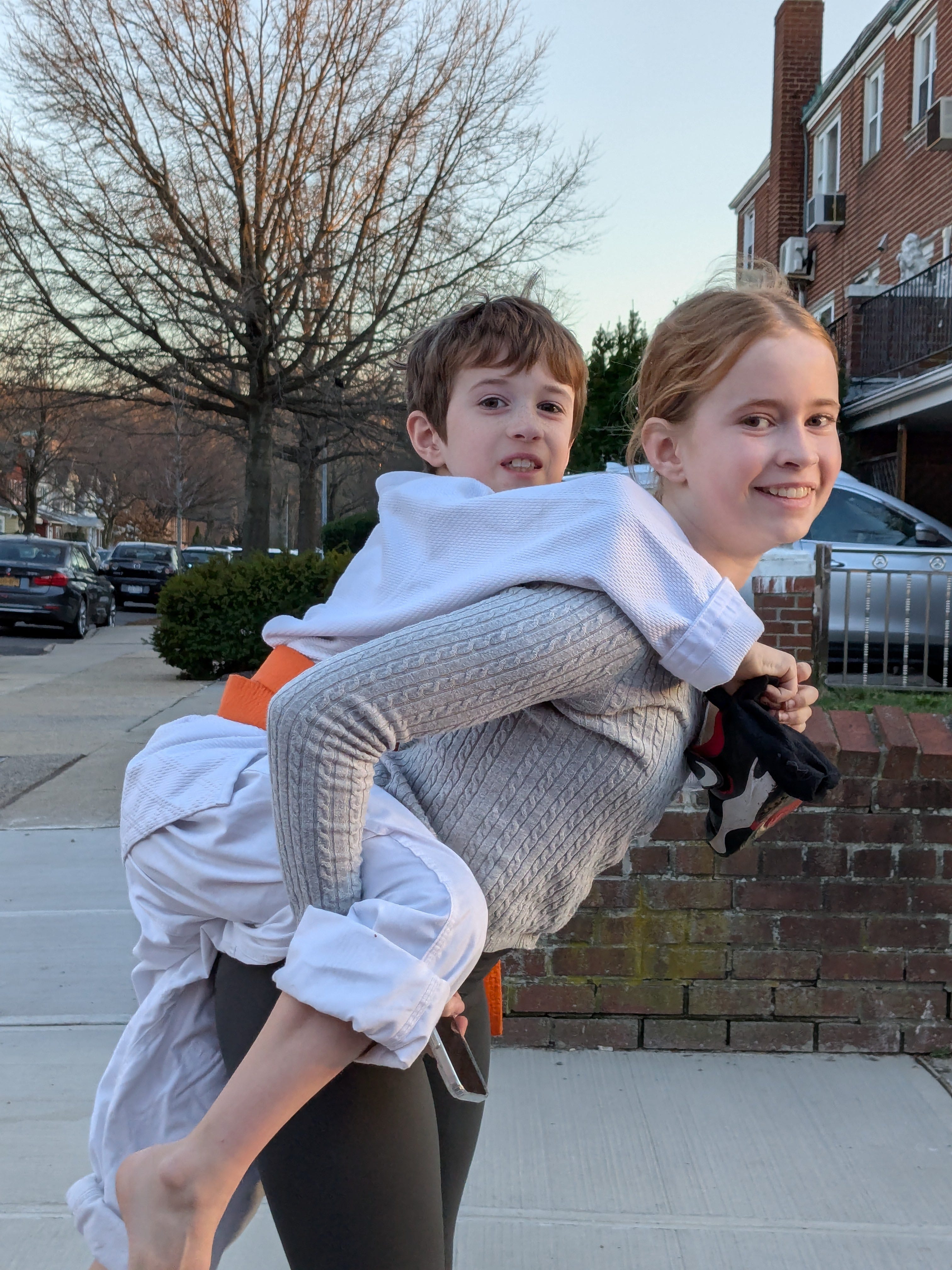
Fast forward to this week. On Tuesdays and Thursdays my son has karate. On Thursdays our schedule is particularly tight because I have to get my oldest daughter from dance at 6:45 and then get Colin from karate at 6:55. This week Cecelia was running late leaving dance and I hurried her along, reminding her we had to get Colin. As we neared the dojo a light stopped us, so Cecelia decided to get out of the car and run up to Colin. From where I was at the light I saw her crouch down and give him a hug. Interesting, I thought. Then I saw her struggle to get him situated on her back and piggyback him all the way back to the car. I realized he must be hurt. She carefully helped him into the backseat, explaining that his toe was all bloody. After he told me the whole saga of his injury he suddenly said, “hey Mom, when Dylan, Jake (not their real names) and I were walking home a lady was taking pictures of us from her car. Am I going to get in trouble?” Lancy’s research paper is fresh in my mind at this point, but I’m trying to understand how Colin interpreted the situation.
I pressed him, “Why would you get in trouble?”
“I think she thought we weren’t supposed to be walking on our own. Like without a parent.”
I let him know that’s what I assumed she thought too.
He asked me again, “Am I going to get in trouble? Do you think she wants to show the police a picture of us walking on our own?”
At Colin’s school, fourth and fifth graders can walk home alone, as long as a parent signs a form allowing them to do so. We live fairly close to this school, as do his friends, and they all have permission to walk alone. Colin was the first of his friends to get this permission from us, but eventually most of his other buddies followed suit. I tell Colin that his school is filled with people who have spent decades of time with children and understand their capabilities so if he has permission from the school to walk home he has nothing to worry about.
“But do you think the police will want to talk to you if she showed them those pictures of us walking without a parent?”
I couldn’t help but find it ironic that Colin was actually hurt, actively bleeding in fact. His injury was sustained while under adult supervision, yet instead of worrying about that he was gripped with fear about a stranger’s irrational concern and subsequent creepy behavior about his right to walk through his own neighborhood.
As calm as I was trying to stay, I got up on my soapbox just a little at this point. “Colin, I would love to have a conversation with the police about your right to be in the world. I would also love to have a conversation with that lady about what the real threat to children is these days. If she thinks you’d be safer in your house on the internet with millions of strangers, rather than walking in the neighborhood we’ve lived in for nine years with your two best friends, I’d gladly show her research to prove that she’s sorely mistaken.”
At this point Cecelia started laughing and chimed in, “Colin, this is where you want mom to be the way she is. Seriously, you have nothing to worry about.”
I loved, loved, loved the backhanded nature of this adolescent chime in. I can only imagine what she meant when she said, “the way she is” but nonetheless, it calmed Colin right down. I looked at him in the rearview mirror and could see a little smile spread over his face.
The article I’m working on has far more to do with children’s executive function than with their level of supervision. But in trying to get to the root of the lack of follow-through and initiative children from WEIRD (Western, Educated, Industrialized, Rich, and Democratic) societies demonstrate, as compared to their indigenous counterparts, I was asking Dr. Lancy if there were ways parents from WEIRD societies were inadvertently subverting their children’s agency. There were many ways he said, but interestingly, one was constant supervision. As much as we assume risks to children solely exist in the physical realm, the correlations Lancy makes between lack of childhood independence, and steady decline in mental health outcomes should make any parent pause.
But, as I saw this week, even if some parents begin to embrace what’s referred to as “children’s independent mobility,” a key factor in children’s mental health, there’s going to be societal pushback. People tend to have an extremely difficult time trusting children are safe if an adult isn’t within arm’s reach. But, as Lancy points out:
“Parents today are regularly subject to messages about the dangers that might befall unsupervised children and the value of high achievement in school. However, they hear little of the countervailing messages that if children are to grow up well-adjusted, they need ever-increasing opportunities for independent activity, including self-directed play and meaningful contributions to family and community life, which are signs that they are trusted, responsible, and capable.”
While I understand it may not be feasible for younger children to be walking through their neighborhood, and I similarly understand not all neighborhoods are safe to walk in, the food for thought here is more about how to maintain a semblance of balance between keeping children safe and preserving their sense of agency in the world. Loosening the reins just a little when it comes to how much and how intensely children are supervised isn’t exclusively exposing them to risk. It’s also inviting in necessary building blocks of healthy development like resilience, internal locus of control, problem solving skills, self-efficacy and the often overlooked necessity of a sense of adventure that use to be part and parcel of childhood.
Until next time,
Christine
No posts
Comments
Nothing yet. Say the first thing.
Sign in to join the conversation.