
Organisations that defend scientific evidence are being accused of playing politics and of abandoning their duty to be “non-partisan”. For instance, in Britain, the Met Office has spent the past year defending its temperature records against sceptic outlets that accuse it of running a political “Net Zero” agenda, publishing detailed fact-checks rather than staying silent. When America’s main paediatric body, the American Academy of Pediatrics, kept recommending the established childhood vaccine schedule after federal policy moved away from it, health secretary Robert F Kennedy Jr accused it of issuing “corporate-friendly” recommendations bought by drug companies.
Non-partisan should mean refusing to take sides between political parties: no endorsing candidates, no campaigning, no bending findings to help one side win. I agree that scientific institutions should be non-partisan in this sense. The problem is that “non-partisan” is increasingly being interpreted by institutions as “stay out of anything that has become politically charged, avoid controversy, say nothing”. I believe such silence is neither non-partisan nor harmless.
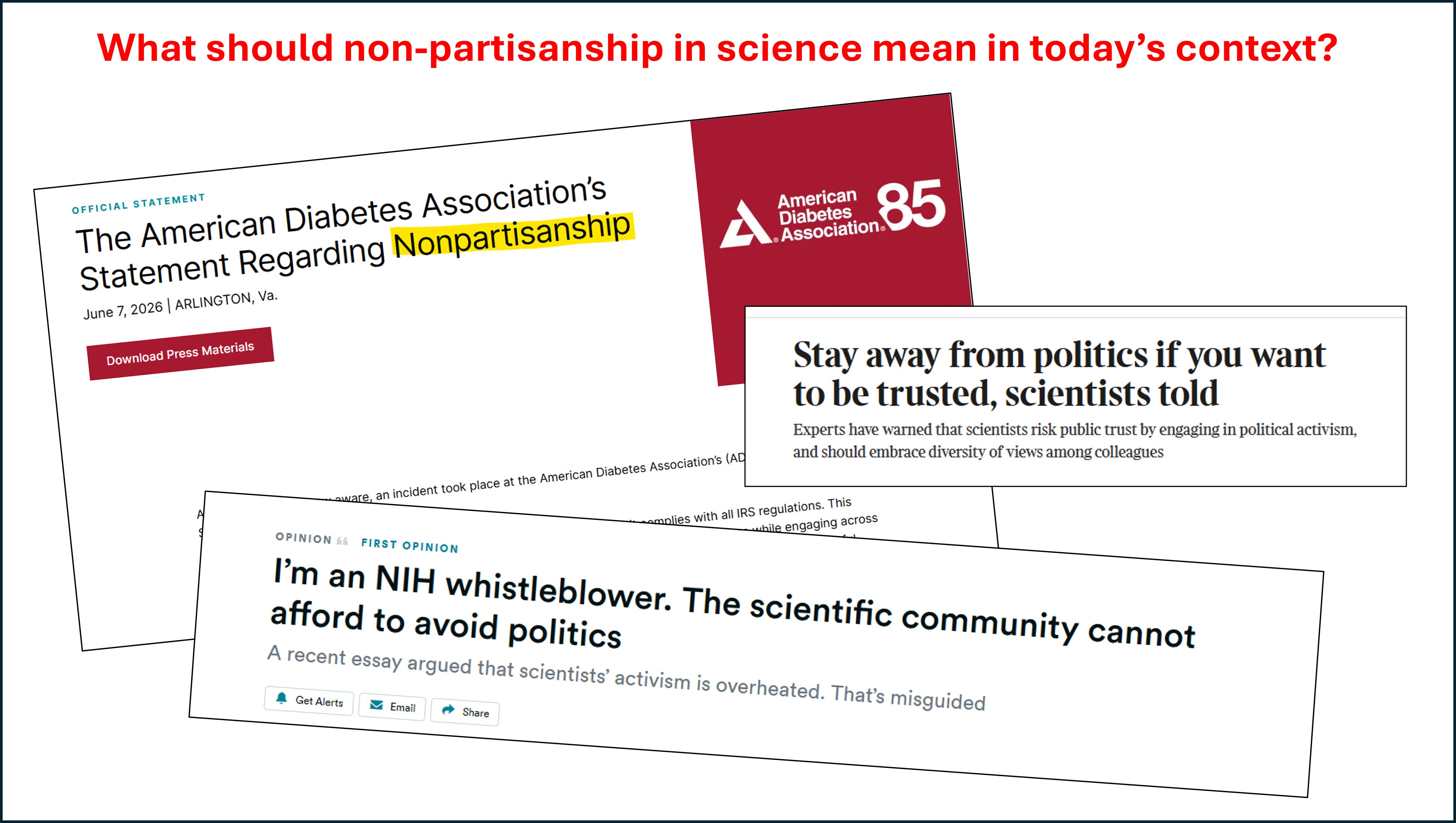
The integrity of evidence itself is not a partisan issue: whether peer review is independent of political appointees, whether researchers can publish findings without being punished for them, whether public health data is ethical and transparent, whether advisory committees are chosen for expertise or for loyalty. Politicians on the right or left who agree on nothing else should both want the evidence underlying their different policy agendas to be sound.
Scientific institutions as ‘referees’ over use of evidence is a useful analogy. A referee should never favour a team but if they see one team commit foul after foul and stay silent for fear that penalising that team would look like favouritism, then they have failed at being a referee. Indeed, their silence is favouritism but for the side committing the infringements. In our analogy, scientific institutions don’t decide the winner between political parties, but they should ensure that ‘shared facts’ (the rulebook) are adhered to.
Of course, evidence is not always clear-cut, and there can be legitimate debate over the meaning or veracity of emerging findings (e.g. the pandemic was characterised by policy making under considerable uncertainty), or how to incorporate evidence into policy (e.g. which vaccines to offer to which populations), or uncertainty at the edges of accepted evidence (e.g. second- or third-order effects of a changing climate). But just because some evidence is less certain does not mean it all is (e.g. we may not fully understand the second-order impacts of climate change, but we do know that climate change is a major problem) while the underlying conditions which support the integrity of evidence and its production are not themselves in doubt.
The populist right’s tactics are two-pronged. One is an assault on the process: handing political appointees the power to overrule scientific review, removing experts who produce inconvenient results, removing funding from, or starting investigations into, institutions that do not fall into line. The second is the denial of plain evidence in order to enact policies that do real harm: expanding fossil fuels while calling climate change a “hoax”; or rolling back newborn hepatitis B vaccination against the evidence and the experts.
Silence answers neither attack. It does not defend the process, and it does not challenge the harm. And this is why scientists and scientific institutions need to speak up for science.
******
Note: this piece is adapted from some of the discussion in this new editorial: McKee, Correia, Pagel, “Europe must learn from America’s assault on science”, European Journal of Public Health, 2026
Comments
Nothing yet. Say the first thing.
Sign in to join the conversation.