
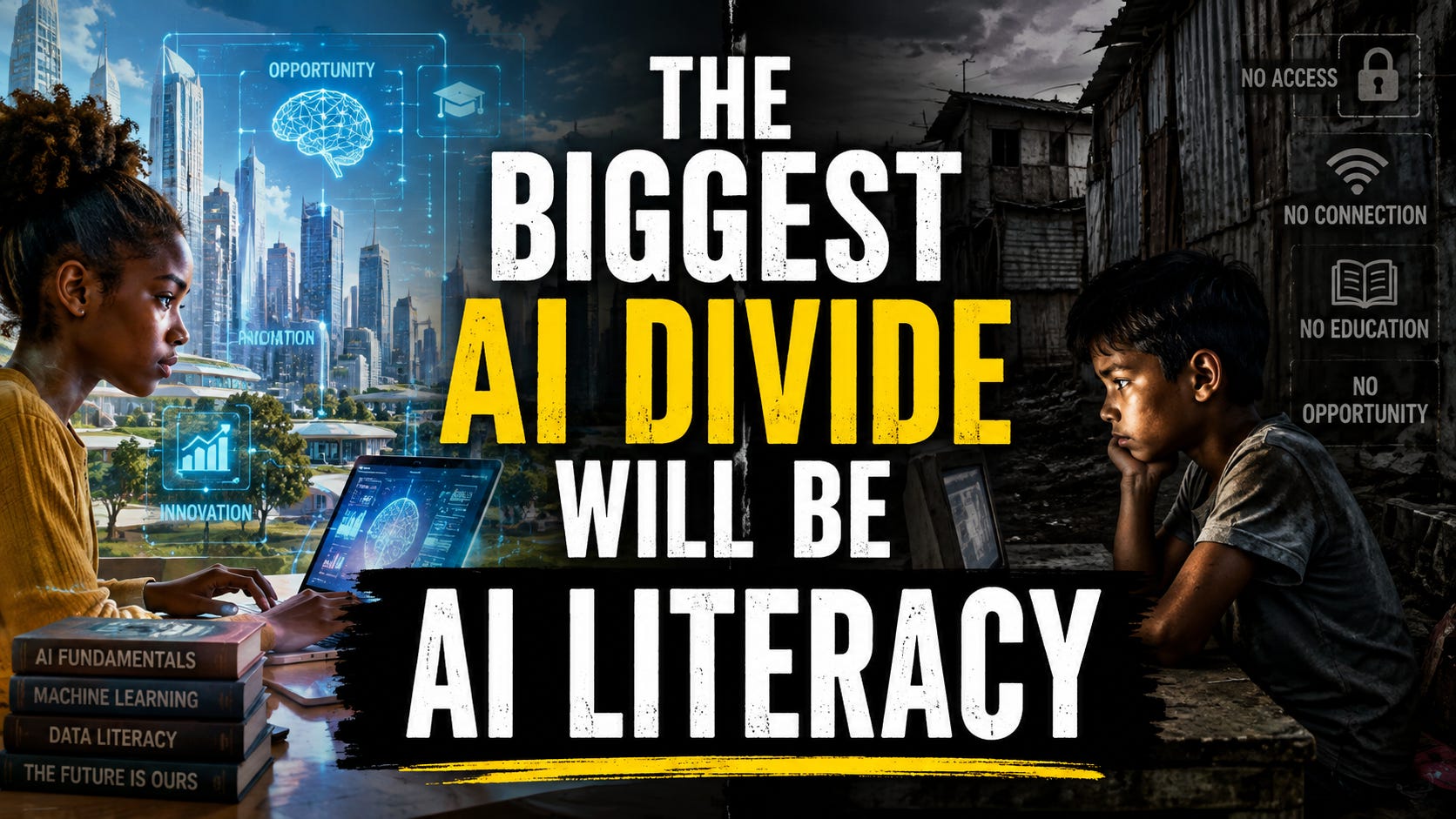
Artificial intelligence is rapidly becoming one of the defining technologies of the twenty-first century. Governments are investing billions in AI infrastructure. Businesses are integrating AI into customer service, marketing, hiring, healthcare, education, finance, and operations. Universities are redesigning curricula. News headlines focus on faster models, larger investments, and the race to dominate artificial intelligence. Yet I believe the most important AI story is being overlooked. The biggest AI divide won’t be who has access to artificial intelligence. It will be who understands it.
Every major technological revolution has created a literacy revolution. The printing press expanded the importance of reading. Industrialization demanded new technical skills. The internet transformed digital literacy from an advantage into a necessity. Artificial intelligence is creating the next evolution. AI literacy is becoming a foundational skill for modern life. The organizations, schools, governments, and communities that invest in understanding AI will be better prepared than those who simply adopt it.
One of the most persistent misconceptions about artificial intelligence is that AI is creating a generation incapable of critical thinking. That diagnosis misses something deeper. AI didn’t invent educational inequity, declining media literacy, uneven access to quality education, or long-standing disparities in digital access. Those challenges existed long before the first large language model entered public conversation. What AI has done is expose them. Instead of confronting those root causes, it is often easier to blame the technology than to address the educational, institutional, and structural conditions that have shaped them for decades.
This pattern is familiar. Throughout history, societies have often blamed new technologies for revealing older problems. Television did not invent misinformation. Social media did not invent polarization. Search engines did not invent unequal access to knowledge. Likewise, artificial intelligence did not create every challenge now attributed to it. It has accelerated our awareness of longstanding issues while making them more difficult to ignore. Treating AI as the sole cause allows institutions to avoid difficult conversations about education, critical inquiry, public investment, and systemic inequality.
From a DEIBA perspective, AI literacy cannot be separated from questions of equity, access, inclusion, belonging, and accountability. Communities do not encounter artificial intelligence from identical social, economic, linguistic, or educational starting points. A rural public school, a multinational corporation, a community nonprofit, and a well-funded research university each approach AI from different positions of access and opportunity. Building equitable AI literacy requires acknowledging those differences rather than assuming one universal pathway serves everyone equally.
AI literacy is also about understanding power. Large language models learn from enormous collections of human-created information. Those collections reflect publishing systems, institutional priorities, dominant languages, historical documentation, and the uneven preservation of knowledge across societies. Understanding artificial intelligence therefore requires asking whose knowledge is represented, whose perspectives remain difficult to find, and how information ecosystems influence what AI can generate. AI literacy becomes more than technical training. It becomes an invitation to examine how knowledge itself is produced, preserved, and distributed.
That is why I believe AI literacy must extend beyond learning how to write better prompts. Prompt engineering is useful. It is not sufficient. AI literacy should include understanding how language models generate responses, how hallucinations occur, why verification matters, how bias can emerge, what governance structures support responsible deployment, and when human judgment should override automated recommendations. These are practical skills that strengthen decision-making across every sector.
Business leaders increasingly ask which AI platform they should adopt. ChatGPT, Claude, Gemini, Microsoft Copilot, and enterprise AI solutions dominate strategic conversations. Those discussions matter, but they are incomplete without a parallel investment in AI literacy. Purchasing artificial intelligence is relatively simple. Building an organization capable of governing, evaluating, and responsibly using AI requires ongoing education. The greatest return on investment may not come from buying another AI platform. It may come from helping people understand the one they already have.
The same principle applies to education. Schools should not frame AI simply as a threat to learning or as a shortcut around thinking. Students need opportunities to understand how AI works, when it is useful, where it fails, and why evidence still matters. AI literacy should strengthen curiosity rather than replace it. The goal is not to produce students who depend on AI for every answer. The goal is to develop learners who know how to question AI, verify information, and continue thinking critically.
The Decolonial Intelligence Algorithmic (DIA) Framework™ grew from this conviction. Rather than viewing responsible AI solely as a technical engineering challenge, the framework emphasizes governance, accountability, transparency, education, and institutional responsibility. It asks organizations to examine not only what AI systems can accomplish but also how they are implemented, who remains accountable for their outcomes, and how human oversight is maintained throughout the AI lifecycle. Responsible AI begins long before deployment. It begins with the decisions organizations make about governance, education, and accountability.
This philosophy also inspired the creation of the Decolonial Algorithmic Coalition. Our mission is not simply to promote another AI product. It is to expand AI literacy as a public good. We believe educators, nonprofit organizations, businesses, public agencies, libraries, community leaders, and everyday citizens deserve practical opportunities to understand artificial intelligence before it becomes embedded in every aspect of modern life. AI literacy should not become another resource available only to organizations with the largest budgets or the greatest technical capacity.
Justice AI GPT was built from the same belief. We don’t see AI governance as a compliance checklist completed after deployment. We see it as an ongoing practice of responsible leadership. Through AI governance, algorithmic accountability, responsible AI consulting, and the DIA Framework™, our work encourages organizations to ask better questions before technology becomes deeply integrated into decision-making. Technology alone will never determine the future of AI. The quality of our governance, education, and institutional choices will.
The next decade will not simply reward organizations that adopt artificial intelligence quickly. It will reward those that develop the wisdom to use it responsibly. AI capability will continue to improve. The greater challenge is whether our collective understanding, critical thinking, governance, and public education evolve at the same pace. The biggest AI divide will not separate those who have AI from those who do not. It will separate those who understand AI from those who merely use it.
If we truly want a future where artificial intelligence serves humanity well, then AI literacy must become part of how we prepare students, train employees, support nonprofit organizations, advise governments, and strengthen communities. AI is not the root cause of declining literacy or critical thinking. It is revealing the consequences of systems we have neglected for far too long. Blaming AI for those failures will not solve them. Investing in AI literacy, responsible AI governance, and equitable access to knowledge just might.
No posts
Comments
Nothing yet. Say the first thing.
Sign in to join the conversation.