
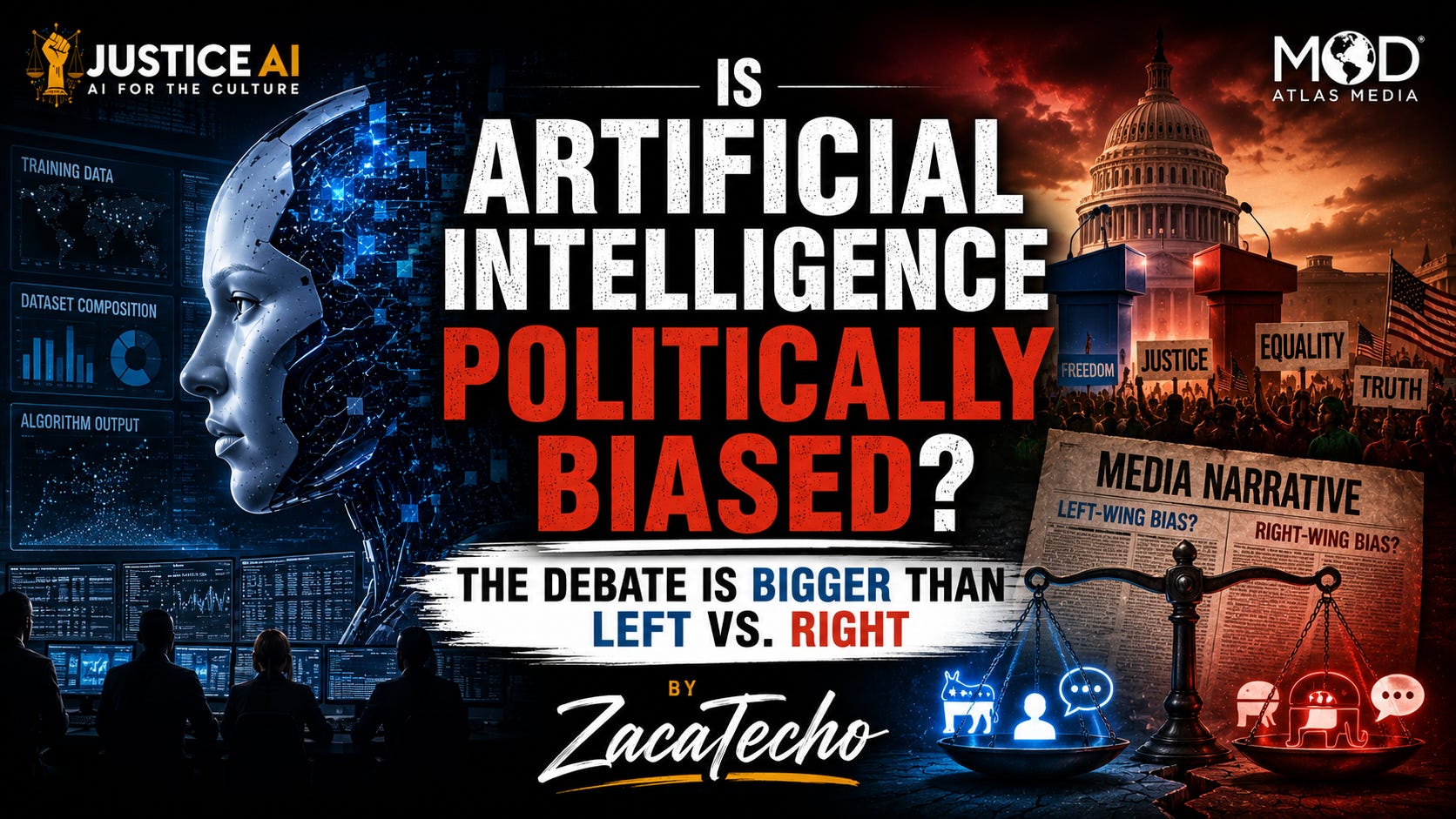
Artificial intelligence is often described as politically biased, but that question is too narrow to explain what is really happening. AI does not wake up with political beliefs, join a political party, or choose one ideology over another. It learns from enormous collections of human-created information, including books, news articles, government records, academic research, websites, and online conversations. Those sources reflect the values, conflicts, priorities, and power structures of the societies that produced them. When people ask whether AI is politically biased, they are often seeing the results of those human systems reflected back through technology.
Much of the public debate focuses on whether an AI system sounds conservative, liberal, progressive, or moderate. While independent studies have found differences in how AI models respond to political questions, reducing the conversation to left versus right misses a much larger issue. Political bias is not only about ideology. It is also about whose voices are treated as trustworthy, whose experiences become part of the historical record, whose knowledge is considered legitimate, and who gets left out altogether. Those decisions shape AI long before anyone starts chatting with it.
Training data plays a major role in how AI responds to political topics. Large language models learn from information that has already been published, archived, translated, and made available online. That means AI learns from institutions that have historically had the resources and influence to produce knowledge at scale. Governments, universities, major media organizations, corporations, and large publishers all contribute enormous amounts of information. Communities with fewer resources, oral traditions, local histories, Indigenous knowledge systems, or languages with limited digital content often appear far less frequently. AI is not deciding these voices matter less. It is learning from a digital world where they have been documented less often.
Human feedback shapes AI as well. After a model is trained, people review its answers and help improve how it responds. They evaluate whether responses are accurate, respectful, helpful, and safe. Those reviewers are not simply checking grammar. They are making decisions about how AI should respond to complex social issues, political disagreements, and harmful content. These choices are made with the goal of reducing harm, but they are still human decisions. AI reflects those decisions because people define the rules it follows.
Safety systems add another layer to this conversation. AI companies build guardrails to reduce hate speech, harassment, misinformation, violent content, and illegal activity. Some users interpret these guardrails as political bias because certain political arguments overlap with areas the AI has been instructed to handle carefully. In many cases, what appears to be political favoritism is actually the result of safety policies, legal obligations, or company governance decisions. Understanding the difference between moderation and political preference is essential before assuming an AI system supports one ideology over another.
People also bring their own experiences into every conversation with AI. When a chatbot agrees with us, it often feels objective. When it challenges our beliefs, it can feel biased. This happens across the political spectrum. Our own experiences shape how we interpret neutrality. That does not mean AI cannot produce biased responses. It means that understanding political bias requires looking at both the system and the expectations people bring when they use it.
The conversation becomes even more complicated because AI is used around the world. Every country has different laws, different histories, different ideas about free speech, and different expectations about public debate. What is considered responsible moderation in one country may be viewed as censorship in another. What one government requires by law may be prohibited somewhere else. AI developers must build systems that operate across these competing expectations, making political neutrality much harder than simply avoiding controversial topics.
Justice AI approaches this conversation differently. Instead of asking whether AI is politically biased, it asks who decides what political knowledge looks like inside AI systems. Every model reflects decisions about what information is collected, which sources are considered reliable, how conflicting evidence is handled, what safety rules exist, and how responses are evaluated. Those are governance decisions. They shape AI long before users ever ask a political question.
Looking through a DEIBA lens expands the conversation even further. Political debates often center the voices that already have the greatest visibility while overlooking the communities most affected by public policy. Indigenous Nations, disabled people, neurodivergent communities, migrants, refugees, rural communities, religious minorities, LGBTQIA+ communities, and many people across Africa, Latin America, Asia, and the Pacific are frequently discussed in political debates without being equally represented in the information AI learns from. A model can appear balanced between major political parties while still overlooking the people who live with the consequences of those policies every day.
An intersectional perspective reminds us that political decisions never affect everyone in the same way. A healthcare policy may affect a disabled woman differently than an able-bodied man. Immigration policy affects citizens, asylum seekers, refugees, and undocumented families differently. Education policy has different consequences depending on language, disability, geography, race, income, and internet access. When AI summarizes political issues without recognizing these overlapping realities, it risks presenting one experience as though it represents everyone.
A decolonial perspective asks an even deeper question. Instead of asking whether AI treats political parties fairly, it asks whose knowledge became part of the digital record in the first place. Throughout history, governments, colonial institutions, corporations, and powerful organizations decided which histories were documented, which languages were preserved, which communities were mapped, and whose knowledge counted as official. Many Indigenous knowledge systems, oral histories, community traditions, and local ways of governing were ignored, suppressed, or never digitized at the same scale. AI inherits those historical gaps because it learns from the records society chose to preserve.
This is where many discussions about political bias stop too early. Most articles compare political parties or measure whether AI appears left-leaning or right-leaning. Those conversations have value, but they rarely ask how knowledge entered the dataset in the first place. They rarely examine who controlled the archives, who wrote the textbooks, who funded the research, who shaped public narratives, or who had the power to define what counted as objective information. Without those questions, the conversation stays focused on AI outputs instead of the systems that produced them.
The Decolonial Intelligence Algorithmic (DIA) Framework adds another layer by encouraging organizations to examine the institutions behind AI, not just the model itself. It asks who collected the data, whose experiences are missing, who benefits from existing systems, who bears the greatest risk when AI makes mistakes, and whether the communities most affected have meaningful opportunities to shape governance. The goal is not to make AI support one political viewpoint over another. The goal is to make AI systems more accountable to the people whose lives they influence.
Organizations developing AI should treat political bias as a governance responsibility rather than a public relations problem. Transparency about training data, independent audits, diverse review teams, accessible appeals processes, community participation, and regular evaluation all help build trust. Technical improvements remain important, but trust also depends on showing people how decisions are made, who participates in those decisions, and how organizations remain accountable when AI causes harm.
So, is artificial intelligence politically biased? AI can absolutely produce responses that reflect political assumptions, institutional priorities, or governance decisions built into its training and deployment. The more important question, however, is not whether AI has political beliefs. It is who decides what knowledge AI learns, whose voices become part of the historical record, who remains invisible, and how those decisions are made. Until those questions become part of mainstream AI governance, debates about political bias will continue treating the symptoms while overlooking the systems that shape them.
#ArtificialIntelligence
#AIGovernance
#AIBias
#ResponsibleAI
#AlgorithmicAccountability
#MachineLearning
#DigitalEthics
#JusticeAI
No posts
Comments
Nothing yet. Say the first thing.
Sign in to join the conversation.