
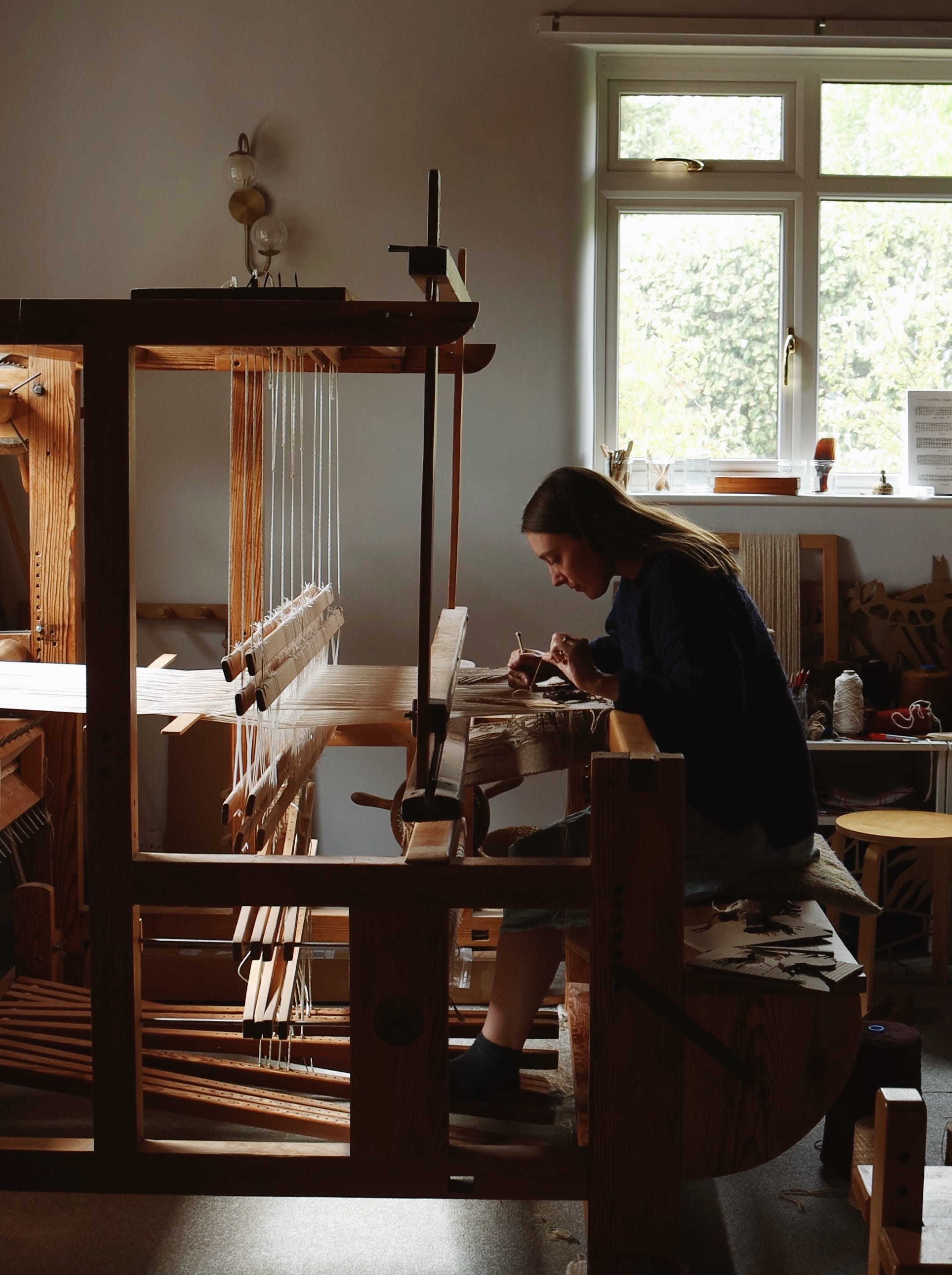
I am three weeks in to making my first tapestry collection in almost five years. Progress has been slow, as I’m currently splitting my time between the loom and my work at Balfour Weaving School. We’re entering the final two weeks before I close enrolment on my online weaving courses, so I’m busy answering emails, onboarding students and mounting one final marketing push. Enrolment will close on 6th September, and after that I’ll be able to turn my full attention to my weavings.
I’ve embarked on this collection as something of an experiment. It’s the first time in years that I’ve sat down to weave a series of brand new artworks specifically to sell, instead of being intended for an exhibition, or a trade show or even as samples for a weaving workshop. It’s the first time in years that I’ve set specific parameters for myself in design, colour and size, and it’s the first time in a long while that I’ve done any form of market research.
What I’ve learnt so far in this process has surprised me. And what’s more, it’s changed how I think about selling my work - and how I share it with my audience.
The Benefits Of Having A Plan
The first surprise has been how much I like having a plan.
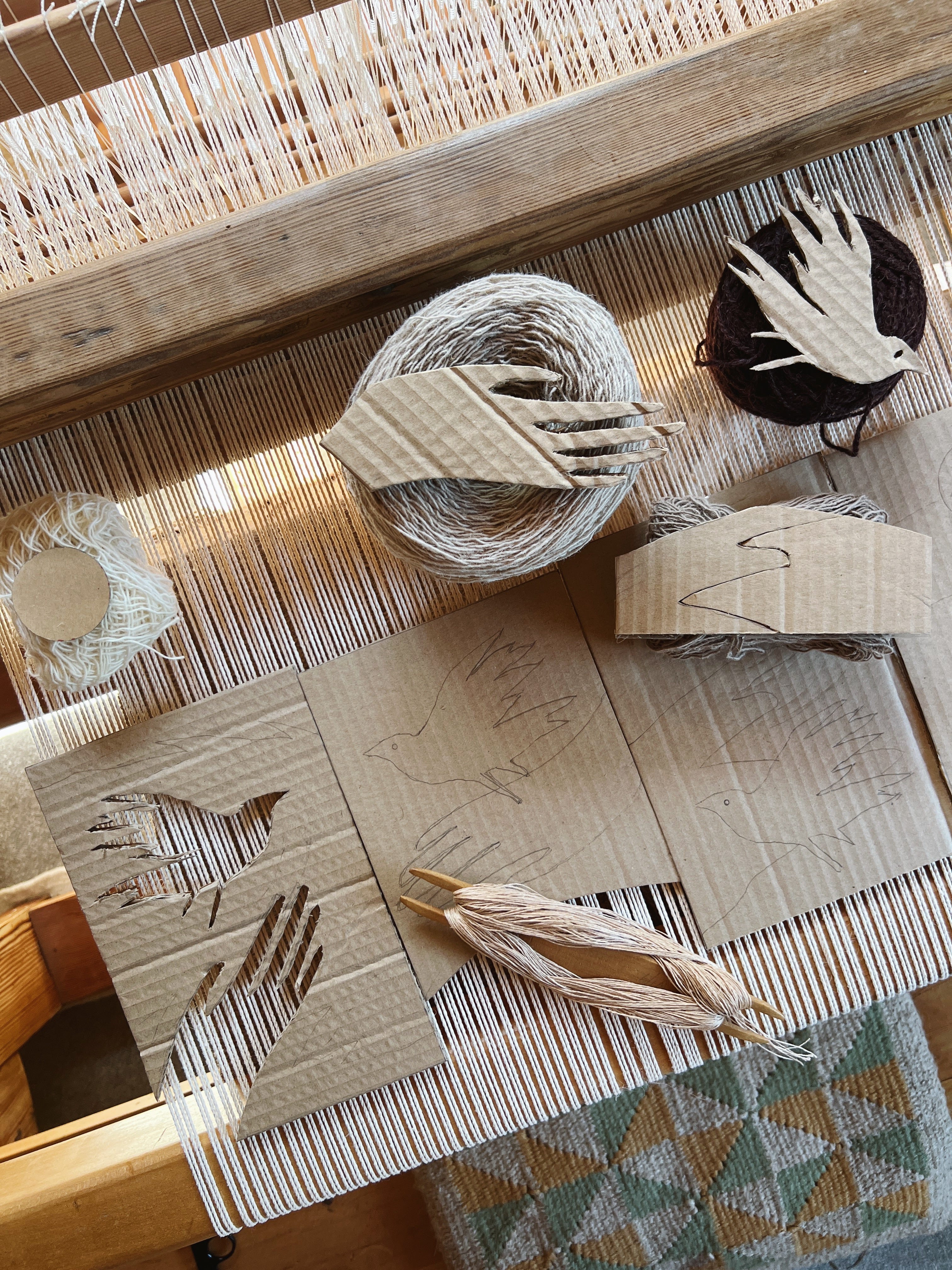
Throughout my weaving career, I’ve actively avoided planning out my designs too carefully. At most, I would have a rough pencil sketch with some dimensions marked onto it. I would make cardboard cut-outs, arrange them spontaneously on the loom, and change the design as I wove. In practice, it meant that I spent a lot of time agonising about the positioning of each shape and line. I couldn’t see the full weaving laid out in front of me, so I never felt quite sure about what I was creating.
With this collection, I decided from the beginning that each composition must be worked out ahead of time before being transferred onto the loom. I still used cardboard cut outs to mark out my designs and I adjusted the position of each cut out just slightly when it was on the loom. But having a roadmap meant that I could focus entirely on weaving, instead of designing as I worked.
The Joy Of Repetition
Making anything by hand involves repetition, and tapestry is more repetitive than most. I used to think that because my process was already so repetitive - passing the weft back and forth, over and over, to make up the woven surface - that I should therefore avoid weaving designs that were repetitive as well. One of my earliest misfires as a young tapestry weaver was when I released a collection of made-to-order rugs, the idea being that clients could commission specific rug designs in custom colour-ways. Half-way through my first made-to-order rug, I realised that actually, I hated weaving the same design over and over. I’ve avoided made-to-order ever since.
What I found with this new collection is that I actually don’t hate weaving the same shape again and again - so long as that shape is interesting to weave.
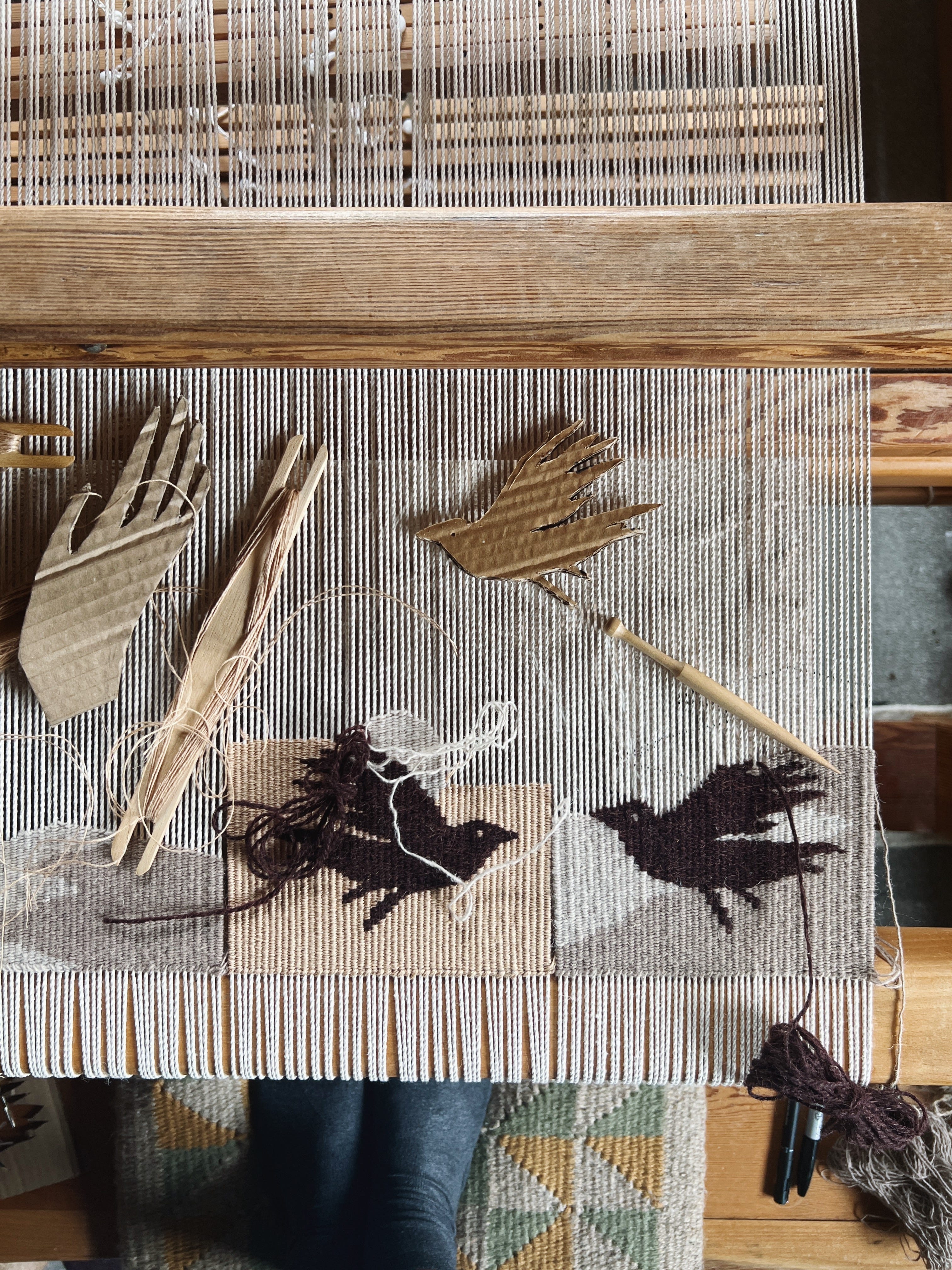
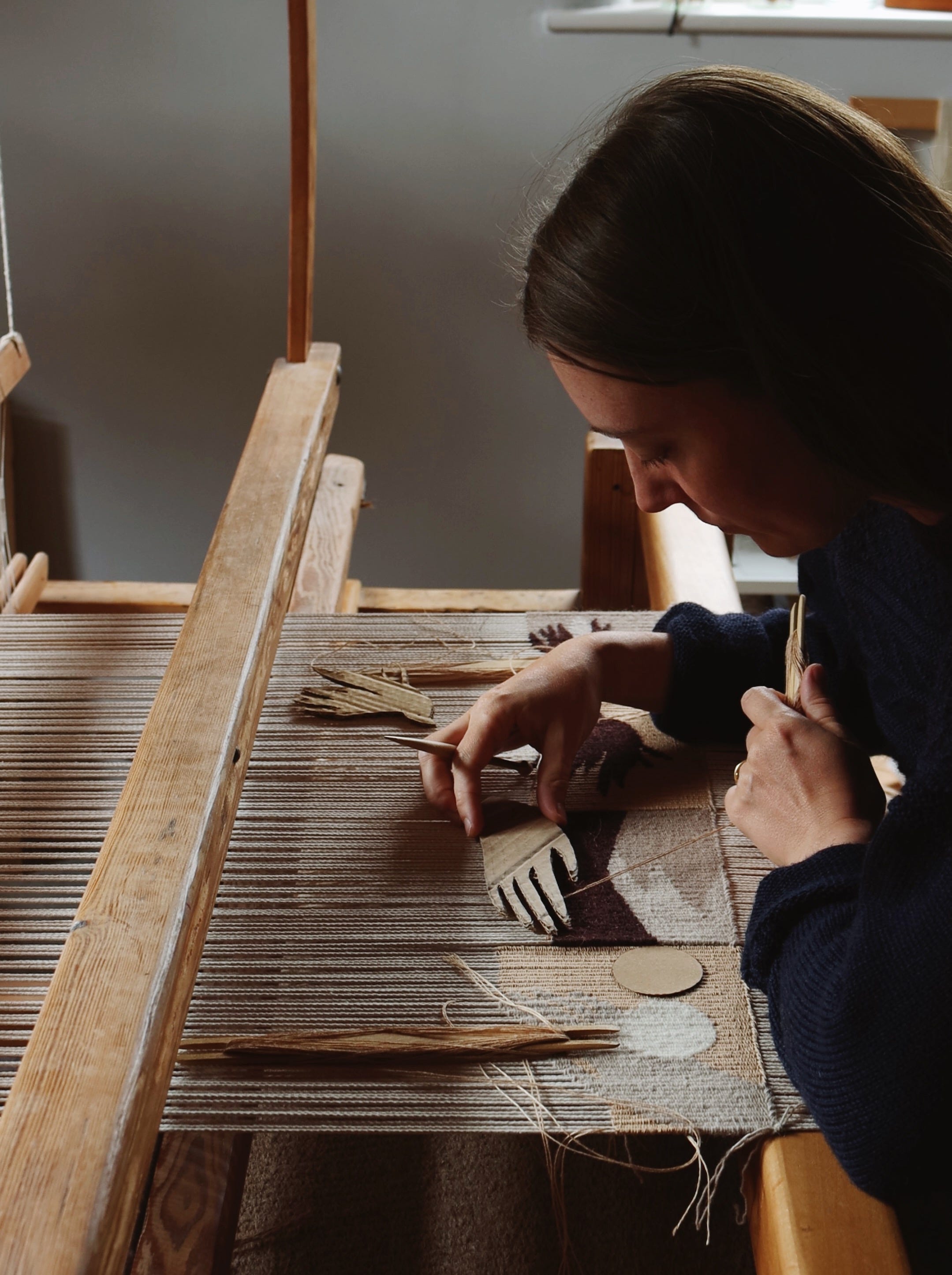
The central motif of this new collection is the bird in flight - landing on or departing from an outstretched hand, hovering over mountain or a river. I’m using the same cardboard cut-out to weave each bird, but in every tapestry the angle of the cut-out is slightly different - and so I have to weave the design differently. Each form is a new challenge, and no bird is exactly the same. Even though I’ve already mapped out my design, there’s still enough of a technical challenge involved in weaving each repeated shape to keep my brain engaged.
The Gift Of Weaving Quickly
No one gets into tapestry weaving for instant results, but there are ways to speed up the process. With this collection, I challenged myself to design something smaller and simpler than my usual large-scale works, but which would still be interesting to weave. I hoped that I’d be able to weave just a bit faster - and I’ve been pleasantly surprised by how much faster I’m actually weaving now! I’ve also been surprised by how much I’ve loved it.
Anyone who knows me well will tell you that I hate to be rushed and do not enjoy doing things quickly. But in this series, with the design decisions already made and an interesting technical challenge on the loom in front of me, I’ve really enjoyed myself. There is something so, so satisfying about sitting down at the loom and getting up two hours later with a tapestry half way done or nearly completed. Compared to my usual process - like the tapestry that I’ve been steadily working on since November - it’s a breath of fresh air.
And the best part of all of this - the planning, the repetition, the working much, much faster - has been the creative energy within all of it. I used to worry that if I set too many parameters around my woven work, I would stamp out the spark of creativity and would feel like I was just going through the motions. Instead, I’ve built a supportive structure around my creative process - and it’s starting to really soar.
The Choice To Document Less
But within this new infrastructure that I’ve built for myself, one thing has shifted. It’s partly a consequence of working faster and partly a consequence of wider changes I’m making in my practice. Whatever the reason, lately I’ve found that I’m no longer documenting my weaving process as much as I usually do.
On my larger projects, I document my weaving process all the time, whether that’s through setting up a tripod to film myself or stopping to photograph my progress every few hours. There’s an element of necessity to this, of course - if I don’t stop to document my work, I’ll have nothing to share with my audience for months on end. And there’s also an element of personal preference. If I’m going to spend a year or more working on a single tapestry, I do want to keep track of my progress, if only to remind myself, when the end feels a very long way off, of just how far I’ve come.
But while I’m working on these smaller tapestries, I’ve found I’m much less inclined to document any of it. The weaving process is so quick that stopping to set up a camera, film myself, stop and turn the camera off, change the angle, start the process again is an annoying disruption instead of a helpful break. Once I get into the flow, I could very easily weave six or seven tapestries without stopping to document any of it.
It’s made me start to re-think how I document my process, and the role that filming and photography have in my studio routine. Should I keep filming myself and work a bit slower, letting the whole process take longer? Or should I focus on making the work itself, and document only sparingly? How much time should I be setting aside to make content about these tapestries while I’m still making them? And what can I learn from the artists who inspire me the most, and their approach to sharing their process?
The Importance Of The Finished Work
I started planning this collection with one aim in mind - to become comfortable and confident in making art and then selling it. The last time I launched a collection of framed tapestries was in 2021. I worked towards it for months, expecting to sell at least some of these pieces straight away.
Instead, I didn’t sell a single tapestry for the next six months. It was a blow to both my finances and my confidence - and I’ve barely listed any work for sale on my website ever since. So when I plan to create this collection, I knew that I needed to not only refine my designing and weaving process. I also needed to think carefully about what went wrong last time, and what I can do differently this time around.
The first step I took was to look at the artists whose work I most admired (and whose work I’d most love to own myself one day) - and to think about how they presented their work.
Comments
Nothing yet. Say the first thing.
Sign in to join the conversation.