
in our daily standup today, my cofounder Mark (the guy I’m building infinitysci.com with) pitched this interesting idea of having a choose your own adventure textbook.
imo the idea is solid, I was wondering why this doesn’t exist already?
If you’re like me, you’ve had the experience of buying a textbook or some sort of learning material, and getting demotivated by all the stuff you kinda don’t really want to learn before getting to the interesting stuff
or you have a kind of weird thing about only wanting to progress through the textbook linearly, making the journey long and arduous for most textbooks.
even if in the preamble the textbook author is like: “here are a few ways you can progress through this course”, or “here a few ways one could use the chapters in this textbook for a semester or two semester long course”, i feel like we never really take that to heart, and always feel like we kind of have to move in linear order.
and also, the textbook authors usually don’t do a good job of actually ensuring you can take a non-linear path through the textbook and not be hit with hidden prerequisites, i.e. you actually did need stuff from that chapter they told you you can skip, or you needed the fluency with the material you would have gained from going through that chapter.
but what if textbooks were a lot more choose your own adventure?
like, for each chapter, at the end it says:
”want to learn about cool sounding topic X? skip to page 178
want to learn about lame sounding topic Y? skip to page 80
etc.
”
and the textbook author ensures that for each journey, there is no missing knowledge, i.e. the learning journey for the student feels fluid, and not like they are being shown anything that they haven’t learned yet. No “hidden” prerequisites.
At the end of the chapter, if it tells you you can move on to X topic by going to page 178, then it really means it.
i think textbooks should be structured more like this, because humans are unique, and even within a specific textbook subject, everyone has different tastes and preferences.
but we should still be making sure we’re setting students up for success. That is, if they do want to jump around according to their tastes, that they can do so properly, learning the prerequisites in the required order, never encountering “hidden” prerequisites, so they don’t get demotivated or disinterested!
it also relates to this idea of a “knowledge graph”, here’s a sneak preview of (part of) the knowledge graph for our upcoming introduction to quantum theory course:
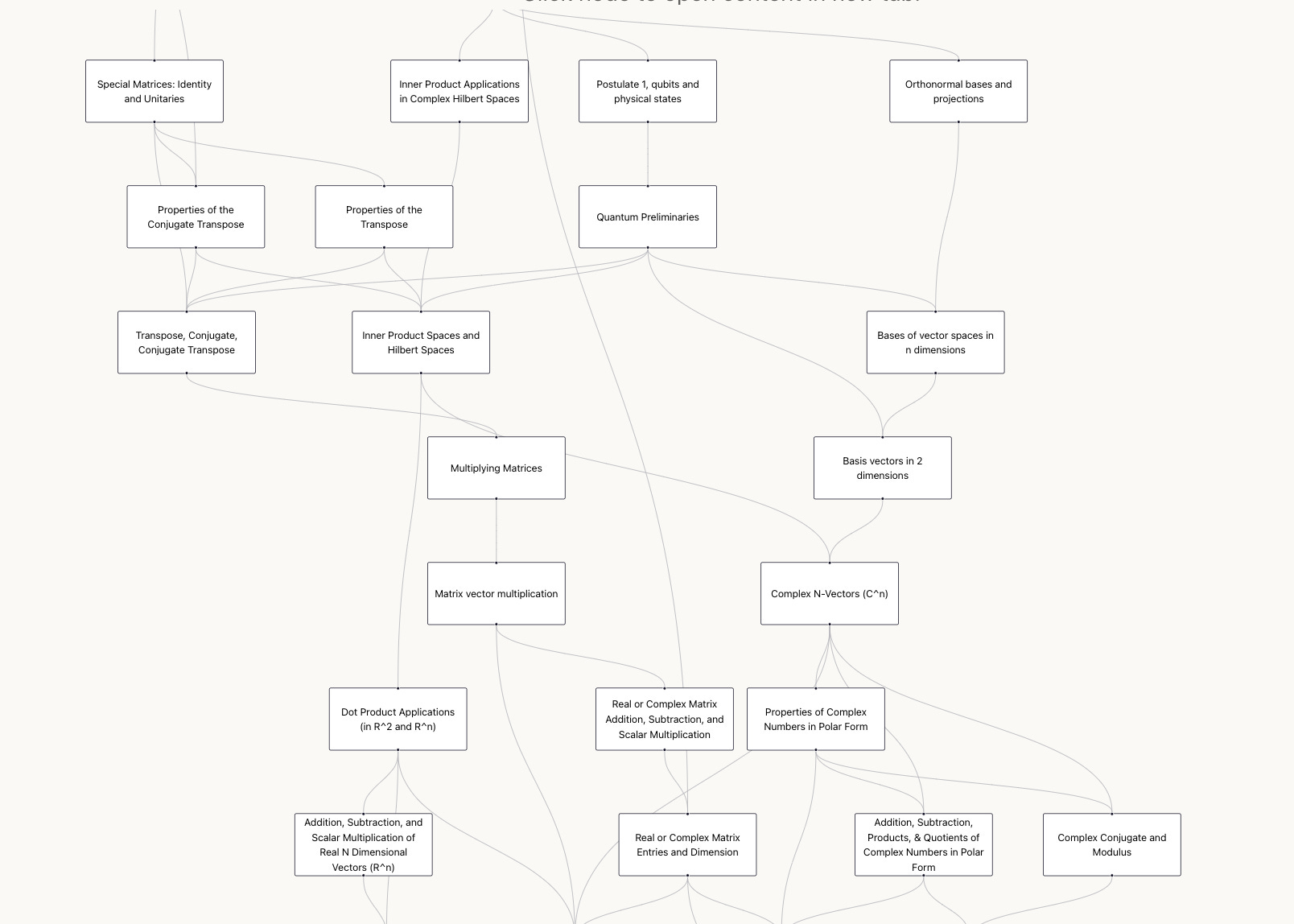
everywhere you see a connection between topics in the graph above, it means one topic is a prerequisite for the other (the graph flows bottom to top).
and though this course is relatively short, so there won’t be too much chose your own adventure, in knowledge graphs for larger courses you will definitely notice it won’t at all be a linear progression through the “nodes” (topics), which means, you have some freedom as to which path you want to travel, based on your tastes and interests.
Anyways, that’s all for now, I’m curious, would you prefer your learning experience to be more like a choose your own adventure? or would you prefer to have only one path to follow, so long as it were structured properly?
i guess this question kind of boils down to: a very large textbook, with many different paths of travel, i.e. choose your own adventure, with no hidden prerequisites at any point, or shorter, more concise textbooks, that are linear, but also very well structured (like those of Andriy Burkov), ensuring no hidden prerequisites at any point.
the former would definitely be a lot harder to write, but if done well, should give the student a ton of flexibility as to what they learn about, based on their tastes and interests.
All the best,
Chris
P.S btw, i write these quickly off the top of my head, never with the help of LLMs, so please excuse whatever typos and random punctuation you may find. i’d prefer these feel more relaxed and conversational than what typically hits your inbox :) (this is my excuse for not spending more time editing).
No posts
Comments
Nothing yet. Say the first thing.
Sign in to join the conversation.