

I originally published this behind the paywall back in January, so it’s new to most readers. Hope you have a grande time reading it.
Starbucks has great branding. The bold green, the blocky font, the mermaid—they’re as distinctive as they are ubiquitous.
The in-store experience is familiar and consistent too. You get friendly baristas, a calm and comfortable environment, and customers exhibiting the kind of irrational affection that makes you wonder if the company is spiking the coffee with molly.
Disciples of the chain often display bizarre, illogical behavior that goes against their own interests. This and other telltale signs make clear that Starbucks is, in fact, a cult. I can speak with authority because I used to be in it.

There was a long stretch of my life when I stopped at Starbucks every morning. I’d get a black coffee and go about my day. I’ve come to realize this was a sign that I suffered from deep emotional problems and was punishing myself, because Starbucks coffee is terrible.
I’d choke it down, convincing myself that the cup of burnt motor oil was fine. Not only that, I’d happily fork over more than I would have paid for a better product somewhere else.
After a few years of this, I started to acknowledge the fact that Starbucks coffee is very bitter—even more bitter than I am now for living in denial for so long. So, I began adding milk. It was better, in the way that a kick to the stomach is better than one to the balls.
That’s problem one: the way Starbucks roasts its beans is a hate crime. There may be masochists who enjoy drinking the ashy runoff from a charred sofa after a doused house fire, but I’m not one of them.
So, why do so many people drink it? Because we’ve been told it’s high-quality. We’ve been conditioned to believe that it’s a superior cup of coffee.
In other words, we’ve been trained to ignore our own instincts and senses to belong to this group. And to pay a premium for the privilege.
That brings us to problem two.
Like every business, Starbucks needs to make a profit. Like every cult, Starbucks persuades people to hand over egregious sums of their hard-earned money for the promise of a richer life.
Starbucks drinks cost more than their competitors’. But they’re a bargain compared to everything else they sell.
Feeling peckish? How about a pair of Egg Bites, which are basically tiny quiches that come with your choice of inclusions like mushrooms, bacon, or roasted red peppers. And by “quiche” I mean frozen protein blob pulled from a plastic sack and warmed in a toaster oven. I’ve never had one, so I can’t speak to the flavor, but I think you’ll agree that the price is a choking hazard: $6.75.
Maybe you fancy a Cake Pop, which is essentially a slightly denser Dunkin’ Munchkin on a stick. That’ll cost you $4.
Perhaps you’d like a snack that’s a little healthier. You can pick up a Kind Bar for nearly $3, about twice what you’d pay at a grocery store.
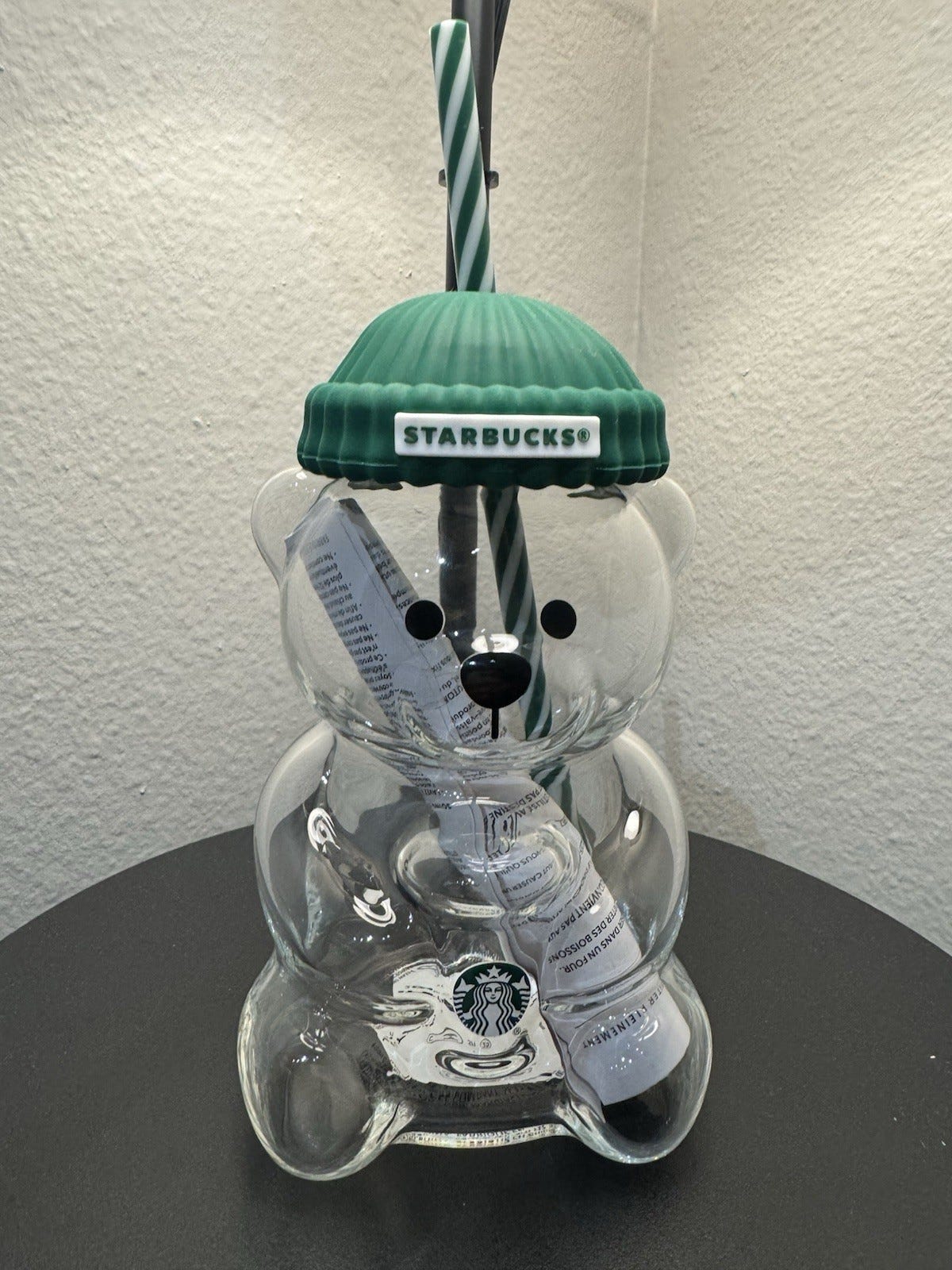
The list goes on. But there’s no more glaring sign of cultish behavior than the spectacle that surrounded the “Starbucks Bearista Bear Glass Jar Cold Cup with Straw” this past holiday season. Unhindered by its unbearably convoluted name, the 20-oz. item sold for $30.
But this is where the company’s manipulation comes in. Starbucks didn’t just make it a limited-time-only offering, they deceptively manufactured scarcity. They shipped very few units to each store—in many cases, only one or two—and claimed they underestimated demand and didn’t have enough to restock the stores.
This is what marketing experts refer to as “fucking bullshit.” And it worked.
People lost their goddamn minds. There were long lines. There were fights. There were people posting pics on social media, bear cup in hand and smug expression on face. There were opportunists reselling them at exorbitant prices.
In all, there were millions of dollars worth of free PR, as the media drank up this mess like a Peppermint White Chocolate Mocha Frappuccino Blended Beverage, and what is with these fucking names?
The extreme allegiance is ongoing. An eBay search turned up a bunch of the bear-jar-cup things, with one going for $399.99. As of today, 25 had been sold, and eight people had it in their carts.
Here’s a photo of said treasure:
And here’s a screenshot from an article on sheknows.com, dated November 7, 2025:
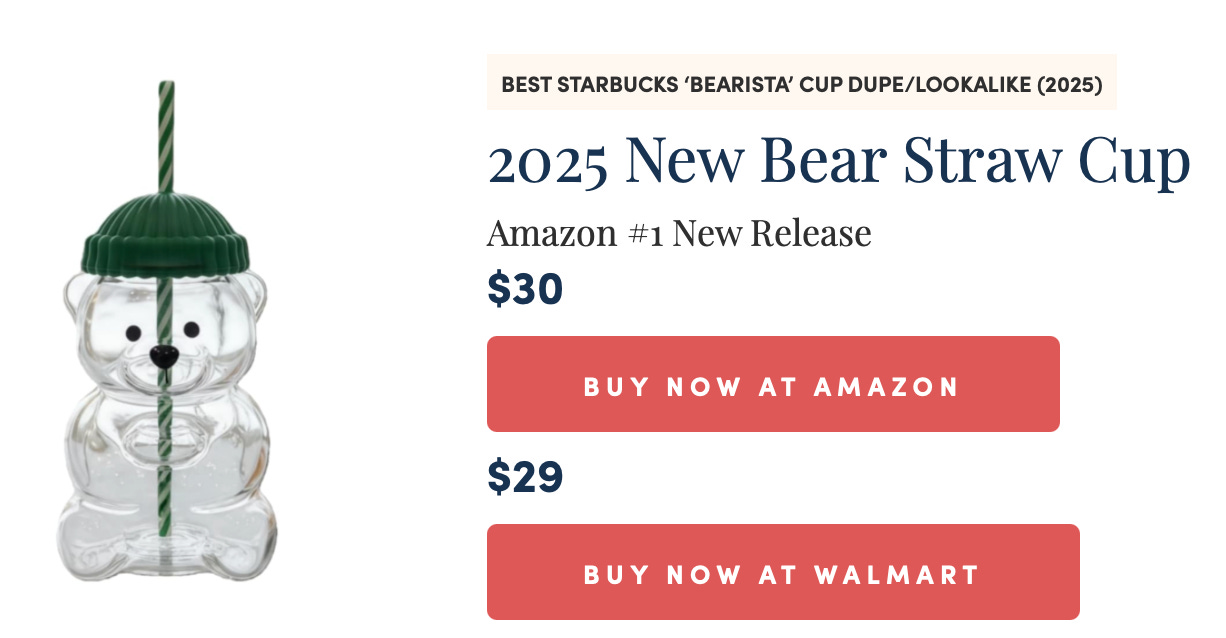
There’s currently one of the above on Amazon for $8.90. Again, eight eBay users are contemplating paying $400 for one that’s identical, save for Starbucks branding.
This isn’t rational behavior. It’s some venti-sized brainwashing at work. And that leads us straight into problem three.
One thing cults do particularly well is foster a feeling of unity through a common language. They have specific jargon that isn’t shared by outsiders. They do this to create exclusivity and a familial rapport, an “us vs. them” dynamic.
In olden times, we were all content with our standard sizing system. It had the advantage of actually describing the thing we were purchasing: small, medium, large, and extra large.
This was true of clothing, trash cans, artificial Christmas trees, and everything else that came in various sizes. Nowhere was this standard applied more regularly than with beverages.
Until Starbucks. They introduced their own hierarchy and forced us to adopt it. Here’s what you need to know to be an obedient Starbucker.
Trenta. “Thirty” in Italian. A Starbucks trenta is 30 oz. But it’s only for iced drinks. You can’t get a trenta hot coffee.
Venti: “Twenty” in Italian. A Starbucks venti is 20 oz. But only if it’s a hot drink. If it’s cold, a venti becomes 24 oz. I guess “ventiquattro” would have been too confusing even for them.
Grande: “Large” in Italian. But venti is Starbucks’ large, so grande is medium. That’s 16 oz.
Tall: Wait, we’re doing English now? A Starbucks tall is their small, which is 12 oz.
Short: Okay, I guess it’s English from here on out. A Starbucks short is 8 oz. Though smaller than tall, short isn’t their smallest, or shortest, size.
Demi: Jesus Christ, this isn’t English or Italian. Demi is short for “demitasse,” which is a French word meaning “half cup.” A Starbucks demi is 3 oz., which is not half of 8 oz.
Obviously, none of this was done with the goal of simplifying things for customers. Or linguists, for that matter. But once you buy into the jargon, you buy into the lifestyle.
Starbucks is a cult, but it’s a benign one. They’re not pushing you to prepare for the coming of supreme being Yazbo, who’ll be arriving via 3I/ATLAS. They’re not urging you to grab your purple Adidas and tracksuits and head down to the bunker.
The chain has its faults for sure, but they provide great benefits packages to their employees, and they’re one of the top 20 most sustainable companies in the world.
In fact, I pop in from time to time just to shake things up. I’ll order an iced tea (venti) or some kind of Frappuccino (grande). No regrets, not even a demi.
Still, Starbucks has one unforgivable sin. It happened in 2003. That was the year they introduced the pumpkin spice latte. The dire consequences of that one decision have grown exponentially in the ensuing years.
The seasonal beverage was and remains incredibly popular, of course, but its true legacy is that it was Patient Zero in the pumpkin spice epidemic that’s infected us all.
Every autumn, pumpkin spice flavoring creeps into more and more products, including Oreos, Twinkies, Cheerios, Spam, sushi, beard oil, sanitary wipes, and lube.
The inevitable result will be that someday, it’ll squeeze its way into any vessel that will hold it, and you won’t be able to bite into a burger or get your car washed without being enveloped in a punishing haze of pumpkin spicery.
This plague is what I call an “atro.” That’s a shortened version of a word that’s nearly identical in Italian, French, and English: atrocity.
If you enjoyed this, please tap the ❤️. It helps my work to reach more people. Thanks!
To get a weekly jolt of fun with no caffeine jitters, subscribe for free, or support my writing by becoming a Patron.
Comments
Nothing yet. Say the first thing.
Sign in to join the conversation.