
I have owned chris.pirillo.com since the late nineties. For most of that time, the homepage was a redirect, a links page, a placeholder, or some variant of “I exist, here’s where to find me on the platform of the year.” Thirty years on the internet, and I never had a single page that did the job of saying what I do and how to hire me.
That changed in the past month. I built chris.pirillo.com/host/ for hosting work and chris.pirillo.com/community/ for community work. Two separate pages because I do two separate kinds of work and conflating them was costing me. Both took an afternoon. Both replaced an hour I’d been spending in DMs every time someone asked what I do.
What I did not expect was how much building those pages would change what I think about my own work.
Here’s the simple version of why these pages exist. For the last year, every time someone reached out about hiring me for a webinar, a panel, a workshop, or a keynote, I would end up in DMs typing the same paragraphs over and over. “Yes, I host. Yes, remote works. Here are the platforms I’m comfortable on. Here’s the studio setup. Here’s my rate range. Here’s where to see me on camera.” The work of selling me was happening one DM at a time, in my voice, on someone else’s platform, and at a pace that scaled exactly with how many DMs I felt like answering on a given week. Which is to say, badly.
A pitch page collapses all of that into a URL. The page does the explaining once. I send the link. The buyer either keeps reading or they don’t. The conversation either continues or it ends. Either outcome saves me an hour. The math on this turns out to be brutal in retrospect. I spent twelve months answering the same six questions in DMs, when I could have spent one afternoon answering them on a page. That’s the practical version of what happened. Then there’s the deeper version.
The hosting page was the easier of the two, and the surprise was about value. I started with a chronological list of what I’d hosted. Every webinar. Every panel. Every event. The first draft read like a CV. When I asked Claude to restructure it, the first thing it did was split “what I’ve done” from “what I do.” The reader doesn’t care about the chronology. The reader cares about whether I can do the thing they need done. So the page led with the format and the proof, and the FAQ answered the same six questions I’d been answering one-at-a-time in DMs for a year. What I noticed during that rewrite was how much of my hosting practice I had been treating as invisible labor. Studio setup. Sponsor tech-stack prep. The renewal-rate signal: sponsors who book me a second time, which is the only metric in webinar hosting that survives bad attendance numbers and good ones. None of it was on my LinkedIn. None of it was in my email signature. The pitch page made it visible. Writing it forced the question “what does this buyer need to know in thirty seconds?” The answer to that question is different from “what have I done?” and different from “what am I proud of?” It’s a third question, and it’s the one nobody asks until they sit down to write a pitch page for themselves.
The community page was harder, because community work is messier. There’s no clean ledger of “events hosted.” There are programs you built, ambassadors you recruited, Discord servers you set up, internal tools you championed, hires you helped close. I had Claude pull every signal it could find from my LinkedIn and a long brain dump I wrote for the page. Halfway through, it asked me a clarifying question I wasn’t expecting: “What’s the biggest single outcome of your community work?”
I had to think about it.
The answer surprised me. The biggest outcome of my community work is that the Intel Graphics community Discord I set up at Intel in 2019 is still running today, six years and at least one reorg later, with a thriving moderator team I haven’t been in contact with for years. I built it. I stepped away. It kept going. That’s the outcome.
I had not been telling that story. I’d been telling chronological stories about my time at Intel. “Established a community advocate program.” “Owned end-to-end social media calendar.” Resume language. None of it captured the actual point, which is that the work I did seven years ago is still load-bearing. The pitch page reframed it as: built an internal community that’s still running after I left. That’s the line. That’s the proof. Everything else is supporting evidence.
The lesson here is bigger than Intel or Discord. It’s about what happens when you sit with your own work long enough to ask “what survived?” Most of us list activity instead of outcome. The pitch page forces the outcome question. AI helps you answer it.
The other thing I learned, and this is the one I want to leave you with: the act of writing the page IS the work. The HTML is incidental. Claude wrote the HTML in about ten minutes per page. The slow part was answering the questions the structure raised. “What do you do?” “Who hires you?” “What’s the proof?” “What’s the FAQ?” Most people, including me, have spent a career not having to answer those questions in writing. Doing it in writing is a different exercise from talking through them with a recruiter or a friend. The keyboard does not let you wave your hands. You have to commit, in fixed text, to a description of yourself that a stranger can read and decide on.
The hosting page has been live for a few weeks now. People who used to ask me three rounds of qualifying questions in DMs show up to the first call ready to talk numbers. The page did the qualifying. That alone has paid for the afternoon I spent building it, and that’s before counting the value of the reframe: seeing my own work the way a buyer sees it, instead of the way a chronology sees it. There’s a version of this exercise that every founder, freelancer, and consultant I know would benefit from doing. The cost is one afternoon. The cost of NOT doing it, as I learned, is twelve months of repetitive DMs and a slow, invisible undervaluing of your own work.
If you want the full breakdown of the format (what goes on a pitch page, why it’s the missing layer between your resume and your portfolio, the AI workflow for building one in an afternoon), that’s the deep editorial in this week’s ctrl+alt+create live newsletter. Long version. Industry-facing. Designed to make the case for the format itself.
This version is the personal one. Same subject, different reason for writing.
Most people reading this never went to Gnomedex. That’s fine. The ones who did still bring it up twenty years later, which is the part that matters.
The event worked because the people in the room had paid to be there and chosen to be there. Self-selection did the heavy lifting before anyone walked on stage.
In many ways, what I’m doing with the new “ctrl+alt+create live” community event series is based on the same principles, albeit with a wildly different focus. Bringing technical and non-technical people together to not just learn from but to inspire one another. Building their own software out of nothing but natural language.
This fundamental “event instinct” is also what I want to bring to other people’s events (online or IRL). So, if your event program isn’t sticking, or you’re trying to start one, drop me a line.
Four new ones, plus the two pages above.
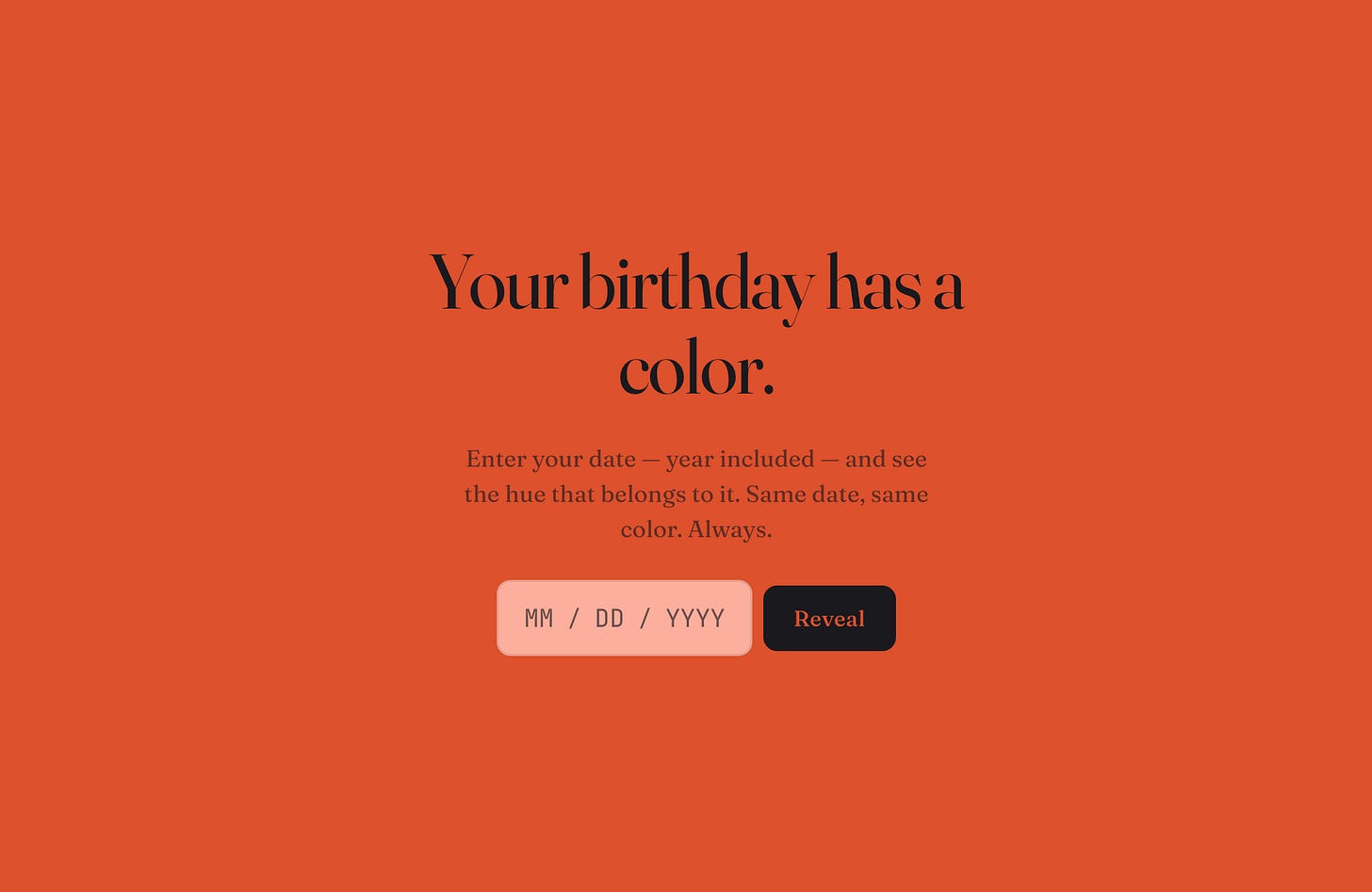
Hueday. The free alternative to Colorstrology. Type a birthday, get a unique color back. The interesting bug here was the empty state. The first version was a beige screen with a date input on it and a “Reveal” button. I shipped it. I hated it. I went back and built an ambient color cycle that crossfades every seven seconds across eight curated hues, with the text inverting in real time to stay legible against whatever color is currently filling the screen. The empty state is now the marketing material. If you land on the page, you immediately know it’s a color app.
Vibe Brief. A free, browser-based worksheet that turns a vague app idea into a paste-ready prompt for whatever AI you build with. I built it because the April ctrl+alt+create live event landed on the keyword “Educational,” and the lesson I keep watching people relearn the hard way is that vibe coding works when your brief works. Skip the brief and you get sprawling features, unclear users, and an AI that builds the wrong thing beautifully. So I made the part everyone skips into something you can do in ten minutes: four short sections that force you to name who hurts, what you’re shipping, what could kill it, and what you’re cutting. It’s especially for the non-developer who’s been burned by “build me an app” prompts that go nowhere, the curious tinkerer who wants their first AI build to finish, and anyone in this community who wants to teach this discipline to someone else, because once you’ve written one good brief, you can’t unsee how much faster everything goes.
TileLoom. Sculpt seamless 3D-printable tiles in your browser, single 3MF export to Bambu Studio. The thing I’m proudest of in this build is the Frank Lloyd Wright preset pack. Wright’s textile blocks from the Storer House and the Ennis House are public domain at this point and they’re some of the most beautiful tile geometries ever designed. Seeing them come off a 3D printer in 2026 is the kind of timeline collision I built the arcade for.
Hopf Skip. Interactive Hopf fibration playground. WebGL, twelve topology presets, ribbon and tube fibers, 4K render export. Be warned: the Hopf fibration is a rabbit hole. I went in to build a math toy and came out with twelve presets, generative color palettes, and a working understanding of stereographic projection. Worth it.
The arcade is at about 290 free apps now. None of them require a signup. None of them collect your data. All of them work in any browser.
The longer descriptions are over in the ctrl+alt+create newsletter linked above, but the short version: md-preview.app is the native Mac markdown viewer I wish I’d had two years ago. Human 3.0 and PAI, both from Daniel Miessler, are an interesting paired bet on AI-augmented self-direction. One’s a paid program, the other’s open-source infrastructure. Also worth a look: Scratchpad by Casey Margell, a small utility from someone in the broader community.
The pitch page exercise is the most useful self-audit I’ve done in a decade. Every founder, freelancer, and consultant should sit down and try to answer “what’s the biggest single outcome of my work?” in one sentence. Most of us can’t, and the inability is diagnostic.
I rebuilt my community page five times in two days because the AI and I were iterating in the wrong dimension. Fiddling with chrome (icons, label sizes, section markers) when the actual issue was structural (layout, density, proportions). The fix was stopping iteration on the first draft, walking away, and asking “what’s wrong with this?” out loud. Sometimes the bug is the diagnosis.
Watching an AI try to “improve” working code I’d already signed off on three times in a row is the clearest argument I have for why review skills should be scoped narrowly. A code review is for finding bugs and missing things. It is not for retrofitting opinions. Same lesson applies to most reviews humans do.
Yours Digitally,
Comments
Nothing yet. Say the first thing.
Sign in to join the conversation.