
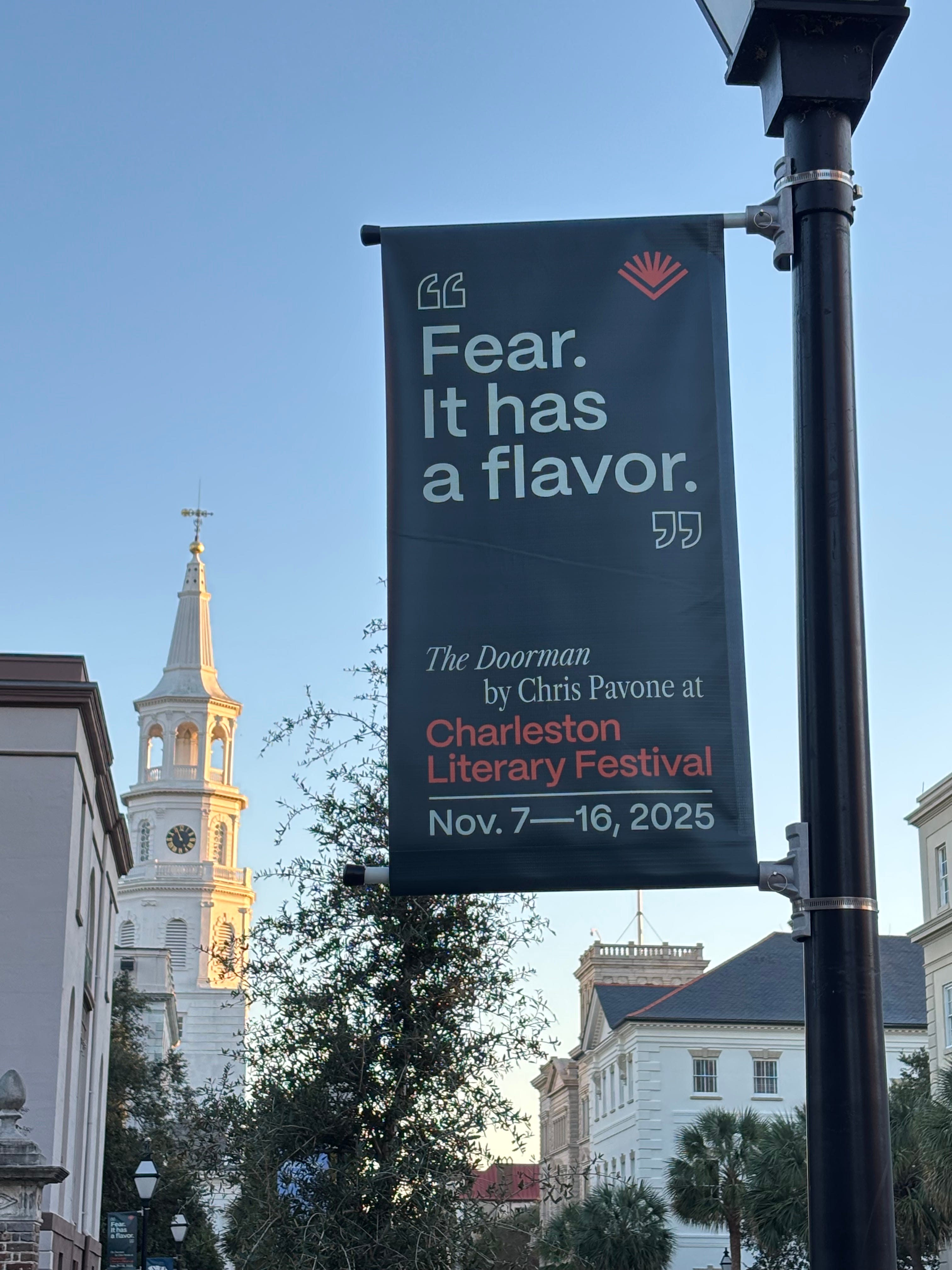
Last week I went to the Charleston Literary Festival, my 10th festival or conference of 2025. This Part I is about how these things work, what they’re for, why I go. Part II will be about how to do it and—maybe more to the point—how not to do it.
First, let’s get the nomenclature straight:
A BOOK FESTIVAL or LITERARY FESTIVAL is usually a weekend event that’s open to the public, often with a headliner event on Friday night, then presentations throughout Saturday and maybe Sunday. Many festivals are free to attend. There’s often ample programming for children, and plenty of people come for no reason other than to have something to do with the kids. Attendees are just as likely to buy a lunch-truck banh mi as they are to buy a book.
The biggest festivals (LA, Tucson, Miami, Washington) attract more than 100,000 people, spread out among dozens of events that are happening at any given moment, hundreds of authors over the course of the day. At more modestly scaled festivals, there might be just a few concurrent events—a nonfiction panel, a fiction one, something for kids.
Other festivals are smaller, ticketed affairs, maybe with tiered pricing plans—single-event tickets, or full-weekend passes, or VIP access. These usually stretch out over a few days, during which at any hour there’s only a single session happening, and not much (or any) of it is for children.
At such smaller festivals, the audience may have shelled out hundreds of dollars to spend the whole weekend listening to book discussions; these are serious readers, they’re excited to meet authors, and they buy a lot of books. There are a couple dozen authors at these things, and we’re all on something akin to a school trip: meals together, shuttle buses, maybe flights too.
No matter the size or the model, all festivals share this: the thing exists mainly for the benefit of the audience.
A CONFERENCE is a different beast entirely. Everyone at a conference is a professional (or wants to be), and everyone is there for professional development of one sort or another. Attending a conference is like going to college: there are faculty, there are staff, but mainly there are students, including many writers who are at the early stages of the path to publication, looking for advice and connections to help take the next step.
The point of a conference is the participants. There is essentially no audience.
The normal routine begins with an opening-night cocktail party for the organizers, sponsors, donors, other friends of the festival, and authors.
Most author appearances are a single hour-long session, which is usually a panel shared with a second author or a third, plus a moderator. The panel is followed by a book signing, often in a tent, along with whichever other authors had a session at the same time. This can look a lot like a popularity contest, with long lines of readers waiting for signatures, and short lines, and no lines. At one festival, I got outsold by a German shepherd at a rate of approximately 100 to 1. It was so bad it was funny (which is a pretty good summary of what it can be like to promote a book).
Although it’s not required of me, I try to attend other people’s sessions too, largely because I think it’s the polite thing to do, and interesting to boot, especially for an author whose work I enjoy, or a friend.
Whether big or small or ticketed or not, festivals tend to cover the expenses of the authors who are presenting. Attending a festival doesn’t cost us authors anything except our time, it doesn’t cost our publishers anything at all.
Some festivals turn out to be great events for bookselling, but some are not, and in my experience it’s easy to predict which: there’s an inverse relationship between the total size of the festival and the book sales. The smaller the festival, the better.
And not just for bookselling. I’ve enjoyed everything about the smaller ones more than I’ve enjoyed any of the huge ones.
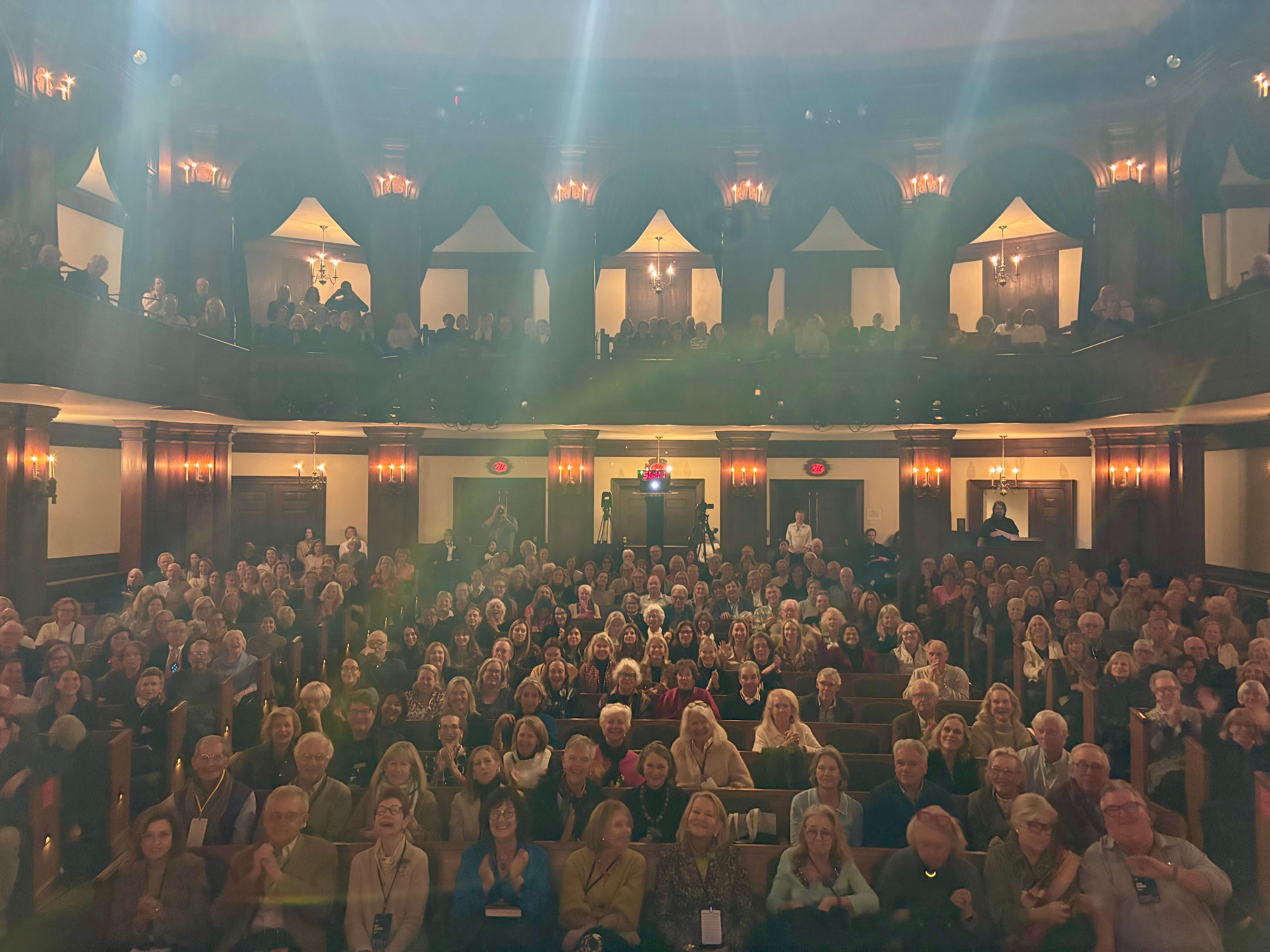
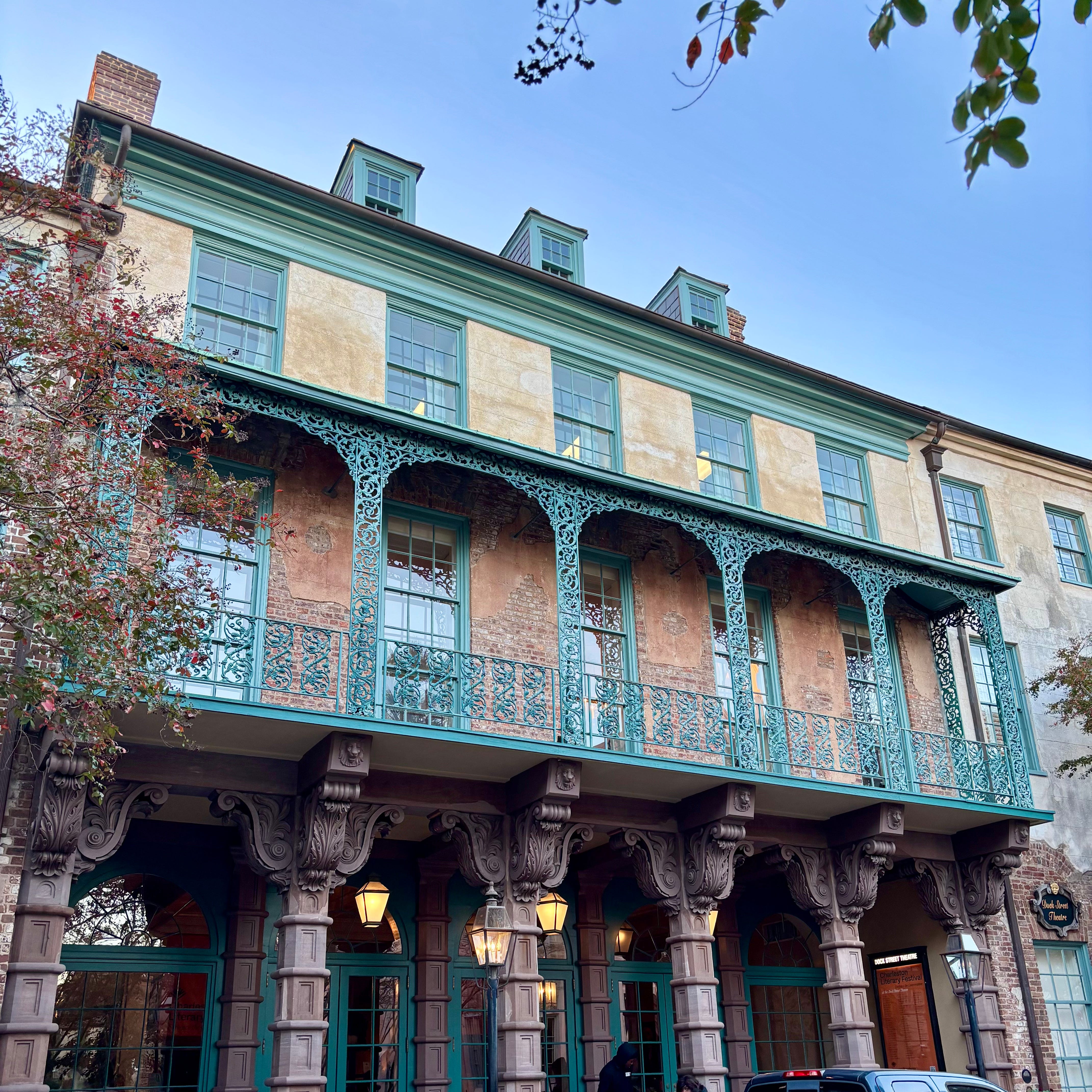
A perfect grand finale of THE DOORMAN tour: the beautiful Dock Street Theatre at the Charleston Literary Festival.
A conference can be up to a week long, with programming throughout every day: panels, workshops, so-called master classes, solo presentations, one-on-one interviews, plus cocktail parties galore, maybe even an awards ceremony on the Saturday night.
As with festivals, authors usually participate in one panel or sometimes two, and may serve as moderator for another. But these panels might include six authors. So if you attend a conference with the hope of hearing yourself talk, you’re either going to be disappointed, or inconsiderate, or both. (More on this very special topic in conference physics, and many others, in Part II.)
For an author, participating in a panel is not something that qualifies as labor, and does not require preparation. But some conferences also have substantive workshop programming, which is even more like going to college, for both students and faculty. Teaching a workshop is real work.
Conferences happen at big hotels in sub-divisible ballrooms, bordered by wide corridors where people spend the day chitchatting. For many attendees, the corridors (and their nighttime counterpart, the lobby bar) are at least half the point. Everyone is wearing a name tag on a lanyard, and it’s easy to meet people, and that’s exactly why many people are here.
Some conferences cover some authors’ expenses, but at others all authors pay their own way. The bill can really add up. Conference registration fees are never incidental, and travel is travel, all your meals in restaurants, taxis, flights—before you know it you’ve spent a few thousand dollars. You rightfully expect something in return; in fact it might be nuts to not. But what?
A writers’ conference is not unlike a conference in any other field: it’s much more of an investment in long-term career development than an opportunity for any short-term gains. It’s not really a book-promotion activity.
Festivals never feel much like work to me, but conferences always do. Just because there’s alcohol, and it’s not taking place in an office, doesn’t mean it’s not work. The product of this work is different for different attendees; people have a variety of goals. Some authors come armed with stacks of lavishly printed bookmarks to thrust in the direction of brand-new acquaintances. Others are hell-bent on meeting agents and editors. Others are there to listen quietly and learn. Others mainly to see old friends. But whether we’re explicit about it or not, the real reason that all of us are there is the same: to be part of a community.
What very few people are there to do, though, is buy other authors’ books, to lug home hardcovers in suitcases. We’re all there primarily for ourselves, to broaden our expertise and professional orbit. We’re not there to trade money and books with one another.
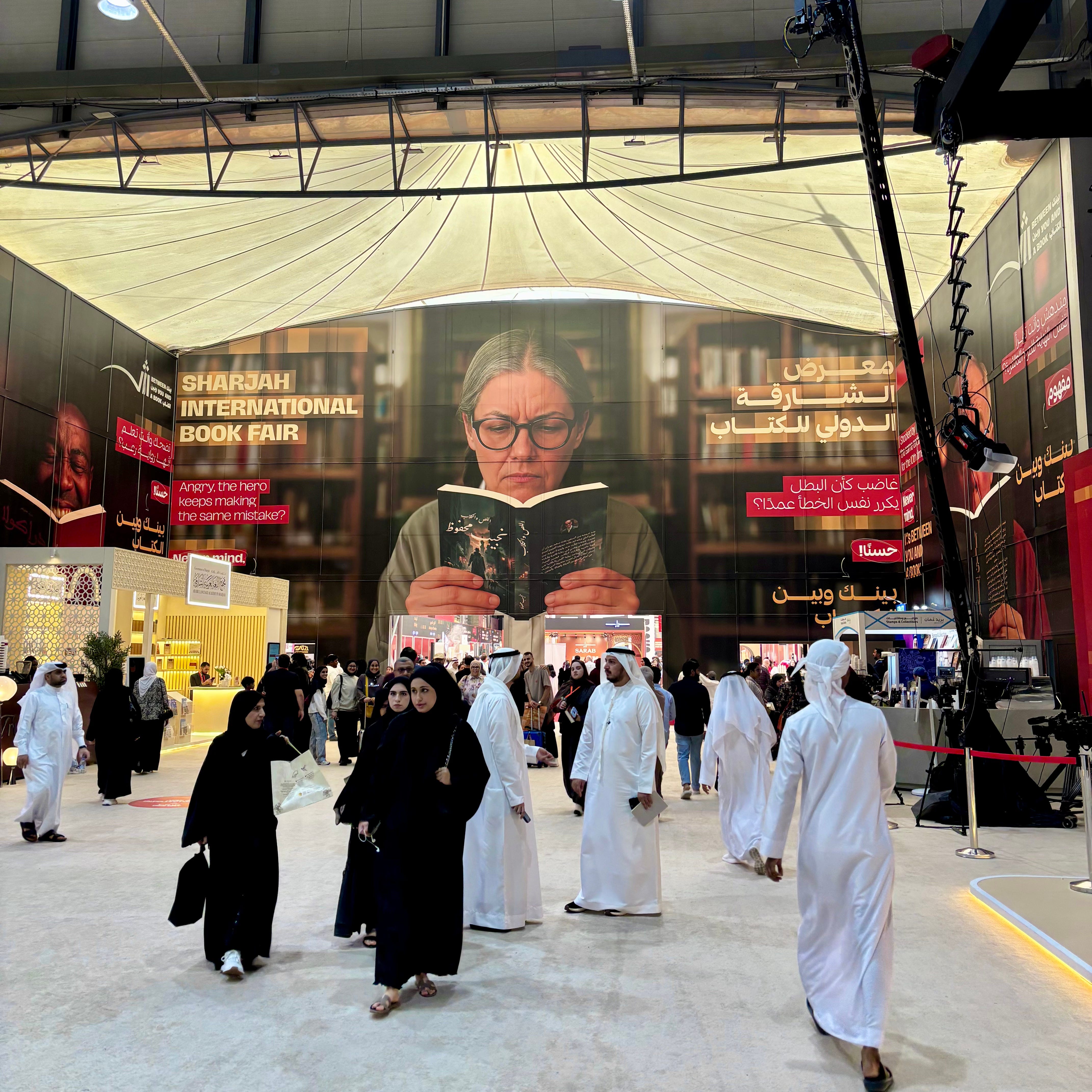
If you can’t articulate why you’re doing something, then maybe you shouldn’t be doing it. In 2025 I’ve spent a month of my time attending these things. Why?
Simple: because I enjoy it. Maybe that’s not enough of a reason for some people, but it’s enough for me.
I left behind office jobs two decades ago. I don’t miss commuting, I don’t miss having a boss, I don’t miss sitting in meetings where I contribute nothing and learn nothing, wasting time.
But I do miss colleagues. The act of writing a novel is a solitary occupation. I don’t do it quickly, so entire months can go by during which I have no specific reason to discuss work with anyone. Sure, it’s liberating to be beholden to no one, to not have to suffer fools, to be rid of petty office politics. But the removal of things you don’t like is not the same as the addition of things you do.
I like talking shop with other people who do what I do, and I also just like other people who do what I do. I like sitting at a restaurant table filled with novelists. I like the road-trip feeling of being somewhere new, with new people. Many of my writer friends are people I first met at a festival or conference. That’s also where I met at least half the people who were ever generous enough to provide a blurb for one of my books. (This is an even more special topic for Part II.)
I also really enjoy meeting readers, and not just the rare ones who come to the signing table to say they loved something I wrote. I like talking to readers who have have never heard of me, and will never read a book of mine. Anyone who’s a dedicated enough reader to come to a festival is someone I’m happy to talk with. I want to hear about what they do read, and how they choose their books, and how they come to be at a festival.
Looking back on the dozens of group events that I’ve attended—festivals, conferences, fairs, conventions, fundraisers—I realize that I’ve never not had at least some fun, even in places where I didn’t especially want to be. Some festivals have definitely been better than others—in towns I find more attractive, or with more appealing leisure opportunities, or a more interesting collection of authors, or a more engaged audience. But even at the worst of them, I’ve always met at least one person I’m glad to know, and I’ve always learned something.
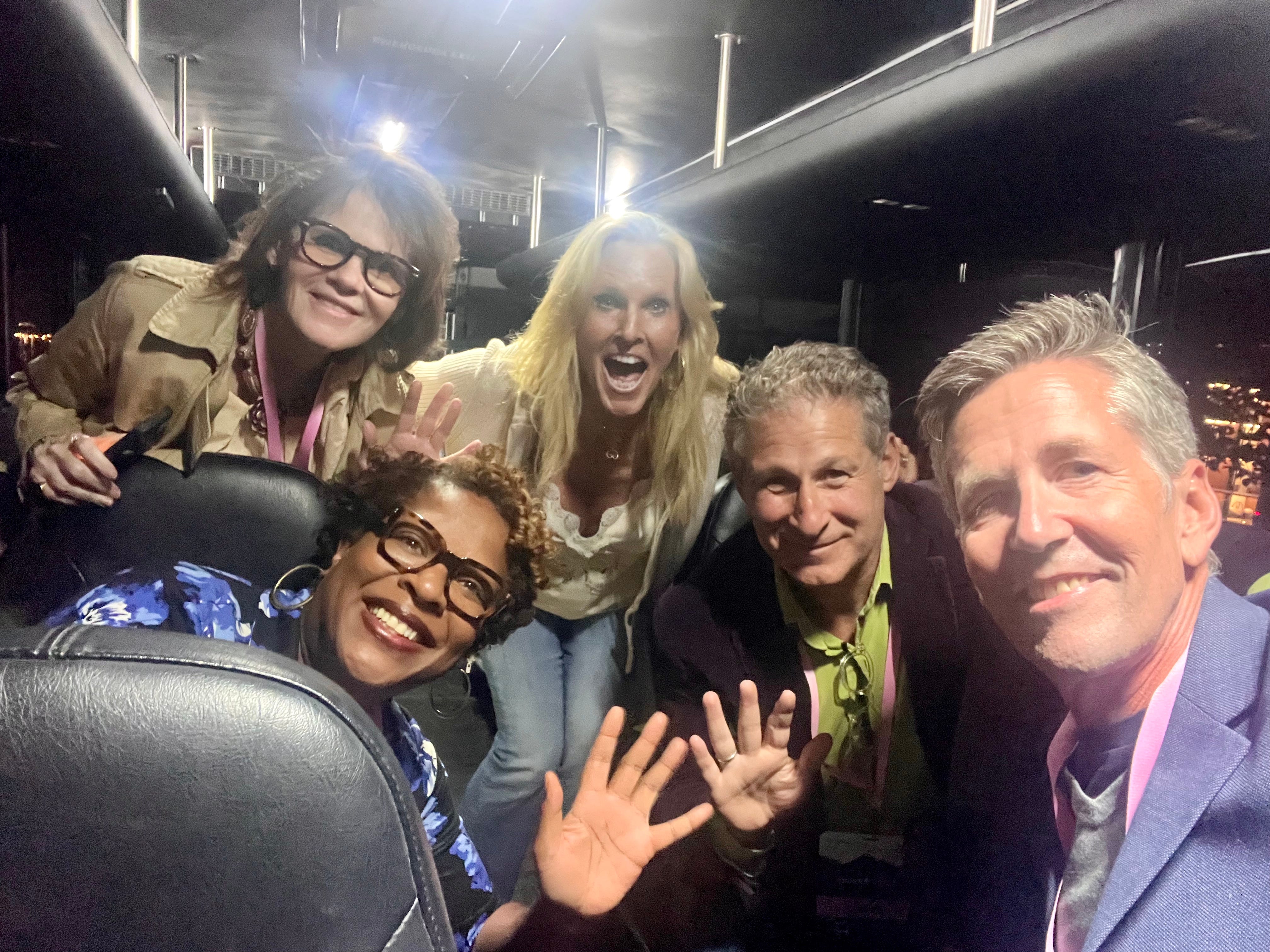
On a shuttle bus at the Aspen Literary Festival with Maria Semple (whom I met 12 years ago at the LA Times festival), Tayari Jones (this year, here), Elin Hilderbrand (6 years ago, Phoenix), and Jess Walter (last year, Kauai).
I know what I’m there for, so I make a concerted effort to ensure that those things happen. I organize lunches and dinners, large and small. I rent cars to go on adventures. I say yes to nearly any invitation, and I extend plenty myself. I spend time on the festival grounds, and keep myself open to meeting readers everywhere. I’m fundamentally there to participate in a community, so that’s what I do.
I do not order room service, I do not pay-per-view movies. I have my meals with other people. I exercise every day, if only to combat travel fatigue; I often bring my tennis racquet, and find someone I don’t know to hit with. I sit in the front seat next to taxi drivers, so I can learn something non-guidebook-y about wherever I’m visiting. I go to bed late, I wake up early, I sleep poorly, and I come home exhausted.
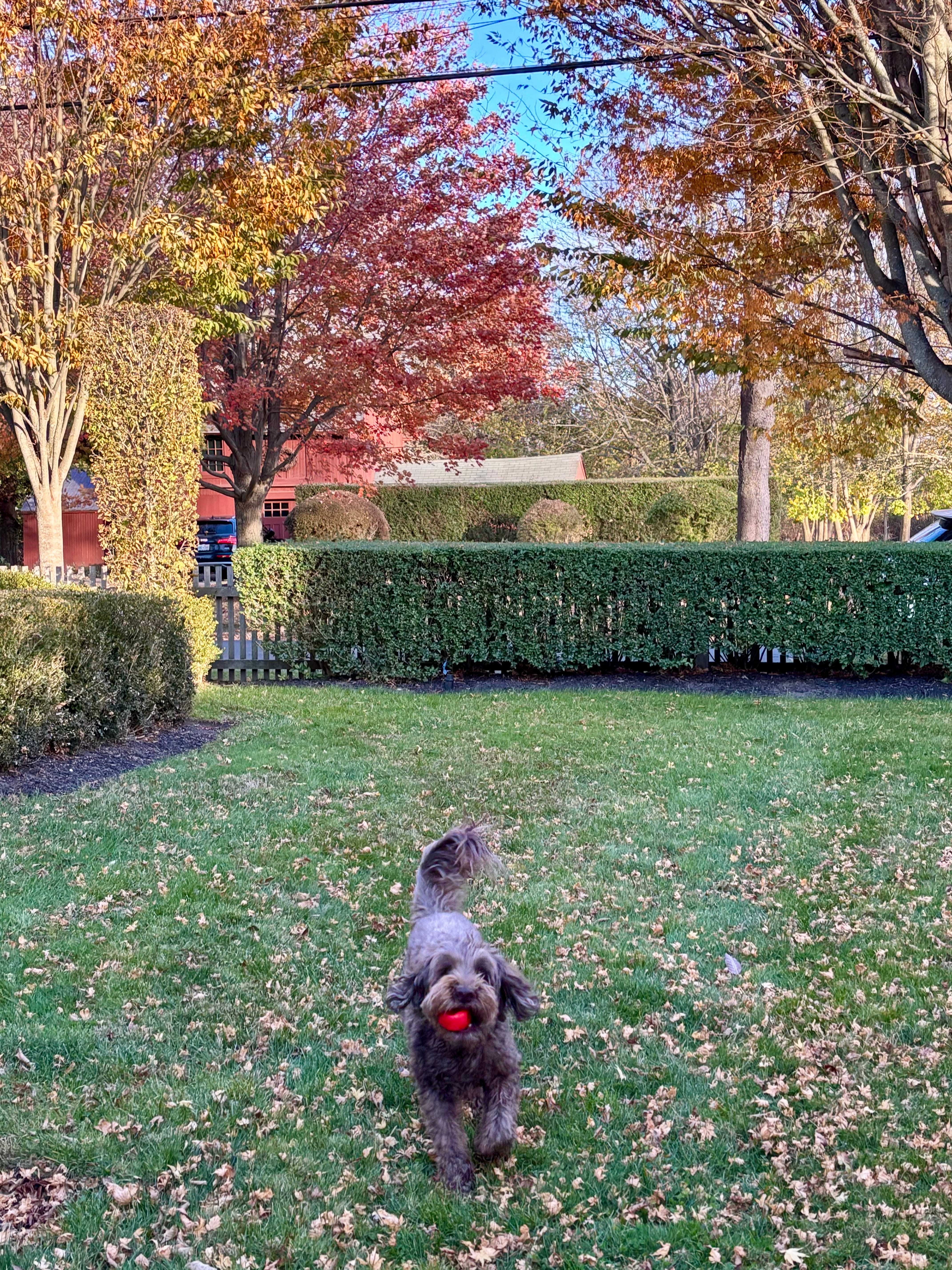
But that’s okay. I never need to go to the office tomorrow. And when I get home, Wally is always waiting to greet me as if I just saved the planet.
Comments
Nothing yet. Say the first thing.
Sign in to join the conversation.