
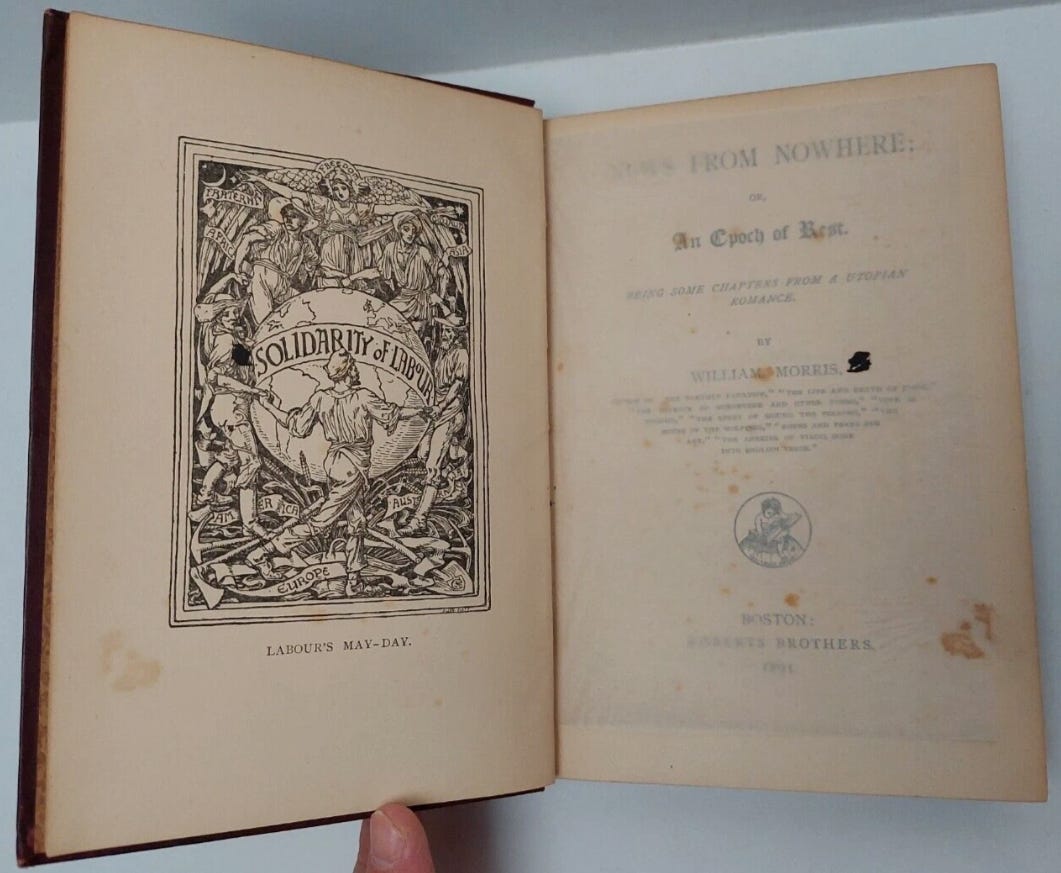
The book is called News from Nowhere by William Morris.
At first glance, it feels like an odd read for someone working in housing, infrastructure, and technology. Morris was a designer, writer, and social thinker living during the height of the Industrial Revolution. Steam engines were transforming cities. Factories were changing labor. The modern economy was taking shape.
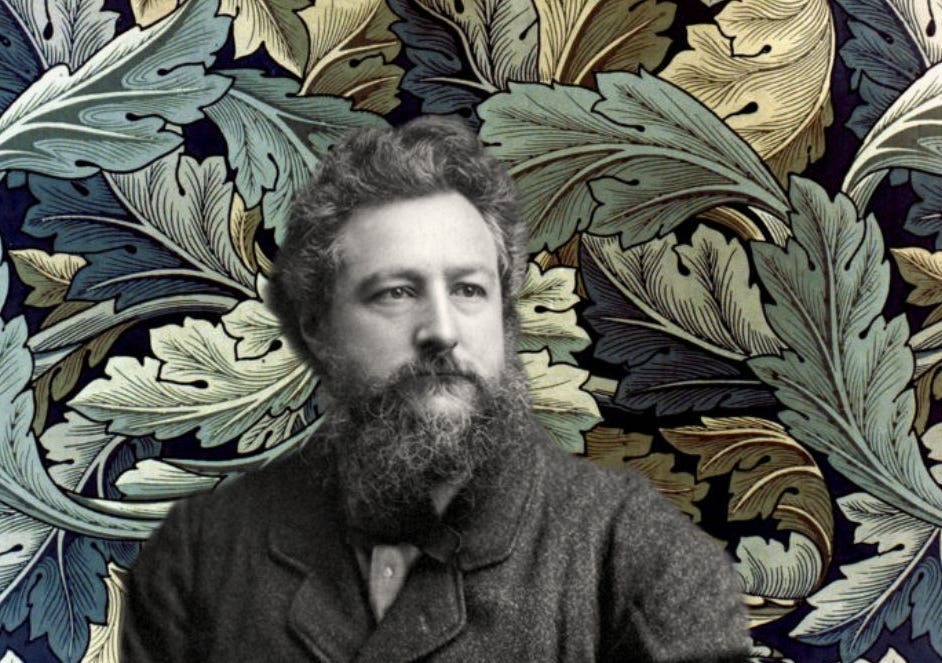
Yet as I read it, I couldn’t shake the feeling that he was wrestling with many of the same questions we are today. Not about technology, about purpose. Not about efficiency, about people.
The story follows a man who falls asleep in an industrial London and wakes up in a future society that has reorganized itself around beauty, stewardship, meaningful work, and community. The rivers are clean. Neighborhoods are human-scaled. People take pride in craftsmanship. Work is valued not because it maximizes output, but because it contributes to life.
It is, admittedly, a utopian vision.
But beneath the idealism sits a question that feels surprisingly modern:
What happens when a society optimizes for human flourishing instead of economic efficiency?
For the last 200 years, we’ve become remarkably good at optimization. We optimize supply chains, labor, logistics, square footage, shareholder value, return on investment….The results are undeniable. Humanity has experienced extraordinary gains in productivity and material abundance.
But there’s always a balance to consider.
The more we optimized transportation, the more disconnected we became from place. The more we optimized housing as a financial asset, the more difficult ownership became for many of the people our communities depend upon. The more we optimized work, the more people began asking whether work itself felt meaningful.
This isn’t an argument against progress. It’s an argument for remembering what progress was supposed to be for.
I’m not certain William Morris would recognize our modern world, and I certainly don’t believe we can return to his. Morris imagined a future with little technology. I spend most of my days building with artificial intelligence, intelligent automation, digital infrastructure, and data systems.
He imagined a future without money. I spend my time trying to create circular capital stacks and financial systems that make ownership more attainable.
He imagined a pastoral society. I’m focused on adaptive reuse, industrialized offsite construction, and revitalizing existing communities.
Yet despite those differences, we seem to be aiming toward a similar destination. A society where housing is a foundation rather than a burden. A society where technology serves people rather than the other way around. A society where communities are designed around belonging, participation, and upward mobility. A society where stability viewed as critical infrastructure.
That last point has become increasingly important to me. For years, I’ve worked in commercial real estate. Buildings, projects, infrastructure. But somewhere along the way I began realizing that housing is not simply a building problem….it’s not even primarily a building problem. It’s a systems problem.
Housing touches education.
Healthcare.
Transportation.
Workforce development.
Financial health.
Social mobility.
In other words, housing isn’t a product. It’s infrastructure. And if it’s infrastructure, then perhaps our goal should not be maximizing housing production alone. Perhaps the goal should be maximizing #StableLiving™.
That idea eventually became the foundation for Pathway Communities and the StableLiving Index™ (SLIx).
It’s not affordable housing. It’s not workforce housing. It’s not luxury housing - it’s stable living.
A condition where people have enough stability in their lives that they can meaningfully participate in their future. When viewed through that lens, William Morris starts feeling less like a utopian dreamer and more like an early systems thinker. He understood something that many of us are rediscovering today:
People don’t want efficiency as an end goal. They want what efficiency is supposed to provide. Security, time, belonging, purpose, beauty, hope.
The challenge before us is not choosing between technology and humanity. It’s choosing whether technology serves humanity. That’s a different question.
What are we really building toward?
135 years ago, William Morris imagined a future that prioritized human flourishing. Today, standing in communities struggling with housing affordability, economic uncertainty, social fragmentation, and natural disasters, I find myself asking the same question. Not how do we build more. Not how do we move faster. Not how do we optimize further.
But simply: How should we live?
#StableLiving™ #TinyGiants #TheyisUs #TotalTenancy™
This article is best paired with a healthy does of Arts and Crafts Style. The movement emerged as a reaction to industrialization. Morris looked around Victorian England and saw factories producing cheap goods at scale, but he believed something important was being lost. One of his most famous ideas:
Have nothing in your house that you do not know to be useful or believe to be beautiful.
Willow Boughs (1887) is one of my favorites because of the simplicity. It’s just flowing willow branches repeated across a surface - creating what he calls a ‘satisfying mystery’ rather than a demanding of your attention.

No posts
Comments
Nothing yet. Say the first thing.
Sign in to join the conversation.