
Last week, I spent time in the beautiful state of Washington. Think Mt. Rainier, black bears, lakes, campfires, and some touristy sight seeing. The smoke from the Spokane fires was evident the first couple of days, but prevailing winds shifted and pushed everything out by Thursday. Those fires weren’t wildfires, by the way. Not sure why they’re being reported as such. The cause was arson. The impact was incredible.
Three major fires burned roughly 10,000 acres, forced 60,000+ people to evacuate, and destroyed nearly 1,000 homes.
This week, I wanted to touch on something I’ve been working on for several years now: We cannot keep building yesterday’s housing for tomorrows conditions.
I hope you’ll join me as I attempt to define ‘building different’ as something beyond fire-resistant siding and metal roofing.
Onward and Upward… but always Forward.

#StableLiving #TheyIsUs #TinyGiants
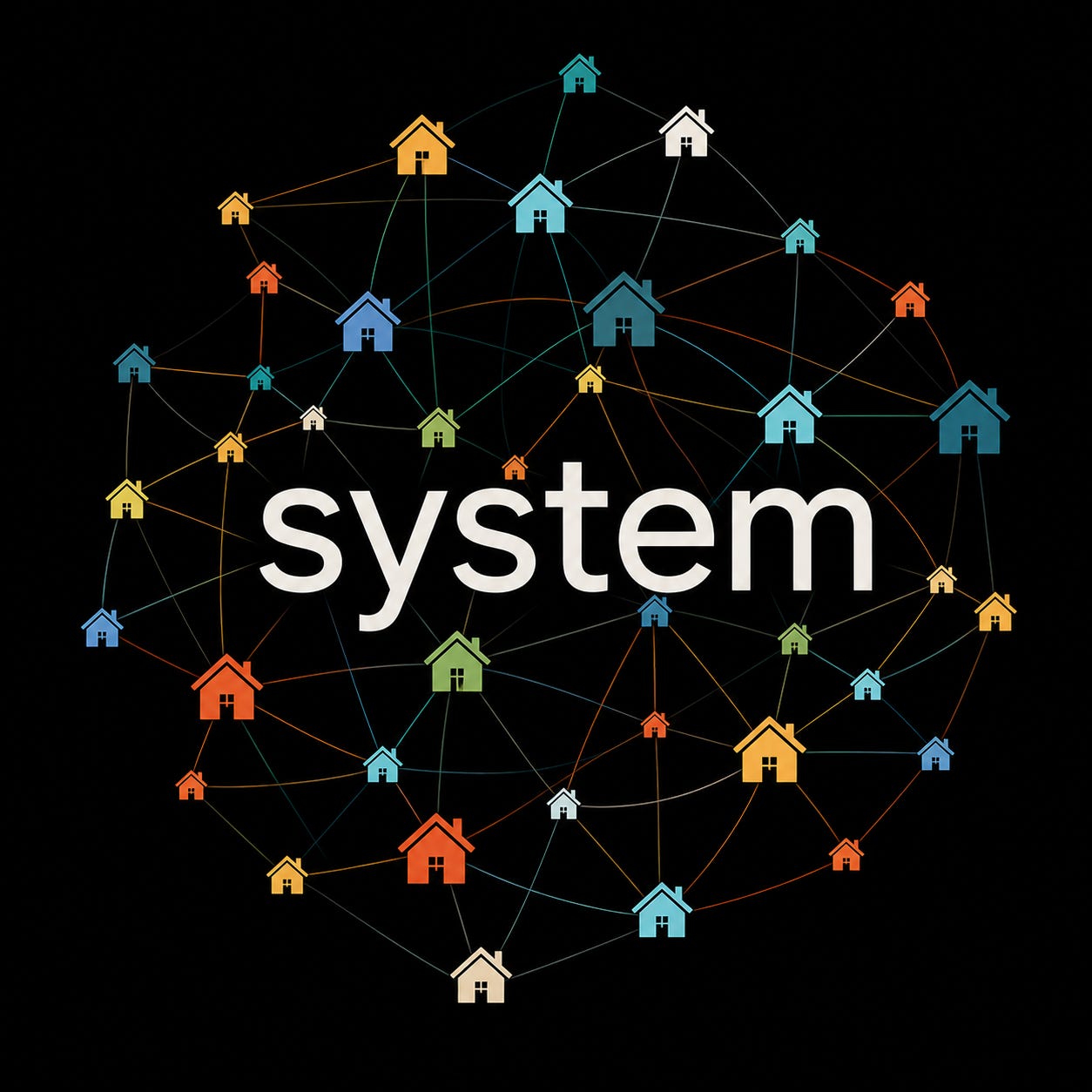
Housing is a system. A vast, entangled network of land, capital, policy, infrastructure, energy, materials, labor, insurance, transportation, public health, and people.
And every home is an output of that system.
We have to make that distinction evident, because when a house becomes unattainable, uninsurable, unhealthy, energy-intensive or vulnerable to fire, flood, heat, and storm, we tend to treat the house as the problem. But the house just where the failures of the system become visible.
We cannot create resilient housing without creating a resilient housing system first.
I’m gonna break the system (the way I see it for Pathway Communities) into 6 parts:
The Building
The Site
Energy
Water
Community
Insurance + Finance
Because a beautifully hardened house sitting inside a poorly planned subdivision, dependent on one road, one electrical feeder, one water system and combustible neighboring structures is only partially resilient. Wildfire is particularly good at exposing that flaw because wind-driven embers can turn the built environment itself into the fuel source. But it’s not the only cause. We saw it with intense rain here in Western North Carolina during Helene.
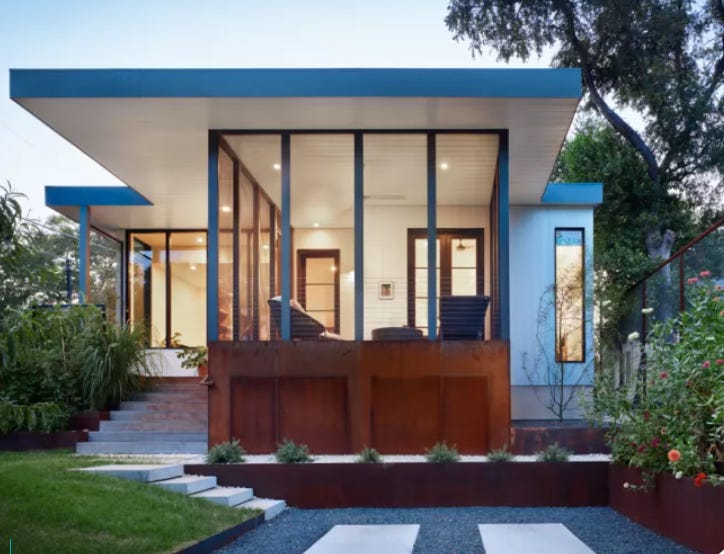
Shout out Phius and Theresa Passive House - Austin, TX
The cheapest house to build isn’t necessarily the cheapest house to live in
Resilience begins by changing what we mean by a ‘good’ building, moving from code compliance and first cost toward survivability, operability, durability, and lifecycle cost.
For most of the last century, we’ve optimized housing around a pretty narrow set of variables: how much does it cost to build, how quickly can we build it, does it meet code, and what will someone pay for it? Those questions still matter, but they’re incomplete. A house can check every one of those boxes and still be poorly prepared for the conditions it will face over the next 50 or 100 years. Extreme heat and cold, severe storms, flooding, drought, wildfire, poor air quality, and prolonged power outages aren’t exceptions anymore. They’re part of the operating environment.
Building differently doesn’t mean adding a few upgraded materials to a conventional house. It means designing the building as a system around durability, efficiency, adaptability, and occupant health. This is where Passive Building principles become particularly important. Better insulation, tighter envelopes, high-performance windows, ventilation, filtration, moisture management, and smaller mechanical systems don’t just reduce energy consumption. They allow a building to maintain safe temperatures longer during an outage, protect indoor air quality, require less from the electrical grid, and ultimately remain habitable when the systems around it are under stress.
And this changes how we should think about cost. The cheapest building on the day it opens may be far from the cheapest building over its useful life. Energy, maintenance, insurance, repairs, equipment replacement, health, and disaster exposure are all part of the actual cost of housing. Yet we mostly measure what it costs to build because that’s the easiest number to see. The costs we avoid are harder to measure. The insurance claim that never happens. The emergency shelter that isn’t needed. The equipment that lasts another decade. The family that can stay safely in its home during an outage. Those costs don’t disappear. They simply migrate somewhere else in the system.
We need a way to see those costs so we can monitor, record, and validate them….and ultimately improve or eliminate them altogether.
Shout out Landscope
The cheapest piece of land isn’t necessarily the cheapest place to live. Where we build matters every bit as much as what we build.
The second essential element for the system is the site. For decades, our primary question about land has been: can we build on it? Is it zoned correctly, can we get utilities to it, can we engineer the site, and can we make the numbers work? But where we build has an enormous influence on how people live. Can someone walk to food, work, school, healthcare, parks, or their neighbors? Is the community connected to the places around it or isolated from them? How much time and money will a household spend simply getting from one part of their life to another? A resilient community shouldn’t require a car for every basic need.
Building differently means designing with the site instead of simply engineering our way around it. Work with the topography. Preserve natural drainage and mature trees where possible. Create shade, sidewalks, trails, gathering spaces, and connections to the surrounding community. Think about how buildings relate to one another and how people move between them. Manage water, vegetation, access, and extreme weather risks intentionally. Some of the most valuable infrastructure may not look like infrastructure at all. It may be a sidewalk, tree canopy, trail, garden, commons, or simply land we decided not to disturb.
And once again, the economics are bigger than the development budget. Cheap land on the edge of town may produce lower acquisition costs while transferring thousands of dollars a year in transportation costs to every household that lives there. Poor site planning can create decades of additional infrastructure, maintenance, stormwater, transportation, and public-service costs. Those costs don’t disappear, either. They simply move somewhere else in the system - just like they do in the building.
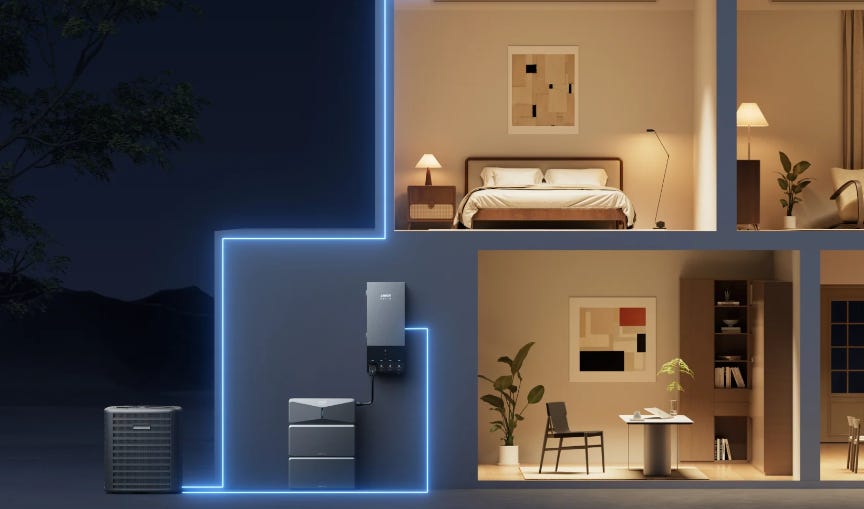
Shout out Anker Solix
The cheapest unit of energy isn’t the one we generate. It’s the one we never needed in the first place.
We have a crazy dependency on energy - and yet we don’t build with redundancy or independence from centralized grid….at all. For most of us, energy is something we don’t think much about until the bill comes or the power goes out. We build a house, connect it to the grid, and accept whatever energy costs come with it for the next 50 years. But energy is part of the cost of housing. A $1,500 mortgage with a $400 utility bill doesn’t create the same household stability as a $1,500 mortgage with a $75 utility bill. If we’re serious about attainable housing, we have to stop separating the cost of the house from the cost of operating it.
Building differently starts by reducing demand. A high-performance building needs less energy in the first place. From there, distributed generation, solar, batteries, microgrids, smart controls, and increasingly efficient appliances give communities more control over where their energy comes from and what it costs. Instead of every home operating as an isolated consumer at the end of a massive centralized system, homes can become participants in a smaller, smarter energy network that can generate, store, share, and manage energy locally.
And once again, this is bigger than the electric bill. Lower demand means smaller mechanical systems, less strain on the grid, lower peak loads, and potentially less infrastructure required to serve growing communities. Local generation and storage can also keep critical systems operating when the larger grid doesn’t. Build the demand out of the housing first, then design a smarter system to provide what’s left.
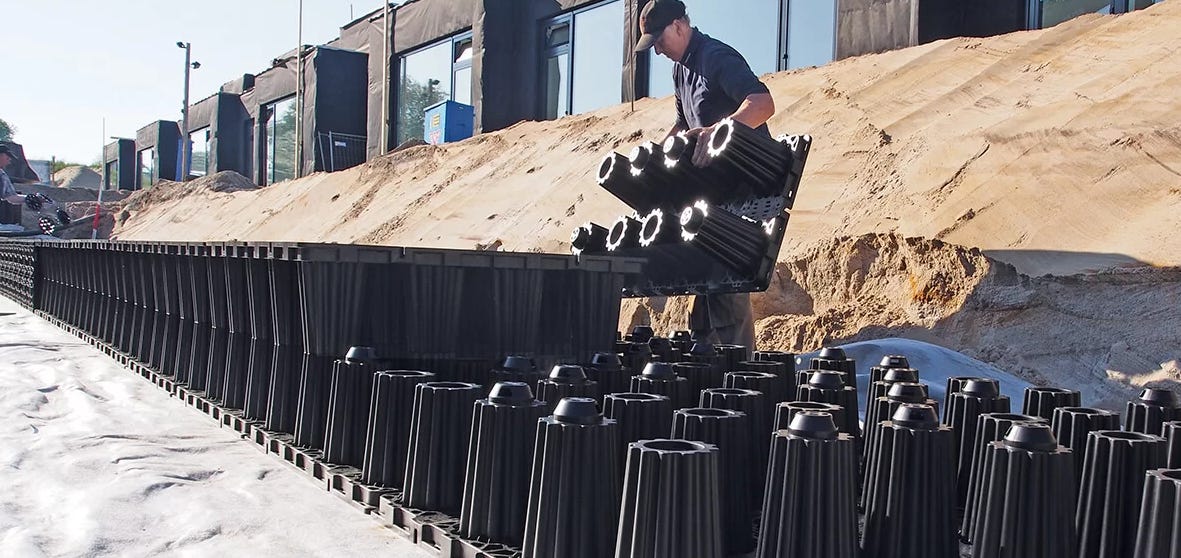
Shout out Aco Stormbrixx
The goal isn’t simply to use less water. It’s to get more value from every gallon that passes through the system.
Water is another system we’ve largely made invisible. Turn on the faucet and clean water appears. Flush the toilet and it disappears. Rain hits the roof, driveway, and parking lot and we work as quickly as possible to pipe it somewhere else. We treat drinking water, wastewater, and stormwater as separate infrastructure problems, even though they’re all part of the same cycle. And just like energy, the household ultimately pays for a system it has very little ability to influence.
Building differently means thinking about water before it enters the pipe. Use less of it. Capture it. Slow it down. Let it infiltrate where appropriate. Design landscapes that don’t require enormous amounts of irrigation. Use rainwater where regulations allow. Reduce impervious surfaces and incorporate bioswales, gardens, trees, and other natural systems that can manage water while making the community a better place to live. At the building level, efficient fixtures, leak detection, smart metering, and thoughtful plumbing design can reduce both consumption and the damage caused when something goes wrong.
The opportunity gets much bigger when we stop thinking one house at a time. Shared water strategies can reduce demand on municipal systems, manage stormwater closer to where it falls, reduce flooding, lower infrastructure costs, and create redundancy when centralized systems are disrupted. Instead of treating water as something we buy, use once, and send away, we can begin treating it as an asset moving through the community.
For our Pathway Communities model, #StableLiving™, housing shouldn’t consume infrastructure. That’s why we properly design our communities to help infrastructure perform better.
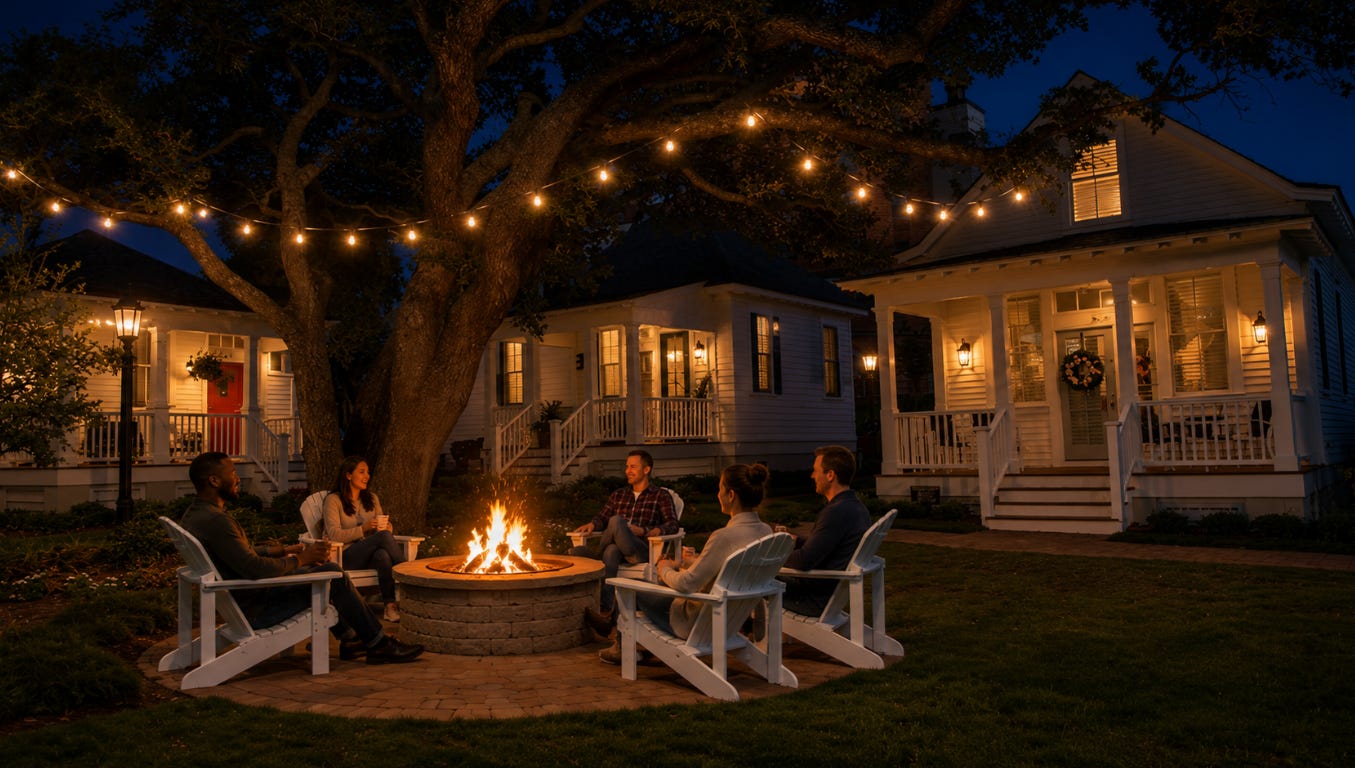
The most important infrastructure in a community may ultimately be the relationships between the people who live there.
Somewhere along the way, we got really good at building houses and not necessarily communities. We can engineer streets, install utilities, build homes, landscape the entrances, and call the project complete. But people don’t experience housing as a collection of buildings. They experience neighbors, sidewalks, parks, schools, food, gathering places, services, and the thousands of small interactions that determine whether a place actually feels like home. Social infrastructure is every bit as real as physical infrastructure, even if it doesn’t appear on the engineering drawings.
Building differently means creating places where connection doesn’t have to be scheduled. Front porches instead of garage doors dominating the street. Sidewalks and trails that cross paths. Commons, gardens, kitchens, coworking spaces, playgrounds, and places to sit. Housing designed around people rather than automobiles. It also means connecting residents to resources beyond the physical neighborhood: food, healthcare, digital access, financial education, transportation, education, and employment. The goal isn’t to manufacture community. It’s to create the conditions where community has a much better chance of forming.
And those connections have real value. A neighbor who checks on someone during an outage, shares a tool, watches a child for an hour, offers a ride, recommends a job, or simply notices when something isn’t right is part of the resilience of a place. We spend enormous amounts of money trying to solve problems downstream that stronger communities can sometimes prevent upstream.
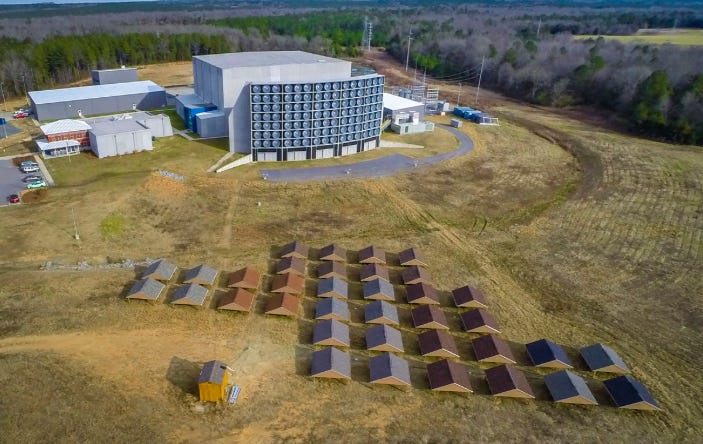
Shout out to the IBHS - Insurance Institute for Business & Home Safety
If we want different outcomes from housing, eventually the capital & insurance behind it has to reward the outcomes we actually want.
Insurance and finance may seem like the least physical parts of housing, but they influence nearly every decision we make. Lenders determine what can be financed. Insurers determine what risks can be covered. Investors determine what returns are required. Developers respond by trying to deliver a product that fits within those constraints. The problem is that the system still tends to reward the lowest cost today more clearly than the lower risk tomorrow. We can spend more to create a building that uses less energy, lasts longer, requires less maintenance, and is better prepared for disruption, yet struggle to capture that value in the financing.
Building differently means financing differently too. If better buildings reduce energy consumption, maintenance, insurance losses, infrastructure demand, and long-term risk, those benefits should have economic value. The conversation should move beyond construction cost and toward total lifecycle performance. A dollar spent today that prevents five dollars of expense tomorrow isn’t necessarily an additional cost. It’s an investment in cost avoidance. And if someone else in the system benefits from that avoided cost, whether it’s an insurer, lender, utility, municipality, employer, healthcare system, or homeowner, we should be asking how that value gets recognized.
Ultimately, insurance and finance are supposed to help us manage risk and allocate capital. That gives them enormous power to change what gets built. Imagine a housing market where the safest, healthiest, most efficient, most durable homes were also the easiest and least expensive to finance and insure. Suddenly resilience wouldn’t be an upgrade reserved for people who can afford it. It would simply be good economics.
Housing is a system. A vast, entangled network of buildings, land, energy, water, infrastructure, capital, insurance, policy, technology, and institutions. Change one part and you inevitably affect another. Optimize one piece without understanding the others and you can simply move the cost, risk, or problem somewhere else. That’s why building differently can’t just mean a better wall assembly, a solar panel, a bigger stormwater pipe, or a new financing program. We have to start thinking about how the whole system works together.
But systems aren’t the reason we build housing. People are the lifeblood running through all of it. The buildings, sidewalks, energy systems, water systems, financial structures, technology, and infrastructure only matter because of what they allow people to do. Raise a family. Walk to work. Know their neighbors. Stay healthy. Weather a setback. Build some wealth. Age in place. Find opportunity. Help someone else. Live with a little less uncertainty about what tomorrow might bring.
Maybe that’s the biggest shift in what it means to build differently. Instead of optimizing housing around the production of real estate, we optimize the system around the people who live there. We measure success not simply by units delivered, construction cost, or return on investment, but by whether the place we’ve created makes life more stable for the people who call it home. We aren’t building a collection of better houses. We’re building a better system for living.
#StableLiving™ #TheyIsUs #TinyGiants
Song Pairing: Once in a Lifetime - Talking Heads
No posts
Comments
Nothing yet. Say the first thing.
Sign in to join the conversation.