
The shorter published version of this piece first appeared here in Jacobin.
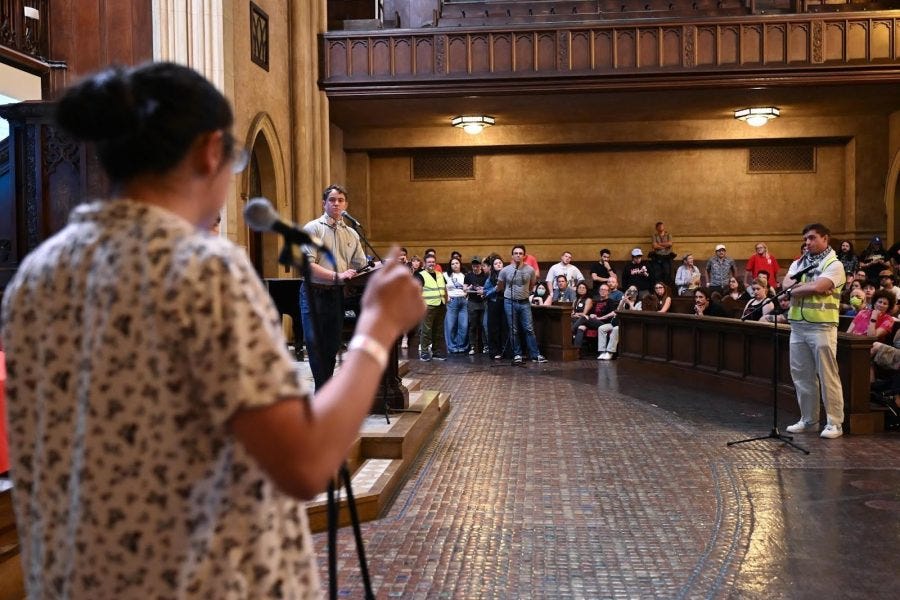
On a late March afternoon, beneath the vaulted, medieval-revival ceiling of Immanuel Presbyterian Church, more than 400 members of the Los Angeles chapter of the Democratic Socialists of America (DSA) gathered in the lingering heat of a citywide heat wave. The air inside the sanctuary was thick and stubborn as members fanned themselves with agendas and shifted in their seats.
The agenda moved briskly at first. Members discussed strike solidarity with the teachers union, upcoming labor actions, and campaign work. But as the temperature held and the room settled, the chapter turned to the main act, a more contentious question: whether to reopen its endorsement process for the 2026 Los Angeles mayoral race. What followed was a three-sided debate, carried out with intensity but also with (mostly) practiced comradely discipline.
More than 100 members had signed petitions backing housing activist Rae Huang. Another 100 supported City Councilmember Nithya Raman. (Both candidates are members of the chapter). Others argued just as forcefully that reopening the process would risk overextending the chapter’s resources and undermine a carefully built electoral strategy. In the end, 54 percent voted to reopen endorsements, but the measure failed to reach the required supermajority.
It was the kind of outcome that would have once remained internal and relevant only to a relatively small organization. As DSA-LA has grown from just under 3,000 in late 2024 to 5,000 members, its decisions have begun to register as reportable events in the political life of the city. What was once “inside baseball” now carries implications for multimillion-dollar races and the direction of governance in the second largest city in the United States, part of a broader maturation of democratic socialist politics.
Less than a month now before mail ballots go out the race is unusually still up in the air with the largest bloc of voters being the 40 percent undecided. The incumbent Karen Bass is vulnerable, polling consistently around only 15-25 percent of the vote. Indeed one recent, if controversial poll had Raman as the front runner with 33 percent and Huang almost in a tie with Bass for second place. (The same poll had support for “democratic socialists” as candidates at 47.7 percent.) It’s unlikely that any candidate will win outright June 2 with the 50 percent margin needed to avoid a November run off. That kind of blood in the water is amping up and complicating strategy for the LA Left.
For years, DSA-LA has pursued a disciplined electoral strategy focused primarily on City Council races, where massive districts encompass over 260,000 residents–but still when scaled up and forces concentrated where ground games can meaningfully shift outcomes. The strategy flows from both ongoing campaign work and the longform political program of the chapter–and has delivered results with council.
According to Tal Levy, chair of the chapter’s electoral political committee: “DSA-LA’s focus on Los Angeles’ city council has allowed the chapter to be the defining organization in a broad left political pole advocating consistently for pro-tenant and pro-worker victories. Particularly in the wake of 2022’s Fed Tapes leak, DSA-LA’s electoral have begun to win support from powerful unions like UNITE HERE Local 11 and United Teachers Los Angeles. Los Angeles’ labor movement had previously been tied deeply into an uneasy multiracial “Status Quo Coalition” tying together capital and labor into blocs mostly divided along ethnic lines. The unified interventions of Los Angeles’ socialists in office to lower rents and raise wages while breaking city hall’s culture of near unanimity has started to realign the city’s electoral politics along class lines, with business interests dedicating millions to attacking left-labor candidates and parts of organized labor joining with socialists to defend them.”
Shake Up City Hall Slate
Nithya Raman’s 2020 victory marked a breakthrough, and in the years since, DSA-backed candidates have steadily expanded their presence. Today, multiple members or allies of the organization sit on the 15-member City Council, and the chapter has built a reputation for running serious, field-heavy campaigns rooted in tenant organizing and labor alliances.
In the current cycle, DSA-LA has endorsed the Shake Up City Hall slate of six candidates. DSA-LA’s 2026 slate blends incumbency and insurgency, with councilmembers Eunisses Hernandez, a Highland Park organizer advancing tenant rights and care-based alternatives to policing, and Hugo Soto-Martínez, a former hotel worker and union organizer who has delivered major wins for renters, immigrants, and labor. School board member Rocío Rivas is seeking reelection as a defender of public education against privatization.
Challengers include Estuardo Mazariegos, a South L.A. organizer running on social housing, tenant power, and a Green New Deal, and Faizah Malik, a tenants’ rights attorney focused on housing affordability and land use reform on the Westside.
Beyond council races, Marissa Roy is mounting an insurgent bid for city attorney to reorient the office toward civil rights and corporate accountability.
The Other Citywide Race
That last race represents something new. The office of city attorney has historically been low-profile, technocratic, and largely insulated from ideological contestation. Roy’s campaign, by contrast, seeks to transform it into a site of democratic accountability, raising questions about prosecution priorities, tenant rights, and the legal architecture of inequality in Los Angeles.
“The City Attorney is one of the most powerful and least understood offices in LA, and the current City Attorney is using the office to obstruct the pro-tenant, pro-worker agenda our DSA electeds are trying to implement in city council,” said Syd Ghazarian, co-chair of DSA’s Marissa Roy Working Group and a former DSA National Political Committee leader. “We’ve learned the hard way that the policies we pass don’t matter if the City Attorney refuses to enforce them. ”
Roy’s candidacy is not just another race. It is a test of whether democratic socialists can expand their project beyond legislative bodies into the legal machinery of the city itself. It’s one thing to pass legislation, it’s another thing to enforce it and have the city devote its legal might to supporting tenants and workers.
“Right now, we have a City Attorney who wastes the office’s resources defending indefensible LAPD misconduct instead of prosecuting slumlords, bad bosses, and pollutive corporations,” added Ghazarian. “ Marissa will use the power of the office to defend tenants, workers, and millions of working class Angelenos– not just the powerful few.”
The Mayor’s Race Enters the Room
The debate over the mayor’s race sits uneasily alongside this strategy. Before Zohran Mamdani’s election as NYC mayor last November, the question of intervening in the race wasn’t live with many LA chapter members but that upset election rippled out in energizing waves across the country.
On one side are those who see a mayoral endorsement as a natural next step. With DSA-backed candidates now holding multiple council seats and with the deep polling weakness of LA’s current mayor, Karen Bass, the prospect of a democratic socialist mayor no longer feels entirely out of reach. A mayoral campaign in their eyes would bring visibility, attract new members, and potentially consolidate the gains of the past decade.
“I want our chapter to be able to seize this moment and demonstrate to thousands of working class Angelenos that DSA-LA is an organization worth joining, and I want a movement that understands 2028 is not just about returning to corporate-Democratic policies but rather reshaping the fabric of American society,” says chapter co-chair Leslie Chang who supported a Nithya endorsement. “Supporting Nithya for mayor is our chance to build a movement here in Los Angeles that is ready to support a democratic socialist for president in 2028.”
On the other side are those who view such a move as premature or even counterproductive. The chapter’s strength has been its disciplined allocation of resources, particularly volunteer labor for phonebanking and canvassing. A citywide race could absorb enormous capacity, potentially weakening the campaigns where DSA has its clearest path to victory.
There are also political considerations. Raman, despite her history with DSA and her record on tenant protections and advocacy for the homeless, has at times diverged from the organization on some key issues, including Palestine, housing policy, policing budgets, and the implementation of the city’s “mansion tax.”
Huang, by contrast, is seen by some members as more closely aligned with socialist principles but faces questions about electability and citywide recognition. “She’s not on the Shake Up City Hall slate, but she’s here to shake up city hall,” says Gabbie Metheny, a DSA LA chapter member and volunteer Community Manager for the campaign with emphasis: “Rae stands on her values. She believes in housing justice, abolishing ICE, and defunding the police and reinvesting that money in our communities, values that DSA members hold and that have drawn many of us into her campaign.”
Democracy is Good, Actually
These are not superficial disagreements. They reflect a deeper tension within democratic socialist strategy: whether to prioritize ideological clarity or electoral viability, and how to balance the two in a political environment still largely hostile to both.
What stands out, however, is not the existence of disagreement but the form it takes.
The debate inside DSA-LA is structured, participatory, and transparent. Petitions circulate. Members argue openly. Votes are taken, and outcomes are respected even when they are narrow or frustrating. The result is messy, sometimes slow, and occasionally anticlimactic.
Members also sometimes vote with their feet in a mass org where democratic socialism spills out into a broader movement not always contained by DSA. Formal endorsement or not over 120 DSA LA, Long Beach, and Orange County mostly newly-recruited members volunteer (out of 1,100 total) for Huang’s campaign taking up organizing roles in canvassing, digital outreach, policy and more. DSA members active in the United Auto Workers have been pillars of support for the Nithya campaign.
But messy or not, it is also a rare example of large-scale democratic practice in an era when most political organizations operate through top-down decision-making or informal networks of influence.
Wider Stakes
The stakes of that effort extend beyond Los Angeles.
As democratic socialism continues to reemerge as a force in American politics, questions of strategy, scale, and internal democracy will only become more pressing. DSA-LA offers one possible model: a mass-membership organization capable of contesting elections, organizing in social movements, and still arguing, in full view of its own membership, about how best to proceed.
If there is a lesson in the scene at Immanuel Presbyterian Church, it is this: the growth of the Left has not resolved its strategic dilemmas. It has simply made them more unavoidable.
And for now, at least, those dilemmas are being worked out not behind closed doors, but in crowded rooms, under vaulted ceilings, with hundreds of people raising their hands to decide what comes next.
[Photo courtesy of Chloe Dykstra)
No posts
Comments
Nothing yet. Say the first thing.
Sign in to join the conversation.