
When I first saw The Fly, I was in my mid-twenties, crossing a “must-see” off my list. I can’t remember if I watched it before or after I saw David Cronenberg’s A History of Violence, but I believe the two views were linked, which would have put me at about 26 years old. I liked The Fly and appreciated its goopy effects, but it didn’t get under my skin and I went about two decades without thinking much about it again.
Watching it at 47, with lived-in experience of bodily decay and encroaching fears about mortality was a completely different experience. What I dismissed as an effective creature feature and gnarly bit of body horror years ago – although it is certainly those things – unsettled me and broke my heart. It’s a work that’s just as sad as it is scary, and might be Cronenberg’s most effective and accessible work.
It’s tempting to call The Fly a mad scientist movie, but the appeal of Jeff Goldblum’s Seth Brundle is that he’s not really too unhinged when the film opens. He’s the quintessential Goldblum character – quirky and eccentric, over-confident, and charismatic. As the film opens, he’s at a soiree that has gathered some of the nation’s best tech minds, and he’s chatting up Veronica Quaife (Geena Davis), a science journalist. He tells her that unlike all the other posers at the party, his ideas will change the world. He invites Veronica to his apartment to see his work, and she’s skeptical but intrigued. Of course, maybe he’s just trying to get into her pants; she seems intrigued by that, too.
But Seth really is working on an invention that could have world-shaking ramifications. He’s built a transporter, and he’s really close to cracking it. He invites Veronica to work alongside him and document his work for a future book, and the two quickly become lovers. Despite an early and messy hiccup while trying to transport a baboon, Seth gets his machine to work. And while he’s initially willing to move slowly into human testing, a bout of jealousy leads to a tiff with Veronica, and a drunken evening makes Seth eager to test the machine on himself. It goes smoothly – except for the fly that enters the transport pod and contaminates the process, fusing itself to the scientist’s DNA and kickstarting a horrifying transformation.
I haven’t seen the original The Fly from 1958, but I understand it’s a completely different animal, with a more mysterious tone and structure and a swap between human and fly parts that lends it more a 50s creature feature feel. Cronenberg isn’t interested in mystery, slow burns or cheesy sci-fi. When it hired him, 20th Century Fox wanted Cronenberg to focus less on an instantaneous transformation and more on the slow process of Brundle transforming into his new form. Cronenberg does that, and forces us to watch.
The director is, of course, probably more focused on the concept of “the flesh” than any other filmmaker1. Cronenberg is obsessed with the ways the human body can be transcended, corrupted, defiled and destroyed, often telling his stories through surreal, horrific stories like Videodrome, Crimes of the Future and Existenz. With The Fly, his skill for depicting the terrifying ways we push our bodies to extremes and their tendency to fail us is perhaps even more horrifying because, even though he’s playing with a sci-fi concept, the themes he’s exploring are all too real.
John Mulaney opened a special years ago by saying he was older and “I’m gross now,” launching into a diatribe about how his body began to go to hell when he hit his 30s. “I’m damp all the time,” is the line that I remember most. And it’s funny because who can’t attest to hitting a milestone age and suddenly finding sore joints, strange hairs and your body refusing to behave in the ways that it used to? Seth first finds that his transformation has energized him, and he begins to spiral mentally as he believes he’s on the cusp of transcending his form. He’s stronger, more athletic and shows no fatigue – particularly in the bedroom, the place where, perhaps next to the hospital bed, we’re most focused on the flesh. As Veronica senses that something horrible has happened and refuses to place herself in the transporter so they can transcend the flesh together, Seth dismisses her and isolates. He picks up a girl to meet his needs, but even she won’t go through the machine. But it’s not long before Seth calls Veronica again – this time because something’s gone horribly wrong, and he’s beginning to decay.
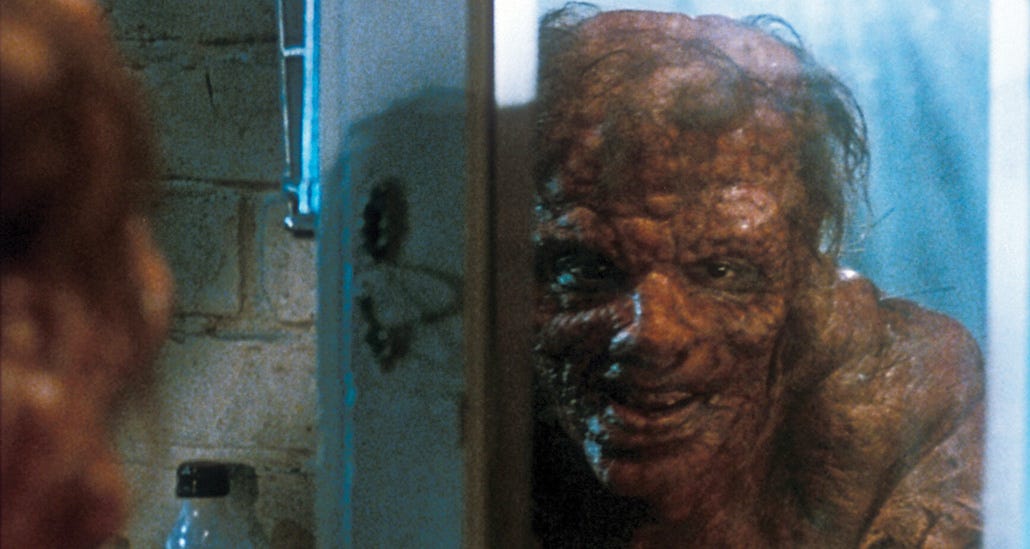
The Fly is one of a few horror movies to actually horrify, as Cronenberg largely shuts us in Seth’s apartment to observe his decay. Working with special effects and makeup artists Chris Walas and Stephan Dupuis, Cronenberg lathers on the grossness. Pustules break out on Seth’s face, deforming him until he’s almost unrecognizable – it’s a testament to Goldblum as an actor that we can still see him peeking out through the eyes. He vomits on his food before devouring it. His teeth fall out and an ear comes off – in a bleak bit of dark humor, we see that Seth, ever the scientists, keeps all these pieces in his medicine cabinet. It’s revolting, and yet it never feels like horror for horror’s sake.
Cronenberg’s film forces us to confront sickness and mortality. Released at the height of the AIDS epidemic, it surely can be seen as a metaphor for that crisis. But because it’s couched in metaphor, it isn’t limited to this. Anyone who’s ever found a strange lump or had to call their doctor to talk about a worrying symptom can resonate with Seth’s mounting fears as he wonders whether he’s dying and begs Veronica for help. As the best sci-fi and horror directors do, Cronenberg uses genre trappings to explore our deepest and most common fears. And while Seth grows more narcissistic and deluded, Goldblum still invests him with humanity, fear and sympathy so that rather than gawk at the geek show, we’re invested. The Fly might disturb, but it also breaks our hearts.
What I’d forgotten was how great Goldblum and Davis are together, creating a compelling and believable relationship that serves as the film’s engine – the other reason this film is so accessible despite its gnarly effects. Perhaps more horrifying than suffering through decay is being the person who has to watch their loved one waste away and succumb, losing their mind and control over their body. Davis – who has acted far too infrequently in recent decades – is superb. Veronica is a smart, driven reporter, and she wisely doesn’t stay around for Seth’s bullshit once she senses that he’s losing his grip. But Davis also conveys the love Veronica has for Seth, and her decision to be with him as he suffers is just as devastating as watching Seth transform into Brundle-Fly. If The Fly is about the inevitability of decay and the betrayal of our bodies, it’s also about the emotional torture that accompanies being a caregiver or supporter. Despite Seth’s belief that there’s a way to reverse the process – which makes him even more unhinged and dangerous in the film’s final passages – Veronica knows that there’s no hope for him. When she finds out she’s pregnant with Seth’s baby – and has a terrifying dream about delivering a giant maggot – the film begins to engage concepts of euthanasia and abortion without turning into a diatribe. It’s a film full of ideas, but it never loses sight of its humanity. Even though her old boyfriend and magazine editor is there to help her, we also know that when it comes time to permanently stop Seth, it’s going to be up to Veronica.
The film’s final act is one of the greatest monster movie stretches ever, as Seth attempts to force Veronica into the transporter so they can fuse themselves into one being and live together, as one, transcendent creature. It’s a terrifying premise, and the effects when Seth makes his final transformation are still impressive. But it’s the final moments that truly shatter me, as Veronica has a shotgun pointed at the hideous human-fly hybrid and hesitates because she knows she can’t pull the trigger on the man she loves. And then, proving that Seth is still there behind the spindly arms and buggy eyes, a claw grabs the barrel and puts it to its own head; Seth is still conscious and knows it’s time to end his misery. It’s the rare horror movie ending that feels like a heartbreaker rather than a moment of catharsis, and Cronenberg wisely doesn’t allow us any time to come down and have a happy ending – the movie ends moments later. It’s truly one of the great sci-fi movies of the ‘80s, maybe of all time.
I had considered doing one more Summer of ‘86 entry prior to Labor Day, but the pickings are slim – I’m curious about Texas Chainsaw Massacre Part 2 and maybe Night of the Creeps, but there are countless Halloweens to explore those movies. Why not end on a high note? Besides, in September I’m starting a new miniseries that I’m excited to tell you all about soon!
Christians also have a focus on the dangers of “the flesh” and being trapped in a corrupted form, and if you’re looking for a good read on this film through a more theological lens, I hope you’ll check out the terrific piece my friend Kevin McLenithan wrote on it for Christ and Pop Culture years back.
No posts
Comments
Nothing yet. Say the first thing.
Sign in to join the conversation.