
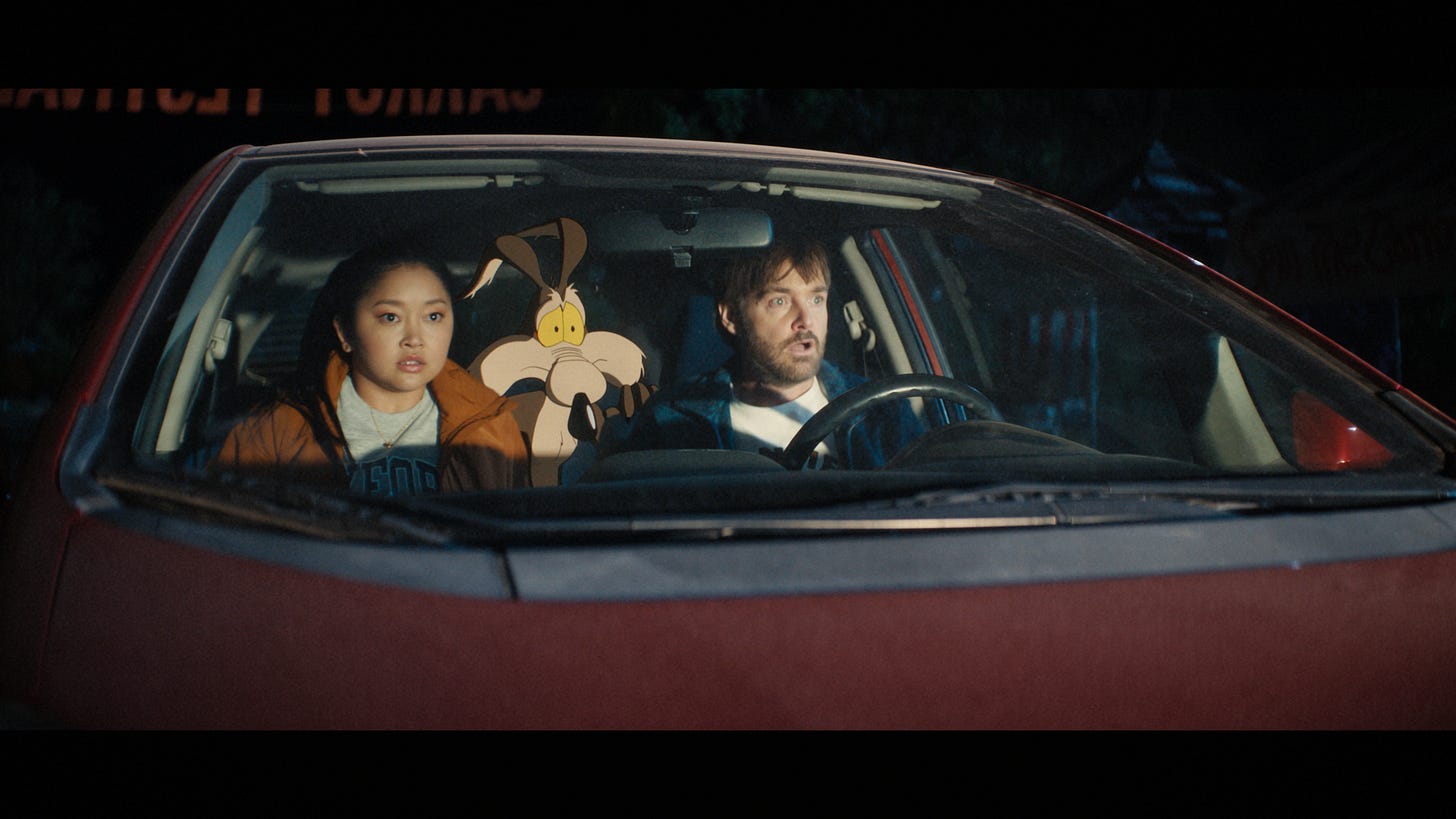
Is Wile E. Coyote’s story a cautionary tale about crushing futility or an inspirational one about persistence? These have been two sides of the same coin since the character first chased the Roadrunner in the 1949 Chuck Jones short “The Fast and the Furry-ous,” and it’s the question behind every anvil drop, cliff plummet and dynamite explosion that has followed.
It’s the engine that drives Dave Green’s very funny Coyote vs. Acme, in which Wile E. emerges from his latest attempt to catch and cook his fast, feathered nemesis determined to never again be thwarted by shoddy products from the Acme Corporation. Singed from a missile blast, Coyote pushes in his lumps, cleans off his singed fur and heads to Albuquerque, where he decides to end this ordeal in the most American way possible: He’s going to sue Acme.
It’s a clever premise, pulled from a piece published in The New Yorker in 1990. And while it may seem foolhardy to stretch a satirical essay that clocked in at under 2,000 words – based on cartoons that were under 10 minutes – to feature length, Coyote vs. Acme is a silly, smart and surprisingly sweet romp that understands the Looney Tunes characters better than anything has since the original shorts.
And, of course, it nearly never saw the light of day.
It’s impossible to talk about Coyote vs. Acme without discussing the story behind its release. Completed in 2023, it was shelved indefinitely by Warner Brothers CEO and President David Zaslav, who decided to take a tax write-off rather than release a movie featuring one of the studio’s most enduring characters. After years of protest by the film’s cast and crew, as well as support from other artists and fans, the small distributor Ketchup Entertainment – who also salvaged the very good Looney Tunes movie The Day the Earth Blew Up from Zaslavian oblivion – picked up the movie, which will be released in theaters Friday.
I’ve seen some suggest that Zaslav shelved Coyote vs. Acme because the exec – currently embroiled in yet another attempt to merge the studio with yet another megacorporation – was scared of or offended by a movie satirizing the evil of conglomerates. I think that’s giving the movie too much credit – most media execs are perfectly fine letting directors poke fun at capitalism as long as it makes money. It think it’s more a case of Zaslav not respecting artists, not understanding Warner Brothers’ legacy, and not trusting that young audiences would show up to watch a spoof of legal thrillers starring a character who’s been around for nearly 80 years1.
But, wow, does that fiasco now cast the film in a different light and turn what would probably have been a curiosity for die-hard fans into the underdog story of the year – and, yes, I’m a bit raw that the Warner Brothers logo still shows up at the start.
Because just as Green and Ketchup find themselves standing up to a capitalist behemoth, Coyote and his scrappy, hapless lawyer, Kevin Avery (Will Forte), find themselves taking on the world’s biggest corporation, with its tendrils in nearly every product on the market and a desire to crush anyone in their way. The only difference is that Coyote and Kevin aren’t up against Zaslav but Foghorn Leghorn.
Coyote vs. Acme would be a clever send-up of legal thrillers even without being a victim of real-life corporate shenanigans. In the grand tradition of Who Framed Roger Rabbit – still the gold standard of animated/live-action hybrids – the film uses the tropes and aesthetics of the genre to create a new playground in which its animated characters run (duck) amok. Green understands not just how to mix cartoons and humans, but also how to use the conventions of action movies, spy thrillers and detective movies as counterpoints so the comedy pops. If I don’t think Coyote vs. Acme is quite as transcendent as Roger Rabbit or even quite as funny as the Disney+ film Chip N’ Dale: Rescue Rangers, it’s just a matter of taste on the latter and a matter of the former being one of the best films of the ‘80s. But Coyote definitely feels of a piece with those movies and is more than just “too good to be shelved” – it’s legitimately funny, and it understands the appeal behind the Looney Tunes characters and cartoons.
The Coyote/Roadrunner cartoons have always been my favorite Looney Tunes shorts – I’m a sucker for his Sisyphean attempts to eat that bird – but I’ll admit he’s tough to frame a movie around. He doesn’t speak – he communicates through action and, as the movie states, a “limited number of signs.” And he’s a self-described genius whose only goal is to catch, cook and eat a friendly bird. Yet, Green’s direction, bolstered from a script by Samy Burch, turns him into a sympathetic character without betraying his simplicity. Who can’t relate to the Coyote’s constantly thwarted pursuits? The inevitable futility is funny but, the film asks, what if the persistence is also inspiring? By placing him alongside Forte as a lawyer so afraid of failure that he’s stopped trying, he becomes something of an aspirational figure, a testimony to the power of endurance, even if it means most of the time you’ll be smashed by an anvil or flattened on the road. There’s a sweetness to the relationship between the two that never needs Coyote to speak a word.
Burch and Green create a love letter to Looney Tunes that makes me even more angry that two Space Jam movies exist without understanding what makes the toons tick. Nearly every major character in the stable appears, however briefly – I appreciate the restraint for keeping Bugs Bunny’s involvement limited, and if I could have used just a bit more Daffy Duck and Porky Pig, I’ll just remind you that The Day the Earth Blew Up is out there and a lot of fun. Minor characters flit in and out, perfectly integrated into the world, often slotted into positions where it’s funniest to imagine them (Elmer Fudd’s current career made me laugh) or pulling them out for a quick and effective gag (there’s a very fast and very funny Pepe LePew reference). The world feels natural and lived-in, helping the film avoid becoming a cameo factory. There are deep cuts from the cartoons’ past — never did I think an animated Peter Lorre would play this much of a role in a summer movie — and the film has fun incorporating its cartoon logic into our real world, with a slapstick gag or visual pun always at the ready.
The success of these hybrids often depends on finding actors who are able to play in the same sandbox as their cartoon pals, and Coyote vs. Acme is helped by having two game humans at its center. Forte is best playing either overconfident doofuses (MacGruber, Last Man on Earth), which is the gear I prefer him in, but he’s also funny when playing pathetic and lazy. He’s best here when Kevin is trying to skirt any obligation to the law and in portraying his budding friendship with an animated coyote; it’s really difficult to make us believe your character is pals with a cartoon, but Forte pulls it off. Even better is John Cena as the opposing lawyer, just as ruthless as he is jacked – Cena has found a great niche in making fun of his hulking size, and he’s willing to go silly for the film. The movie’s funniest moment might be a dressing-down his character gives Tweety Bird.
The film does occasionally drag – this is a movie that would work much better at a tight 85 minutes than at the 100 it clocks in at. And I’m not sure whether its satirical nature is sharp or if it just takes on new resonance due to the fact that a movie about a crushing conglomerate was nearly crushed by the conglomerate2 that made it. But does it matter? Better than anything in ages, Coyote vs. Acme is a Looney Tunes movie that celebrates the Looney Tunes – it’s an added bonus that it’s also a real-life underdog story where, unlike for its hero, persistence paid off.
I’ll concede that I don’t know that, pre-controversy, Coyote vs. Acme holds much youth appeal, and there probably was a small argument for making it a streaming release instead of theatrical. But there’s also a long line of Looney Tunes fans who would easily devour this – says the writer who wore Looney Tunes clothing to school every day in the mid-90s (no, I didn’t get invited to parties, why are you asking?)
That said, the Acme slogan “We’re a family of companies who cares about our family…of companies” made me laugh very hard.
No posts
Comments
Nothing yet. Say the first thing.
Sign in to join the conversation.